Topics (384k) Articles (398k) Users (410) Discussions (242) Comments (383) Files (13k) New article

For a uniformly stratified fluid, internal-wave phase velocity is parallel to the wavevector while group velocity is perpendicular to it. Energy from a localized monochromatic source propagates along four beams forming a St Andrew's cross.
The Mellin transform is an integral transform suited to changes of scale: replacing by multiplies its transform by for . For a locally integrable function , definewhere the improper integral converges. The complex number uses the real natural logarithm because . Its absolute value is , so absolute convergence depends on the real part rather than the imaginary part . The Mellin fundamental strip records the open range of such real parts.[ref]
A familiar example is the exponential function :This is exactly the Gamma integral. Near zero tends to one, so absolute convergence requires ; at infinity for every real , so there is no upper boundary. The Gamma function has a meromorphic continuation with simple poles at , but a finite continued value elsewhere in does not make the defining improper integral converge.[ref]
The Mellin transform of an interval indicator gives an elementary example with absolute convergence for every complex number . The Mellin transform in logarithmic coordinates explains why changes of scale become translations, connecting the scaling property of the Mellin transform to the Fourier transform.
Fix a finite source alphabet , a probability mass function , a finite reconstruction alphabet , and a nonnegative distortion measure . The information rate-distortion function isThe source probability distribution stays fixed; the conditional distribution of the reconstruction is what we optimize. Each feasible test channel must keep expected distortion at most . The objective is mutual information, measured in bits when the logarithms have base two. If no test channel satisfies the constraint, the infimum is .[ref]
Consider independent and identically distributed fair bits and Hamming distortion, which charges one for an incorrect bit. At zero expected distortion, every bit must be reconstructed correctly, and . If an average fraction of incorrect bits is allowed, the binary rate-distortion function givesHere is binary entropy. This is an asymptotic limit for long block codes, rather than a claim that a single bit can be stored in physical bits. The three-bit lossy Hamming code gives a small, fully explicit version of the same tradeoff, with rate and expected distortion .
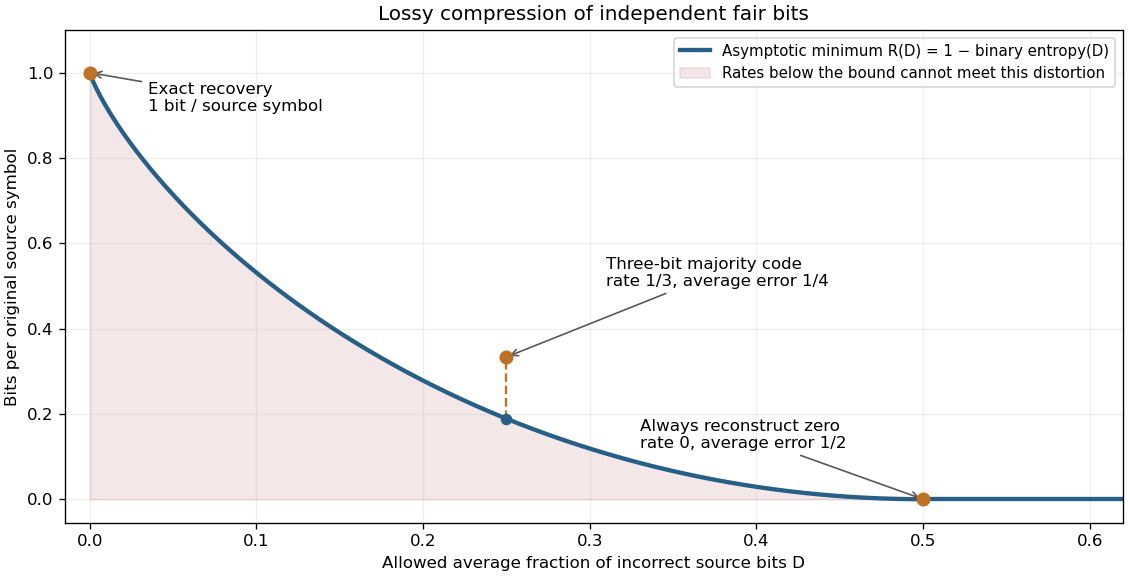
Allowing more incorrect fair bits lowers the asymptotic information rate
. The curve is the exact binary rate-distortion function. The marked three-symbol code has rate at expected distortion ; its gap above the curve shows that a small explicit block code need not attain the asymptotic bound. Rates count bits per original source symbol. Details.Rate-distortion theory separates the question of what is possible from the design of a practical encoder and decoder. It also forces the fidelity criterion to be explicit. Hamming distortion treats all symbol mismatches alike; mean squared error instead penalizes larger numerical errors more strongly. Those objectives can favor different reconstructions of the same data. An average error criterion does not by itself control the error on every individual input.
Claude Shannon's Coding Theorems for a Discrete Source With a Fidelity Criterion by Claude Shannon was published in 1959. Its formulation fixes a cost for replacing one source letter by another and studies the communication rate compatible with the allowed average cost. The important shift is to quantify which distinctions may be discarded, rather than requiring exact recovery of every letter.[ref]
For mutually independent random variables taking values in , with identically distributed,Here is Shannon entropy. Apply the Entropic Ruzsa triangle inequality in its entropy form to :Since every vector equals its negative over the two-element finite field, this is the claimed all-plus inequality.[ref]
In a general abelian group the last term remains ; it cannot simply be rewritten as . The group and sign conventions are therefore part of this statement. This form is useful when Shannon entropy replaces cardinality in binary additive combinatorics.
The closed time contour of the in-in formalism gives four bulk propagators: time-ordered , anti-time-ordered , and the two Wightman functions and . Vertices on the two contour branches carry opposite factors of .
The Hom functor sends two -modules to the abelian group of -linear maps between them. It is contravariant in its first argument and covariant in its second.
A cochain complex is a sequence of abelian groups or modules and maps satisfying . Its cohomology is .
A group is residually finite when every nonidentity survives in some finite quotient: there are a finite group and a homomorphism with .
Group homology is obtained by tensoring a projective resolution of the trivial -module with a coefficient module and taking homology.
For a group acting on an abelian group , group cohomology consists of the groups obtained from the standard cochain complex of maps . In degree zero it gives the invariant subgroup . In degree one it gives one-cocycles modulo group coboundaries.
If the action is trivial, the one-cocycle identity becomes and all one-coboundaries vanish, so . Degree two encodes group extensions with the prescribed action on the kernel. This explains why cohomology naturally measures whether local multiplication data can be assembled into a globally associative extension.
The angle of repose characterizes the free-surface slope of a resting granular material, measured relative to horizontal under a specified preparation protocol. A slowly poured dry sand pile often forms an approximately conical surface, with slope . It is a bulk consequence of contact friction, particle shape, packing and any cohesion, rather than a universal constant of one chemical substance.
A simple comparison is to pour a pile through a funnel, measure its height and base radius, and infer the slope from their ratio. A second experiment slowly tilts a layer until it avalanches. The onset angle and the angle after flow stops can differ, so reports should state which quantity was measured. For a single sliding block, static balance suggests , but identifying a pile's angle of repose with a microscopic coefficient of friction ignores rearrangement and collective contact geometry.
The transformed Eulerian mean combines the Eulerian-mean meridional circulation with an eddy-induced circulation. This moves eddy buoyancy transport out of the mean thermodynamic equation and gathers wave forcing into the divergence of an Eliassen–Palm flux.
The Rossby number compares inertial acceleration with Coriolis acceleration. For speed , horizontal length , and Coriolis parameter , it is . Small Rossby number supports geostrophic balance and the quasi-geostrophic approximation.
A CAT(0) space is a geodesic metric space whose geodesic triangles are no thicker than their Euclidean comparison triangles.
A Bogomolny-Prasad-Sommerfield monopole is a finite-energy Yang-Mills-Higgs configuration satisfying . Its magnetic charge is the degree of the normalized Higgs field at spatial infinity.
A conformal field theory is a quantum field theory invariant under conformal transformations. Local operators are organized into conformal families labelled by scaling dimension and spin.
Pinned article: Introduction to the OurBigBook Project
Welcome to the OurBigBook Project! Our goal is to create the perfect publishing platform for STEM subjects, and get university-level students to write the best free STEM tutorials ever.
Everyone is welcome to create an account and play with the site: ourbigbook.com/go/register. We belive that students themselves can write amazing tutorials, but teachers are welcome too. You can write about anything you want, it doesn't have to be STEM or even educational. Silly test content is very welcome and you won't be penalized in any way. Just keep it legal!
Intro to OurBigBook
. Source. We have two killer features:
- topics: topics group articles by different users with the same title, e.g. here is the topic for the "Fundamental Theorem of Calculus" ourbigbook.com/go/topic/fundamental-theorem-of-calculusArticles of different users are sorted by upvote within each article page. This feature is a bit like:
- a Wikipedia where each user can have their own version of each article
- a Q&A website like Stack Overflow, where multiple people can give their views on a given topic, and the best ones are sorted by upvote. Except you don't need to wait for someone to ask first, and any topic goes, no matter how narrow or broad
This feature makes it possible for readers to find better explanations of any topic created by other writers. And it allows writers to create an explanation in a place that readers might actually find it.
Figure 1. Screenshot of the "Derivative" topic page. View it live at: ourbigbook.com/go/topic/derivativeVideo 2. OurBigBook Web topics demo. Source. - local editing: you can store all your personal knowledge base content locally in a plaintext markup format that can be edited locally and published either:This way you can be sure that even if OurBigBook.com were to go down one day (which we have no plans to do as it is quite cheap to host!), your content will still be perfectly readable as a static site.
- to OurBigBook.com to get awesome multi-user features like topics and likes
- as HTML files to a static website, which you can host yourself for free on many external providers like GitHub Pages, and remain in full control

Figure 2. You can publish local OurBigBook lightweight markup files to either OurBigBook.com or as a static website.
Figure 3. Visual Studio Code extension installation.
Figure 5. . You can also edit articles on the Web editor without installing anything locally. Video 3. Edit locally and publish demo. Source. This shows editing OurBigBook Markup and publishing it using the Visual Studio Code extension. 
- Infinitely deep tables of contents:



All our software is open source and hosted at: github.com/ourbigbook/ourbigbook
Further documentation can be found at: docs.ourbigbook.com
Feel free to reach our to us for any help or suggestions: docs.ourbigbook.com/#contact