Topics (384k) Articles (398k) Users (410) Discussions (242) Comments (383) Files (13k) New article

A Hertzsprung-Russell diagram plots stellar luminosity against effective temperature or a calibrated spectral classification. Conventionally, high luminosity is upward and high temperature is to the left. The Stefan–Boltzmann law, , explains why stars of equal temperature but different luminosities must have different stellar radii.
The main sequence crosses the diagram, giant stars occupy a luminous region, and white dwarfs lie at low luminosity despite their high temperatures. An evolutionary track follows one model star through this space; a population diagram instead combines many stars at once. A colour-magnitude diagram is the observational counterpart, requiring distance, extinction and spectral calibration for the conversion.
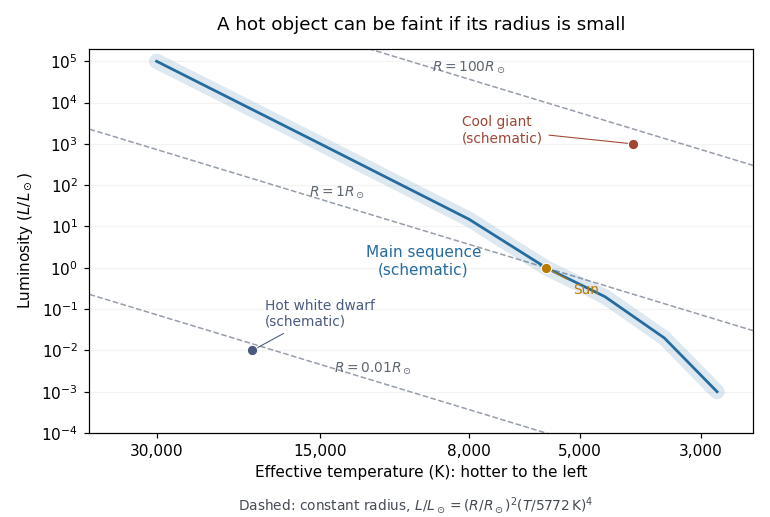
Schematic Hertzsprung-Russell diagram with lines of constant stellar radius
. The main sequence curve and giant/dwarf positions illustrate regions rather than measured population data. The dashed lines follow the Stefan–Boltzmann law; the Sun normalizes the axes. Details.A probabilistic graphical model represents factorization and conditional-independence structure using a graph whose vertices are random variables.
A location family has distribution functions , so changing the parameter translates the distribution without changing its shape.
Assouad's lemma turns many neighbouring testing problems into a lower bound for minimax risk. One direct form estimates an unknown bit vector from data with law , using Hamming distance as loss. If every neighbouring pair satisfies , where differ in one bit, thenTo prove it, average the risk over all vertices. For a fixed coordinate, pair vertices differing only in that bit. The sum of the two bit-error probabilities of any hypothesis test is at least , so the averaged error in that coordinate is at least . Sum over coordinates and use that a maximum dominates an average.
An Assouad hypercube embeds this construction in a larger estimation problem. The embedding must also relate the original loss to bit errors; it is that geometric separation which transfers the testing difficulty into a numerical estimation lower bound.
A plug-in estimator replaces unknown components of a statistical functional by estimators and evaluates the same functional at those fitted components.
A statistical estimator is consistent when it converges in probability to the target parameter as the sample size tends to infinity.
A scale estimator measures the spread of a distribution and transforms proportionally when all observations are multiplied by a positive constant.
A statistical functional is Fisher-consistent for a parameter when evaluating it at the model distribution returns that parameter.
Quantum chromodynamics, or QCD, is the non-Abelian gauge theory of quarks and gluons. Quarks transform in the fundamental color representation and the eight gluon fields in the adjoint representation. The non-Abelian field strength generates gluon self-interactions as well as quark–gluon interactions.
The strong coupling constant changes with scale: it becomes small at sufficiently high energies, permitting perturbative predictions, and grows toward the QCD scale. Low-energy color confinement and hadron structure are therefore not obtained by extrapolating a few weak-coupling diagrams without qualification. Parton distribution functions describe the long-distance input needed for many hard hadron-scattering predictions. Jets connect the calculated energetic partons with measured sprays of color-neutral particles after hadronization.
The hierarchy problem asks why the Higgs mass remains far below a much larger ultraviolet scale when scalar mass parameters receive additive radiative corrections proportional to that scale squared.
An elementary embedding between first-order structures preserves and reflects every first-order formula with parameters: for every finite tuple from ,In particular it is injective, by applying the condition to equality, and its image is an elementary substructure of . An elementary inclusion is the defining map of an elementary extension.
For example, the rational order is an elementary substructure of the real order in the language containing only , by quantifier elimination for dense linear orders without endpoints. Elementarity is stronger than preserving just the atomic relations. For embeddings between suitable transitive models of set theory, one can additionally ask which ordinals are moved; the least moved ordinal, when there is one, is the critical point of an elementary embedding. This ordinal notion is not part of the definition for arbitrary structures.
Every uncountable family of finite sets has an uncountable subfamily whose distinct members have the same pairwise intersection, called the root. It is also known as the sunflower lemma.
Kruskal–Szekeres coordinates extend the Schwarzschild solution smoothly through its future and past horizons. Constant Schwarzschild radius curves are hyperbolae, while the horizons are null lines through the bifurcation sphere.
The Schwarzschild singularity is the spacelike curvature singularity at . Curvature invariants and orthonormal tidal components diverge there.
Painlevé–Gullstrand coordinates write the Schwarzschild metric asThe constant- spatial slices are flat, and the coordinates remain regular at the Schwarzschild radius.
In a Ricci-flat spacetime, the Penrose wave equation is a nonlinear covariant wave equation for the Riemann tensor. Its principal part is and its lower-order terms are quadratic contractions of curvature.
A rheometer imposes a controlled stress or deformation and measures the complementary response. In a rotational instrument, a sample fills a gap between surfaces such as concentric cylinders, parallel disks or a cone and plate. The directly controlled or measured quantities include torque, angular displacement and angular velocity; the geometry converts these into shear stress, shear strain and shear rate.[ref]
Rheology and DMA Theory, Instrumentation, and Basic Methods by TA Instruments. slides 8–14: geometries and the distinction between raw rotational signals and calculated material variables
For example, a small-angle cone-and-plate rheometer produces approximately uniform shear rate and shear stress , with cone angle , radius , rotation rate and measured torque . A parallel-plate rheometer instead has a radius-dependent shear rate. The conversion therefore requires the appropriate flow model. Wall slip, edge failure, temperature drift and the instrument's own inertia can mimic a material response, especially for very weak or rapidly varying signals.
A gravity current is a predominantly horizontal flow driven by a density difference. Its front speed scales as the square root of reduced gravity times current depth.
Pinned article: Introduction to the OurBigBook Project
Welcome to the OurBigBook Project! Our goal is to create the perfect publishing platform for STEM subjects, and get university-level students to write the best free STEM tutorials ever.
Everyone is welcome to create an account and play with the site: ourbigbook.com/go/register. We belive that students themselves can write amazing tutorials, but teachers are welcome too. You can write about anything you want, it doesn't have to be STEM or even educational. Silly test content is very welcome and you won't be penalized in any way. Just keep it legal!
Intro to OurBigBook
. Source. We have two killer features:
- topics: topics group articles by different users with the same title, e.g. here is the topic for the "Fundamental Theorem of Calculus" ourbigbook.com/go/topic/fundamental-theorem-of-calculusArticles of different users are sorted by upvote within each article page. This feature is a bit like:
- a Wikipedia where each user can have their own version of each article
- a Q&A website like Stack Overflow, where multiple people can give their views on a given topic, and the best ones are sorted by upvote. Except you don't need to wait for someone to ask first, and any topic goes, no matter how narrow or broad
This feature makes it possible for readers to find better explanations of any topic created by other writers. And it allows writers to create an explanation in a place that readers might actually find it.
Figure 1. Screenshot of the "Derivative" topic page. View it live at: ourbigbook.com/go/topic/derivativeVideo 2. OurBigBook Web topics demo. Source. - local editing: you can store all your personal knowledge base content locally in a plaintext markup format that can be edited locally and published either:This way you can be sure that even if OurBigBook.com were to go down one day (which we have no plans to do as it is quite cheap to host!), your content will still be perfectly readable as a static site.
- to OurBigBook.com to get awesome multi-user features like topics and likes
- as HTML files to a static website, which you can host yourself for free on many external providers like GitHub Pages, and remain in full control

Figure 2. You can publish local OurBigBook lightweight markup files to either OurBigBook.com or as a static website.
Figure 3. Visual Studio Code extension installation.
Figure 5. . You can also edit articles on the Web editor without installing anything locally. Video 3. Edit locally and publish demo. Source. This shows editing OurBigBook Markup and publishing it using the Visual Studio Code extension. 
- Infinitely deep tables of contents:



All our software is open source and hosted at: github.com/ourbigbook/ourbigbook
Further documentation can be found at: docs.ourbigbook.com
Feel free to reach our to us for any help or suggestions: docs.ourbigbook.com/#contact