Topics (384k) Articles (398k) Users (410) Discussions (242) Comments (383) Files (13k) New article

An elliptical galaxy has a smooth spheroidal stellar distribution and little cold gas. Low-mass systems are commonly flattened fast rotators, while the most massive systems are commonly slowly rotating, anisotropic, and triaxial.
Cauchy's functional equation asks for functions satisfyingThe identity must hold for every pair of real numbers, and a solution is an additive function. It says that combining two inputs before applying gives the same result as combining their outputs.[ref]
Remarks on the Cauchy functional equation and variations of it by Daniel Reem. Daniel Reem, Remarks on the Cauchy functional equation and variations of it, version 7, §1.1, Eq. (1) and the real domain
For example, satisfies the identity because . At and the two sides giveFor positive widths, a rectangle of height three makes this visible: cutting its width into and partitions its area into and . The same identity also holds for negative inputs, where is a signed output rather than an ordinary area.
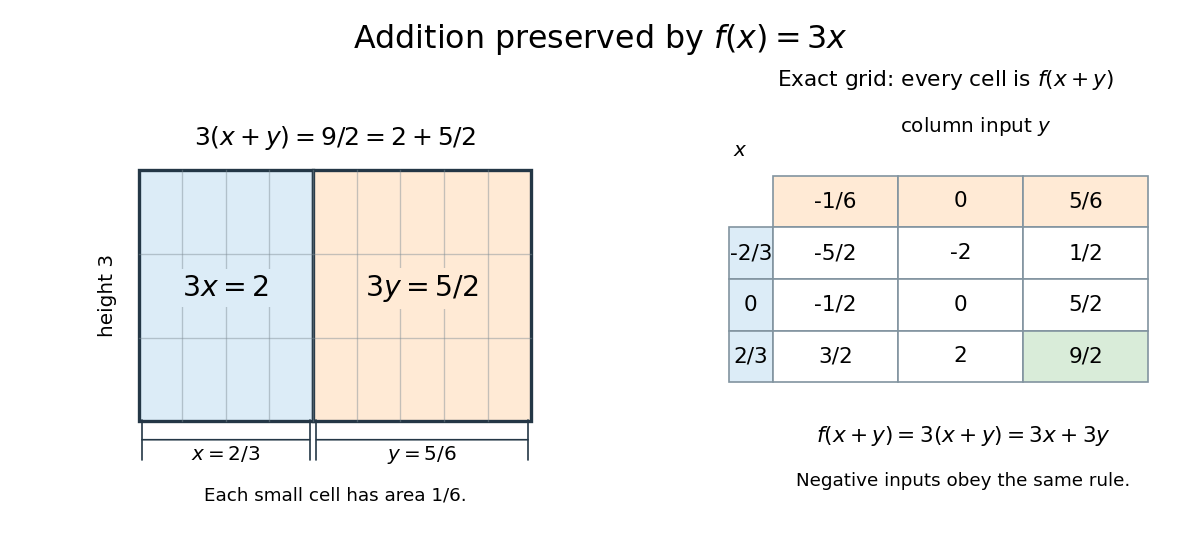
The function f(x)=3x preserves addition: partitioning a rectangle and checking exact rational grid sums
. Details. Every function with a fixed real number solves Cauchy's functional equation. The surprising question is whether these are all the solutions. Rational homogeneity of an additive function forces for every rational number , but reaching an irrational number requires an additional argument. Continuity at just one point or being a bounded function on an interval of positive length supplies that argument; without such a condition, discontinuous additive functions exist.[ref]
Remarks on the Cauchy functional equation and variations of it by Daniel Reem. Reem, version 7, §1.1, printed p. 2: classical continuity and bounded-interval conditions and nonlinear solutions
This makes Cauchy's functional equation a useful test of the boundary between algebra and analysis: a rule about addition fixes all rational multiples, while a tiny amount of continuity fixes the entire real line. For example, the continuous exponential functional equation reduces to an additive function after taking a logarithm, so this result explains why its nonzero solutions are exponential functions.
A function of bounded mean oscillation has exponentially integrable oscillation. A scale-invariant bound on implies, for some dimensional ,where is the scale-invariant gradient bound.
Every nonempty compact convex subset of a Hausdorff locally convex space is the closed convex hull of its extreme points. In particular, it has an extreme point.
The solvability complexity index counts nested limiting processes needed to compute a mathematical object from prescribed finite information. Arithmetic towers use finite arithmetic operations and comparisons at each stage.
The gap between closed operators is the symmetric gap between their closed graphs in . Gap convergence is the natural topology for continuous families of unbounded closed operators.
For a linear operator on a nonzero Hilbert space, its lower norm isIt measures how far is from sending some unit vector arbitrarily close to zero. Suppose now that is closed and densely defined, and set . Then exactly when is bijective, and in that caseIndeed, gives injectivity and, by closedness, closed range. The same bound for the adjoint operator gives , so the range of is dense and therefore all of . For an invertible , applying the definition to its bounded inverse gives , and the adjoint operator has the same inverse norm.
Closedness cannot be dropped. Restrict the identity on to the proper dense subspace of finitely supported sequences. Both its lower norm and its adjoint's lower norm equal1, yet the restricted identity is not onto. Its graph is not closed. Thus the symmetric lower-norm criterion concerns closed densely defined linear operators, not arbitrary restrictions.
Every positive linear functional on for a compact Hausdorff space has a unique representationby a finite regular positive Borel measure . More generally, is isometrically the space of finite regular complex Borel measures with the total-variation norm.
A positively curved pressureless matter universe with zero cosmological constant has the cycloid parametrization displayed above. In natural units, if the Friedmann equation is with , then and for conformal time measured from the Big Bang. Substituting in verifies the scale factor; integrating gives cosmic time. The universe reaches maximum size at and recollapses into a Big Crunch at .
Use terms in the arithmetic mean. The Fejér kernel isHere is the Dirichlet kernel. Counting pairs with a fixed index difference proves the middle coefficient formula. The finite geometric series givesThe squared-modulus form proves nonnegativity, and the constant Fourier coefficient gives . Thus is the unit-mass convolution density. Another common half-kernel convention uses with convolution prefactor ; these normalizations must be distinguished.
For each fixed , when , so the mass away from zero tends to zero. Positivity, total mass and this concentration make the kernels an approximate identity, explaining Fejér's theorem. In this convention the degree is , while is the number of averaged partial sums.[ref]
245C, Notes 2: The Fourier transform by Terence Tao. §2, Exercise 26, Cesàro averaging and the positive Fejér kernel
A Fourier partial sum retains the modes whose integer frequency multipliers satisfy in a complex Fourier series:For a real function of period , this is equivalently . It is a trigonometric polynomial, even when the original function is discontinuous. For a square wave, retaining nonzero odd sine modes gives ; all even-frequency coefficients are zero. The Gibbs phenomenon illustrates why more retained modes need not reduce the maximum error.
A wavelet is a localized analyzing function whose shifted and scaled copies examine a signal at different positions and resolutions. Its usefulness is to separate where a change occurs from how large a region that change spans. A brief feature can contribute to a few nearby wavelet coefficients instead of being described entirely through global oscillations.
The Haar wavelet is the simplest example: compare the first half of an interval with the second. A constant value contributes nothing to this contrast, while a difference between the halves survives. Moving the function changes which part of the signal is examined; shrinking it compares smaller neighbouring regions. In an orthonormal wavelet construction, these comparisons fit together without duplicating squared-norm contributions.
A scaling function retains the coarse information that such contrasts omit. The discrete wavelet transform computes both coarse values and details, and the wavelet series recombines them. This gives signal processing a representation that can expose local structure and support image compression. The transform itself is reversible in the complete orthonormal representation; discarding coefficients introduces approximation error. [ref]
https://arxiv.org/pdf/math/9304214. Gilbert Strang, Wavelet Transforms versus Fourier Transforms (1993): localized bases and reconstruction
For integers and ,This orthogonality extracts matching coefficients when two Fourier series are integrated over one period.
The Poisson summation formula equates sample sums of a function and its Fourier transform. Exchanging broad and narrow sums can save work. Use the conventionFor every Schwartz function ,Both series have absolute convergence. A sufficient hypothesis is that is smooth and for all nonnegative integers ; its Fourier transform is then also a Schwartz function.[ref]
245C, Notes 2: The Fourier transform by Terence Tao. §3, Definition 32 and Exercise 54: Schwartz hypotheses and Poisson summation on the integer lattice
This assumption controls both decay and regularity; mere membership of an L1 space does not control values at individual sampling points, as periodization of an integrable function illustrates.Here counts cycles per unit length. In the angular convention used elsewhere in Fourier analysis, , so and the right-hand side becomes . Keeping the Fourier transform convention explicit prevents stray factors. Changing the sample spacing leads to the Poisson summation formula for a Euclidean lattice.
With signature and units , parametrizing a timelike worldline by proper time makes its four-velocity satisfy .
A supermultiplet is an irreducible representation of the Super-Poincaré algebra. Conserved supercharges pair its bosonic and fermionic states at equal four-momentum.
The Super-Poincaré algebra extends the Poincare algebra by odd spinor generators. In four-dimensional supersymmetry, and the equal-chirality anticommutators vanish.
A field is perfect when every algebraic extension is separable. In positive characteristic , this is equivalent to surjectivity of the Frobenius endomorphism ; every finite field is perfect.
BCS theory describes a superconducting instability caused by attractive interactions between opposite-momentum fermions near a Fermi surface.
John Bardeen, Leon Neil Cooper and John Robert Schrieffer developed BCS theory in 1957, using attraction mediated by phonons.[ref]
Theory of Superconductivity by John Bardeen and others. pp.1175–1177, introduction and microscopic pairing mechanism
Weak-coupling Cooper pairs overlap. The Cooper instability reorganizes an unpaired Fermi surface; it is not Bose-Einstein condensation of compact, pre-existing molecules. The original paper explicitly distinguishes these pictures.[ref]
Theory of Superconductivity by John Bardeen and others. p.1177, footnote 18 and coherence-distance discussion
Two complementary clues made the microscopic problem concrete. The superconducting isotope effect connected the transition to phonons.[ref]
Electron-Phonon Interactions and Superconductivity by John Bardeen. p.55, isotope effect as a clue to the microscopic mechanism
A 1957 transmission experiment used thin lead and tin films as samples in far-infrared and millimeter-microwave measurements. The measured transmission was converted to complex electrical conductivity, normalized to the normal-state value. Comparing film thickness, resistance, annealing and the two metals tested the response's reproducibility. Weak low-photon-energy absorption followed by an onset supported a superconducting energy gap; its extraction required a thin-film electrodynamic model.[ref]
Conductivity of Superconducting Films for Photon Energies between 0.3 and 40kTc by R. E. Glover III and M. Tinkham. Abstract: sample metals, transmission method, normal-state normalization and comparisons; inferred excitation gap
The later Giaever superconducting tunnelling experiment provided another way to resolve the superconducting energy gap through quantum tunnelling.[ref]
Electron-Phonon Interactions and Superconductivity by John Bardeen. p.61, section 4, tunnelling conductance and the superconducting density of states
The derivations below explain what the model predicts, including the distinction between a single quasiparticle's minimum energy and the threshold for making two of them.Fermi-surface renormalization-group scaling sends frequency and normal displacement from the Fermi surface to zero while leaving tangential momentum fixed. Generic interactions are irrelevant, while forward-scattering and opposite-momentum Cooper channels can remain marginal.
Pinned article: Introduction to the OurBigBook Project
Welcome to the OurBigBook Project! Our goal is to create the perfect publishing platform for STEM subjects, and get university-level students to write the best free STEM tutorials ever.
Everyone is welcome to create an account and play with the site: ourbigbook.com/go/register. We belive that students themselves can write amazing tutorials, but teachers are welcome too. You can write about anything you want, it doesn't have to be STEM or even educational. Silly test content is very welcome and you won't be penalized in any way. Just keep it legal!
Intro to OurBigBook
. Source. We have two killer features:
- topics: topics group articles by different users with the same title, e.g. here is the topic for the "Fundamental Theorem of Calculus" ourbigbook.com/go/topic/fundamental-theorem-of-calculusArticles of different users are sorted by upvote within each article page. This feature is a bit like:
- a Wikipedia where each user can have their own version of each article
- a Q&A website like Stack Overflow, where multiple people can give their views on a given topic, and the best ones are sorted by upvote. Except you don't need to wait for someone to ask first, and any topic goes, no matter how narrow or broad
This feature makes it possible for readers to find better explanations of any topic created by other writers. And it allows writers to create an explanation in a place that readers might actually find it.
Figure 1. Screenshot of the "Derivative" topic page. View it live at: ourbigbook.com/go/topic/derivativeVideo 2. OurBigBook Web topics demo. Source. - local editing: you can store all your personal knowledge base content locally in a plaintext markup format that can be edited locally and published either:This way you can be sure that even if OurBigBook.com were to go down one day (which we have no plans to do as it is quite cheap to host!), your content will still be perfectly readable as a static site.
- to OurBigBook.com to get awesome multi-user features like topics and likes
- as HTML files to a static website, which you can host yourself for free on many external providers like GitHub Pages, and remain in full control

Figure 2. You can publish local OurBigBook lightweight markup files to either OurBigBook.com or as a static website.
Figure 3. Visual Studio Code extension installation.
Figure 5. . You can also edit articles on the Web editor without installing anything locally. Video 3. Edit locally and publish demo. Source. This shows editing OurBigBook Markup and publishing it using the Visual Studio Code extension. 
- Infinitely deep tables of contents:



All our software is open source and hosted at: github.com/ourbigbook/ourbigbook
Further documentation can be found at: docs.ourbigbook.com
Feel free to reach our to us for any help or suggestions: docs.ourbigbook.com/#contact