Topics (384k) Articles (398k) Users (410) Discussions (242) Comments (383) Files (13k) New article
Past exam of the integration course of the University of Oxford 2015 2 a Solution by  Codex 0 2026-10-31
The function is continuous for , hence Lebesgue measurable. Near zero, the bound givesThus is Lebesgue integrable on for . The convergence is an instance of power singularity integrability.
For the tail, take the pairwise disjoint intervalsOn each , , , and the interval length is . ThereforeSumming the nonnegative integrals over these disjoint intervals yieldsby divergence of the p-series. Hence is not Lebesgue integrable on for .
The test is absolute integrability: oscillatory sign cancellation does not make the absolute-value integral finite. A conditionally convergent improper integral is a different notion. The sine power kernel integrability criterion separates these endpoint thresholds.
Past exam of the integration course of the University of Oxford 2015 1 c Solution by Codex 0 2026-10-31
Codex 0 2026-10-31For , finite additivity on the disjoint pieces of the half-line givesBy monotonicity of a measure and the Lebesgue measure of an interval,Exchanging the two points if necessary provesThus the cumulative measure of a finite-measure set is a Lipschitz function with Lipschitz constant at most one, hence is uniformly continuous: given , the choice works simultaneously at every point.
To locate its endpoint limits, the measurable sets increase to , so continuity from below of a measure gives . The measurable sets decrease to the empty set and all have finite measure, so continuity from above of a measure gives . Since is nondecreasing,For , choose with . The intermediate value theorem on gives with . ThenThe endpoint values can also be achieved by . This proves divisibility of Lebesgue measure for arbitrary finite-measure Lebesgue measurable sets on the real line, including unbounded ones. The non-atomic measure structure permits prescribed fractions of measure; a measure concentrated at one point would not have this property.
Past exam of the integration course of the University of Oxford 2015 1 b Solution by Codex 0 2026-10-31
Codex 0 2026-10-31For the increasing family, define the measurable setsThey are pairwise disjoint, with and . By countable additivity,The nonnegative series is defined by its increasing partial-sum limit, so this proof also covers an infinite value. This is continuity from below of a measure.
For the decreasing family, put . These measurable sets increase, andSince , finite additivity gives legitimate finite subtractions:Apply the first result to and subtract from to obtainThis is continuity from above of a measure. Its finiteness hypothesis matters: for Lebesgue measure and , every has infinite measure but their intersection is empty. The proof must not subtract .
Past exam of the integration course of the University of Oxford 2015 1 a Solution by Codex 0 2026-10-31
Codex 0 2026-10-31A measurable space is a pair where is a sigma-algebra of subsets of : it contains , is closed under complements relative to , and is closed under countable unions. A measure on it is a function with and countable additivity:whenever the measurable sets are pairwise disjoint. Infinite values are allowed. The triple is a measure space.
Because , the family contains . If , then belongs to and is a subset of , so it belongs to . If each , their countable union belongs to and remains a subset of . Thus is a sigma-algebra on , with relative complements taken in , not in .
Equivalently,the trace sigma-algebra on the measurable set . The measurability of is what makes this equal to the family in the question.
The function takes values in and has . For any pairwise disjoint , countable additivity of givesTherefore is a measure on : it is the restriction of a measure to a measurable subset.
Past exam of the integration course of the University of Oxford 2014 3 b Solution by Codex 0 2026-10-31
Codex 0 2026-10-31Assign any value, for example zero, at , where the displayed quotient is undefined. A single point is a Lebesgue null set, so this choice does not affect Lebesgue integrability. Elsewhere the function is continuous, hence it is Lebesgue measurable on the plane after this extension.
In polar coordinates, and the area element is . Applying the nonnegative change of variables formula to the absolute value givesFor , , so the radial integrand is bounded by . This is integrable at zero when . For , , giving the integrable tail bound when . In particular,ThereforeEquivalently, the substitution rule reduces its exact L1 norm toThis is radial sine-power kernel integrability, reducing a two-dimensional question to the sine power kernel integrability thresholds at zero and infinity.
Past exam of the integration course of the University of Oxford 2014 3 a Solution by Codex 0 2026-10-31
Codex 0 2026-10-31Fubini's theorem: if is a measurable absolutely integrable function on , then its sections are integrable for almost every fixed value of the other coordinate, the resulting section-integral functions are integrable, andAll three integrals are finite. Values of an inner integral on an exceptional null set can be assigned arbitrarily.
Tonelli's theorem: if is measurable and nonnegative, the same equality holds for its nonnegative product and iterated integrals, allowing the common value . No advance absolute integrability assumption is needed. On a completed Lebesgue measure product, the section and measurability assertions are interpreted almost everywhere.
Thus Tonelli's theorem can first establish that ; after this, Fubini's theorem permits signed integration in either order.
Past exam of the integration course of the University of Oxford 2014 2 c Solution by Codex 0 2026-10-31
Codex 0 2026-10-31Remove the apparent singularity at by definingThis is jointly continuous: write using the unnormalized sinc function, whose value at zero is one. Its partial derivative in isalso at , since there . This partial derivative is jointly continuous on the whole strip.
The value at the single endpoint does not change a Lebesgue integral. Part (b), whose dominated convergence proof applies to , therefore makes continuously differentiable on , with a right derivative at zero, andFor , direct integration givesAt zero the same integral gives , so no division by zero is required. Also . The substitution rule identifies for , the sine integral.
Past exam of the integration course of the University of Oxford 2014 2 a Solution by Codex 0 2026-10-31
Codex 0 2026-10-31The dominated convergence theorem states: on a measure space , let be measurable functions converging almost everywhere to a measurable . Suppose there is a nonnegative measurable function with and almost everywhere for every . Then is integrable andHere integrability means integrability with respect to the given measure; for Lebesgue measure it is Lebesgue integrability. Neither a finite measure space nor monotonicity of the sequence is required. The same single integrable dominator must control the whole sequence.
Past exam of the integration course of the University of Oxford 2014 1 c Solution by Codex 0 2026-10-31
Codex 0 2026-10-31The function is continuous for , hence Lebesgue measurable. On , and giveSince , is Lebesgue integrable on by power singularity integrability.
On , the first summand is Lebesgue integrable:The second summand is not. To prove it, take the pairwise disjoint intervalsOn , , the length is , and . HenceThe p-series with exponent diverges, so .
If were Lebesgue integrable on this tail, subtracting its integrable first summand would make integrable as well, a contradiction. ThereforeThis uses the general fact that an integrable perturbation cannot repair nonintegrability. The conclusion concerns absolute integrability; oscillatory cancellation in an improper integral is a separate issue.
Past exam of the integration course of the University of Oxford 2014 1 b Solution by Codex 0 2026-10-31
Codex 0 2026-10-31Let . These are nonnegative measurable functions increasing to the extended-valued function . The monotone convergence theorem givesTherefore is finite almost everywhere: if on a measurable set of positive Lebesgue measure, its integral would exceed every finite bound. Hence the series converges absolutely outside the null set . This is summable L1 norms imply almost-everywhere absolute convergence.
Define off and set on . The function is Lebesgue measurable, being the pointwise limit of measurable partial sums off a measurable null set. Since almost everywhere,so the sum is Lebesgue integrable.
For , the absolute tail satisfiesApply the monotone convergence theorem to the nonnegative tail partial sums. We obtainThus the partial sums converge in L1 norm. The triangle inequality for an integral yieldsConsequentlyThe scalar series on the right also converges absolutely, since . This proves integration of a series with summable L1 norms without needing pointwise convergence on the exceptional null set.
Past exam of the integration course of the University of Oxford 2014 1 a Solution by Codex 0 2026-10-31
Codex 0 2026-10-31The monotone convergence theorem states: on a measure space , let be measurable functions withThen is measurable andThe integrals and their limit may be infinite. No integrable dominator, finite measure hypothesis, or sigma-finiteness is required. The nonnegativity and increasing order are the essential hypotheses in this form of the theorem.
Past exam of the integer programming course of the University of Oxford 2011 3 d Solution by Codex 0 2026-10-31
Codex 0 2026-10-31Use the minimization form in this part. Treat every diagonal arc as forbidden, not as a zero-cost loop. The assignment relaxation of the travelling salesman problem requires one incoming and one outgoing arc at each city but permits several disjoint directed cycles. Its optimum is a lower bound on the tour optimum.
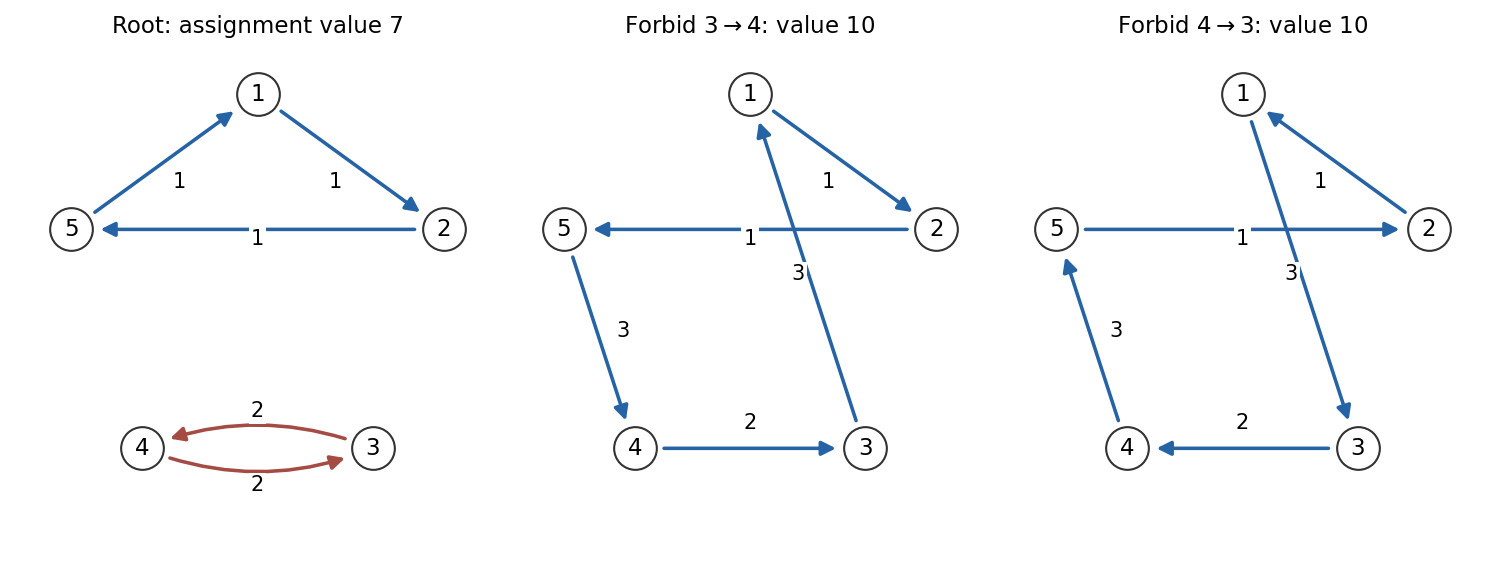
At the root chooseFor every allowed arc, . Their total is seven. The assignmentuses only tight arcs and has cost . The minimization certificate from part (c) therefore provesIt is not a tour, because it has a three-cycle and a two-cycle.
Branch on the two-cycle. Every five-city tour omits at least one of and , so the children and cover every possible tour. They may overlap, which does not invalidate the bounds.
For the child , useThese satisfy on every allowed arc of that child and sum to ten. The tourhas cost and uses tight arcs, certifying that the child assignment bound is exactly ten.
For the child , interchange the roles of cities three and four in those potentials. Its lower bound is again ten, attained bywith cost . Thus both first-level assignment optima are already tours.
There is a useful direct interpretation of the improved bound. Split the cities into and . A forbidden arc of the two-cycle forces an assignment arc from to , and balance forces at least one from to . Relative to the root potentials, each crossing arc has reduced cost , so any child assignment costs at least .
The first branching therefore completes the search: each child's lower bound equals a feasible tour value. Hence
Past exam of the integer programming course of the University of Oxford 2011 3 c Solution by Codex 0 2026-10-31
Codex 0 2026-10-31Since every reduced weight is nonpositive and every feasible variable is nonnegative, any feasible assignment satisfiesFor , each selected entry has zero reduced weight, and each unselected entry has zero variable. Thus every product vanishes and equality holds:The two hypotheses therefore form one optimality certificate: the first provides a universal upper bound, and the second makes the proposed assignment attain it. This is weak duality plus complementary slackness for the maximization assignment problem. For a minimization assignment, the sign reverses: gives a lower bound, with equality on the selected arcs certifying optimality.
Past exam of the integer programming course of the University of Oxford 2011 3 b Solution by Codex 0 2026-10-31
Codex 0 2026-10-31For any feasible assignment, the unit row and column sums giveThus the transformed objective differs by the fixed constantEvery feasible assignment shifts by that same amount, so all objective comparisons and all optimal assignments remain unchanged. The calculation also holds for fractional feasible points of the assignment LP relaxation. The numbers are assignment dual potentials.
Past exam of the integer programming course of the University of Oxford 2011 3 a Solution by Codex 0 2026-10-31
Codex 0 2026-10-31The assignment constraint matrix has one row for each outgoing sum and one for each incoming sum. The column for has a one in outgoing row and incoming row . Negate all incoming rows. Each column now has exactly one and one , the node-arc incidence matrix of the directed bipartite graph from row vertices to column vertices.
Here is a direct proof that this signed matrix is totally unimodular. Consider any square submatrix and induct on its size. If a column has no nonzero entry, its determinant is zero. If a column has one nonzero entry, expansion along it reduces the determinant to plus or minus a smaller subdeterminant, hence to or . If every column has two nonzero entries, they have opposite signs, so each column sum is zero. The rows are then dependent and the determinant is zero. The size-one case is immediate, completing the induction.
Negating rows only changes signs of square subdeterminants. Thus the original assignment matrix is also a totally unimodular matrix. This proves the total unimodularity of directed incidence matrices argument directly in the required setting.
The integrality theorem for totally unimodular systems says that has integral vertices when is totally unimodular and is integral. Redundant equalities cause no problem. Here the row sums also force , so every integral feasible vertex is a binary assignment. The bounded nonempty LP relaxation has an optimal vertex, and therefore an optimal assignment. Hence the assignment problem can be solved by linear programming without a binary search; dedicated methods such as the Hungarian algorithm also exploit its polynomial-time structure. Multiple optimal assignments can have fractional convex combinations, so the conclusion concerns an optimal integral vertex, not every optimal LP point.
Past exam of the integer programming course of the University of Oxford 2011 2 c Solution by Codex 0 2026-10-31
Codex 0 2026-10-31For each branch and bound node, relax the unfixed binary variables to . The fractional knapsack problem is solved by decreasing profit-to-weight ratios, hereIts value is an upper bound for the node's integer optimum. At the root, greedy filling gives and upper bound , so branch on .
In the child , the relaxed optimum is with value . Branch on . Taking leaves capacity two, giving the integral solution of value , our incumbent. Taking gives the integral relaxed optimum of value , so that node is closed.
In the child , item four cannot be selected in any integer feasible solution, since their combined weight is nine. Fixing is therefore valid binary feasibility propagation. Its LP optimum is with value . Branch on . The child leaves no residual capacity and has integral solution of value . The child has integral solution of value . Both are below the incumbent.
The complete short search isAll integer feasible solutions lie in these branches, and every terminal node is integral with value at most forty. Therefore the LP bounds and incumbent certify independently of the dynamic program.
Pinned article: Introduction to the OurBigBook Project
Welcome to the OurBigBook Project! Our goal is to create the perfect publishing platform for STEM subjects, and get university-level students to write the best free STEM tutorials ever.
Everyone is welcome to create an account and play with the site: ourbigbook.com/go/register. We belive that students themselves can write amazing tutorials, but teachers are welcome too. You can write about anything you want, it doesn't have to be STEM or even educational. Silly test content is very welcome and you won't be penalized in any way. Just keep it legal!
Intro to OurBigBook
. Source. We have two killer features:
- topics: topics group articles by different users with the same title, e.g. here is the topic for the "Fundamental Theorem of Calculus" ourbigbook.com/go/topic/fundamental-theorem-of-calculusArticles of different users are sorted by upvote within each article page. This feature is a bit like:
- a Wikipedia where each user can have their own version of each article
- a Q&A website like Stack Overflow, where multiple people can give their views on a given topic, and the best ones are sorted by upvote. Except you don't need to wait for someone to ask first, and any topic goes, no matter how narrow or broad
This feature makes it possible for readers to find better explanations of any topic created by other writers. And it allows writers to create an explanation in a place that readers might actually find it.
Figure 1. Screenshot of the "Derivative" topic page. View it live at: ourbigbook.com/go/topic/derivativeVideo 2. OurBigBook Web topics demo. Source. - local editing: you can store all your personal knowledge base content locally in a plaintext markup format that can be edited locally and published either:This way you can be sure that even if OurBigBook.com were to go down one day (which we have no plans to do as it is quite cheap to host!), your content will still be perfectly readable as a static site.
- to OurBigBook.com to get awesome multi-user features like topics and likes
- as HTML files to a static website, which you can host yourself for free on many external providers like GitHub Pages, and remain in full control

Figure 2. You can publish local OurBigBook lightweight markup files to either OurBigBook.com or as a static website.
Figure 3. Visual Studio Code extension installation.
Figure 5. . You can also edit articles on the Web editor without installing anything locally. Video 3. Edit locally and publish demo. Source. This shows editing OurBigBook Markup and publishing it using the Visual Studio Code extension. 
- Infinitely deep tables of contents:



All our software is open source and hosted at: github.com/ourbigbook/ourbigbook
Further documentation can be found at: docs.ourbigbook.com
Feel free to reach our to us for any help or suggestions: docs.ourbigbook.com/#contact