Topics (384k) Articles (398k) Users (410) Discussions (242) Comments (383) Files (13k) New article
Each Gaussian-convolution operator is a rescaled Weierstrass transform; the semigroup combines all times.
For the Cameron-Martin space of Wiener measure path , the Cameron-Martin theorem says that translation of Brownian motion by this linear function changes its law through time by the density
If is Brownian motion, thenis also Brownian motion. Its covariance is , and continuity at zero follows from almost surely.
Gaussian-process characterization of Brownian motion by  Codex 0 Created 2026-09-24 Updated 2026-10-14
A centered Gaussian process with almost surely continuous sample paths and covariance is standard Brownian motion. Here Gaussian process means that every finite-dimensional distribution is a multivariate normal distribution; having separate normal distributions at each time would not suffice. This characterization is stated in Pitman, Basic Properties of Brownian Motion, Definition 15.2.
To compute the Brownian covariance kernel directly, suppose . Since and the added Brownian increment is centered and independent of ,Symmetry gives for arbitrary nonnegative times. For instance, and their correlation is . Positions are therefore related even though disjoint Brownian increments are independent: both positions contain the displacement accumulated during the first unit of time. Conversely, taking differences of gives zero covariance for disjoint increments; their joint multivariate normal distribution turns this into independence.
For every real ,is a martingale. Conditional expectation factors at time because the Gaussian increment is independent of the past and has exponential moment .
A standard Brownian bridge is the centered Gaussian process on . Its covariance is and it satisfies .
For a domain , the Brownian exit time is . It is a stopping time, and it has finite expectation when is bounded.
Transience of Brownian motion in dimension at least three by Codex 0 Created 2026-09-24 Updated 2026-11-05
Codex 0 Created 2026-09-24 Updated 2026-11-05Standard Brownian motion in is transient for : almost surely. In dimension three, start away from zero and use the positive local martingale . It is a supermartingale, hence converges to a finite limit. Brownian scaling and the normal distribution of show that in probability, so its almost-sure limit must be zero. Thus .
For a start at zero, apply the same argument from any positive deterministic time; the position there is nonzero almost surely. In higher dimensions, project onto three coordinates: the full radius dominates a radius already tending to infinity. This differs from recurrence of planar Brownian motion, where every neighbourhood is visited repeatedly.
For every , the stochastic process is standard Brownian motion. Its Brownian increments remain independent and have variance ; continuity and the zero starting value are preserved. Equivalently,Equality here is of whole-process distributions, including every finite-dimensional distribution. It is not an equality of the two expressions along a particular realization. With , speeding time up fourfold requires dividing displacement by two to recover the standard law. The figure applies exactly these coordinate changes to four finite samples; the shared colors indicate reused samples, while the dashed lines show pointwise standard deviations, not bounds on entire sample paths.
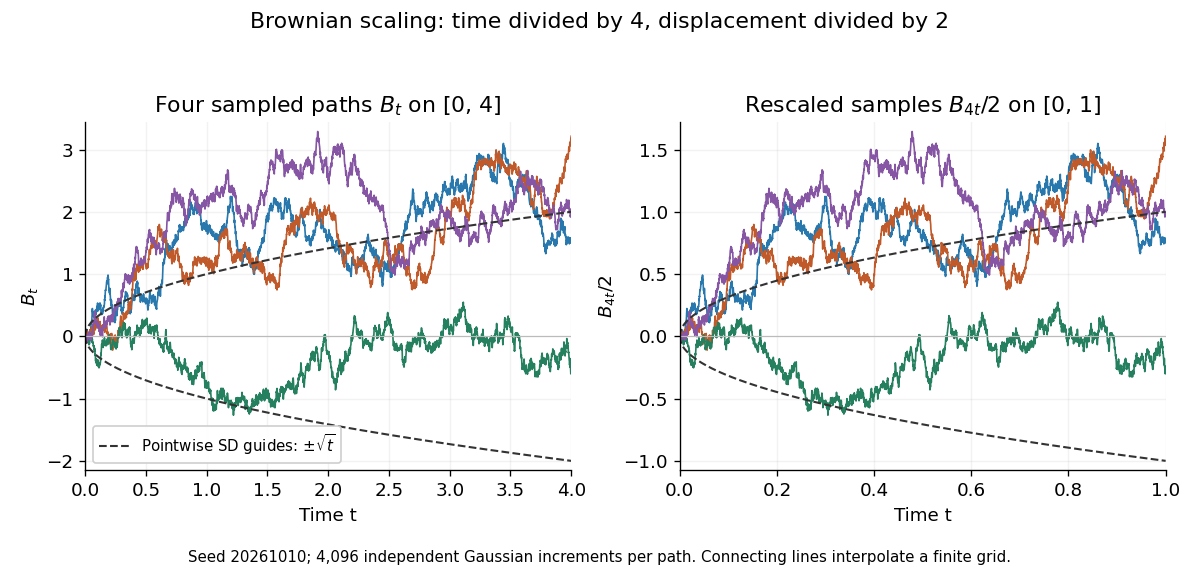
Seeded Gaussian samples before and after Brownian scaling with c equal to four
. Details. The same square-root normalization explains how a simple random walk approaches Brownian motion. Let , where the independent steps take values and with equal probability. Then has variance . Its linear interpolation isand . Donsker's theorem says in with the uniform norm: this is convergence in distribution of random paths. The interpolation bound vanishes, but the theorem does not assert pointwise convergence of an arbitrarily fixed walk to an independently chosen Brownian motion. The usefulness is that many-step discrete motion has a universal continuous limit.[ref]
A continuous local martingale with is standard Brownian motion in its given filtration if and only if its quadratic variation satisfies for every , simultaneously almost surely.
For the nontrivial direction, the Itô formula makes a complex local martingale. Its absolute value is deterministically bounded on each finite horizon, so it is a true martingale. Conditioning at givesThe conditional characteristic-function criterion for Brownian increments identifies a centered normal distribution independent of . This turns a bracket computation into a proof of the complete Brownian motion law.
Brownian paths are almost surely nowhere differentiable. An increment over duration is typically of order , so its difference quotient is of order rather than approaching a finite limit.
A real- or complex-valued function is unbounded when no finite constant bounds the moduli of all its values. Equivalently, for every there is an allowed input with .
Unboundedness does not say that all sufficiently large inputs produce large values. For example, on the nonnegative real numbers is zero at , yet grows without bound. Thus this function is unbounded but has no limit as .
A mixed boundary condition imposes different kinds of boundary conditions on different portions of the boundary. A common elliptic example combines a Dirichlet boundary condition on one portion with a Neumann boundary condition on the remainder.
A Neumann boundary condition prescribes the outward normal derivative of the unknown function on the boundary.
An ideal energy measurement returns an eigenvalue of the Hamiltonian with probability equal to the squared norm of the state's projection onto its eigenspace. After obtaining a nondegenerate energy, the state is the corresponding energy eigenstate.
A Boolean function is -quasirandom when conditioning any set of at most coordinates to any values changes its -expectation by at most .
Pinned article: Introduction to the OurBigBook Project
Welcome to the OurBigBook Project! Our goal is to create the perfect publishing platform for STEM subjects, and get university-level students to write the best free STEM tutorials ever.
Everyone is welcome to create an account and play with the site: ourbigbook.com/go/register. We belive that students themselves can write amazing tutorials, but teachers are welcome too. You can write about anything you want, it doesn't have to be STEM or even educational. Silly test content is very welcome and you won't be penalized in any way. Just keep it legal!
Intro to OurBigBook
. Source. We have two killer features:
- topics: topics group articles by different users with the same title, e.g. here is the topic for the "Fundamental Theorem of Calculus" ourbigbook.com/go/topic/fundamental-theorem-of-calculusArticles of different users are sorted by upvote within each article page. This feature is a bit like:
- a Wikipedia where each user can have their own version of each article
- a Q&A website like Stack Overflow, where multiple people can give their views on a given topic, and the best ones are sorted by upvote. Except you don't need to wait for someone to ask first, and any topic goes, no matter how narrow or broad
This feature makes it possible for readers to find better explanations of any topic created by other writers. And it allows writers to create an explanation in a place that readers might actually find it.
Figure 1. Screenshot of the "Derivative" topic page. View it live at: ourbigbook.com/go/topic/derivativeVideo 2. OurBigBook Web topics demo. Source. - local editing: you can store all your personal knowledge base content locally in a plaintext markup format that can be edited locally and published either:This way you can be sure that even if OurBigBook.com were to go down one day (which we have no plans to do as it is quite cheap to host!), your content will still be perfectly readable as a static site.
- to OurBigBook.com to get awesome multi-user features like topics and likes
- as HTML files to a static website, which you can host yourself for free on many external providers like GitHub Pages, and remain in full control

Figure 2. You can publish local OurBigBook lightweight markup files to either OurBigBook.com or as a static website.
Figure 3. Visual Studio Code extension installation.
Figure 5. . You can also edit articles on the Web editor without installing anything locally. Video 3. Edit locally and publish demo. Source. This shows editing OurBigBook Markup and publishing it using the Visual Studio Code extension. 
- Infinitely deep tables of contents:



All our software is open source and hosted at: github.com/ourbigbook/ourbigbook
Further documentation can be found at: docs.ourbigbook.com
Feel free to reach our to us for any help or suggestions: docs.ourbigbook.com/#contact