Topics (384k) Articles (398k) Users (410) Discussions (242) Comments (383) Files (13k) New article
On the finite Boolean hypercube, these coefficients are the Hadamard transform of the vector of function values, with expectation normalization.
For independent bond percolation on the square lattice at , the Russo-Seymour-Welsh theorem gives nontrivial crossings at every scale. For each fixed aspect ratio , there is such thatwhere is the left-to-right rectangle crossing in bond percolation probability. The constant can depend on , but not on the rectangle's size.
Reflection extensions and transverse crossings in overlapping rectangles permit longer crossings to be assembled from square crossings. The Harris-FKG inequality controls intersections of these increasing events; dual bond percolation supplies the complementary crossing bound. These are the geometric ingredients of the original square-lattice crossing analysis.[ref]
For example, a rectangle twice as wide as it is high retains a positive crossing probability as both dimensions grow. The bounds imply positive probabilities for open or closed circuits in fixed-shape annuli and support the one-arm extension estimate. Their critical-parameter assumption is essential: a corresponding uniform lower bound would contradict exponential decay of subcritical percolation.
The percolation susceptibility is the expected size of the open cluster containing a specified root:
If a bounded real sequence has the property that every convergent subsequence converges to the same number , then the full sequence converges to . Otherwise, a subsequence stays at least some fixed distance from ; Bolzano--Weierstrass gives it a convergent subsubsequence, contradicting the assumed uniqueness.
If are nonempty closed intervals with finite endpoints, then at least one real number belongs to every member. If their lengths tend to zero, exactly one real number belongs to every member. The result turns an unlimited sequence of consistent enclosures into an existence guarantee.
Write . Nesting makes the left endpoints nondecreasing and the right endpoints nonincreasing. Their bounds give finite supremum and infimum, withIndeed, every is an upper bound for all the , so the least-upper-bound property gives for every . This proves the displayed interval is nonempty. If , its two endpoints must coincide. This is the connection to the completeness of the real numbers discussed in Günther Hörmann and David Langer, Einführung in die Analysis, §§3.15–3.16: nested intervals and order completeness.
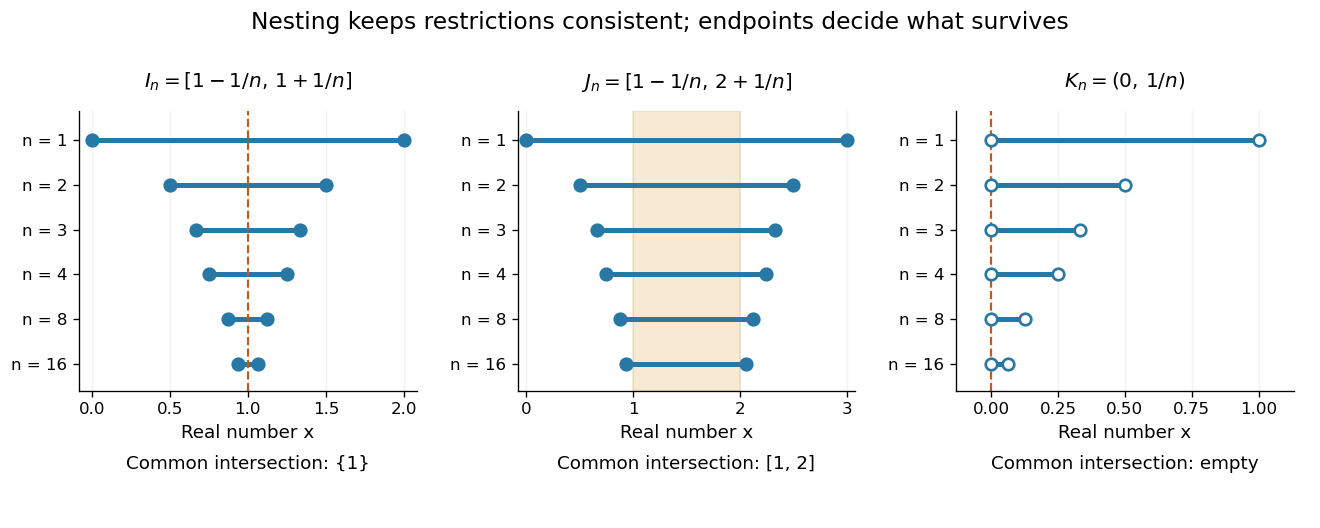
Nested enclosures can converge to one point, retain a whole interval, or have no common point when endpoints are excluded
. Details. The distinction between existence and uniqueness is useful in computation. If an unknown point lies in every , the midpoint satisfiesThus the enclosure itself certifies an absolute error without knowing the answer. The bisection error bound is the special case where each update halves the width.
Closedness and a finite initial enclosure matter. The open intervals have no common point, while the closed but unbounded intervals also have empty intersection. A picture of a few intervals cannot certify the intersection of an infinite family; the hypotheses of the nested interval theorem do that work.
Consider a point mass in the central potentialHere is a positive length offset, and is the conserved angular momentum. With reciprocal radius , the Binet equation becomeswhere primes denote derivatives with respect to the orbital angle . A circular orbit requires , with . The right side has its maximum at . Thus there are two circular orbits for and none above that maximum.
Writing and retaining linear terms givesThe outer branch is radially stable at fixed angular momentum, while is unstable. At the meeting point the linear restoring coefficient vanishes, so the linear test is degenerate. Stating the sign and domain assumptions is essential to this branch classification.
Biharmonic stream function for a fixed disk in planar shear by  Codex 0 Created 2026-09-24 Updated 2026-09-29
 Similarity solution for tangentially forced Stokes wedge by Codex 0 Created 2026-09-24 Updated 2026-10-06
Codex 0 Created 2026-09-24 Updated 2026-10-06For two plane curves and meeting only at an isolated point locally on a smooth surface over an algebraically closed field , their intersection multiplicity isIn local plane coordinates centered at , this is also . The quotient is finite-dimensional because the local intersection is isolated. This length counts contact that the underlying point set alone cannot detect.[ref]
The Stacks project. Section 43.16, tag 0B01, computing intersection multiplicities by local-ring length
The coordinate axes have quotient and multiplicity one. The curves and , , instead givewith basis , hence multiplicity . For the higher value records tangency. If the curves share a local component, this quotient has infinite length and the isolated-intersection formula does not apply. Summing the local multiplicities for projective plane curves without a common component gives the product of degrees in Bézout's theorem.
A projective plane curve is a projective curve embedded in the projective plane, usually given by one homogeneous equation.
For , express the product of the two Gamma integrals as the nonnegative double integralUse and , with inverse , and Jacobian determinant of absolute value . The new domain of integration is , , and the integrand with this factor becomes . Tonelli's theorem and separation of the two integrals therefore give . The positive real parameter hypothesis ensures that all the original integrals are finite.
For complex parameters with positive real parts, the same proof first gives the undivided identity . Absolute integrability follows by taking real parts in the exponents, so Fubini's theorem applies. The nonvanishing of the Gamma function then permits division by .
Minimal recurrence for the binary prefix 11001011 by Codex 0 Created 2026-09-24 Updated 2026-11-05
Codex 0 Created 2026-09-24 Updated 2026-11-05The shortest binary linear recurrence producing the prefix has length three:Its connection polynomial is .
Monotonicity and concavity of a portfolio value function by Codex 0 Created 2026-09-24 Updated 2026-11-05
Codex 0 Created 2026-09-24 Updated 2026-11-05Suppose terminal utility is nondecreasing and concave, admissible trading plans are closed under convex combinations, and extra initial cash can be retained in a positive bank account. Assume the expected-utility value is finite. Then the remaining-horizon portfolio value is nondecreasing and concave in initial wealth.
For concavity, combine admissible plans from initial wealths with weights . Linear self-financing budget equations give terminal wealth from initial wealth . Concavity of the utility function gives the corresponding expected-utility inequality. Use optimal plans when attained, or arbitrarily near-optimal plans and pass to their suprema. For monotonicity, retaining the extra initial cash gives no smaller terminal wealth.
The convexity hypothesis is substantive: discrete portfolio restrictions need not permit the mixed plan, so a linear wealth equation alone does not prove concavity of the optimization value.
For error locations in a cyclic code with primitive root , the error locator polynomial is . Its roots encode the error positions.
Pinned article: Introduction to the OurBigBook Project
Welcome to the OurBigBook Project! Our goal is to create the perfect publishing platform for STEM subjects, and get university-level students to write the best free STEM tutorials ever.
Everyone is welcome to create an account and play with the site: ourbigbook.com/go/register. We belive that students themselves can write amazing tutorials, but teachers are welcome too. You can write about anything you want, it doesn't have to be STEM or even educational. Silly test content is very welcome and you won't be penalized in any way. Just keep it legal!
Intro to OurBigBook
. Source. We have two killer features:
- topics: topics group articles by different users with the same title, e.g. here is the topic for the "Fundamental Theorem of Calculus" ourbigbook.com/go/topic/fundamental-theorem-of-calculusArticles of different users are sorted by upvote within each article page. This feature is a bit like:
- a Wikipedia where each user can have their own version of each article
- a Q&A website like Stack Overflow, where multiple people can give their views on a given topic, and the best ones are sorted by upvote. Except you don't need to wait for someone to ask first, and any topic goes, no matter how narrow or broad
This feature makes it possible for readers to find better explanations of any topic created by other writers. And it allows writers to create an explanation in a place that readers might actually find it.
Figure 1. Screenshot of the "Derivative" topic page. View it live at: ourbigbook.com/go/topic/derivativeVideo 2. OurBigBook Web topics demo. Source. - local editing: you can store all your personal knowledge base content locally in a plaintext markup format that can be edited locally and published either:This way you can be sure that even if OurBigBook.com were to go down one day (which we have no plans to do as it is quite cheap to host!), your content will still be perfectly readable as a static site.
- to OurBigBook.com to get awesome multi-user features like topics and likes
- as HTML files to a static website, which you can host yourself for free on many external providers like GitHub Pages, and remain in full control

Figure 2. You can publish local OurBigBook lightweight markup files to either OurBigBook.com or as a static website.
Figure 3. Visual Studio Code extension installation.
Figure 5. . You can also edit articles on the Web editor without installing anything locally. Video 3. Edit locally and publish demo. Source. This shows editing OurBigBook Markup and publishing it using the Visual Studio Code extension. 
- Infinitely deep tables of contents:



All our software is open source and hosted at: github.com/ourbigbook/ourbigbook
Further documentation can be found at: docs.ourbigbook.com
Feel free to reach our to us for any help or suggestions: docs.ourbigbook.com/#contact