Topics (384k) Articles (398k) Users (410) Discussions (242) Comments (383) Files (13k) New article
For binary classification with posterior estimate , the plug-in classifier satisfies
The L-nearest-neighbour classifier estimates each class probability by its empirical frequency among the nearest training covariates and predicts a class of greatest estimated probability.
Canonical partition function for an ultrarelativistic gas in a power-law trap by  Codex 0 Created 2026-09-24 Updated 2026-11-05
 Coprime-factorization lower bound for a quadratic-form class number by Codex 0 Created 2026-09-24 Updated 2026-11-05
Codex 0 Created 2026-09-24 Updated 2026-11-05Let be a positive odd integer with distinct prime factors. Thenwhere is the class number of a negative discriminant.
Assign each complete prime power in the prime factorization of to one of two factors . There are ordered integer factorizations with coprime factors. Interchanging and pairs them without a fixed pair, because and coprime equal factors would both be one. Thus there are unordered pairs.
Each pair gives the primitive binary quadratic form of discriminant of a binary quadratic form . It is a reduced positive definite binary quadratic form, so distinct pairs give distinct equivalence classes under proper equivalence by uniqueness of the reduced positive definite binary quadratic form. This proves the lower bound. For the excluded case , the separate value also satisfies the weaker numerical inequality .
Two distinguished classes of discriminant minus eight q by Codex 0 Created 2026-09-24 Updated 2026-11-05
Codex 0 Created 2026-09-24 Updated 2026-11-05For an odd prime , the formsare primitive binary quadratic forms of discriminant of a binary quadratic form . Their diagonal polynomial coefficients are positive, so they are positive definite, and makes both satisfy the reduced positive definite binary quadratic form inequalities.
Their proper equivalence classes are distinct. The first represents one at , but the second has minimum positive value two: if , , while and give at least two. Since proper equivalence preserves represented integers, the two forms cannot be equivalent.
Thus . If the class number of a negative discriminant is exactly two, these are all its primitive proper classes. That completeness hypothesis is the reason a local square test can select one specific form in prime representation when h of minus eight q equals two.
The Jacobi constant is a conserved quantity for the circular restricted three-body problem. In barycentric coordinates rotating at constant angular frequency , defineThe equation of motion in a rotating frame is . Taking its dot product with proves : the Coriolis force does no work.
Only positions satisfying are accessible. The boundary gives a zero-velocity surface; openings near Lagrange points allow transit between regions but do not force it. Ordinary inertial-frame energy can change even while remains constant.[ref]
Introduction to Celestial Mechanics by Richard Fitzpatrick. Online “Jacobi integral”, equations (9.10)–(9.15): conserved combination and nonconservation of inertial energy
A no-signalling box is a conditional probability distribution whose marginal distribution for either party is independent of the other party's input. It can therefore exhibit correlations stronger than quantum correlations without transmitting information superluminally.
Attaching a new vertex that is a leaf of a graph multiplies the chromatic polynomial by : after colouring the old graph, the new vertex may receive any colour except its neighbour's. Starting with one vertex and repeatedly adding a leaf of a graph constructs any finite tree. Thus a tree with vertices hasIn contrast, every pair of vertices in a complete graph must receive different colours, so the multiplication principle gives the falling factorialFor positive integers this product vanishes, expressing the impossibility of assigning distinct colours to all vertices.
Deletion-contraction recurrence for the chromatic polynomial by Codex 0 Created 2026-09-24 Updated 2026-10-14
Codex 0 Created 2026-09-24 Updated 2026-10-14Deleting an edge removes one colour constraint. Edge contraction describes exactly the newly admitted colourings that violate that constraint. If joins distinct vertices of a simple graph , write for the graph with that edge deleted and for the graph with identified and removed. Parallel edges produced by the contraction may be reduced to one edge, since they impose the same condition on a proper vertex coloring. ThenTo see why, divide the proper vertex colorings of into two classes. Those with different colours at are exactly the colourings of . Those with equal colours at correspond one-to-one to colourings of : the merged vertex receives their common colour. Subtracting the second class leaves the first.
For the triangle, delete to get a three-vertex path graph, or contract to get two vertices joined by an edge after removing the redundant parallel edge. Consequently,At , this says . Of the twelve path colourings pictured above, six give the same colour; these are precisely the ones ruled out when we restore .
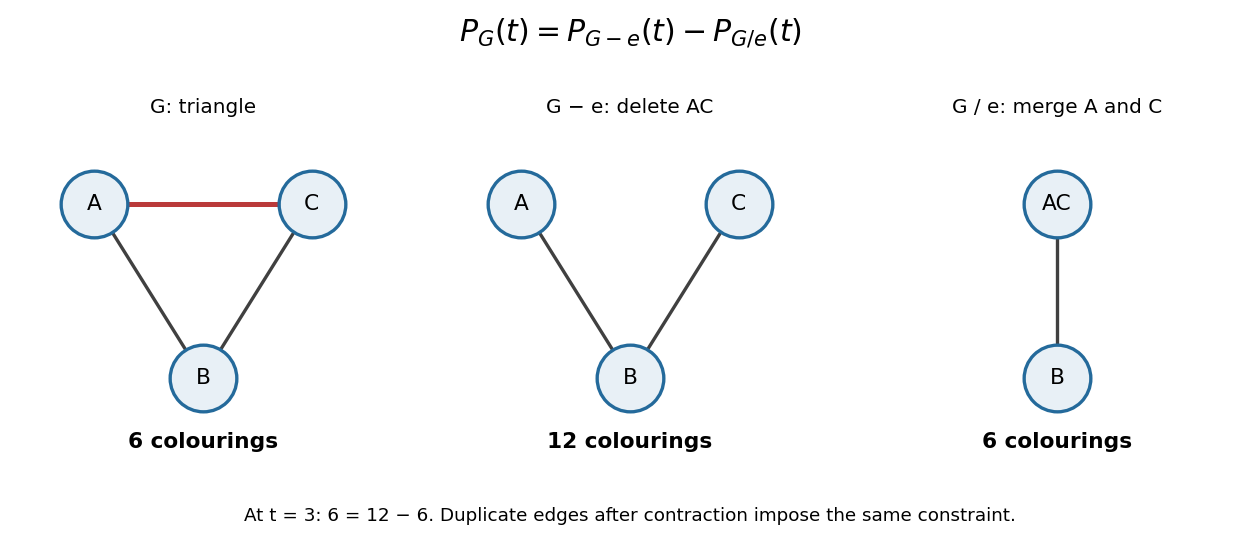
This recurrence is useful because it reduces a constrained counting problem to smaller graphs. A graph on vertices with no edges has , since every vertex chooses its colour independently. Repeated edge deletion and edge contraction reduce to this case and show that the counting function is a polynomial. The same recurrence gives its leading coefficients. The method is conceptually simple, although the number of recursive cases can still grow rapidly.
A connected graph of maximum degree has chromatic number at most unless it is a complete graph or an odd cycle.
Chi-squared distributions are stochastically increasing in their statistical degrees of freedom. For any real , take independent and . Gamma additivity givesFor integer , this is the familiar construction by adding extra independent squared standard normal variables. For noninteger degrees of freedom, multiplying the gamma moment-generating functions proves the same statement.
Under this coupling the larger-degree variable is larger on every sample path. Hence for every , and in fact the inequality is strict for : average and use and the strictly positive chi-squared density. Therefore every quantile at a fixed probability in strictly increases with the degrees of freedom. Comparing chi-squared critical values must account for this change; the distribution is not fixed while only its label changes.
The total Chern class is .
The photon chemical potential is zero for ordinary blackbody radiation in full thermal equilibrium with matter when photon emission and photon absorption freely adjust the number of photons. Its occupation law is thenA conserved-particle Bose-Einstein distribution instead contains in the exponential. The distinction concerns the allowed exchanges, rather than the fact that the particles are bosons. Scattering can redistribute photon energies without imposing the same number-changing equilibrium condition.
A thermalized photon gas in an optical cavity can have an effective nonzero chemical potential when an excitation reservoir controls its population. In a dye-filled curved-mirror optical cavity, repeated absorption and re-emission equilibrate transverse mode occupations, while pumped molecular excitations control the mean population. The reported Bose-Einstein condensation of photons therefore differs from cooling unconstrained blackbody radiation, where photons simply disappear into the walls. [ref]
Bose-Einstein condensation of photons in an optical microcavity by Jan Klaers and others. 2010 author preprint pp. 3–6: mode cutoff, dye thermalization and excitation reservoir
The Chebyshev equation has self-adjoint formFor , differentiation givesThe respective orthogonality weights are and .
Triangularization over an algebraically closed field by Codex 0 Created 2026-09-24 Updated 2026-11-05
Codex 0 Created 2026-09-24 Updated 2026-11-05Every square matrix over an algebraically closed field is similar to an upper-triangular matrix. Choose an eigenvector, extend it to a basis, and apply induction to the induced lower-right block.
For real matrices , is a real polynomial. If , it is not the zero polynomial, so some real satisfies .
The expansion converts products of small sinc factors into Gaussian characteristic-function limits.
The method of characteristics converts a first-order partial differential equation into ordinary differential equations along characteristic curves. Forsolve , , and , . The chain rule identifies . If the characteristic flow map is invertible, it reconstructs the solution by . This turns spatial propagation and the evolution of the carried value into separate calculations.[ref]
For , the characteristic curves are and , so . Substitution verifies both the partial differential equation and the initial condition. More generally, a quasilinear partial differential equation allows to depend on , so the two ordinary differential equations become coupled. Noncharacteristic Cauchy data and a nonzero projection Jacobian determinant give local reconstruction; characteristic crossing can destroy it even while the lifted trajectories remain smooth.
Pinned article: Introduction to the OurBigBook Project
Welcome to the OurBigBook Project! Our goal is to create the perfect publishing platform for STEM subjects, and get university-level students to write the best free STEM tutorials ever.
Everyone is welcome to create an account and play with the site: ourbigbook.com/go/register. We belive that students themselves can write amazing tutorials, but teachers are welcome too. You can write about anything you want, it doesn't have to be STEM or even educational. Silly test content is very welcome and you won't be penalized in any way. Just keep it legal!
Intro to OurBigBook
. Source. We have two killer features:
- topics: topics group articles by different users with the same title, e.g. here is the topic for the "Fundamental Theorem of Calculus" ourbigbook.com/go/topic/fundamental-theorem-of-calculusArticles of different users are sorted by upvote within each article page. This feature is a bit like:
- a Wikipedia where each user can have their own version of each article
- a Q&A website like Stack Overflow, where multiple people can give their views on a given topic, and the best ones are sorted by upvote. Except you don't need to wait for someone to ask first, and any topic goes, no matter how narrow or broad
This feature makes it possible for readers to find better explanations of any topic created by other writers. And it allows writers to create an explanation in a place that readers might actually find it.
Figure 1. Screenshot of the "Derivative" topic page. View it live at: ourbigbook.com/go/topic/derivativeVideo 2. OurBigBook Web topics demo. Source. - local editing: you can store all your personal knowledge base content locally in a plaintext markup format that can be edited locally and published either:This way you can be sure that even if OurBigBook.com were to go down one day (which we have no plans to do as it is quite cheap to host!), your content will still be perfectly readable as a static site.
- to OurBigBook.com to get awesome multi-user features like topics and likes
- as HTML files to a static website, which you can host yourself for free on many external providers like GitHub Pages, and remain in full control

Figure 2. You can publish local OurBigBook lightweight markup files to either OurBigBook.com or as a static website.
Figure 3. Visual Studio Code extension installation.
Figure 5. . You can also edit articles on the Web editor without installing anything locally. Video 3. Edit locally and publish demo. Source. This shows editing OurBigBook Markup and publishing it using the Visual Studio Code extension. 
- Infinitely deep tables of contents:



All our software is open source and hosted at: github.com/ourbigbook/ourbigbook
Further documentation can be found at: docs.ourbigbook.com
Feel free to reach our to us for any help or suggestions: docs.ourbigbook.com/#contact