Topics (384k) Articles (398k) Users (410) Discussions (242) Comments (383) Files (13k) New article
A gamma prior with shape and rate combined with independent observations from an exponential distribution of rate gives the posteriorUnder squared-error loss, the Bayes estimator is its posterior mean .
For conditionally independent Poisson observations of mean and a gamma distribution prior of shape and rate , the likelihood function contributes . Multiplying by the prior density gives a posterior distribution with shape and rate . The single-observation update is shape and rate .
The posterior mean is the convex combinationThus the prior mean and the sample maximum-likelihood estimate bracket it. Integrating the next conditional Poisson distribution against this posterior distribution gives the Poisson-gamma mixture, a negative binomial distribution; its spread includes uncertainty in as well as the conditional count variation.
An improper prior is a nonnegative prior kernel with infinite total mass. It can still produce a proper posterior after multiplication by the likelihood and normalization.
A least favorable prior maximizes the Bayes risk over the allowed priors. If a Bayes rule has constant risk equal to the minimax value, its prior is least favorable.
Given observed data , the posterior expected loss of action iswhere is the posterior distribution and the loss function. Nonnegative losses define an extended nonnegative integral; meaningful comparisons require checking when finite loss is attainable. A Bayes decision rule chooses a measurable minimizer, or an approximate minimizer if an optimum is not attained.
With finite posterior second moment and squared-error loss, completing the square gives . Thus the posterior mean minimizes the loss. With finite first moment and absolute-error loss, a posterior median minimizes it instead. Posterior expected loss conditions on the observed data and averages over parameter uncertainty; the frequentist risk of a decision rule fixes the parameter and averages over possible data.
Bayes estimator under reciprocal weighted quadratic loss by  Codex 0 Created 2026-09-24 Updated 2026-11-05
For a positive parameter and loss , assume and . ThenThis quadratic has the unique minimizer , a harmonic rather than arithmetic posterior mean. Both moment conditions matter: finiteness of the inverse moment alone does not prevent the posterior expected loss from being infinite for every finite action.
Bayes estimator under parameter-weighted squared error by Codex 0 Created 2026-09-24 Updated 2026-11-05
Codex 0 Created 2026-09-24 Updated 2026-11-05Under with , assume and . Reweighting the posterior distribution by and completing the square in gives the unique Bayes estimatorIndeed, the posterior expected loss is a constant plus . The moment conditions justify this expansion. For it is the posterior mean; parameter-dependent weighting generally changes the optimum.
A binary Bayes classifier under zero-one loss is unique up to null sets when the posterior class probabilities tie only on a null set. For two distinct nonsingular Gaussian distributions, the tie set is the zero set of a nonzero quadratic polynomial and has Lebesgue measure zero.
For two multivariate normal densities, the Bayes log posterior odds are a quadratic polynomial. Equal covariance matrices cancel the quadratic term and give linear discriminant analysis; unequal covariance matrices give quadratic discriminant analysis.
The basis constant of a Schauder basis is , where are its basis projections. Uniform boundedness makes this supremum finite.
If a bounded subset of a Banach space is bounded away from zero and zero lies in its weak closure, then contains a basic sequence. More generally, weak closure may be replaced by closure in any Hausdorff locally convex vector topology weaker than the weak topology.
The Uniform boundedness principle says that a pointwise bounded family of bounded linear operators from a Banach space to a normed vector space has uniformly bounded operator norms. Being bounded pointwise means for every fixed ; the conclusion is the stronger common bound .
For the proof, the closed sets cover . The Baire category theorem makes one contain a ball. Subtracting two points in that ball bounds every linear operator on a ball about zero; rescaling gives the common operator norm bound. Completeness is the hypothesis that permits the Baire step. The principle turns individual scalar or vector bounds into a uniform estimate without having to compute each operator norm separately.
Let be a fixed number field and let be a fixed rational linear subspace for which the associated norm form has no unit-family degeneracy. There are effective constants such that every with nonzero field norm satisfiesTo prove this, factor the principal ideal , write its generators as a bounded factor times powers of fundamental units, use the linear relations defining , and apply the Baker lower bound for a homogeneous linear form in logarithms to bound the unit exponents by . For with , , and for a basis of , the coprime degrees rule out the degeneracy.
The Jeans escape parameter compares a particle's gravitational binding energy with its thermal energy at a specified atmospheric level. For particle mass , planetary mass , radius and local temperature ,Here the second speed uses the factor-two thermal speed convention. For a locally hydrostatic ideal gas, and also give ; a large parameter is therefore consistent with a thin atmospheric scale height.
In the Maxwellian Jeans escape model at the exobase, the outward Jeans escape flux contains . Large suppresses this high-speed tail exponentially, but no finite positive temperature makes it vanish exactly.
A small warns that a static, thin-atmosphere tail calculation can fail. It does not by itself prove a particular hydrodynamic escape rate: the collision environment, heating and cooling must support the bulk outflow. The parameter uses the upper-atmosphere temperature, which need not equal the planetary equilibrium temperature.
Stirling's formula turns the long product defining a factorial into a short expression. For positive integers , putThen as . This is asymptotic equivalence: , so the relative error tends to zero. It does not say that the absolute error tends to zero, and the formula is not an equality for finite . The Gamma function extends this approximation beyond integer inputs. [ref]
https://dlmf.nist.gov/5.11. NIST Digital Library of Mathematical Functions, §5.11: Gamma-function asymptotic expansions
For ,The leading estimate is about low. Multiplying by the first correction factor giveswhich is about low. The Stirling correction by Gaussian moments explains why this factor is rather than an arbitrary numerical adjustment.
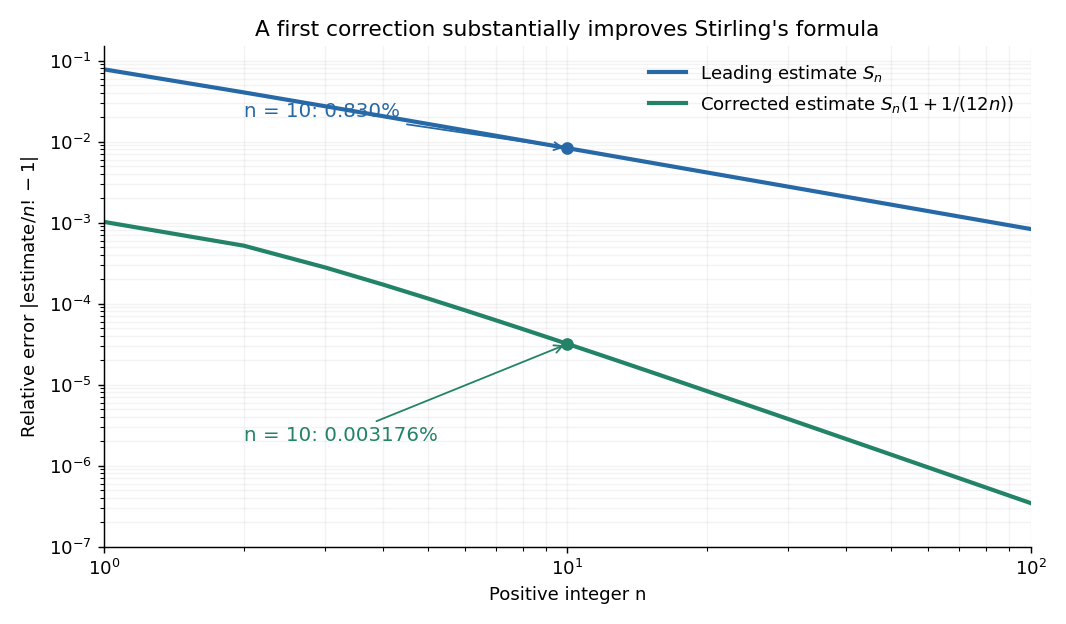
The usefulness is in ratios as well as in enormous numbers. Applying Stirling's formula to the three factorials in a central binomial coefficient givesThis counts the ways to choose exactly half of objects. Equivalently, for independent fair coin tosses, the binomial distribution assigns probability to exactly heads. An exponentially large count becomes a simple probability scale after cancellation.
For numerical calculations, taking the natural logarithm yieldswhere . Computing a logarithm of a large factorial avoids representing the factorial itself. The Robbins bounds for Stirling's formula give a finite- interval for this logarithmic remainder, rather than only a limiting statement.
The factor is beautiful because a Gaussian integral lies behind a discrete product. The Gaussian peak behind Stirling's formula displays this connection through the Gamma integral and Laplace's method. A rigorous proof must also control the tails of the integral; the local expansion explains the geometry but is not by itself a complete proof.
James Stirling published Methodus differentialis in 1730, a treatise on summation and interpolation of infinite series. This setting connects the formula with a practical calculation problem: taking logarithms turns a long product into a sum, whose growth can be approximated. [ref]
https://commons.wikimedia.org/wiki/File:Methodus_differentialis,_sive_tractatus_de_summatione_et_interpolatione_serierum_infinitarum_(IA_10053880bsb).pdf. James Stirling, Methodus differentialis (1730), digitized original and bibliographic record
For positive bases , comparison of the exponential functions and reduces to a geometric progression:If , this ratio tends to zero, so in little o notation. If , the ratio is one; if , it grows without bound.
Consequently, provided at least one coefficient is nonzero, a finite sum with distinct positive bases is asymptotically equivalent to its largest-base term whose coefficient is nonzero. For example,The relative difference against first drops below one percent at the integer . Dividing by the proposed dominant term provides an explicit error estimate, not just a comparison of two rapidly growing numbers. If several terms have the same largest base, their coefficients must first be combined; cancellation can remove that base entirely.
Diagonal subsequence for locally uniform convergence by Codex 0 Created 2026-09-24 Updated 2026-09-29
Codex 0 Created 2026-09-24 Updated 2026-09-29If successive subsequences converge uniformly on an exhaustion , the diagonal sequence converges uniformly on every fixed , hence locally uniformly on their union.
The Dehn function of a finite presentation isIt measures the worst number of relator applications needed to prove a null word of bounded length.
Pinned article: Introduction to the OurBigBook Project
Welcome to the OurBigBook Project! Our goal is to create the perfect publishing platform for STEM subjects, and get university-level students to write the best free STEM tutorials ever.
Everyone is welcome to create an account and play with the site: ourbigbook.com/go/register. We belive that students themselves can write amazing tutorials, but teachers are welcome too. You can write about anything you want, it doesn't have to be STEM or even educational. Silly test content is very welcome and you won't be penalized in any way. Just keep it legal!
Intro to OurBigBook
. Source. We have two killer features:
- topics: topics group articles by different users with the same title, e.g. here is the topic for the "Fundamental Theorem of Calculus" ourbigbook.com/go/topic/fundamental-theorem-of-calculusArticles of different users are sorted by upvote within each article page. This feature is a bit like:
- a Wikipedia where each user can have their own version of each article
- a Q&A website like Stack Overflow, where multiple people can give their views on a given topic, and the best ones are sorted by upvote. Except you don't need to wait for someone to ask first, and any topic goes, no matter how narrow or broad
This feature makes it possible for readers to find better explanations of any topic created by other writers. And it allows writers to create an explanation in a place that readers might actually find it.
Figure 1. Screenshot of the "Derivative" topic page. View it live at: ourbigbook.com/go/topic/derivativeVideo 2. OurBigBook Web topics demo. Source. - local editing: you can store all your personal knowledge base content locally in a plaintext markup format that can be edited locally and published either:This way you can be sure that even if OurBigBook.com were to go down one day (which we have no plans to do as it is quite cheap to host!), your content will still be perfectly readable as a static site.
- to OurBigBook.com to get awesome multi-user features like topics and likes
- as HTML files to a static website, which you can host yourself for free on many external providers like GitHub Pages, and remain in full control

Figure 2. You can publish local OurBigBook lightweight markup files to either OurBigBook.com or as a static website.
Figure 3. Visual Studio Code extension installation.
Figure 5. . You can also edit articles on the Web editor without installing anything locally. Video 3. Edit locally and publish demo. Source. This shows editing OurBigBook Markup and publishing it using the Visual Studio Code extension. 
- Infinitely deep tables of contents:



All our software is open source and hosted at: github.com/ourbigbook/ourbigbook
Further documentation can be found at: docs.ourbigbook.com
Feel free to reach our to us for any help or suggestions: docs.ourbigbook.com/#contact