Topics (384k) Articles (398k) Users (410) Discussions (242) Comments (383) Files (13k) New article
The distance on a connected Riemannian manifold is the infimum of the arc lengths of piecewise smooth curves joining the endpoints:It answers “how far must I travel while staying in this geometry?” The Riemannian metric measures an instantaneous tangent vector, whereas Riemannian distance is the global result of comparing complete routes.
In Euclidean space the straight segment achieves this infimum, giving . On a round sphere it gives great-circle distance, for positions with unit vectors . For and a central angle , the surface distance is , while the chord length is . On a circular cylinder, routes with different winding lead to the minimum in Riemannian distance on a circular cylinder.
The word infimum matters: a shortest route need not exist. In the Euclidean plane with the origin removed, the points and still have Riemannian distance , approached by paths detouring around an arbitrarily small circle. Every allowed route has length strictly greater than , since the only Euclidean straight segment passes through the missing point. The Hopf-Rinow theorem guarantees a minimizing geodesic between any two points when a connected Riemannian manifold is complete.
A rotation of a circular annulus through an angle is a continuous map with no fixed point. In complex coordinates it is . Since an annulus excludes the center, , and the fixed-point equation has no solution. Thus the annulus lacks the fixed-point property.
The condition is nonzero modulo a full turn: an angle such as is nonzero as a real number but gives the identity map, which fixes every point.
For two spin-one-half particles, the singlet isEvery component of the total spin annihilates it, and has eigenvalue zero.
The multivalued inverse hyperbolic sine consists of all solutions of . If is any one solution, every solution isTo see this, put in the hyperbolic sine definition. The equation becomes , whose nonzero roots are . Their product is . Thus if one root is , the other is ; all values of the complex logarithm give precisely the two displayed families.
A chosen local branch of a multivalued function is often written . Its branch points occur at , where the two quadratic roots coincide. This is a member of the inverse hyperbolic functions, rather than an inverse of the ordinary sine.[ref]
NIST Digital Library of Mathematical Functions. Section 4.37(i), general values and branch points; section 4.37(iv), logarithmic forms
The monodromy theorem says that, when analytic continuation exists throughout a domain, its ambiguity depends on homotopy. Let be a domain, , and a germ of a holomorphic function at . Assume admits analytic continuation along every continuous path in starting at . Two such paths ending at give the same terminal germ of a holomorphic function if they are homotopic with endpoints fixed in . [ref]
Here a homotopy with endpoints fixed is a continuous map satisfyingEvery intermediate path must stay in . Equality means agreement on a neighbourhood of , rather than merely equal values at . [ref]
The identity theorem provides local rigidity; the monodromy theorem shows precisely how topology controls the remaining global freedom. Deforming a route without crossing a forbidden point cannot change the resulting germ of a holomorphic function. Thus a complicated analytic continuation calculation can be replaced by one on a simpler homotopic route. Distinct homotopy classes can still give the same continuation: a rational function on its domain already gives a single-valued answer along every route, even around a pole.
Thermal stability of an accretion disk asks whether a small temperature disturbance decays while the local surface density is effectively fixed. Write net heating as ; with positive effective heat capacity, stability requires at equilibrium. A hotter patch must gain a restoring excess of cooling. The comparison belongs on the thermal timescale of an accretion disk, before slower radial redistribution changes the column. Its outcome depends on the stress and opacity prescriptions. The standard total-pressure alpha disk closure predicts instability in a radiation-supported, electron-scattering regime.[ref]
Dynamics of Astrophysical Discs by Gordon I. Ogilvie. Lecture9, section9.1: fixed-column perturbations and heating/cooling response
The magnetorotational instability allows a weak magnetic field to destabilize some differentially rotating flows that are stable to axisymmetric hydrodynamic displacements. A useful picture connects two fluid elements by magnetic tension: the inner element loses angular momentum and moves inward, while the outer element gains angular momentum and moves outward. Decreasing angular velocity amplifies their separation. This makes the instability relevant to angular momentum transport in an accretion disk.
For a local, unstratified, incompressible ideal-MHD model with vertical magnetic field , take an axisymmetric perturbation proportional to . Let and be the radial epicyclic frequency, withEliminating the horizontal velocity and magnetic perturbations givesFor a hydrodynamically stable background with , a growing root exists exactly whenIndeed, the constant term is then negative, so the quadratic in has one positive root. If the constant term is nonnegative, both roots are nonpositive: their sum is negative and their discriminant is . The vertical-field local limit follows from the original linear analysis.[ref]
A Powerful Local Shear Instability in Weakly Magnetized Disks. I. Linear Analysis by Steven A. Balbus and John F. Hawley. Sections 2.1–2.3, dispersion relation (2.9) and weak-field stability conditions
In a Keplerian disk, the unstable interval is . Maximizing the positive root gives and growth rate . Strong tension stabilizes shorter wavelengths. In a finite disk the unstable wavelengths must also fit the vertical domain; magnetic diffusivity, viscosity and nonideal magnetic coupling can modify or suppress them. Thus a negative angular-velocity gradient alone is not a universal sufficient condition for every magnetized flow. Linear growth also does not by itself specify the eventual turbulent stress.
The Shakura--Sunyaev thin disk combines a thin disk, large optical depth, efficient local radiative cooling and an alpha disk stress prescription. At each radius, orbital-energy dissipation is balanced by radiation escaping vertically. The model predicts a radial sequence of effective temperatures and therefore a broad spectrum. It is useful when vertical adjustment and cooling are faster than radial evolution; strong inward heat transport, winds or large thickness require a different approximation.[ref]
Dynamics of Astrophysical Discs by Gordon I. Ogilvie. Lecture8, section8.1: vertical energy transport and neglected radial terms
Let be real independent and identically distributed random variables with , and let be their expected value. Their sample mean satisfiesThis is almost sure convergence: with probability one, an entire infinite sequence of observations has averages that eventually stay within every prescribed positive tolerance of . The variance need not be finite. The strong law of large numbers implies the weak law of large numbers, which asserts convergence in probability at each increasing sample size.
For independent trials with a Bernoulli distribution of parameter , is one for success and zero for failure. Then is the observed success proportion, and the strong law of large numbers says almost surely. This turns a theoretical probability into a quantity one can estimate by repetition. It does not say that each new trial improves the estimate: a long string of failures can move the proportion away from before later observations bring it back.
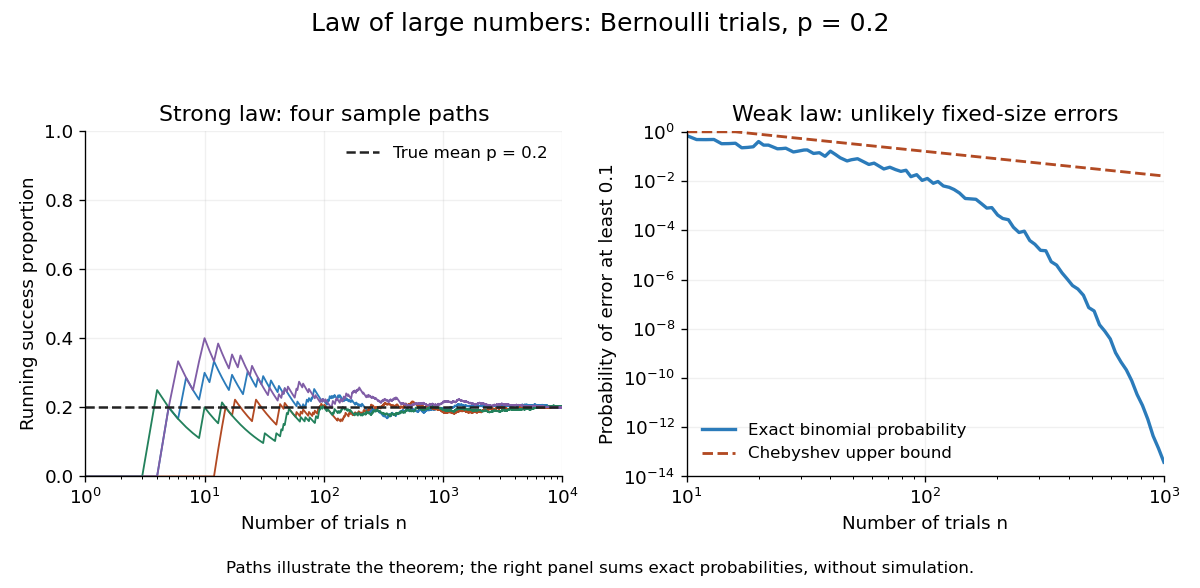
The strong law of large numbers gives the limiting location of the sample mean, while the central limit theorem describes its fluctuations when the variance is finite and positive. The two assertions can hold together:The first error shrinks to zero; the second has been enlarged enough to retain a nontrivial probability distribution. The second assertion is convergence in distribution, not a claim that the enlarged error along one sequence approaches a particular normal random variable.
The assumptions make a practical difference. If every observation repeats the same nonconstant Bernoulli random variable, , then for all : identical probability distributions alone do not make repeated observations informative. For independent observations with a Standard Cauchy distribution, the Cauchy sample mean has an unchanged distribution, so it does not concentrate around a constant. Its expected value is undefined, and ; neither example contradicts the stated strong law of large numbers.
A brief proof outline in the case of finite variance uses the Kolmogorov maximal inequality for the centered partial sums. The probability that their maximum up to exceeds is at most . These bounds are summable, so the Borel-Cantelli lemma controls all sufficiently large such blocks and hence every intermediate sample size. The general case requires truncation to control large observations; the argument using finite variance alone does not prove that full version.
random variables and are almost surely equal when . Probability theory conventionally identifies random variables that differ only on a null event.
Rational equivalence is generated by principal divisors of nonzero rational functions on integral subvarieties one dimension larger than the cycles.
Affine semidirect product of cyclic groups of orders eleven and five by  Codex 0 Created 2026-09-24 Updated 2026-11-05
Let be the subgroup of nonzero squares in . The affine mapsform the nonabelian semidirect product , with multiplication
Affine Galois group of the splitting field of x to the p minus two by Codex 0 Created 2026-09-24 Updated 2026-11-05
Codex 0 Created 2026-09-24 Updated 2026-11-05For an odd prime , the splitting fieldof has Galois groupThe translation subgroup multiplies by powers of , while the multiplicative subgroup acts on by cyclotomic automorphisms.
Irreducible components of two intersecting complex hyperbolas by Codex 0 Created 2026-09-24 Updated 2026-09-24
Codex 0 Created 2026-09-24 Updated 2026-09-24The algebraic sethas the two irreducible componentsEach is irreducible because the linear change , identifies its coordinate ring withan integral domain.
For an affine algebraic set , its coordinate ring isThe set is irreducible exactly when is an integral domain.
For an algebraic group , a flat -torsor over is a faithfully flat morphism with a right -action such that , , is an isomorphism. A Zariski torsor additionally becomes on a Zariski open cover of .
Pinned article: Introduction to the OurBigBook Project
Welcome to the OurBigBook Project! Our goal is to create the perfect publishing platform for STEM subjects, and get university-level students to write the best free STEM tutorials ever.
Everyone is welcome to create an account and play with the site: ourbigbook.com/go/register. We belive that students themselves can write amazing tutorials, but teachers are welcome too. You can write about anything you want, it doesn't have to be STEM or even educational. Silly test content is very welcome and you won't be penalized in any way. Just keep it legal!
Intro to OurBigBook
. Source. We have two killer features:
- topics: topics group articles by different users with the same title, e.g. here is the topic for the "Fundamental Theorem of Calculus" ourbigbook.com/go/topic/fundamental-theorem-of-calculusArticles of different users are sorted by upvote within each article page. This feature is a bit like:
- a Wikipedia where each user can have their own version of each article
- a Q&A website like Stack Overflow, where multiple people can give their views on a given topic, and the best ones are sorted by upvote. Except you don't need to wait for someone to ask first, and any topic goes, no matter how narrow or broad
This feature makes it possible for readers to find better explanations of any topic created by other writers. And it allows writers to create an explanation in a place that readers might actually find it.
Figure 1. Screenshot of the "Derivative" topic page. View it live at: ourbigbook.com/go/topic/derivativeVideo 2. OurBigBook Web topics demo. Source. - local editing: you can store all your personal knowledge base content locally in a plaintext markup format that can be edited locally and published either:This way you can be sure that even if OurBigBook.com were to go down one day (which we have no plans to do as it is quite cheap to host!), your content will still be perfectly readable as a static site.
- to OurBigBook.com to get awesome multi-user features like topics and likes
- as HTML files to a static website, which you can host yourself for free on many external providers like GitHub Pages, and remain in full control

Figure 2. You can publish local OurBigBook lightweight markup files to either OurBigBook.com or as a static website.
Figure 3. Visual Studio Code extension installation.
Figure 5. . You can also edit articles on the Web editor without installing anything locally. Video 3. Edit locally and publish demo. Source. This shows editing OurBigBook Markup and publishing it using the Visual Studio Code extension. 
- Infinitely deep tables of contents:



All our software is open source and hosted at: github.com/ourbigbook/ourbigbook
Further documentation can be found at: docs.ourbigbook.com
Feel free to reach our to us for any help or suggestions: docs.ourbigbook.com/#contact