Topics (384k) Articles (398k) Users (410) Discussions (242) Comments (383) Files (13k) New article

A wall displacement with spring law , combined with linear Bernoulli and kinematic condition , gives the displayed dynamic boundary condition. For a rectangular cavity of width , height , rigid remaining walls and sound speed , real vertical modes obey and . On each interval the tangent equation has a real root. As at fixed mode numbers, these branches tend to , the pressure-release upper-wall acoustic spectrum. Imaginary vertical exponents can describe additional branches and are not counted by this real-root argument.
A velocity potential obeying the wave equation with constant speed of sound has spherical normal modes , . Zero radial velocity at radii gives Neumann conditions on the potential, not on its numerator. The inner condition is built into . The outer condition gives , equivalent to the displayed equation for nonzero oscillatory modes. The formal zero root is a constant potential gauge, rather than a nonzero-frequency acoustic wave. Applying a one-dimensional sine condition to the numerator would miss the spherical geometric factors.
A search direction is the nonzero vector used in the displayed optimization update. In a line search with positive step size, its orientation matters: a descent direction has negative directional derivative of the objective function. Minimization over a full line instead permits either sign of .
Suppose is bounded below on its initial level set, continuously differentiable with a Lipschitz gradient nearby, and each descent direction uses a step satisfying fixed Wolfe conditions. If , the displayed series converges. In particular a uniform positive lower bound on these cosines gives .
For a gradient Lipschitz constant , the curvature condition gives . Sufficient decrease then gives . Summing and using the lower bound on proves the assertion.
A rectangular upper bound , , is inward pointing for the Leslie-Gower predator-prey model. To avoid the singular edge , use and the inequality , obtained by completing a square. Choose sufficiently small and . Then , , is a compact forward-invariant set in the positive quadrant. Removing an outward-flow neighborhood of a repelling equilibrium leaves a trapping region without equilibria, so the Poincaré-Bendixson theorem yields a periodic omega-limit orbit.
Time-dependent elastance models the pressure generated by a cardiac ventricle at its current stressed volume. The reference is its zero-pressure volume. The inverse of elastance is compliance at fixed time. Rising elastance increases pressure without volume change during isovolumetric contraction; an approximately constant systolic value gives compliance during a simplified ejection stage.
Return the successive accumulator values of a left fold, including the initial accumulator:
scanl f e [] = [e] and scanl f e (x:xs) = e : scanl f (f e x) xs. The th result is the fold of the first elements, proved by the fold equation. Thus the scan equals map (foldl f e) . inits, but computes updates instead of on a finite input of length . Accumulator strictness and the cost of an update remain separate from this operation count.Here the residual map may be nonlinear. Its Jacobian matrix gives and . The Gauss-Newton algorithm drops the second term to obtain an approximation using only first derivatives of the residuals. Full column rank of makes positive definite; at a zero-residual solution this approximation equals the exact Hessian.
The +2 oxidation state of lead. The actual aqueous species can depend on pH, hydrolysis and ligands; a bare ionic formula is an analytical shorthand.
For a finite nonempty collection of exact real multipliers greater than one, the multiplicative closure of one can be enumerated by a shared lazy list: emit one, then merge its elementwise multiples by all generators. Every value after one has a smaller predecessor obtained by removing one factor, proving productivity by increasing value. There are only finitely many exponent tuples below any fixed bound, because every generator is greater than one; thus locally finite sorted-stream merge eventually emits every generated value. Equal products are emitted once.
A multiplier below one contradicts increasing order starting at one. A multiplier equal to one adds no new values and should be removed from the recursive streams; an empty remaining generator collection has the finite closure consisting of one. These qualifications concern exact arithmetic: finite precision or overflow can violate the order and growth assumptions.
A polymeric osmotic laxative; 3350 denotes its approximate average molecular mass. Retention of water in the intestinal lumen accounts for its local action.[ref]
Polyethylene Glycol 3350 by MedlinePlus. Why is this medication prescribed?
The cricothyroid muscle changes the relation of the cricoid cartilage and thyroid cartilage, helping lengthen and tense the vocal folds. This contributes to pitch control during phonation. It is supplied by the external branch of the superior laryngeal nerve, a distinctive relation among intrinsic laryngeal muscles.
The caecum is a blind-ended initial region of the large intestine near the small-intestinal entry. Its size and importance in fermentation vary substantially among mammals. The modest human structure should not be assumed representative of every herbivorous digestive system.
For a maximization problem, every feasible point's finite objective is bounded above by every valid Lagrangian relaxation value. If a sequence of nonnegative multipliers makes those upper bounds tend to minus infinity, no feasible point can exist. Thus a minimization Lagrangian dual problem unbounded below certifies primal infeasibility. Finite dual value alone does not certify primal feasibility.
For conjugate exponents , the constraint set is compact, so the continuous product has a maximum. Boundary endpoints have product zero, while is feasible with product one. An interior maximum therefore satisfies the Lagrange multiplier equations and . Multiplying by and respectively gives , since the multiplier is nonzero. Substitution in the constraint makes both powers equal one. Thus the maximum is one, attained uniquely at . The boundary check and compactness are what turn the necessary multiplier equations into a global conclusion.
An integral constraint need not admit a normal Lagrange multiplier unless its first variation is nonzero. For the quadratic normalization in the title, the variation in direction has derivative , so the constraint is always regular at an admissible function. With free endpoint values this justifies the Euler-Lagrange equation for and its natural endpoint conditions. For , multiplication of the differential equation by gives .
For phases , the Kuramoto order parameter is their complex centroid on the unit circle:The triangle inequality gives . Equality requires all phase vectors to point in the same direction. When , is the complex argument of ; it is undefined at .
Zero does not specify a unique phase distribution. For example, the four phases give , while give . The first has two clusters and the second is evenly spread. A first complex moment cannot recover every detail of a distribution.
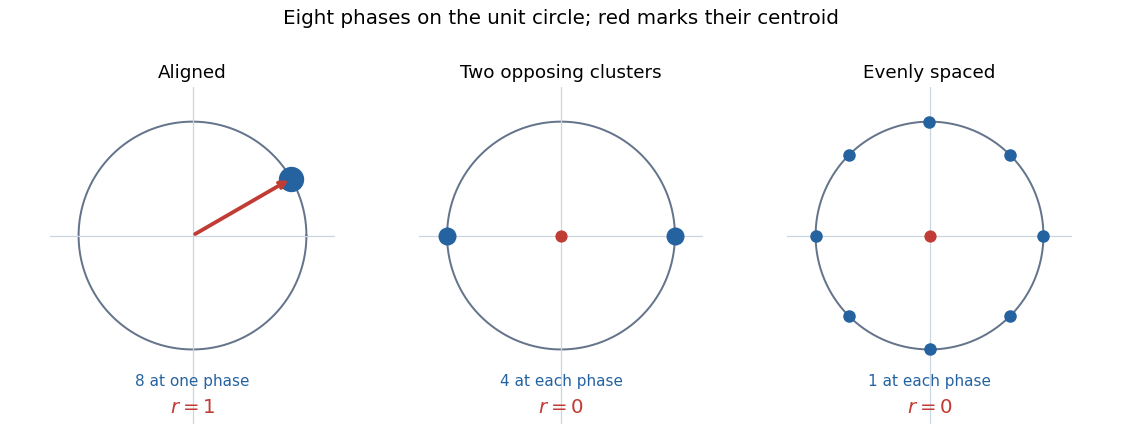
The Kuramoto order parameter distinguishes complete phase alignment but gives zero for both opposing clusters and evenly spaced phases
. Details. Multiplying by and taking the imaginary part givesThis identity rewrites all pairwise terms of the Kuramoto model using two collective real variables. It remains valid at when expressed as , without assigning a nonexistent complex argument to zero.
Pinned article: Introduction to the OurBigBook Project
Welcome to the OurBigBook Project! Our goal is to create the perfect publishing platform for STEM subjects, and get university-level students to write the best free STEM tutorials ever.
Everyone is welcome to create an account and play with the site: ourbigbook.com/go/register. We belive that students themselves can write amazing tutorials, but teachers are welcome too. You can write about anything you want, it doesn't have to be STEM or even educational. Silly test content is very welcome and you won't be penalized in any way. Just keep it legal!
Intro to OurBigBook
. Source. We have two killer features:
- topics: topics group articles by different users with the same title, e.g. here is the topic for the "Fundamental Theorem of Calculus" ourbigbook.com/go/topic/fundamental-theorem-of-calculusArticles of different users are sorted by upvote within each article page. This feature is a bit like:
- a Wikipedia where each user can have their own version of each article
- a Q&A website like Stack Overflow, where multiple people can give their views on a given topic, and the best ones are sorted by upvote. Except you don't need to wait for someone to ask first, and any topic goes, no matter how narrow or broad
This feature makes it possible for readers to find better explanations of any topic created by other writers. And it allows writers to create an explanation in a place that readers might actually find it.
Figure 1. Screenshot of the "Derivative" topic page. View it live at: ourbigbook.com/go/topic/derivativeVideo 2. OurBigBook Web topics demo. Source. - local editing: you can store all your personal knowledge base content locally in a plaintext markup format that can be edited locally and published either:This way you can be sure that even if OurBigBook.com were to go down one day (which we have no plans to do as it is quite cheap to host!), your content will still be perfectly readable as a static site.
- to OurBigBook.com to get awesome multi-user features like topics and likes
- as HTML files to a static website, which you can host yourself for free on many external providers like GitHub Pages, and remain in full control

Figure 2. You can publish local OurBigBook lightweight markup files to either OurBigBook.com or as a static website.
Figure 3. Visual Studio Code extension installation.
Figure 5. . You can also edit articles on the Web editor without installing anything locally. Video 3. Edit locally and publish demo. Source. This shows editing OurBigBook Markup and publishing it using the Visual Studio Code extension. 
- Infinitely deep tables of contents:



All our software is open source and hosted at: github.com/ourbigbook/ourbigbook
Further documentation can be found at: docs.ourbigbook.com
Feel free to reach our to us for any help or suggestions: docs.ourbigbook.com/#contact