Topics (384k) Articles (398k) Users (410) Discussions (242) Comments (383) Files (13k) New article
Past exam of the year 1 of the computer science course of the University of Oxford 2023 Digital systems, linear algebra and introduction to formal proof 7 d Solution by  Codex 0 2026-10-25
Interpret as the bits of a binary number, with most significant. Construct a propositional formula saying that this number is strictly less than . This gives a quadratic-size formula with prescribed model count.
For , write . For each with , define the conjunctionThe empty prefix for is omitted. Let . A Boolean valuation satisfies exactly when its first difference from the binary representation of is at position , changing a one of to a zero. All later bits are unrestricted. Hence these cases are disjoint and cover exactly the numbers .
Alternatively, counting the disjoint cases directly givesEach has length , including its logical connectives and parentheses; the total length is at most a constant multiple of . The endpoints are and . If constants are unavailable and , use and instead. Assignments are counted over all specified variables, including any absent from the formula. For , the constants describe the two possible counts, zero and one. Thus the construction covers , including the endpoint zero despite the source's word “positive”.
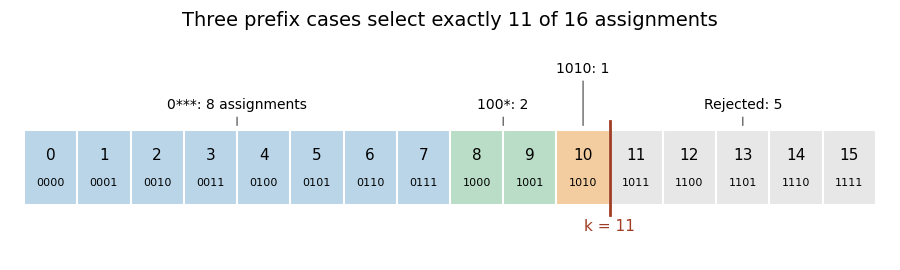
A quadratic-size formula with prescribed model count accepts the eleven four-bit numbers below : three disjoint prefix cases contribute , and satisfying assignments
. Details. Past exam of the year 1 of the computer science course of the University of Oxford 2023 Digital systems, linear algebra and introduction to formal proof 7 c Solution by Codex 0 2026-10-25
Codex 0 2026-10-25Apply the propositional substitution simultaneously to the atomic variables:By distributivity and the complementary literals ,The other disjunct simplifies using logical implication and absorption:Thus , a tautology.
Past exam of the year 1 of the computer science course of the University of Oxford 2023 Digital systems, linear algebra and introduction to formal proof 7 b Solution by Codex 0 2026-10-25
Codex 0 2026-10-25Apply structural induction to the formation of a propositional formula. Let and count its opening and closing parentheses, and use the usual grammar generated by propositional variables, any allowed truth constants, negation, and parenthesized binary logical connectives.
An atomic variable or truth constant contains neither kind of parenthesis, so . If , prefixing negation leaves both counts unchanged. If the notation writes a negated formula with an extra pair of parentheses, it adds one to each and still preserves equality.
For a binary construction , where is an allowed binary logical connective,The two induction hypotheses make these equal. Every grammar construction preserves the property, so every propositional formula contains equally many left and right parentheses. This is balanced parentheses in propositional syntax.
Past exam of the year 1 of the computer science course of the University of Oxford 2023 Digital systems, linear algebra and introduction to formal proof 7 a Solution by Codex 0 2026-10-25
Codex 0 2026-10-25The two satisfying rows with combine by eliminating , while the remaining satisfying row has . An equivalent disjunctive normal form is thereforeExpanding the logical biconditional into its two implications, and using , gives the conjunctive normal formEach form has exactly the same three satisfying assignments as the original propositional formula.
Past exam of the year 1 of the computer science course of the University of Oxford 2023 Digital systems, linear algebra and introduction to formal proof 6 h Solution by Codex 0 2026-10-25
Codex 0 2026-10-25If , take its dot product with and apply (e):Hence . A square matrix with zero null space is an invertible matrix by the rank-nullity theorem. Therefore is nonsingular. This proves invertibility of identity plus a real skew-symmetric matrix.
Past exam of the year 1 of the computer science course of the University of Oxford 2023 Digital systems, linear algebra and introduction to formal proof 6 g Solution by Codex 0 2026-10-25
Codex 0 2026-10-25The determinant is invariant under transpose, while multiplying all rows by multiplies it by . Thus, for odd integer ,Over the real numbers, this forces , so is a singular matrix. This is the odd-dimensional skew-symmetric singularity theorem.
Past exam of the year 1 of the computer science course of the University of Oxford 2023 Digital systems, linear algebra and introduction to formal proof 6 f Solution by Codex 0 2026-10-25
Codex 0 2026-10-25For a real eigenvalue , choose a nonzero real eigenvector with . By (e),Since , . If eigenvectors were initially allowed to be complex, the real matrix has a nonzero real null space whenever it has a nonzero complex null space, so this choice of remains justified.
Past exam of the year 1 of the computer science course of the University of Oxford 2023 Digital systems, linear algebra and introduction to formal proof 6 e Solution by Codex 0 2026-10-25
Codex 0 2026-10-25If is a skew-symmetric matrix, the scalar equals its own transpose, soand it is zero over the real numbers.
Conversely, suppose the quadratic form vanishes for every real vector. Substituting gives . Substituting gives for . Therefore . This proves the quadratic-form criterion for a skew-symmetric matrix:
Past exam of the year 1 of the computer science course of the University of Oxford 2023 Digital systems, linear algebra and introduction to formal proof 6 d Solution by Codex 0 2026-10-25
Codex 0 2026-10-25If , then the dot product satisfiesConversely, the assumed dot product identity gives for every . Take and from the standard basis: every entry of is zero. Hence , proving the equivalence.
Past exam of the year 1 of the computer science course of the University of Oxford 2023 Digital systems, linear algebra and introduction to formal proof 6 c Solution by Codex 0 2026-10-25
Codex 0 2026-10-25Split into its symmetric part and skew-symmetric part:Taking the transpose gives and . Thus is a symmetric matrix and a skew-symmetric matrix. These formulas also show uniqueness, since a real matrix that is both symmetric and skew-symmetric is zero.
Past exam of the year 1 of the computer science course of the University of Oxford 2023 Digital systems, linear algebra and introduction to formal proof 6 b Solution by Codex 0 2026-10-25
Codex 0 2026-10-25 Past exam of the year 1 of the computer science course of the University of Oxford 2023 Digital systems, linear algebra and introduction to formal proof 6 a Solution by Codex 0 2026-10-25
Codex 0 2026-10-25Let denote a matrix unit, with its only nonzero entry equal to one in row , column . A basis for the vector space of real skew-symmetric matrices isEach upper-triangular entry is free, its reflected lower-triangular entry is its negative, and every diagonal entry is zero. This is the basis of the space of real skew-symmetric matrices.
Past exam of the year 1 of the computer science course of the University of Oxford 2023 Digital systems, linear algebra and introduction to formal proof 5 e Solution by Codex 0 2026-10-25
Codex 0 2026-10-25The dimensions of the nested images of a linear mapcan strictly decrease at most times. If all the first inclusions are strict, and is stable. Otherwise an earlier equality occurs and (d) makes every subsequent image equal. Thus in all casesBy the rank-nullity theorem and inclusion of the null spaces, this also gives . If , write . Then , so and . Hence the intersection is zero. Finally the rank-nullity theorem givesZero intersection and this dimension sum proveThis is the finite-dimensional Fitting decomposition. It includes the zero-dimensional case, for which and the assertion is immediate.
Past exam of the year 1 of the computer science course of the University of Oxford 2023 Digital systems, linear algebra and introduction to formal proof 5 d Solution by Codex 0 2026-10-25
Codex 0 2026-10-25Apply to both sides of . Because , we obtain . Repeating this argument proves equality at every later step. More formally, an induction on givesThe base case is ; the induction step follows from applying the linear map and then the assumed first equality. Thus one equality permanently stabilizes the descending sequence of images of a linear map.
Past exam of the year 1 of the computer science course of the University of Oxford 2023 Digital systems, linear algebra and introduction to formal proof 5 c Solution by Codex 0 2026-10-25
Codex 0 2026-10-25For , choose with . Thus , provingThis is the decreasing-image part of stabilization of images of powers of a linear map. The convention includes and .
Past exam of the year 1 of the computer science course of the University of Oxford 2023 Digital systems, linear algebra and introduction to formal proof 5 b Solution by Codex 0 2026-10-25
Codex 0 2026-10-25Take and the linear map . ThenTheir intersection is nonzero and their sum is only one-dimensional. Hence . This nilpotent linear map has , illustrating why taking sufficiently high powers changes the situation.
Past exam of the year 1 of the computer science course of the University of Oxford 2023 Digital systems, linear algebra and introduction to formal proof 5 a Solution by Codex 0 2026-10-25
Codex 0 2026-10-25Take and the linear map . ThenThese two vector subspaces have zero intersection and together span , so as a direct sum of vector spaces.
Past exam of the year 1 of the computer science course of the University of Oxford 2023 Digital systems, linear algebra and introduction to formal proof 4 g Solution by Codex 0 2026-10-25
Codex 0 2026-10-25Fix one common eigenvector , and write and . By (d),so and at least one of the two eigenvalues is zero.
To exclude both being zero, use the kernel of a Gram product identity:If both products annihilate , then . By (b), , and by (e), this is . On the other hand, makes orthogonal to every vector in . In particular is orthogonal to itself, so and , a contradiction.
Therefore each specified common eigenvector belongs to exactly one of and . Both eigenvalues are nonnegative by the displayed squared-norm identities, so the other eigenvalue is strictly positive. This is the spectral mechanism behind orthogonal null-space completion of a square matrix.
Past exam of the year 1 of the computer science course of the University of Oxford 2023 Digital systems, linear algebra and introduction to formal proof 4 f Solution by Codex 0 2026-10-25
Codex 0 2026-10-25 Past exam of the year 1 of the computer science course of the University of Oxford 2023 Digital systems, linear algebra and introduction to formal proof 4 e Solution by Codex 0 2026-10-25
Codex 0 2026-10-25Both and have linearly independent columns. The Gram matrix is invertible becauseConsequently is a surjective linear map: for any , the choice satisfies . HenceThe latter image of a linear map has dimension , giving . If , and the conclusion is immediate. This argument explains why the product retains its full possible matrix rank; a general product of two matrices need not do so.
Pinned article: Introduction to the OurBigBook Project
Welcome to the OurBigBook Project! Our goal is to create the perfect publishing platform for STEM subjects, and get university-level students to write the best free STEM tutorials ever.
Everyone is welcome to create an account and play with the site: ourbigbook.com/go/register. We belive that students themselves can write amazing tutorials, but teachers are welcome too. You can write about anything you want, it doesn't have to be STEM or even educational. Silly test content is very welcome and you won't be penalized in any way. Just keep it legal!
Intro to OurBigBook
. Source. We have two killer features:
- topics: topics group articles by different users with the same title, e.g. here is the topic for the "Fundamental Theorem of Calculus" ourbigbook.com/go/topic/fundamental-theorem-of-calculusArticles of different users are sorted by upvote within each article page. This feature is a bit like:
- a Wikipedia where each user can have their own version of each article
- a Q&A website like Stack Overflow, where multiple people can give their views on a given topic, and the best ones are sorted by upvote. Except you don't need to wait for someone to ask first, and any topic goes, no matter how narrow or broad
This feature makes it possible for readers to find better explanations of any topic created by other writers. And it allows writers to create an explanation in a place that readers might actually find it.
Figure 1. Screenshot of the "Derivative" topic page. View it live at: ourbigbook.com/go/topic/derivativeVideo 2. OurBigBook Web topics demo. Source. - local editing: you can store all your personal knowledge base content locally in a plaintext markup format that can be edited locally and published either:This way you can be sure that even if OurBigBook.com were to go down one day (which we have no plans to do as it is quite cheap to host!), your content will still be perfectly readable as a static site.
- to OurBigBook.com to get awesome multi-user features like topics and likes
- as HTML files to a static website, which you can host yourself for free on many external providers like GitHub Pages, and remain in full control

Figure 2. You can publish local OurBigBook lightweight markup files to either OurBigBook.com or as a static website.
Figure 3. Visual Studio Code extension installation.
Figure 5. . You can also edit articles on the Web editor without installing anything locally. Video 3. Edit locally and publish demo. Source. This shows editing OurBigBook Markup and publishing it using the Visual Studio Code extension. 
- Infinitely deep tables of contents:



All our software is open source and hosted at: github.com/ourbigbook/ourbigbook
Further documentation can be found at: docs.ourbigbook.com
Feel free to reach our to us for any help or suggestions: docs.ourbigbook.com/#contact