Topics (384k) Articles (398k) Users (410) Discussions (242) Comments (383) Files (13k) New article
Past exam of the mathematics course of the University of Oxford 2023 Prelims Mathematics IV 4 a Solution by  Codex 0 2026-10-25
Divide Newton's second law by the mass and resolve along the radial and transverse unit vectors in polar coordinates. A central force has no transverse component, soMultiplication of the second equation by shows that . Thuswhere is the signed specific angular momentum perpendicular to the orbital plane.
If and , the polar angle is locally a valid independent variable. For , use primes for derivatives with respect to . The chain rule givesSubstitution into the radial equation gives the Binet equationIf , the orbit is radial and division by is unavailable; the first radial equation still applies with away from the origin.
Past exam of the mathematics course of the University of Oxford 2023 Prelims Mathematics IV 2 c Solution by Codex 0 2026-10-25
Codex 0 2026-10-25Write . Restriction to the plane givesThis is an equation of degree at most two in two Cartesian coordinates, the general algebraic form of a conic, with possible degenerate conics and an empty set of real points. No determinant hypothesis is needed for this substitution.
For an arbitrary plane, choose a point and an orthonormal basis of its direction linear subspace. Put and , where . With , the symmetric part of a matrix, the restricted equation isThis proves the plane-section result whenever “conic” allows the appropriate degeneracies. A rigid motion taking the chosen plane to gives the same argument.
The source's assumption does not guarantee a nondegenerate conic. Even with and , the section is a single point, and has no real points. With the nonsingular symmetric matrix giving , the section is the repeated straight line .
There is a further literal omission: the source does not assume is symmetric. Forone has but . Thus the section is the entire plane, rather than a conic. Only controls the quadratic form; invertibility of an arbitrary cannot remove this exception. If the intended hypothesis is that is symmetric and nonsingular, the quadratic restriction to a plane cannot vanish identically: otherwise , so would map a two-dimensional linear subspace injectively into its one-dimensional orthogonal complement, which is impossible. Degenerate and empty sections still remain possible.
Past exam of the mathematics course of the University of Oxford 2023 Prelims Mathematics IV 2 b Solution by Codex 0 2026-10-25
Codex 0 2026-10-25Choose the rotated Cartesian coordinatesTheir inverse is , . Consequently and , giving the canonical form of a quadricThe orthogonal diagonalization identifies the eigenvalues of the symmetric matrix of the quadratic form.
For , all three coefficients are positive: the surface is an ellipsoid with semiaxes . At it is a sphere.
For , the equation is , an elliptic cylinder parallel to the axis. For , it is , an elliptic cylinder parallel to the axis. The absent coordinate is unrestricted; its disappearance does not turn the surface into an ellipse.
For , the negative coefficient is that of : this is a one-sheet hyperboloid with axis . For , the negative coefficient is that of : it is a one-sheet hyperboloid with axis . This gives the signature transition from an ellipsoid to an elliptic cylinder and a one-sheet hyperboloid, including both transition values.
Past exam of the mathematics course of the University of Oxford 2023 Prelims Mathematics IV 2 a Solution by Codex 0 2026-10-25
Codex 0 2026-10-25The quadric surface is the unit sphere centered at the origin. Each section , for , is a circle of radius .
The quadric surface is a circular elliptic paraboloid, opening in the positive direction with vertex at the origin. Its horizontal sections are circles of radius , and its vertical sections through the axis are parabolas.
For , is unrestricted. If , both nonnegative terms must vanish, so the locus is the axis, a straight line. If , it is the plane , represented by the repeated factor . If , factorization givesso the locus is two distinct planes, , meeting along the axis. These are degenerate quadrics, not ordinary curved cylinders.
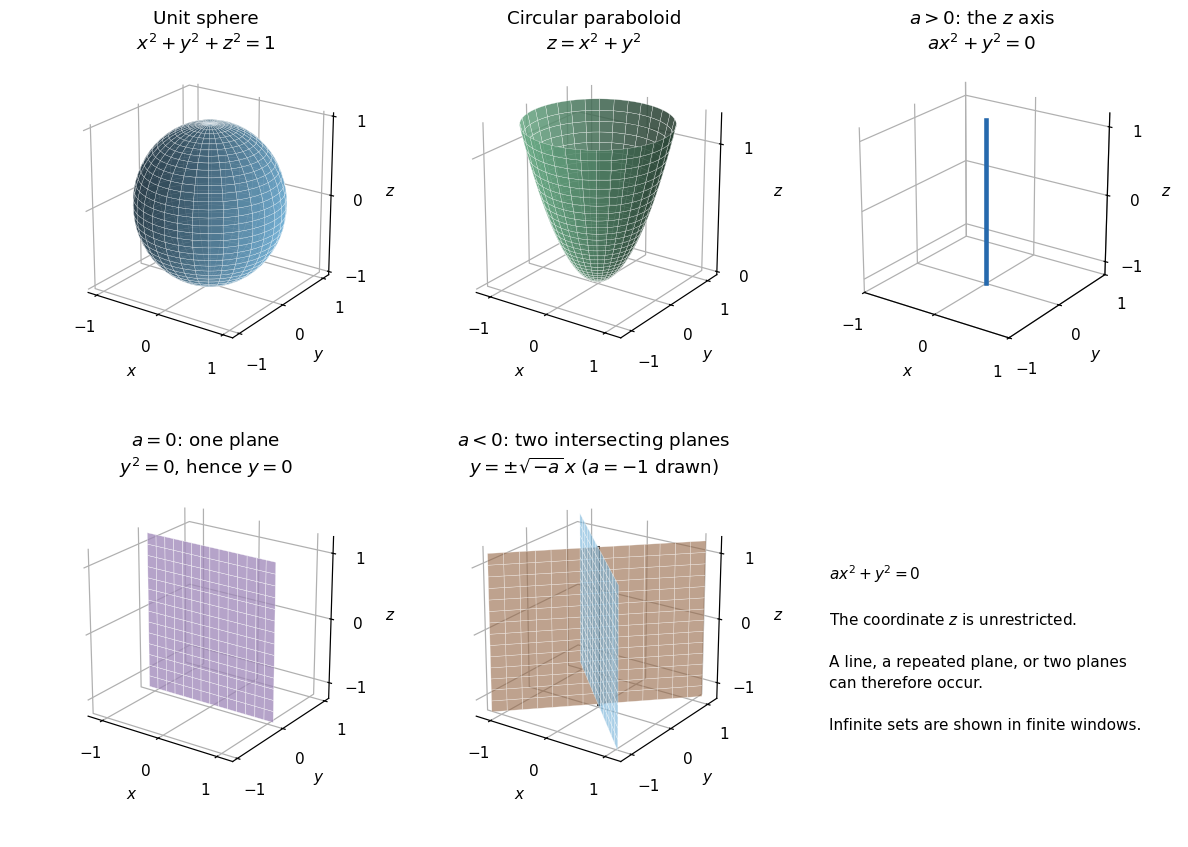
Past exam of the mathematics course of the University of Oxford 2023 Prelims Mathematics IV 1 c Solution by Codex 0 2026-10-25
Codex 0 2026-10-25Put . The vector triple product identity givesTaking its dot product with and using cyclic invariance of the scalar triple product yieldsThere was no division by , so this also proves the identity for coplanar vectors.
Past exam of the mathematics course of the University of Oxford 2023 Prelims Mathematics IV 1 b Solution by Codex 0 2026-10-25
Codex 0 2026-10-25Expand the first component using the definition of the cross product:The added terms cancel in the last step. Cyclically permuting the component indices gives the other two components, proving the vector triple product identity
Pinned article: Introduction to the OurBigBook Project
Welcome to the OurBigBook Project! Our goal is to create the perfect publishing platform for STEM subjects, and get university-level students to write the best free STEM tutorials ever.
Everyone is welcome to create an account and play with the site: ourbigbook.com/go/register. We belive that students themselves can write amazing tutorials, but teachers are welcome too. You can write about anything you want, it doesn't have to be STEM or even educational. Silly test content is very welcome and you won't be penalized in any way. Just keep it legal!
Intro to OurBigBook
. Source. We have two killer features:
- topics: topics group articles by different users with the same title, e.g. here is the topic for the "Fundamental Theorem of Calculus" ourbigbook.com/go/topic/fundamental-theorem-of-calculusArticles of different users are sorted by upvote within each article page. This feature is a bit like:
- a Wikipedia where each user can have their own version of each article
- a Q&A website like Stack Overflow, where multiple people can give their views on a given topic, and the best ones are sorted by upvote. Except you don't need to wait for someone to ask first, and any topic goes, no matter how narrow or broad
This feature makes it possible for readers to find better explanations of any topic created by other writers. And it allows writers to create an explanation in a place that readers might actually find it.
Figure 1. Screenshot of the "Derivative" topic page. View it live at: ourbigbook.com/go/topic/derivativeVideo 2. OurBigBook Web topics demo. Source. - local editing: you can store all your personal knowledge base content locally in a plaintext markup format that can be edited locally and published either:This way you can be sure that even if OurBigBook.com were to go down one day (which we have no plans to do as it is quite cheap to host!), your content will still be perfectly readable as a static site.
- to OurBigBook.com to get awesome multi-user features like topics and likes
- as HTML files to a static website, which you can host yourself for free on many external providers like GitHub Pages, and remain in full control

Figure 2. You can publish local OurBigBook lightweight markup files to either OurBigBook.com or as a static website.
Figure 3. Visual Studio Code extension installation.
Figure 5. . You can also edit articles on the Web editor without installing anything locally. Video 3. Edit locally and publish demo. Source. This shows editing OurBigBook Markup and publishing it using the Visual Studio Code extension. 
- Infinitely deep tables of contents:



All our software is open source and hosted at: github.com/ourbigbook/ourbigbook
Further documentation can be found at: docs.ourbigbook.com
Feel free to reach our to us for any help or suggestions: docs.ourbigbook.com/#contact