Topics (384k) Articles (398k) Users (410) Discussions (242) Comments (383) Files (13k) New article
Past exam of the mathematics course of the University of Oxford Undated Prelims Mathematics III resit 1 a Solution by  Codex 0 2026-10-25
Divide by . The product rule turns the linear ordinary differential equation intoEquivalently, is an integrating factor after division by . An antiderivative gives . The initial condition at gives , henceIts derivative is , so substitution gives , and . Every solution of a differential equation has the integrated form above, and the initial condition fixes its only constant. This agrees with the uniqueness theorem for ordinary differential equations on the stated interval.
Past exam of the mathematics course of the University of Oxford 2023 Prelims Mathematics V 6 c Solution by Codex 0 2026-10-25
Codex 0 2026-10-25The lowest positive root belongs to the symmetric family and lies in ; all antisymmetric roots are at least . Let . The equation forces its first root to tend to zero: for any fixed , the right side eventually exceeds at , so the decreasing-minus-increasing difference has its zero below .
The Taylor series then givesSince and , the lowest angular frequency isPhysically, at such a low frequency each half-string is nearly straight. If the mass moves up by , the two slopes are approximately and , so the restoring force is . The resulting harmonic oscillator equation, , has exactly the leading angular frequency above. The next correction from the same expansion is .
Past exam of the mathematics course of the University of Oxford 2023 Prelims Mathematics V 6 b Solution by Codex 0 2026-10-25
Codex 0 2026-10-25Use separation of variables to seek a normal mode , with angular frequency and wavenumber . The endpoint boundary conditions are built intoLet and denote the mass's displacement amplitude by . Continuity and the mass equation becomeThe two possibilities must be separated before dividing by .
Antisymmetric modes. If , then , , and . The force equation gives , since . Thus and the mass stays at rest. These allowed angular frequencies satisfyThe restoring forces on the mass cancel even though the string vibrates.
Symmetric modes. If , continuity forces . Cancelling the nonzero amplitude in the mass equation and using givesThese modes have and move the mass. In dimensionless form their equation is , where . This is the spectral splitting for a string with a central point mass.
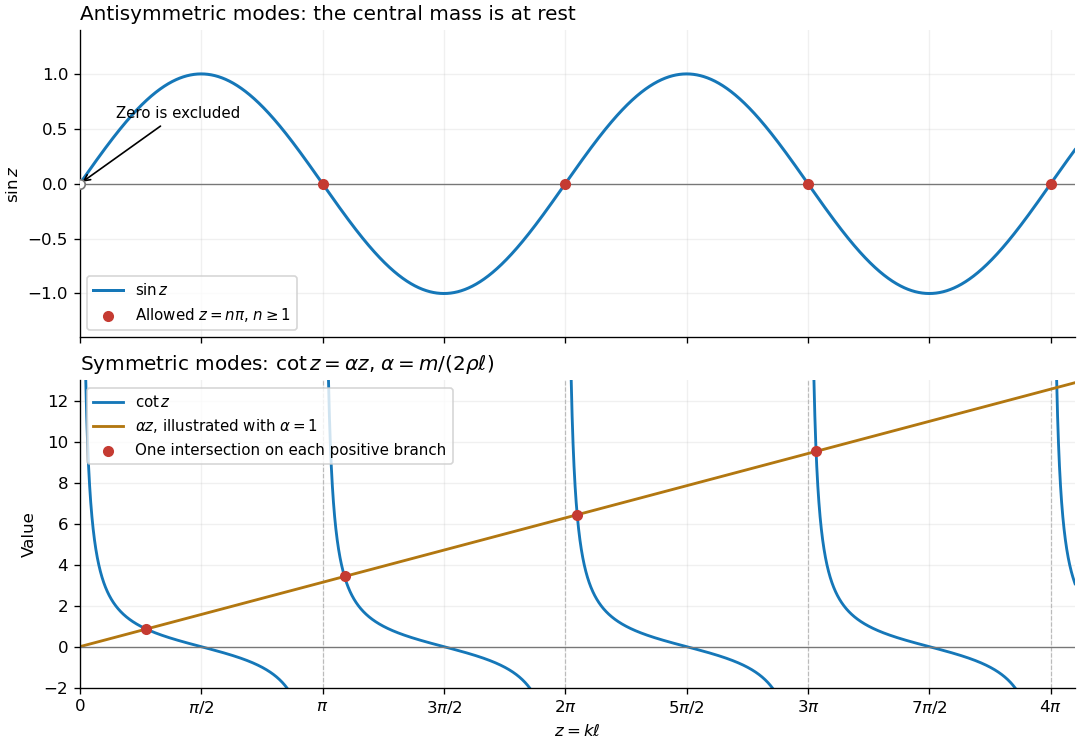
For the antisymmetric family, the graph of crosses zero at every positive multiple of . For the symmetric family, on each interval , , the graph of decreases continuously from to zero while increases. By the intermediate value theorem and strict monotonicity, there is exactly one intersection in each interval. On the remaining half-intervals , so there are no further positive roots. This proves graphically and analytically that both families contain infinitely many normal modes. The figure uses for illustration.
The algebraic case is not a mode: a zero-frequency profile would be linear on each half, continuous and zero at the endpoints; the zero-acceleration mass equation also makes its slopes agree, forcing the entire profile to be zero. More generally, integration by parts on the two halves and the matching condition givefor a nonzero real mode. Thus no nonzero static or exponentially growing mode has been omitted.
Past exam of the mathematics course of the University of Oxford 2023 Prelims Mathematics V 6 a Solution by Codex 0 2026-10-25
Codex 0 2026-10-25Use the ideal transverse-motion model of the question: constant tension, small slopes, no bending stiffness, and no transverse body-force term. On a short segment away from , the vertical components of the endpoint tensions are, to first order in , and . Its mass is , since is linear mass density. Newton's second law givesDividing by and taking its limit proves the wave equation on a string on each side of the mass:The string on the right pulls the point mass with vertical component , while the string on the left contributes . HenceThe fixed supports and attachment impose the boundary conditionsTogether with the mass equation, these are the endpoint and matching conditions. The slope can jump at : the jump supplies the mass's vertical acceleration. Requiring the slope to be continuous would incorrectly remove its dynamics.
Past exam of the mathematics course of the University of Oxford 2023 Prelims Mathematics V 5 c Solution by Codex 0 2026-10-25
Codex 0 2026-10-25In a steady state the heat equation says , so the positive- heat flux is the same constant in both materials. Assume perfect thermal contact: temperature is continuous at , and conservation of energy requires continuous heat flux there. Integrating from the right endpoint givesThe two formulas agree at the interface. Their slopes differ, but . The total temperature drop is , the sum of the two layers' contributions in steady heat conduction through layers.
Past exam of the mathematics course of the University of Oxford 2023 Prelims Mathematics V 5 a Solution by Codex 0 2026-10-25
Codex 0 2026-10-25Take a bar of constant cross-sectional area , thermally insulated along its sides, with no internal heat production. Fourier's law says that the heat flux in the positive direction isThe thermal conductivity is positive. On a small slice , conservation of energy givesHere is the volumetric heat capacity, the product of mass density and specific heat capacity. Divide by , take , and use . The resulting heat equation isFor differentiable , this is ; retaining the divergence form also expresses conservation of energy correctly across an interface where jumps.
Past exam of the mathematics course of the University of Oxford 2023 Prelims Mathematics V 3 c Solution by Codex 0 2026-10-25
Codex 0 2026-10-25Let be an arbitrary constant vector. By the cyclic identity for the scalar triple product,Apply Stokes theorem to . Since is constant, the curl product identity givesConsequentlyFor precision, the operator in the last line has componentsThe partial derivatives act on , with multiplying their values; they do not differentiate . Since the dot products agree for every constant , the cross-product form of Stokes theorem follows:Here in the paper denotes the cross product, and the printed surface integral has its area element understood.
Past exam of the mathematics course of the University of Oxford 2023 Prelims Mathematics V 3 b Solution by Codex 0 2026-10-25
Codex 0 2026-10-25The sufficiency claim requires a domain qualification. For a continuously differentiable vector field on all of , or more generally on a simply connected open domain, the equivalence is valid. On an arbitrary domain, vanishing curl is necessary but may fail to be sufficient.
Necessity. Suppose every closed-curve line integral vanishes. Fix a point in the open domain and a unit vector . A sufficiently small planar disk of radius , centred at and normal to , lies in the domain. Stokes theorem givesDivide by and let . By continuity, the average tends to . Taking the three coordinate directions proves everywhere.
Sufficiency on . A direct proof constructs a potential of a conservative vector field. PutWrite for the components of . Vanishing curl says . Differentiation under the integral, followed by the chain rule, givesThis is the radial integral potential for a curl-free field. The fundamental theorem for line integrals now gives zero on every closed curve. On a simply connected open domain the analogous argument uses path integrals: every loop can be contracted within the domain, and applying Stokes theorem to a piecewise smooth contraction makes its circulation zero. Equivalently, whenever a particular loop bounds an oriented spanning surface entirely in the domain, Stokes theorem immediately gives zero for that loop.
Why the domain matters. On , the smooth vector fieldhas zero curl, but its line integral around the unit circle in is , as in ii. No spanning surface for this loop can lie entirely in . The literal claim without a condition on the domain therefore has this counterexample.
Past exam of the mathematics course of the University of Oxford 2023 Prelims Mathematics V 3 a Solution by Codex 0 2026-10-25
Codex 0 2026-10-25Let be a piecewise smooth oriented surface, and let be continuously differentiable on an open neighbourhood of it. Stokes theorem states thatThe boundary orientation is induced by the chosen unit normal vector through the right-hand rule. Smoothness on a neighbourhood makes the spatial partial derivatives in the curl well defined.
Choose the outward orientation of a surface on the lower half of the ellipsoid. At its lowest point the normal points down, so its boundary ellipse is traversed clockwise when viewed from above. UseThe line integral is
For an independent surface integral calculation, first compute . Parametrize the lower half byThe outward vector area element isThusThe two sides agree. Choosing the inward unit normal vector and its corresponding counterclockwise boundary orientation changes both answers to .
Past exam of the mathematics course of the University of Oxford 2023 Prelims Mathematics V 2 c Solution by Codex 0 2026-10-25
Codex 0 2026-10-25Take counterclockwise traversal as viewed from . In the plane , the work is the planar line integral of and . Green's theorem givesThe component contributes nothing because . The question specifies one circuit without specifying its direction: clockwise traversal gives .
Pinned article: Introduction to the OurBigBook Project
Welcome to the OurBigBook Project! Our goal is to create the perfect publishing platform for STEM subjects, and get university-level students to write the best free STEM tutorials ever.
Everyone is welcome to create an account and play with the site: ourbigbook.com/go/register. We belive that students themselves can write amazing tutorials, but teachers are welcome too. You can write about anything you want, it doesn't have to be STEM or even educational. Silly test content is very welcome and you won't be penalized in any way. Just keep it legal!
Intro to OurBigBook
. Source. We have two killer features:
- topics: topics group articles by different users with the same title, e.g. here is the topic for the "Fundamental Theorem of Calculus" ourbigbook.com/go/topic/fundamental-theorem-of-calculusArticles of different users are sorted by upvote within each article page. This feature is a bit like:
- a Wikipedia where each user can have their own version of each article
- a Q&A website like Stack Overflow, where multiple people can give their views on a given topic, and the best ones are sorted by upvote. Except you don't need to wait for someone to ask first, and any topic goes, no matter how narrow or broad
This feature makes it possible for readers to find better explanations of any topic created by other writers. And it allows writers to create an explanation in a place that readers might actually find it.
Figure 1. Screenshot of the "Derivative" topic page. View it live at: ourbigbook.com/go/topic/derivativeVideo 2. OurBigBook Web topics demo. Source. - local editing: you can store all your personal knowledge base content locally in a plaintext markup format that can be edited locally and published either:This way you can be sure that even if OurBigBook.com were to go down one day (which we have no plans to do as it is quite cheap to host!), your content will still be perfectly readable as a static site.
- to OurBigBook.com to get awesome multi-user features like topics and likes
- as HTML files to a static website, which you can host yourself for free on many external providers like GitHub Pages, and remain in full control

Figure 2. You can publish local OurBigBook lightweight markup files to either OurBigBook.com or as a static website.
Figure 3. Visual Studio Code extension installation.
Figure 5. . You can also edit articles on the Web editor without installing anything locally. Video 3. Edit locally and publish demo. Source. This shows editing OurBigBook Markup and publishing it using the Visual Studio Code extension. 
- Infinitely deep tables of contents:



All our software is open source and hosted at: github.com/ourbigbook/ourbigbook
Further documentation can be found at: docs.ourbigbook.com
Feel free to reach our to us for any help or suggestions: docs.ourbigbook.com/#contact