Topics (384k) Articles (398k) Users (410) Discussions (242) Comments (383) Files (13k) New article

The synaptonemal complex is an organized protein scaffold assembled between aligned homologous chromosomes during Prophase I of meiosis. Two lateral elements run along the homologues, and transverse components connect them through a central region. Its zipper-like appearance makes chromosome synapsis visible, but the structure itself is not a completed exchange of DNA.
Yeast mutants lacking functional Zip1 helped separate these events. Homologues could pair, yet normal synaptonemal complex assembly failed and meiotic progression was disrupted. The comparison distinguishes initial recognition and alignment from construction of the full scaffold.[ref]
ZIP1 is a synaptonemal complex protein required for meiotic chromosome synapsis by M. Sym and others. 1993, abstract: pairing, defective complex formation and meiotic arrest
This is why a microscopy image showing nearby chromosomes should not automatically be interpreted as evidence for a completed crossing over.22R-Hydroxycholesterol is a cholesterol derivative bearing an additional hydroxyl group at carbon 22, with configuration at that position. Its neutral molecular formula is . The stereochemical qualifier identifies a spatial arrangement, while the number 22 identifies the modified carbon.[ref]
It is the first intermediate in the three-step reaction sequence of the cholesterol side-chain cleavage enzyme. A second hydroxylation precedes cleavage into pregnenolone and 4-Methylpentanal.[ref]
Atom counting separates addition of oxygen from loss of carbon. Relative to cholesterol's , the intermediate gains one oxygen without changing the carbon count. Hydroxylating a carbon–hydrogen position replaces C–H by C–OH; it does not necessarily add an extra net hydrogen to the molecular formula.
A 2011 X-ray crystallography study observed the intermediate bound to the enzyme, with its hydroxyl oxygen from the haem iron in the reported structure.[ref]
Structural basis for three-step sequential catalysis by the cholesterol side chain cleavage enzyme CYP11A1 by Natalia Mast and others. Abstract, intermediate-bound structure
This gives a concrete position for a chemically specified intermediate. It does not mean that every bound molecule has already completed the subsequent reactions.Chlorine-37 is a stable isotope of chlorine containing protons and neutrons. Its mass number is , which is distinct from its measured relative atomic mass and from the average atomic weight of a natural chlorine sample.
NIST's representative isotopic composition lists about chlorine-37 and chlorine-35.[ref]
Atomic Weights and Isotopic Compositions for All Elements by National Institute of Standards and Technology. Chlorine entries: masses 35 and 37 and their representative abundances
The two stable isotopes explain characteristic peaks separated by two nominal mass units in chlorine-containing mass spectra. Exact peak patterns also depend on the number of chlorine atoms and other isotopes present.Chlorine-35 is a stable isotope of chlorine, with 17 protons and 18 neutrons in its atomic nucleus. Its mass number is , while its measured relative atomic mass is approximately . NIST lists representative natural fractions for chlorine-35 and for chlorine-37.[ref]
Atomic Weights and Isotopic Compositions for All Elements by National Institute of Standards and Technology. Chlorine rows 35 and 37, masses and compositions
Those fractions explain a characteristic mass spectrometry pattern. In an idealized sample of with independently paired isotope identities, the three molecular combinations have probabilitiesThe middle term has a factor of two because either atom can be the heavier isotope. For singly charged molecular ions, the combinations give nominal mass peaks at 70, 72 and 74. A mass spectrometer separates ions by mass-to-charge ratio, so the two-unit spacing encodes isotope composition rather than three different chemical elements. These are ideal abundance predictions; actual peak intensities also depend on fragmentation and instrumental response.
Chlorine-35 is the stable daughter in sulfur-35 beta-minus decay: increases from 16 to 17 while the mass number remains 35.[ref] Neither that origin nor the presence of chlorine-35 makes an ordinary chlorine-containing compound radioactive.
Chest-wall compliance is the volume response of the passive chest wall to pressure across it. For a local static relation,It differs from lung compliance, which uses the pressure difference between the alveolar gas and pleural surroundings. Active respiratory-muscle effort must be distinguished from passive elastic recoil when defining the chest-wall relation.
The chest-wall relaxation volume is the passive volume at which its recoil pressure is zero. Below that volume, outward recoil corresponds to negative in this convention; above it, inward recoil corresponds to positive . Negative recoil pressure is compatible with a positive slope and positive compliance. OpenStax describes chest-wall elasticity opposing the inward pull of the lungs.[ref]
Anatomy and Physiology 2e by J. Gordon Betts and others. §22.3, The Process of Breathing, pleural coupling and thoracic wall compliance
An original linear illustration makes the signs explicit. Over a chosen volume range, supposewith volume in litres and pressures in centimetres of water. Both components have compliance . At L, lung recoil is and chest-wall recoil is cm water, so their sum is zero. At L, the sum is cm water. The same shared half-litre change requires a five-centimetre-water increment even though both component slopes are positive. These are toy relations, not measured normal curves.
Adding pressure drops givesThe combined compliance in the example is . Treating that total as lung compliance alone assigns the chest-wall contribution to the wrong structure.
Pressure partition requires more information than a total volume and airway-pressure measurement. A primary lung-mechanics study's use of an esophageal balloon and differential pressure measurement illustrates the experimental effort to constrain an internal pressure reference.[ref]
Airway Resistance and Lung Compliance by Ole Storstein and others. Methods, balloon pressure and mouthpiece connection
Its relationship to pleural pressure, posture and muscle activity must be accounted for rather than assumed away.A useful mechanical comparison states whether the wall is passive, which pressure zero is used and whether local or interval compliance is reported. Chest movement, total respiratory-system stiffness and the chest wall's own elastic slope answer distinct questions.
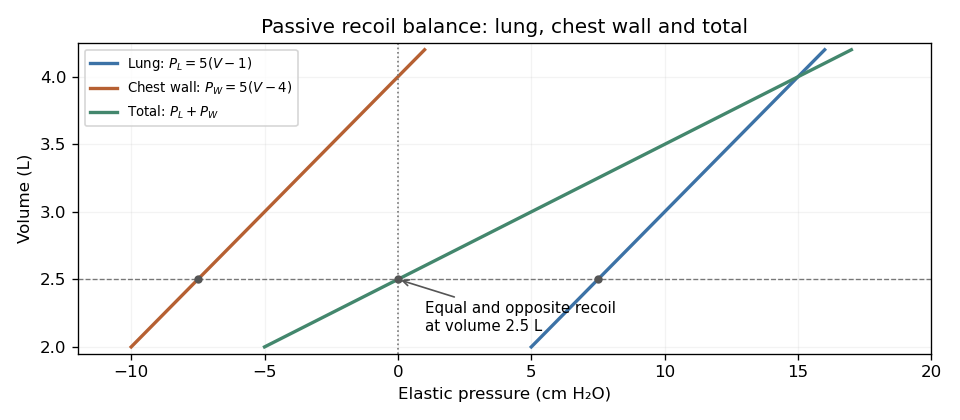
Original linear example of passive lung compliance, chest-wall compliance and their combined recoil; at volume 2.5 L the pressures cancel
. Details. A multiplication-cycle yield specifies how successfully a cycle of a chemical multiplication reaction converts entering material into the intended output. It must state what happens to material that fails to complete the route. A stoichiometric multiplier alone is insufficient to determine the achieved gain.
Suppose successful processing produces copies of the measured species per entering copy, the success fraction is , and a fraction of unsuccessful material survives unchanged. The net cycle multiplier isHere represents survival of all failures and destruction of all failures. In an original example, and give when failures survive, but when they are lost. After five cycles the gains are approximately 118.8 and 79.6. The chemistry's failure pathway materially affects the answer.
For different cycle yields, total gain is . IUPAC's ideal direct-multiplication description gives for repeated identical cycles; the variable-yield expression follows by applying each cycle in sequence.[ref]
Cycle-gain uncertainty depends strongly on whether cycle errors are shared. Taking small perturbations,For independent multipliers with the same relative standard uncertainty , the relative uncertainty of is approximately . If one uncertain multiplier applies identically to every cycle, it is approximately . With and , these models give 3% and 9%, respectively. Repeating a shared error is different from averaging independent errors.[ref]
Evaluation of measurement data — Guide to the expression of uncertainty in measurement by JCGM. §5.2, correlated inputs; sensitivities here are derived for the stated gain model.
Measure standards over the intended cycle range, with matched chemical amplification blanks. Reagent depletion, side reactions or inhibition can make the actual multiplication-cycle yield change with time or amount. A nominal gain calculated from ideal stoichiometry does not replace that experimental test.
Amplification blank timing specifies when background-generating material enters relative to the cycles of a chemical multiplication reaction. Earlier contamination can undergo more multiplication than later contamination. A detector blank and a full chemical amplification blank can therefore test different sources of response.
Let cycle have multiplier and let enter immediately after cycle . Background present before the first cycle contributesAn empty product equals1: material introduced after the final cycle receives no further gain. This is an original bookkeeping model for the repeated-cycle setting described by IUPAC.[ref]
Classification and Use of Terms for Amplification and Related Reactions by D. T. Burns and others. p.1332, ideal direct multiplication over repeated cycles.
For four ideal doubling cycles, one background unit introduced before all cycles becomes16 units. The same unit introduced after cycles1,2,3 or4 becomes8,4,2 or1, respectively. Matching the final reagent composition does not reproduce these different histories.
An original diagnostic model assumes constant multiplier , initial background and equal added background after each cycle. Then and . If mean blank responses are3 and7 in the model's amount units, and . Replicated cycle-count series can test this pattern; two values fitting two unknowns do not independently validate it.
A practical comparison processes blanks from the earliest relevant handling stage and includes deliberately later-entry controls. IUPAC distinguishes a procedural blank carried through the entire procedure from blanks covering only particular stages.[ref]
Blank material in the IUPAC Gold Book. Entry08010, note4, procedural and stage-specific blanks.
Differences can help localize contamination or spontaneous reporter formation, but changing yield, matrix effects and nonlinear gain can create alternative explanations. Report entry stage and cycle count with the blank response and its variation. Pinned article: Introduction to the OurBigBook Project
Welcome to the OurBigBook Project! Our goal is to create the perfect publishing platform for STEM subjects, and get university-level students to write the best free STEM tutorials ever.
Everyone is welcome to create an account and play with the site: ourbigbook.com/go/register. We belive that students themselves can write amazing tutorials, but teachers are welcome too. You can write about anything you want, it doesn't have to be STEM or even educational. Silly test content is very welcome and you won't be penalized in any way. Just keep it legal!
Intro to OurBigBook
. Source. We have two killer features:
- topics: topics group articles by different users with the same title, e.g. here is the topic for the "Fundamental Theorem of Calculus" ourbigbook.com/go/topic/fundamental-theorem-of-calculusArticles of different users are sorted by upvote within each article page. This feature is a bit like:
- a Wikipedia where each user can have their own version of each article
- a Q&A website like Stack Overflow, where multiple people can give their views on a given topic, and the best ones are sorted by upvote. Except you don't need to wait for someone to ask first, and any topic goes, no matter how narrow or broad
This feature makes it possible for readers to find better explanations of any topic created by other writers. And it allows writers to create an explanation in a place that readers might actually find it.
Figure 1. Screenshot of the "Derivative" topic page. View it live at: ourbigbook.com/go/topic/derivativeVideo 2. OurBigBook Web topics demo. Source. - local editing: you can store all your personal knowledge base content locally in a plaintext markup format that can be edited locally and published either:This way you can be sure that even if OurBigBook.com were to go down one day (which we have no plans to do as it is quite cheap to host!), your content will still be perfectly readable as a static site.
- to OurBigBook.com to get awesome multi-user features like topics and likes
- as HTML files to a static website, which you can host yourself for free on many external providers like GitHub Pages, and remain in full control

Figure 2. You can publish local OurBigBook lightweight markup files to either OurBigBook.com or as a static website.
Figure 3. Visual Studio Code extension installation.
Figure 5. . You can also edit articles on the Web editor without installing anything locally. Video 3. Edit locally and publish demo. Source. This shows editing OurBigBook Markup and publishing it using the Visual Studio Code extension. 
- Infinitely deep tables of contents:



All our software is open source and hosted at: github.com/ourbigbook/ourbigbook
Further documentation can be found at: docs.ourbigbook.com
Feel free to reach our to us for any help or suggestions: docs.ourbigbook.com/#contact