Topics (384k) Articles (398k) Users (410) Discussions (242) Comments (383) Files (13k) New article

Network reciprocity is the promotion of cooperation by the pattern of interactions in a biological population. When cooperators interact preferentially with other cooperators, their help can sustain local clusters. A graph makes the mechanism precise: individuals occupy graph vertices, and graph edges specify who interacts with whom. Recognition of a previous helper is not required.
In the donation game, let each cooperator pay a cost per neighbour and supply benefit to that neighbour. On a regular graph with four neighbours per individual, a cooperator surrounded by four cooperators receives payoff ; an isolated cooperator surrounded by nonhelpers receives . Thus the same behaviour has different consequences in different local arrangements.
Hisashi Ohtsuki and colleagues derived the approximate condition for natural selection to favour cooperation on large regular graphs of degree of a vertex , under weak selection. Their updating rule first removed a random individual, then let its neighbours compete for the vacancy according to biological fitness. For , and satisfy the asymptotic condition. The rule concerns fixation probability under stated assumptions; changing the order of death and reproduction can change the result.[ref]
A simple rule for the evolution of cooperation on graphs and social networks by Hisashi Ohtsuki and others. Nature 441, pp. 502–504; large-population weak-selection approximation, Figure 2 and comparison of update mechanisms
Group selection is a contribution to natural selection arising because groups differ in their survival, growth or production of descendant groups. A heritable trait can spread through greater success of groups containing it even while its frequency declines within each mixed group. For cooperation, the essential question is whether this difference between groups can overcome an individual's cost in biological fitness.
Consider a hypothetical biological population with two groups of 100 individuals: one contains 80 cooperators and the other 20. Initially, the overall cooperative fraction is . Suppose the first group grows to 200 individuals with 75% cooperators, while the second remains at 100 with 15% cooperators. Cooperation has declined within both groups, yet the combined cooperative fraction isThe more cooperative group now contributes more individuals to the total. These invented counts illustrate why within-group change and changes in group weights must both be measured; they do not establish the cause of a real group's growth.
In a 2006 model, Arne Traulsen and Martin A. Nowak made this mechanism explicit: individuals reproduced within groups, groups could split on reaching a size limit, and a split displaced another group. Groups with more cooperators could split more often despite the within-group advantage of withholding help. The population structure and rules governing group persistence therefore mattered alongside individual biological fitness.[ref]
Evolution of cooperation by multilevel selection by Arne Traulsen and Martin A. Nowak. PNAS 103, pp. 10952–10955; abstract, Figure 1 and model definition
An automated software build turns declared source inputs and dependencies into outputs through repeatable tool steps, such as code generation, compilation, linking and packaging. A build description defines those steps and their dependencies; a build system decides their order and may reuse outputs whose relevant inputs have not changed.
For example, changing a header can require recompiling several source files before relinking a computer program. Omitting that dependency can produce a stale executable even when every individual compiler invocation succeeds. In continuous integration, the automated build provides a repeatable check of the integrated revision, often combined with tests.[ref]
Continuous Integration by Martin Fowler. Automate the Build and Make the Build Self-Testing
Repeatability requires identifying tool versions, generated inputs and configuration as well as the main source files.A container image digest identifies particular container image content through a cryptographic hash function, commonly written as an algorithm name followed by a hexadecimal value. Unlike a movable tag, a digest fixes the referenced content. Image manifests identify the configuration and layers; multi-platform indexes can refer to several platform-specific manifests.[ref]
Image digests in the Docker documentation. What are Docker image digests?, Pull an image by digest and Multi-platform images and manifests
For example, a tag such as
analysis:stable can point to different content next month. Recording an image reference with a digest makes that change detectable and allows the same referenced content to be requested again. It does not establish who produced the image, whether its software is correct, or that required input data and host facilities are identical. Those claims need separate evidence.Unilateral contact permits bodies to separate while preventing them from passing through each other. In an ideal rigid, nonadhesive model, the supporting normal contact force can push but cannot pull. It is therefore different from a permanently attached support: an upward pull may lift a body away instead of producing a downward support reaction.
Let be the signed normal gap, positive when the bodies are separated, and the outward compressive normal contact force. The nonpenetration constraint and absence of adhesion give the unilateral contact complementarity conditionsAn open gap requires , while requires a closed gap. The pair is also allowed: touching does not by itself imply a loaded contact.[ref]
Underactuated Robotics by Russ Tedrake. Multi-Body Dynamics, Time-stepping LCP: Normal force, nonnegative gap and normal reaction and their complementarity product
Tangential friction requires an additional relation such as Coulomb friction; it is not specified by the normal-gap conditions.The equation of motion is still needed to determine the reaction. Consider a block of mass on a fixed horizontal floor, initially at rest at , with an upward applied force through its center of mass. With upward positive, Newton's second law isIf the contact remains closed, would require . That is feasible for . For , a negative normal reaction would violate unilateral contact, so the contact opens with and . At a closed contact with zero normal velocity, the appropriate acceleration-level contact complementarity iswhich yieldsThese acceleration conditions are being applied at a closed, initially stationary contact; they are not a rule forbidding downward acceleration during separated free flight.
For an original numerical example, let and . Pulling upward with leaves a normal reaction of . At , the reaction is zero and the initial upward acceleration is . At , both the reaction and the initial acceleration vanish, while touching remains possible.
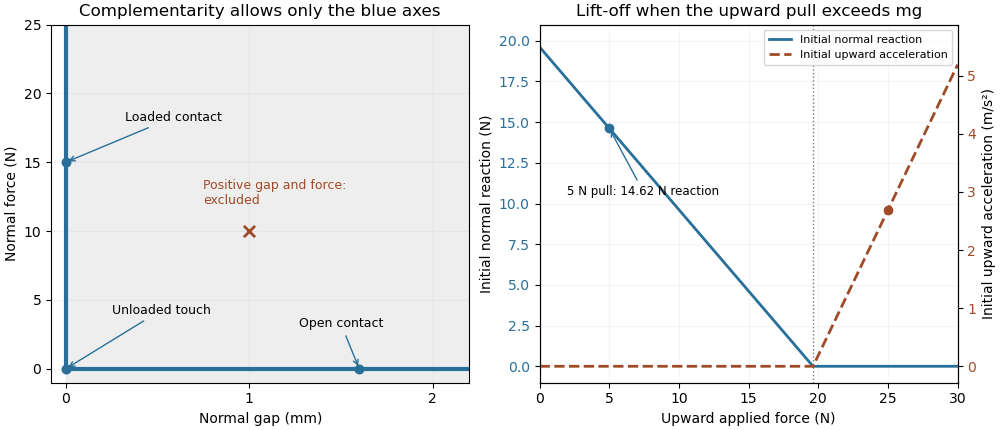
Unilateral contact allows a closed unloaded contact and releases a support when a tensile reaction would be required
. Original ideal-model illustration. The left panel shows allowed gap/reaction pairs; the right shows the initial reaction and acceleration for a stationary 2 kg block as an upward pull is increased. The two panels illustrate geometry and force balance respectively; they are not measured loading data. Details.A simple apparatus test places the block on a calibrated load cell and applies the upward pull through a spring balance, keeping the pull vertical through the center of mass to avoid an extra overturning torque. The support reading should decrease with the pull while contact persists, then vanish at lift-off. Recording the gap as well distinguishes an unloaded touch from a genuinely open contact. Real support elastic deformation and adhesion must be accounted for before treating that apparatus as the ideal rigid, nonadhesive model.
A penalty approximation of unilateral contact replaces perfect rigidity by a chosen stiff response, for exampleHere a small negative gap represents an allowed modeled overlap relative to undeformed reference surfaces. It is not an exact solution of . For the supported load above and chosen penalty stiffness , equilibrium requires . Increasing reduces that overlap at the same load. The penalty method and the ideal constraint are different approximations of the contact response.
Finally, impact requires a rule for the velocity change. The position-level inequalities alone do not decide whether an approaching body sticks or rebounds. A coefficient of restitution or another specified impact law determines that behavior, and the impulsive contact force is summarized by its impulse. Tedrake's particular time-stepping formulation identifies its block collisions as perfectly inelastic; that is a feature of the stated model, not a consequence of the three gap/reaction inequalities alone.[ref]
Underactuated Robotics by Russ Tedrake. Multi-Body Dynamics, Time-stepping LCP dynamics for block collision, perfectly inelastic collision hint
The center of pressure summarizes where a distributed normal pressure acts. On a planar contact region in , take a nonnegative pressure field and positive total normal force . Its center of pressure is the pressure-weighted positionIt is a continuous weighted mean, rather than necessarily the point of largest pressure. For discrete normal forces at , replace the integrals by sums. The resulting convex combination places the center of pressure inside the contacts' convex hull, or support polygon.[ref]
Underactuated Robotics by Russ Tedrake. Highly-articulated Legged Robots, Center of pressure (CoP) and Zero-moment point (ZMP), The special case of flat terrain
This definition preserves the torque as well as the resultant normal force. About the origin in the contact plane,A single vertical force applied at gives the same torque. Thus its line of action passes through the center of pressure. Conversely, force-and-torque measurements reconstruct the point throughThe origin and sign convention are part of these equations; moving the moment reference above the contact plane requires the corresponding torque translation.
For an original discrete example, four vertical reactions of , , and act at the successive corners , , and in metres. Their total normal force is , with and . Hence the center of pressure is . A rigid plate on four load cells provides a simple force platform implementation: calibrate the force channels and positions, then test known vertical loads at known locations. Subtracting the unloaded plate's own force and moment removes its contribution when reconstructing the added load. This is a proposed measurement test, not experimental data.
A continuous example shows the inverse problem hidden by this useful compression. On a rectangle of length and width , put and choose profiles independent of :Both profiles are positive on . The added polynomial has zero integral and zero first weighted integral:Thus both profiles give and the same center of pressure , while their peak pressures are and . These are pressure distributions with identical resultant force and center of pressure. For , and , both give despite different local loads. A force platform alone therefore does not identify every local pressure.
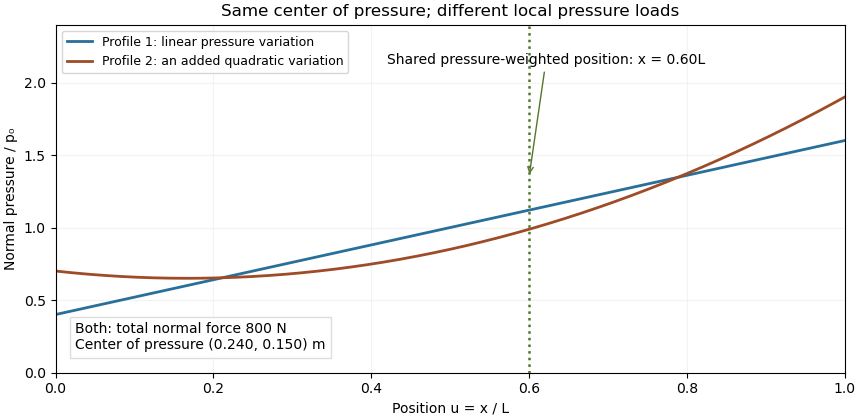
Two limits matter. If , the normal-pressure center of pressure is undefined. At fixed , an absolute moment error changes the reconstructed by , so fixed absolute measurement uncertainty is amplified as a contact unloads. Also, tangential contact forces can leave a residual contact torque at the center of pressure: with full resultant ,Selecting the normal-pressure centroid does not force this yaw torque to vanish.
Under the gravity-only, resting assumptions of support polygon, the center of pressure coincides with the horizontal center of mass projection. During motion it need not. For a planar model driven only by gravity and ground contact forces, at fixed center of mass height and with constant angular momentum about that centre, force and torque balance give . The acceleration term explains why the center of pressure is a contact-force measurement rather than a general substitute for center of mass position.[ref]
Underactuated Robotics by Russ Tedrake. Highly-articulated Legged Robots, equations cop and zmp and their stated constant-height/angular-momentum assumptions
An ideal mechanical constraint is a restriction whose constraint forces do zero total virtual work for every admissible virtual displacement at a fixed time:The condition concerns the permitted variations of the whole chosen system. It does not require every constraint force to vanish, and it does not necessarily imply zero actual constraint power. Stewart's treatment distinguishes a displacement along a moving constraint from a virtual displacement made while its time is held fixed.[ref]
For smooth independent holonomic constraints , allowed variations obeyConstraint forces of the form therefore satisfy the ideal condition, with Lagrange multipliers . The argument explains why reaction forces disappear from the virtual-work equation without being absent from the apparatus.
For an original stationary example, constrain a particle of mass to a fixed horizontal circle of radius . At speed the required radial force magnitude is . The allowed virtual displacement is tangential, so its scalar product with that radial normal reaction is zero. The force nevertheless produces the centripetal acceleration needed to maintain the trajectory.
A moving support shows the limitation of equating ideality with energy conservation. For the Cartesian constraint , admissible virtual displacements satisfy , whereas the actual velocity satisfies . A reaction has zero virtual work but actual power . An actuator moving the support can thus supply or remove mechanical energy. A force readout combined with the support's measured speed would detect that exchange.
For a fixed holonomic restriction, actual velocities obey the same homogeneous tangency condition as virtual displacements, giving zero total constraint power. For linked bodies, that total can cancel while individual powers are nonzero, as in constraint power transfer. Friction and compliance require their own model: calling a surface a mechanical constraint does not establish the ideal virtual-work property.
An ideal rigid link constrains the distance between two attachment points to a fixed length while transmitting an axial constraint force. In the model used here the link is massless, its end joints rotate freely, and it carries tension or compression without bending or stretching. For endpoint positions ,This is a holonomic constraint, with reactions that can be represented by Lagrange multipliers. The virtual-work treatment of constrained motion distinguishes these reaction forces from the applied forces that remain in reduced equations.[ref]
Define the axial unit vector . Differentiating the fixed-length condition givesThus endpoint velocities have equal axial components, while transverse relative motion can rotate the link. For an original planar example, let , so and . The relative velocity is perpendicular to the link and corresponds to angular speed . The length stays constant even though the endpoint velocities differ.
A second derivative exposes the required relative acceleration:In the example it is along the link. Preserving length does not permit setting the relative acceleration to zero during rotation.
For axial force on A and on B, their total actual power is . Individual powers can be nonzero, giving constraint power transfer. A freely hinged rigid strut can carry either sign of axial force in this idealization; a taut ideal string can transmit tension but cannot enforce fixed separation by compression when it goes slack.
A real linkage approximates the model only while axial extension, joint friction and link inertia are negligible for the chosen motion. Tracking endpoint separation during loading tests the assumed length constraint; a load cell and position measurements can test the associated force and power balance.
A stress-strain curve plots a material's stress response against a specified strain measure during a loading experiment. Its initial slope gives an elastic modulus in a linear regime; yielding, hardening and fracture can produce later changes.
The curve depends on temperature, loading rate, sample history and the definitions of stress and strain. Engineering stress divides force by original cross-sectional area, whereas true stress uses current area. After necking these can differ greatly. Unloading can distinguish recoverable elastic strain from permanent deformation, so one loading curve alone does not specify every constitutive property.
A nasal consonant combines a constriction or closure in the mouth with an open airflow route through the nose. Lowering the soft palate opens that route; the mouth can remain closed at the consonant's place of articulation. A sustained
[m] therefore produces sound despite closed lips, whereas closing both routes stops sustained outward flow.[ref]Essentials of Linguistics (2nd edition) by Catherine Anderson and others. §3.4, nasal stops and the oral/nasal airflow distinction
Compare
[m], [n] and [ŋ]. They share a nasal manner of articulation, while their oral closures occupy different places. Comparing [m] with [b] instead holds the bilabial closure approximately fixed while changing the available airflow route. Voicing and the resonant vocal tract shape the recorded signal; the written letter alone does not specify those physical properties.Pixel connectivity specifies which neighboring pixels may be joined directly when forming paths through an image. A region is connected when its pixels can be reached through such allowed steps while remaining in the region. This makes the region a component of an implicitly defined graph.
For a two-dimensional square grid and pixel position , four-neighbor connectivity usesrestricted to positions inside the image. Eight-neighbor connectivity adds the four diagonals:Thus four-neighbor steps cross an edge between pixel cells, while eight-neighbor steps can also pass through a corner.
The diagonal binary imagehas three foreground regions under four-neighbor connectivity and one under eight-neighbor connectivity. SciPy's default two-dimensional connected-component labeling uses the four axial neighbors; a full three-by-three neighborhood also connects diagonals. Its neighborhood must encode connections in both directions.[ref]
label in the SciPy documentation. Parameters, structure; Notes, centrosymmetry; Examples, diagonal connectivity
Connectivity also affects how a boundary separates foreground from background. In a two-by-two checkerboard, allowing diagonal links for both values makes each value connected across its own diagonal. A convention that treats foreground and background differently can avoid interpreting both diagonal paths as uninterrupted planar crossings. The chosen convention should therefore accompany any claim about separate objects or enclosed regions.
A flood fill and connected-component labeling can give different answers on the same stored array solely because their pixel connectivity differs. Check the neighborhood before interpreting that disagreement as a bug or a physical change in the imaged object.
Flood fill finds the region reachable from a seed pixel through allowed neighboring pixels that satisfy a membership rule, often replacing the values in that region. A paint program's fill operation is a familiar application. The seed, membership rule and pixel connectivity together specify what will be filled.
Consider the imageStart at the upper-left pixel, select values equal to one, and allow only horizontal or vertical steps. Exactly three pixels are reachable, giving replacement by nine asWith diagonal steps also allowed, all six ones are reachable and replaced. The fill is a connectivity computation, not a rule to replace every matching value everywhere.
An iterative implementation keeps pending positions in a stack, takes one position and adds eligible unvisited neighbors. Marking a position when it enters the pending collection prevents repeated insertion. This is a depth-first search of the implicit graph. For a fixed neighborhood, visiting a region of pixels takes time complexity, excluding initialization or copying of a whole image. Explicit pending and visited storage avoids relying on a deeply nested recursive call for a large region.
Membership need not require exact equality. The scikit-image
flood_fill API can accept values within a specified tolerance of the original seed value, with connectivity or a supplied neighborhood footprint controlling adjacency. Comparing each candidate to the seed is different from allowing a chain of small local changes to drift arbitrarily far from the seed value.[ref]flood_fill in the scikit-image documentation. flood_fill, seed_point, tolerance, footprint and connectivity parameters
Record visited positions independently when necessary: replacing a value by itself must not make the algorithm revisit it forever. Repeated flood fills with fresh region labels can implement connected-component labeling.
An eclipsed conformation places a pair of groups on adjacent bonded atoms at zero torsion angle: their bonds overlap in a projection looking along the bond joining those atoms. In the idealized Newman projection of an ethane-like group, three front/rear bond pairs can be simultaneously eclipsed. Projected overlap does not mean that two atoms occupy the same point in three-dimensional space.[ref]
Nomenclature of Organic Chemistry: IUPAC Recommendations and Preferred Names 2013 by IUPAC. P-94.2 and P-94.3.1.1: zero torsion angle, eclipsed and staggered descriptions.
For a concrete construction, draw three front bonds at , and . Draw the rear bonds at the same three angles. Their projected directions coincide, giving an eclipsed conformation. Turning the rear set through gives a staggered conformation. Turning both sets together merely rotates the whole drawing and leaves their relative torsion angles unchanged.
The distinction is useful in discussing a rotational energy barrier. A deliberately simplified threefold model,has a maximum at the eclipsed angle and a minimum at . Thus continuous rotation can preserve every bond while changing potential energy. This model defines its own barrier; it does not measure a barrier in a particular substance. The eclipsed conformation is the geometry at the chosen position, while the barrier height and the rate of interconversion require further physical information. J. D. Kemp and K. S. Pitzer's ethane study provides an early thermodynamic setting for the problem of hindered internal rotation.[ref]
The Entropy of Ethane and the Third Law of Thermodynamics. Hindered Rotation of Methyl Groups by J. D. Kemp and Kenneth S. Pitzer. Originating 1937 paper, title and bibliographic record.
A staggered conformation is a conformation in which groups on adjacent bonded atoms are positioned between the groups on the other atom when viewed along the bond. In the idealized Newman projection of an ethane-like arrangement with three equally spaced groups on each carbon, the rear bonds bisect the angles between the front bonds. This is a geometric description relative to the viewing bond, not a change in molecular connectivity.[ref]
Nomenclature of Organic Chemistry: IUPAC Recommendations and Preferred Names 2013 by IUPAC. P-94.2 and P-94.3.1.1: torsion angles and staggered/eclipsed conformations.
Put the three front bonds at angular positions , and in a Newman projection. Rear bonds at , and give a staggered conformation. Rotate the rear group by and the rear bonds line up with front bonds, giving an eclipsed conformation. These positions describe projections: the atoms are still separated along the central bond.
A simple illustrative potential energy for a threefold rotor iswith torsion angle measured from an eclipsed position. It gives for a staggered position and for an eclipsed position. Here is an assumed barrier parameter, not a measured universal constant. Different substituents can give distinct energies to different staggered arrangements, so a geometric label alone is not a complete energy ranking. The historical connection between thermodynamics and hindered methyl-group rotation was examined by J. D. Kemp and K. S. Pitzer.[ref]
The Entropy of Ethane and the Third Law of Thermodynamics. Hindered Rotation of Methyl Groups by J. D. Kemp and Kenneth S. Pitzer. JACS 59,276–279(1937), originating title and scope; no numerical barrier attributed.
An orientation-dependent configuration-space obstacle is the forbidden set for an extended robot whose occupied geometry changes with its orientation. For a planar rigid shape referred to a body-fixed point, translation and rotation matrix , the occupied set is . With obstacle set , collision meansFor each fixed angle, the forbidden translations are thereforeIndeed, an intersection gives , hence , and the converse follows by substitution. This is a reflected Minkowski sum, not an unreflected sum of the two shapes. Hauser develops these angle-indexed slices explicitly for a translating and rotating polygon.[ref]
Robotic Systems by Kris Hauser. Chapter 9, C-obstacles for rotational motion; Motion planning in SE(2)
The full configuration-space obstacle is . Its angular coordinate is periodic: orientations zero and represent the same rotation. Translation and orientation cannot generally be replaced by one planar obstacle inflation. A circular robot centered at its reference point is a special case, because rotating that shape leaves every unchanged.
An original doorway example uses a rectangle with half-length and half-width , centered in an infinitely long horizontal corridor of width . Its vertical half-extent at angle isWith contact counted as collision, a centered placement is clear only if . At zero angle the total width is , leaving at each wall. At , the total width is about , so the same center position collides. For small positive angles, the first touching angle solves , giving approximately . A collision-free center path alone would miss this rotational restriction.
Angular sampling needs a bound on the geometry between checked orientations. If every body point lies within radius of the reference point, changing orientation by moves each corresponding point by at mostThe first expression is the chord length; the inequality follows from . An angular clearance bound for a rotating body uses this motion allowance to transfer a measured separation to nearby orientations. For the rectangle above, . A ten-degree grid has a five-degree worst-case distance to a sampled orientation, allowing about of point motion. A sampled gap would not certify every intermediate orientation under that bound.
A geometric validation can place a rectangular test piece at predicted near-touching angles in a measured corridor, accounting for reference-point offsets and wall tolerances. A planner must also check the continuous motions connecting clear configurations; clear grid vertices alone do not establish clear connecting rotations. A conservative enclosing disk may simplify that check, at the cost of excluding some feasible narrow passages.
R. de L. Kronig, with W. G. Penney, constructed the Kronig-Penney model for electron motion through a periodic crystal potential. The model turns the general periodicity argument behind Bloch's theorem into an explicit calculation of allowed energies.[ref]
W. G. Penney developed a solvable model of electrons in a periodic lattice with R. de L. Kronig. Their 1931 calculation replaced the complicated crystal environment by a repeating one-dimensional potential, exposing allowed and forbidden electron-energy intervals.[ref]
Quantum mechanics of electrons in crystal lattices by R. de L. Kronig and W. G. Penney. Introduction and periodic-potential solution
The Kronig-Penney model makes energy bands concrete: matching wave functions across repeated cells constrains the possible energies. Its value lies in isolating the effect of periodicity, not reproducing every interaction in a real solid.
Evan O. Kane developed influential descriptions of electronic band structure in semiconductors. His 1957 calculation of indium antimonide used k·p perturbation theory to treat the interaction of conduction and valence bands near their extrema. The small band gap made that interaction important rather than a negligible correction.[ref]
Band structure of indium antimonide by Evan O. Kane. Abstract and opening band-structure calculation, Journal of Physics and Chemistry of Solids 1, 249–261, 1957
A central consequence is band nonparabolicity: electron energy need not remain proportional to the square of wave number over the relevant range. A constant band-edge effective mass can therefore fail to describe electrons farther from the minimum. The calculation connects band coupling with a measurable change in the relation between energy and motion.
Kane also calculated the fundamental optical absorption using information from the cyclotron resonance mass and compared the prediction with experimental absorption and its dependence on impurity concentration. The agreement supplied an experimental test of the adopted band picture, rather than merely fitting an arbitrary energy curve.[ref]
Band structure of indium antimonide by Evan O. Kane. Abstract: optical absorption, cyclotron-resonance input and comparison with n-type impurity dependence
This combination of a tractable coupled-band model and measurable consequences explains the continuing usefulness of his work in semiconductor theory.A low-temperature physicist investigates matter when thermal excitation is small enough for quantum behaviour to become especially prominent. Superconductivity, superfluidity and spin systems are characteristic subjects, although the temperature scale depends on the material and the effect being studied.
The central experimental problem is often controlling unwanted heat transfer while making a measurable electrical, magnetic or mechanical probe. A cryostat supplies a controlled low-temperature environment; thermometry and heat-leak measurements establish what the sample actually experiences. Reducing relative to an excitation energy gap can suppress thermal populations, allowing a quantum ground-state response to be distinguished from a classical high-temperature one.
The amount fraction of component is , where is its amount of substance. It is dimensionless and the fractions sum to one for a complete composition specification.
For an ideal gas mixture at common temperature and pressure, amount fraction equals partial-pressure fraction. It generally differs from mass fraction because different species have different molar masses. For one mole each of hydrogen and oxygen molecules, both amount fractions are one half, although their masses are very different. The composition basis must therefore accompany a quoted concentration.
Pinned article: Introduction to the OurBigBook Project
Welcome to the OurBigBook Project! Our goal is to create the perfect publishing platform for STEM subjects, and get university-level students to write the best free STEM tutorials ever.
Everyone is welcome to create an account and play with the site: ourbigbook.com/go/register. We belive that students themselves can write amazing tutorials, but teachers are welcome too. You can write about anything you want, it doesn't have to be STEM or even educational. Silly test content is very welcome and you won't be penalized in any way. Just keep it legal!
Intro to OurBigBook
. Source. We have two killer features:
- topics: topics group articles by different users with the same title, e.g. here is the topic for the "Fundamental Theorem of Calculus" ourbigbook.com/go/topic/fundamental-theorem-of-calculusArticles of different users are sorted by upvote within each article page. This feature is a bit like:
- a Wikipedia where each user can have their own version of each article
- a Q&A website like Stack Overflow, where multiple people can give their views on a given topic, and the best ones are sorted by upvote. Except you don't need to wait for someone to ask first, and any topic goes, no matter how narrow or broad
This feature makes it possible for readers to find better explanations of any topic created by other writers. And it allows writers to create an explanation in a place that readers might actually find it.
Figure 1. Screenshot of the "Derivative" topic page. View it live at: ourbigbook.com/go/topic/derivativeVideo 2. OurBigBook Web topics demo. Source. - local editing: you can store all your personal knowledge base content locally in a plaintext markup format that can be edited locally and published either:This way you can be sure that even if OurBigBook.com were to go down one day (which we have no plans to do as it is quite cheap to host!), your content will still be perfectly readable as a static site.
- to OurBigBook.com to get awesome multi-user features like topics and likes
- as HTML files to a static website, which you can host yourself for free on many external providers like GitHub Pages, and remain in full control

Figure 2. You can publish local OurBigBook lightweight markup files to either OurBigBook.com or as a static website.
Figure 3. Visual Studio Code extension installation.
Figure 5. . You can also edit articles on the Web editor without installing anything locally. Video 3. Edit locally and publish demo. Source. This shows editing OurBigBook Markup and publishing it using the Visual Studio Code extension. 
- Infinitely deep tables of contents:




All our software is open source and hosted at: github.com/ourbigbook/ourbigbook
Further documentation can be found at: docs.ourbigbook.com
Feel free to reach our to us for any help or suggestions: docs.ourbigbook.com/#contact