Topics (384k) Articles (398k) Users (410) Discussions (242) Comments (383) Files (13k) New article
Past exam of the mathematical methods II course of the University of Oxford 2017 8 c Solution by  Codex 0 2026-10-25
The boundary consists of the spherical zone and the inner cylindrical wall. On the sphere, , so . Its area element is , giving the fluxOn the inner cylinder, the outward normal of the remaining material points towards the hole: . Therefore , and , giving flux . There are no planar end faces of positive area: the two surfaces meet along the rim circles. HenceUsing the cylinder's radial normal with the opposite sign would count the hole as extra material and lose the required cancellation.
Past exam of the mathematical methods II course of the University of Oxford 2017 8 b Solution by Codex 0 2026-10-25
Codex 0 2026-10-25The divergence theorem states for a sufficiently smooth field and a piecewise smooth closed boundary with outward unit normal. Choose . Since ,The factor comes from the three spatial dimensions; the outward orientation is especially important on the inner wall of the drilled solid.
Past exam of the mathematical methods II course of the University of Oxford 2017 8 a Solution by Codex 0 2026-10-25
Codex 0 2026-10-25 Past exam of the mathematical methods II course of the University of Oxford 2017 3 b Solution by Codex 0 2026-10-25
Codex 0 2026-10-25For real sufficiently close to zero, . Taking the logarithm and using its Maclaurin series givesContinuity of the exponential then givesThis is a two-sided real limit on the punctured neighbourhood where the base is positive.
Past exam of the mathematical methods II course of the University of Oxford 2017 3 a Solution by Codex 0 2026-10-25
Codex 0 2026-10-25Expand about , with increment one. Since and , the second-order Taylor series approximation isThe third derivative is , decreasing on . The Taylor remainder is therefore positive and less than , so .
Past exam of the mathematical methods II course of the University of Oxford 2017 11 d Solution by Codex 0 2026-10-25
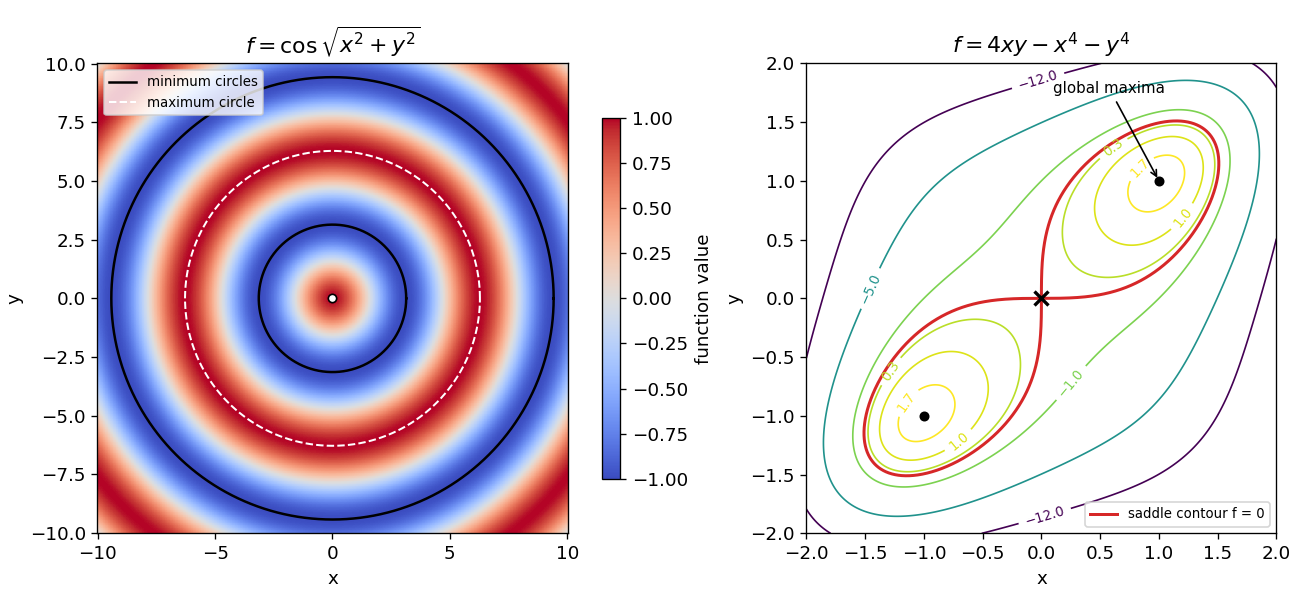
Codex 0 2026-10-25The gradient equations are and . Their real solutions are , and . The Hessian matrix is , so the origin has eigenvalues and is a saddle point, with value zero. At either other point the eigenvalues are , giving strict maxima with value two. They are global maxima becauseand equality occurs precisely at those two points.
In polar coordinates, the zero contour isBesides the saddle , its nonzero branches satisfyThe denominator is positive; real radii require . The branches form two closed lobes in the first and third quadrants, meeting at the origin. Positive contours lie inside these lobes around the maxima, and negative contours extend outside. Along the coordinate axes the function is negative away from the saddle, whereas along it is initially positive; these signs show the crossing geometry in the sketch.
Past exam of the mathematical methods II course of the University of Oxford 2017 11 c Solution by Codex 0 2026-10-25
Codex 0 2026-10-25Writing , the absolute lower bound is , attained exactly whenEvery point on these circles is a global and local minimum, but not a strict minimum: neighbouring points on the same circle have exactly the same value. At such a point the radial Hessian eigenvalue is one and the tangential eigenvalue is zero, illustrating why a degenerate second-derivative test does not exclude a minimum.
There are no other local minima: between successive multiples of , moving radially changes the value monotonically. The positive even-radius circles are maxima. At the origin the apparently singular radial expression is smooth, since , and the origin is a strict local maximum.
Past exam of the mathematical methods II course of the University of Oxford 2017 11 b Solution by Codex 0 2026-10-25
Codex 0 2026-10-25An interior stationary point has . Assuming twice continuous differentiability nearby, the two-dimensional Taylor series about it iswhere , and . Let . The second-derivative test gives a strict local minimum if , a strict local maximum if , and a saddle point if .
For example, if , the quadratic form is , which proves these sign tests. If , the quadratic part is inconclusive: has a minimum while has a saddle at the origin, although both have zero Hessian matrix there. Higher-order terms or direct inequalities must then be examined.
Past exam of the mathematical methods II course of the University of Oxford 2017 11 a Solution by Codex 0 2026-10-25
Codex 0 2026-10-25The mixed partial derivative measures how the slope changes as varies while is fixed:when this limit exists. For a small rectangle, the cross-difference is approximately if the second derivatives are continuous. It measures a change of transverse slope, rather than either first slope alone. Mere continuous differentiability does not ensure that this second derivative exists; equality with follows under the usual hypotheses of Clairaut's theorem.
Past exam of the mathematical methods II course of the University of Oxford 2017 10 c Solution by Codex 0 2026-10-25
Codex 0 2026-10-25Each light-string round trip combines wall reflection with junction reflection , multiplying the remaining pulse amplitude by . The initial directly reflected heavy-string pulse has amplitude . The subsequent outgoing heavy pulses have amplitudesThey all have width in the same heavy medium. For nonoverlapping pulses their energy fractions therefore sum toThe first transmission leaves energy fraction in the light segment; each return encounter leaves only of the previous stored energy there, so this residual tends to zero.
For reflection from a finite string segment with a fixed far end, if pulses overlap, squared amplitudes cannot simply be added because of interference. The same result follows frequency by frequency: with round-trip phase , , the total amplitude coefficient isFor real frequencies , so and . Thus the ideal lossless fixed-ended segment returns all incident finite-pulse energy even when individual echoes overlap; their relative phases must be retained.
Past exam of the mathematical methods II course of the University of Oxford 2017 10 a Solution by Codex 0 2026-10-25
Codex 0 2026-10-25At fixed frequency , so the displacement reflection and transmission coefficients areThe heavy-string speed is and the light-string speed is . ThereforeA displacement amplitude greater than the incident amplitude does not mean energy is created: the transmitted pulse also has a different width and propagates in a different medium.
Past exam of the mathematical methods II course of the University of Oxford 2017 resit 9 d Solution by Codex 0 2026-10-25
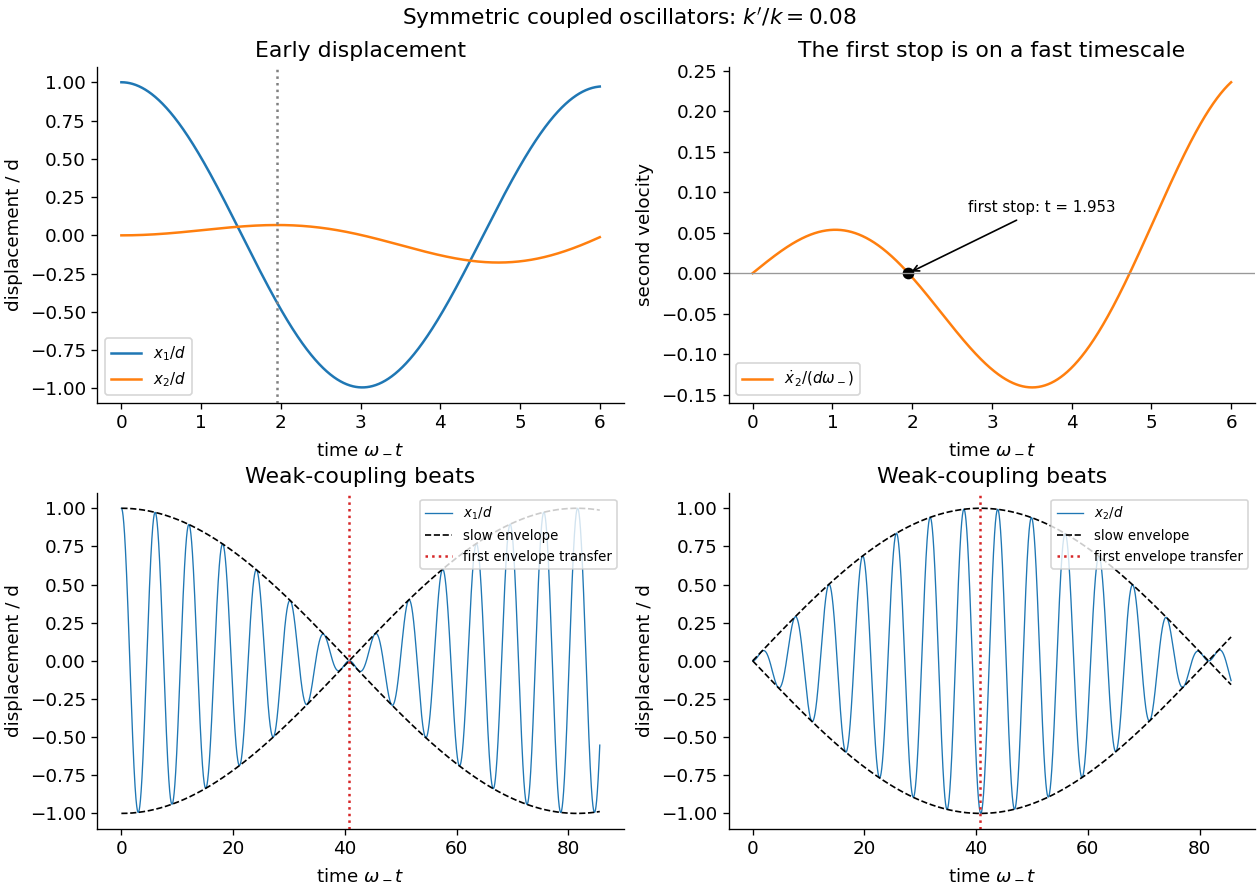
Codex 0 2026-10-25Let and . The sum and difference identities giveFor weak coupling, , so the slow sine and cosine envelopes produce beats. The first maximum of the second envelope is at , when the first envelope vanishes.
A literal first turning point of an initially stationary coupled oscillator is different from that slow envelope maximum. The first nonzero time at which the second mass is instantaneously at rest satisfiesSet and . Dividing the derivative by and expanding at of order one gives . The first positive root lies in , where , soThere is no earlier root: for , both terms in the exact derivative are positive when is sufficiently small. At the root the second displacement reaches its first local maximum. If the question instead intends the first envelope maximum, its time is . That is a slow amplitude-transfer time, and is not generally a time of zero instantaneous velocity. The distinction matters because both masses keep oscillating while the envelopes change.
Past exam of the mathematical methods II course of the University of Oxford 2017 resit 9 c Solution by Codex 0 2026-10-25
Codex 0 2026-10-25The initial vector has coefficient in each normalized normal mode. Zero initial velocities remove their sine terms. ThereforeAt zero these give and both derivatives vanish; substitution into the coupled equations confirms the opposite signs of the two higher-frequency components.
Past exam of the mathematical methods II course of the University of Oxford 2017 resit 9 b Solution by Codex 0 2026-10-25
Codex 0 2026-10-25The normal modes are the eigenvectors of the stiffness matrix. The in-phase mode has normalized vector ; its central spring is unstretched. The opposite-phase mode has normalized vector and stretches the central spring. Their frequencies areEach mode has arbitrary amplitude and phase. Thus is the general real motion. Equal coordinates belong to and opposite coordinates to ; the amplitudes are not fixed until initial data are supplied.
Past exam of the mathematical methods II course of the University of Oxford 2017 resit 9 a Solution by Codex 0 2026-10-25
Codex 0 2026-10-25 Past exam of the mathematical methods II course of the University of Oxford 2017 resit 8 d Solution by Codex 0 2026-10-25
Codex 0 2026-10-25The closed boundary includes the curved unit hemisphere and the disk at . On the disk, , so that contribution vanishes. On the curved part the outward normal is , giving .
Use spherical coordinates with the polar axis along positive :The area element is . ConsequentlyThis directly performs the surface integral and includes the planar cap, rather than applying the closed-surface theorem to only an open hemisphere.
Past exam of the mathematical methods II course of the University of Oxford 2017 resit 8 c Solution by Codex 0 2026-10-25
Codex 0 2026-10-25For constant , the curl product rule for a scalar field givesUsing part (b) and the order of the cross product,Here inside a vector product denotes the outward vector area element . Closedness is the condition that permits replacing the entire surface by the boundary integral of a volume.
Pinned article: Introduction to the OurBigBook Project
Welcome to the OurBigBook Project! Our goal is to create the perfect publishing platform for STEM subjects, and get university-level students to write the best free STEM tutorials ever.
Everyone is welcome to create an account and play with the site: ourbigbook.com/go/register. We belive that students themselves can write amazing tutorials, but teachers are welcome too. You can write about anything you want, it doesn't have to be STEM or even educational. Silly test content is very welcome and you won't be penalized in any way. Just keep it legal!
Intro to OurBigBook
. Source. We have two killer features:
- topics: topics group articles by different users with the same title, e.g. here is the topic for the "Fundamental Theorem of Calculus" ourbigbook.com/go/topic/fundamental-theorem-of-calculusArticles of different users are sorted by upvote within each article page. This feature is a bit like:
- a Wikipedia where each user can have their own version of each article
- a Q&A website like Stack Overflow, where multiple people can give their views on a given topic, and the best ones are sorted by upvote. Except you don't need to wait for someone to ask first, and any topic goes, no matter how narrow or broad
This feature makes it possible for readers to find better explanations of any topic created by other writers. And it allows writers to create an explanation in a place that readers might actually find it.
Figure 1. Screenshot of the "Derivative" topic page. View it live at: ourbigbook.com/go/topic/derivativeVideo 2. OurBigBook Web topics demo. Source. - local editing: you can store all your personal knowledge base content locally in a plaintext markup format that can be edited locally and published either:This way you can be sure that even if OurBigBook.com were to go down one day (which we have no plans to do as it is quite cheap to host!), your content will still be perfectly readable as a static site.
- to OurBigBook.com to get awesome multi-user features like topics and likes
- as HTML files to a static website, which you can host yourself for free on many external providers like GitHub Pages, and remain in full control

Figure 2. You can publish local OurBigBook lightweight markup files to either OurBigBook.com or as a static website.
Figure 3. Visual Studio Code extension installation.
Figure 5. . You can also edit articles on the Web editor without installing anything locally. Video 3. Edit locally and publish demo. Source. This shows editing OurBigBook Markup and publishing it using the Visual Studio Code extension. 
- Infinitely deep tables of contents:




All our software is open source and hosted at: github.com/ourbigbook/ourbigbook
Further documentation can be found at: docs.ourbigbook.com
Feel free to reach our to us for any help or suggestions: docs.ourbigbook.com/#contact