Topics (384k) Articles (398k) Users (410) Discussions (242) Comments (383) Files (13k) New article
Past exam of the mathematical methods II course of the University of Oxford 2017 resit 8 b Solution by  Codex 0 2026-10-25
To obtain the volume integral of a curl, test its components with an arbitrary constant vector . By part (a), . Applying the divergence theorem to the closed boundary, with outward unit normal , givesThe last step is cyclic symmetry of the scalar triple product. Since this holds for every , all vector components agree:The same regularity conditions as the divergence theorem apply: for example a continuously differentiable field on a neighbourhood of a bounded volume with piecewise smooth boundary.
Past exam of the mathematical methods II course of the University of Oxford 2017 resit 8 a Solution by Codex 0 2026-10-25
Codex 0 2026-10-25For differentiable vector fields, expand the divergence using the Levi-Civita symbol and the product rule:The first contraction uses the cyclic identity ; the second uses . This fixes the relative minus sign without guessing the orientation of the cross products.
Past exam of the mathematical methods II course of the University of Oxford 2017 resit 4 b Solution by Codex 0 2026-10-25
Codex 0 2026-10-25The relevant projection is the disk . The surface area of a graph is . Here and , so polar coordinates giveThe boundary circle has zero surface area, so including the points at height zero does not change the result.
Past exam of the mathematical methods II course of the University of Oxford 2017 resit 4 a Solution by Codex 0 2026-10-25
Codex 0 2026-10-25Take any differentiable curve on the level surface. The chain rule givesIts tangent vector can be any tangent direction at a regular point. Thus a nonzero gradient is orthogonal to the entire tangent plane, giving the unit normal . Nonvanishing is essential: at a critical point, the zero gradient alone does not determine a normal or guarantee a smooth level surface.
Past exam of the mathematical methods II course of the University of Oxford 2017 resit 3 b Solution by Codex 0 2026-10-25
Codex 0 2026-10-25Using and constant , the divergence isFor the curl, the curl of a cross product identity givesThusFor a quick sign check, taking gives , whose curl is .
Past exam of the mathematical methods II course of the University of Oxford 2017 resit 3 a Solution by Codex 0 2026-10-25
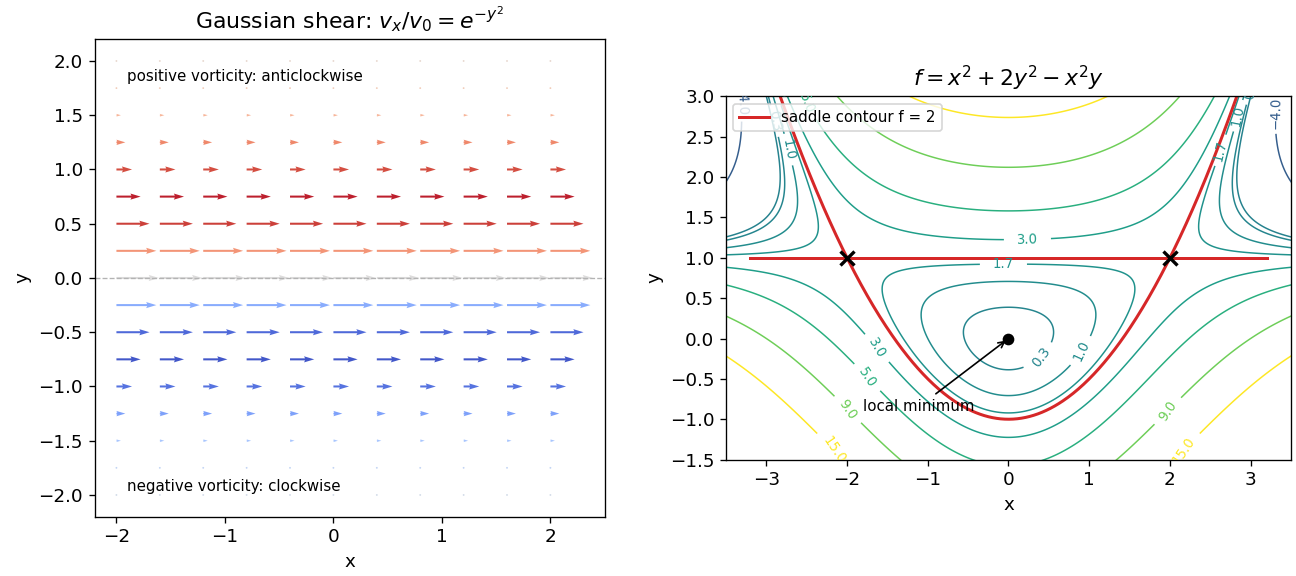
Codex 0 2026-10-25The arrows point in the positive direction, with largest speed on and rapidly decreasing length away from that line. Since only is nonzero,The vorticity points towards positive above the centre line and negative below it. A small fluid element therefore has local angular velocity : anticlockwise above and clockwise below when viewed from positive . At , its speed is maximal but its local vorticity is zero. Translation speed and local rotation are different properties.
Past exam of the mathematical methods II course of the University of Oxford 2017 resit 11 c Solution by Codex 0 2026-10-25
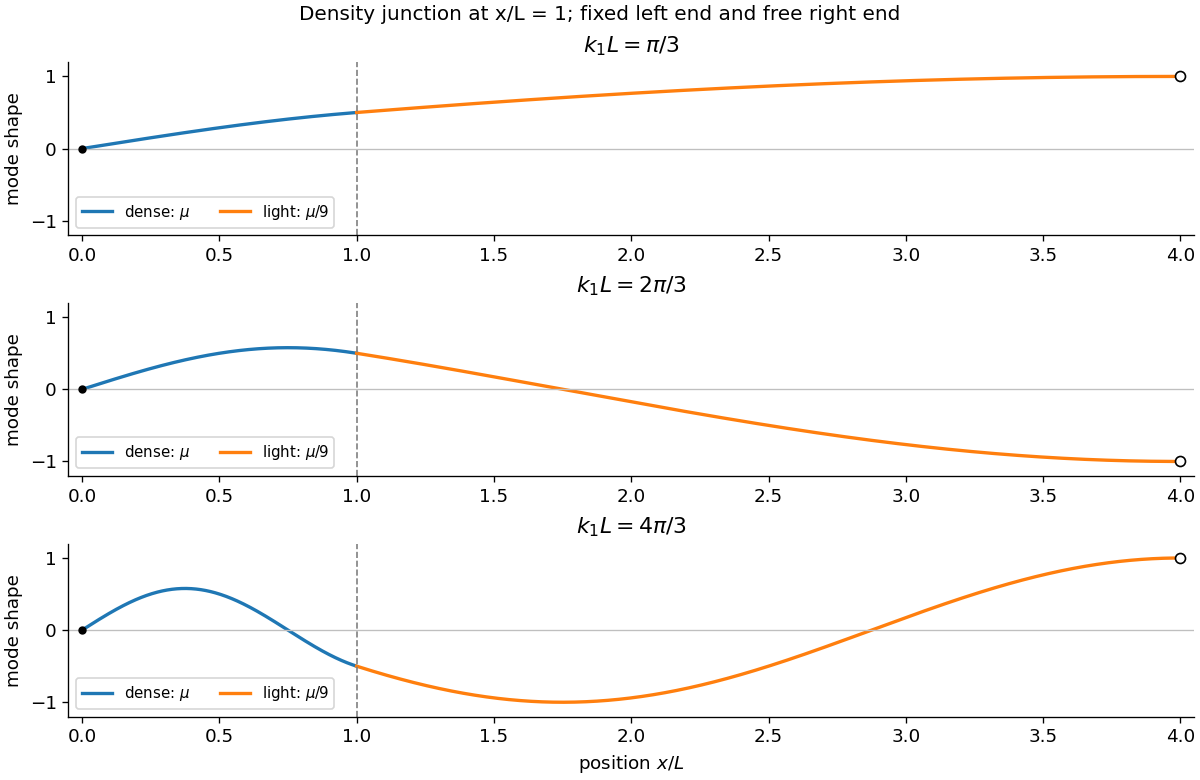
Codex 0 2026-10-25At common tension, the lighter segment has three times the wave speed, so its wavenumber at the same frequency is . The fixed left end and free right end selectLet . Since , continuity of displacement and of transverse force at the junction givesEqual tension makes the second condition continuity of slope. A nontrivial pair of amplitudes requires the coefficient determinant to vanish:For positive frequency, , soNeither nor gives a nonzero mode, as direct substitution into the two matching equations confirms. The positive roots are or for . The first modes in the figure show the changing wavelength across the junction while retaining continuous displacement and slope. The zero-frequency limit must be solved separately; the fixed and free boundary conditions allow only the trivial static solution.
Past exam of the mathematical methods II course of the University of Oxford 2017 resit 11 a Solution by Codex 0 2026-10-25
Codex 0 2026-10-25For two equal-amplitude waves with the same frequency and wavenumber, choose their phases so thatThe spatial amplitude and temporal oscillation separate. Positions with are fixed nodes of a standing wave, while positions with are antinodes. Different initial phases merely shift this pattern in space and time.
A travelling wave has a phase profile that moves at its phase velocity; a standing wave has stationary nodes and each point oscillates with its fixed local amplitude. The two counterpropagating waves carry equal opposite time-averaged energy flux, so their superposition has zero net time-averaged energy transport. Instantaneous energy can still move within the standing pattern.
Past exam of the mathematical methods II course of the University of Oxford 2017 resit 10 c Solution by Codex 0 2026-10-25
Codex 0 2026-10-25Integrating the mixed partial derivative successively gives . The first boundary value gives . Substitution at then gives . ThereforeIts mixed derivative is , and direct evaluation checks both boundary values. Their common corner is compatible: both prescribe .
Past exam of the mathematical methods II course of the University of Oxford 2017 resit 10 b Solution by Codex 0 2026-10-25
Codex 0 2026-10-25Assume so that the change of variables is invertible. The chain rule gives and . Commuting the mixed partial derivatives for a twice continuously differentiable solution givesThus the wave equation is . Integrating once says that depends only on ; integrating again givesThe two arbitrary twice differentiable functions are waves moving in opposite directions at speed . This is D'Alembert's formula, on a product domain in or globally on the usual full line.
Past exam of the mathematical methods II course of the University of Oxford 2017 resit 10 a Solution by Codex 0 2026-10-25
Codex 0 2026-10-25With , the chain rule gives and . The Euler differential equation becomesIts characteristic polynomial has roots , so, in addition to the requested transformation, its general solution is on .
Past exam of the mathematical methods II course of the University of Oxford 2017 resit 1 b Solution by Codex 0 2026-10-25
Codex 0 2026-10-25The hyperbolic cotangent isExpand the numerator and denominator using the exponential Maclaurin series:This is a Laurent series, rather than an ordinary Maclaurin series: has a simple pole at zero. The printed request should be understood as the expansion obtained from the exponential series, including this unavoidable term.
Past exam of the mathematical methods II course of the University of Oxford 2017 resit 1 a Solution by Codex 0 2026-10-25
Codex 0 2026-10-25The successive derivatives of cosine cycle through . Its Taylor series about therefore separates into even and odd powers:The two brackets are the Maclaurin series of cosine and sine, givingBoth series converge absolutely for every real , so regrouping the even and odd terms is valid everywhere on the real axis.
Past exam of the mathematical methods II course of the University of Oxford 2016 9 e Solution by Codex 0 2026-10-25
Codex 0 2026-10-25For , take the mode shapes , and . Their angular frequencies are , and . The initial displacement decomposes asAll initial velocities vanish, so the zero-mode coefficient stays constant and the two oscillatory coefficients use cosines. ThusThe conserved centre of mass is . Omitting the zero mode would incorrectly force this to zero. The two vibrational frequencies are in the ratio , so there is no common nonzero period.
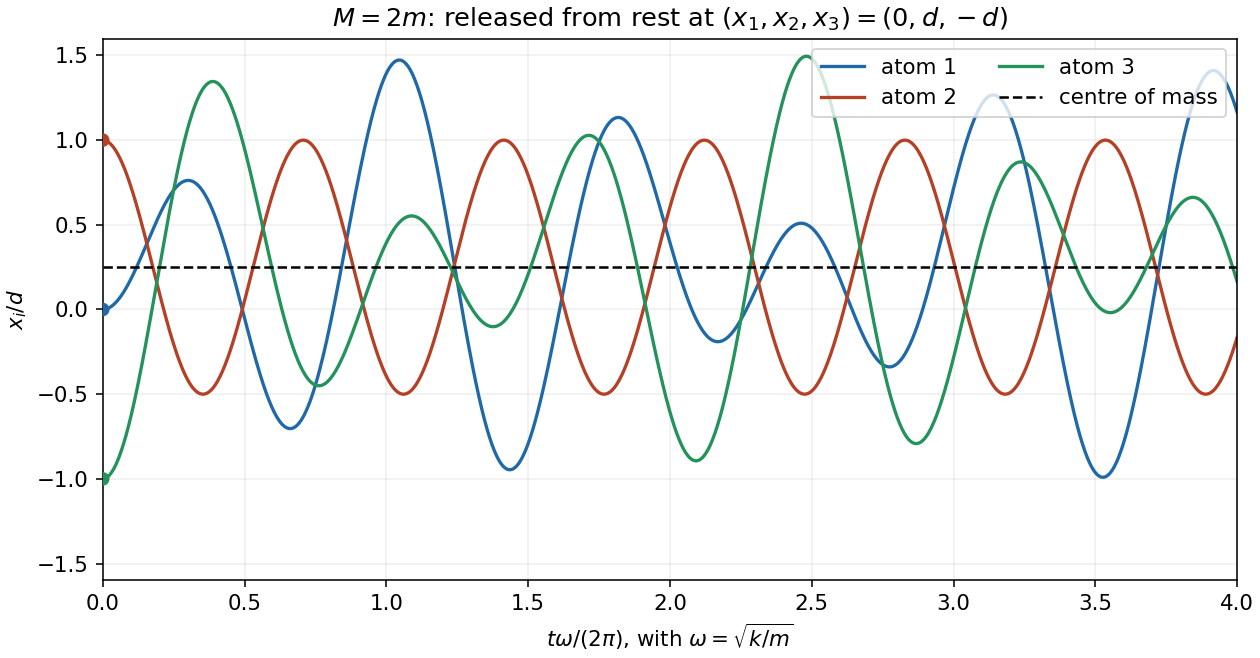
Triatomic-chain motion from the specified initial displacement, including its constant centre of mass
. Details. Past exam of the mathematical methods II course of the University of Oxford 2016 9 d Solution by Codex 0 2026-10-25
Codex 0 2026-10-25For the zero normal mode, . The molecule translates uniformly; a common constant displacement is the special case . For the lower vibrational normal mode, put :The end atoms move oppositely with equal amplitudes, while the central atom remains stationary. In the higher vibrational normal mode, with ,The ends move together and the centre moves in the opposite direction, with central amplitude times an end amplitude. Both internal modes keep the centre of mass fixed and obey mass-weighted orthogonality. The zero mode instead describes motion of that centre of mass.
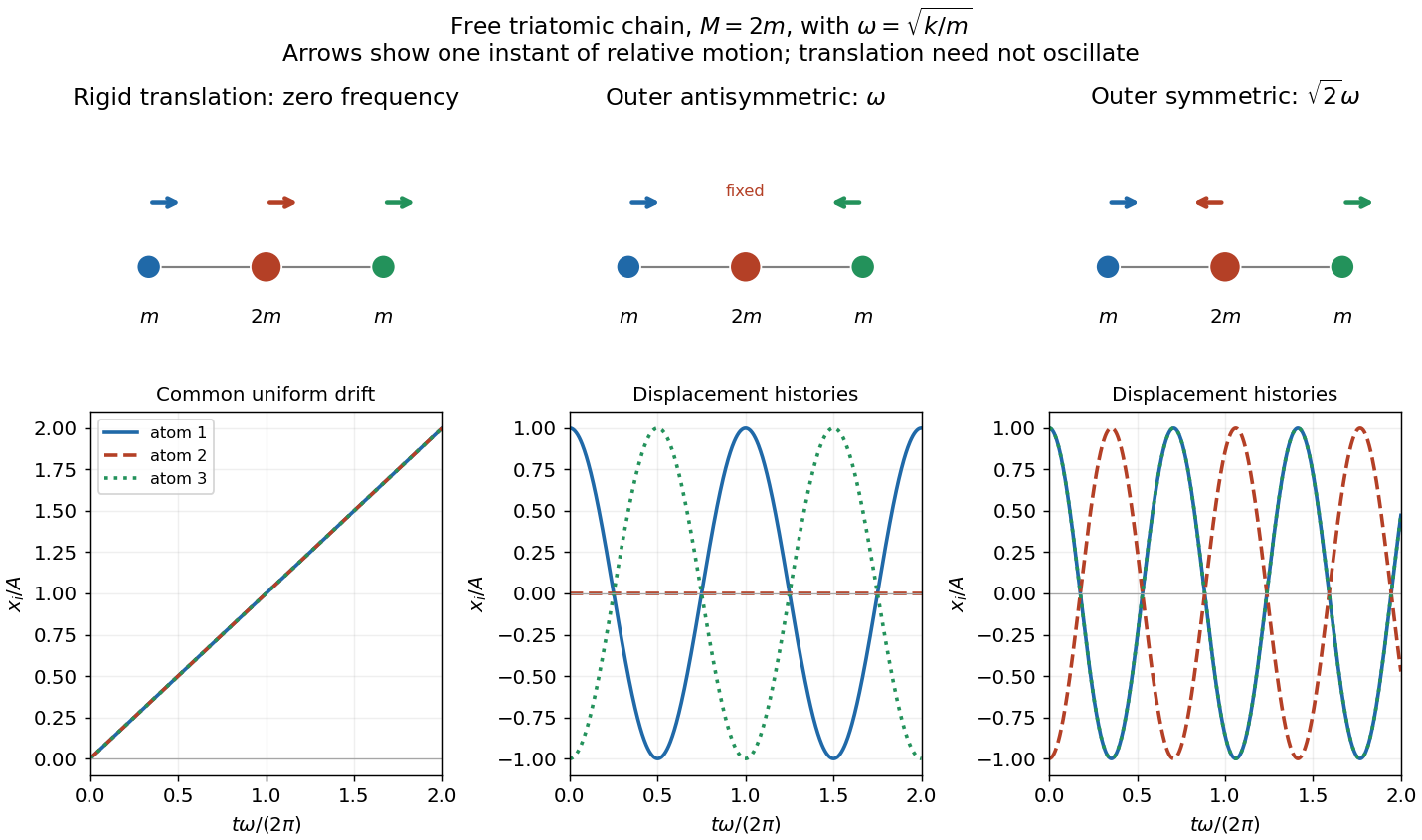
Three free-chain mode shapes and their displacement histories, shown for central mass twice an end mass
. Details. Past exam of the mathematical methods II course of the University of Oxford 2016 9 c Solution by Codex 0 2026-10-25
Codex 0 2026-10-25Write the displacement as . The generalized eigenvalue problem isThe symmetry of the two end atoms suggests an end-antisymmetric shape and two end-symmetric shapes. Direct substitution gives the normal modes of three masses connected by two equal springs:These three independent eigenvectors exhaust the three-dimensional system. The ordinary frequencies are ; the values above are angular frequencies.
Past exam of the mathematical methods II course of the University of Oxford 2016 9 b Solution by Codex 0 2026-10-25
Codex 0 2026-10-25A normal mode has a fixed pattern of relative displacements, with every coordinate proportional to one common time-dependent factor. There are three independent normal modes in this three-coordinate model: two internal vibrations and one zero-frequency rigid-body translation. The latter moves all three atoms together without stretching either spring. This count concerns the specified one-dimensional model, rather than a molecule with unrestricted three-dimensional motion.
Pinned article: Introduction to the OurBigBook Project
Welcome to the OurBigBook Project! Our goal is to create the perfect publishing platform for STEM subjects, and get university-level students to write the best free STEM tutorials ever.
Everyone is welcome to create an account and play with the site: ourbigbook.com/go/register. We belive that students themselves can write amazing tutorials, but teachers are welcome too. You can write about anything you want, it doesn't have to be STEM or even educational. Silly test content is very welcome and you won't be penalized in any way. Just keep it legal!
Intro to OurBigBook
. Source. We have two killer features:
- topics: topics group articles by different users with the same title, e.g. here is the topic for the "Fundamental Theorem of Calculus" ourbigbook.com/go/topic/fundamental-theorem-of-calculusArticles of different users are sorted by upvote within each article page. This feature is a bit like:
- a Wikipedia where each user can have their own version of each article
- a Q&A website like Stack Overflow, where multiple people can give their views on a given topic, and the best ones are sorted by upvote. Except you don't need to wait for someone to ask first, and any topic goes, no matter how narrow or broad
This feature makes it possible for readers to find better explanations of any topic created by other writers. And it allows writers to create an explanation in a place that readers might actually find it.
Figure 1. Screenshot of the "Derivative" topic page. View it live at: ourbigbook.com/go/topic/derivativeVideo 2. OurBigBook Web topics demo. Source. - local editing: you can store all your personal knowledge base content locally in a plaintext markup format that can be edited locally and published either:This way you can be sure that even if OurBigBook.com were to go down one day (which we have no plans to do as it is quite cheap to host!), your content will still be perfectly readable as a static site.
- to OurBigBook.com to get awesome multi-user features like topics and likes
- as HTML files to a static website, which you can host yourself for free on many external providers like GitHub Pages, and remain in full control

Figure 2. You can publish local OurBigBook lightweight markup files to either OurBigBook.com or as a static website.
Figure 3. Visual Studio Code extension installation.
Figure 5. . You can also edit articles on the Web editor without installing anything locally. Video 3. Edit locally and publish demo. Source. This shows editing OurBigBook Markup and publishing it using the Visual Studio Code extension. 
- Infinitely deep tables of contents:




All our software is open source and hosted at: github.com/ourbigbook/ourbigbook
Further documentation can be found at: docs.ourbigbook.com
Feel free to reach our to us for any help or suggestions: docs.ourbigbook.com/#contact