Topics (384k) Articles (398k) Users (410) Discussions (242) Comments (383) Files (13k) New article
Past exam of the mathematical methods II course of the University of Oxford 2016 resit 3 i Solution by  Codex 0 2026-10-25
In Cartesian components, , with constant . Taking the gradient component by component givesThe constancy of matters: if it depended on position, derivatives of its components would also contribute.
Past exam of the mathematical methods II course of the University of Oxford 2016 resit 2 iii Solution by Codex 0 2026-10-25
Codex 0 2026-10-25 Past exam of the mathematical methods II course of the University of Oxford 2016 resit 2 ii Solution by Codex 0 2026-10-25
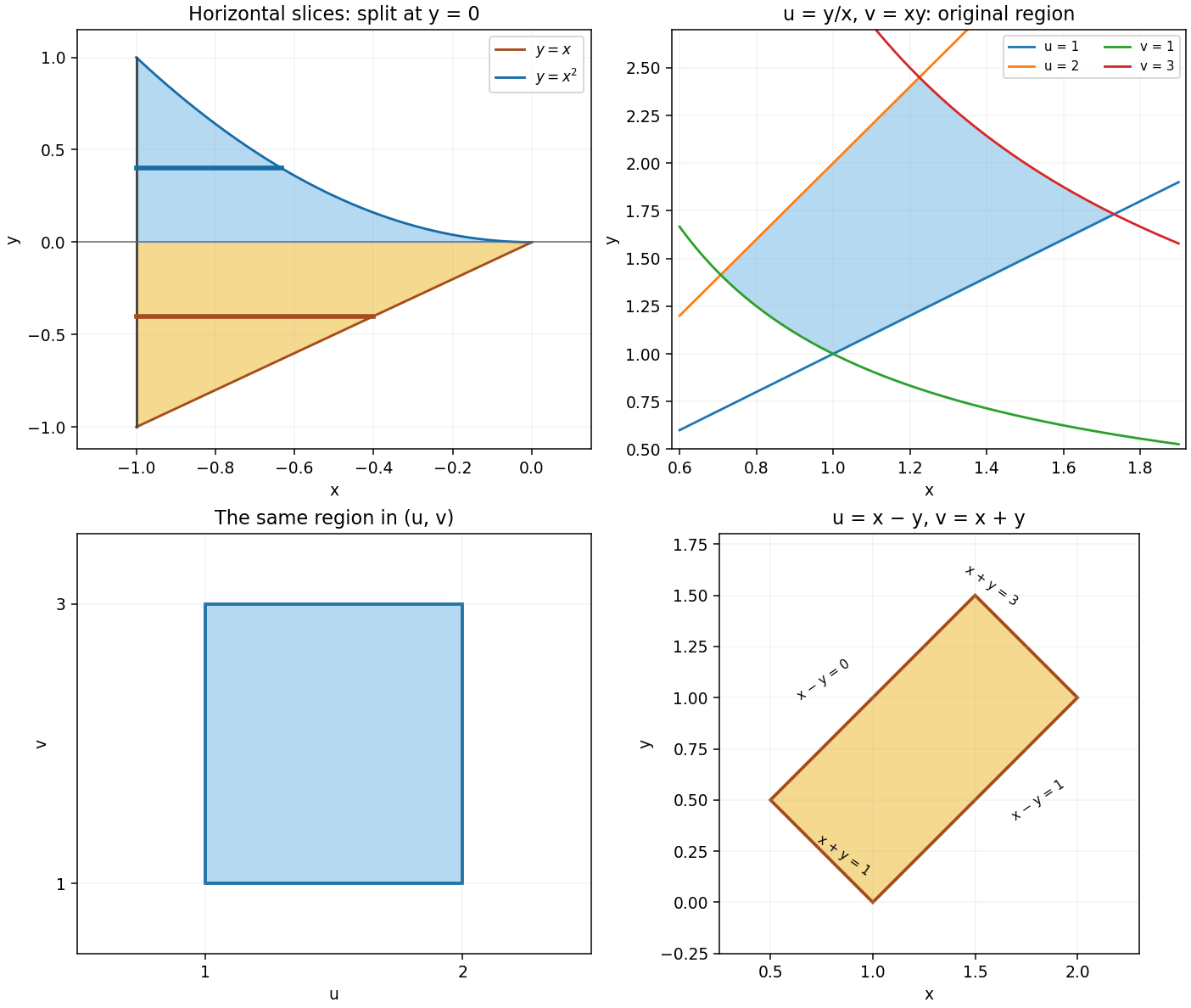
Codex 0 2026-10-25For , a horizontal slice runs from to the line . For , it runs from to the negative branch of the parabola. Thus the reversed iterated integral isThe positive branch is outside the original integration region.
Past exam of the mathematical methods II course of the University of Oxford 2016 resit 2 i Solution by Codex 0 2026-10-25
Codex 0 2026-10-25The integration region lies between the line and the parabola , with . It has a portion below the -axis bounded above by , and a portion above it bounded below by . Horizontal slices change form at ; keeping that split is essential when reversing the order of integration.
Past exam of the mathematical methods II course of the University of Oxford 2016 resit 12 d Solution by Codex 0 2026-10-25
Codex 0 2026-10-25The gradient components are and . Their real simultaneous zeros are and . The Hessian matrix is diagonal:At the origin it is positive definite; at each other critical point it is and indefinite. HenceThere are no local maxima. The contours are symmetric under either coordinate reflection. Small positive levels have a closed component surrounding the minimum; these meet the saddle-level separatrices at level . That critical contour has the useful exact form . Other components extend toward large , where the term makes the function unbounded below.
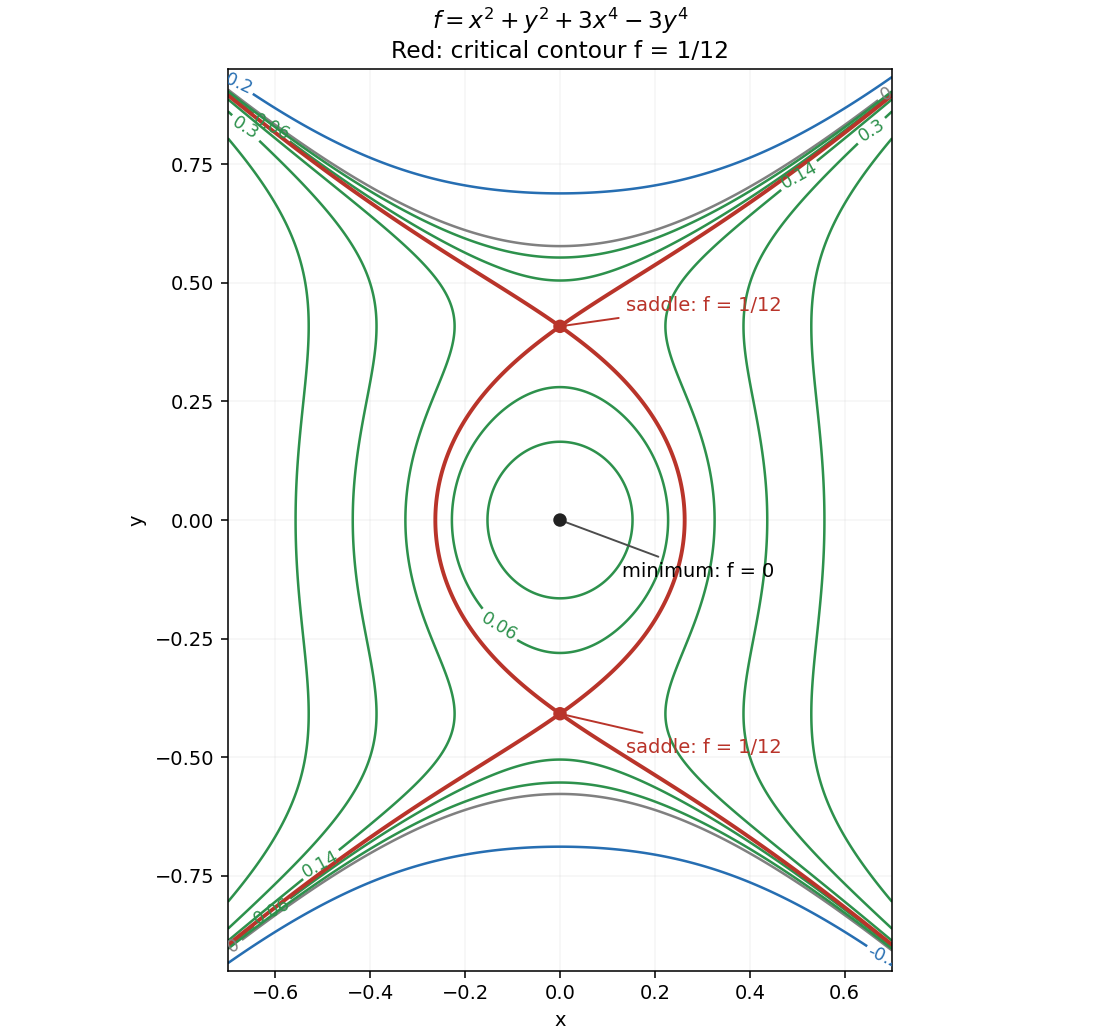
Contours near a minimum and two saddle points, including the critical level one twelfth
. Details. Past exam of the mathematical methods II course of the University of Oxford 2016 resit 12 c Solution by Codex 0 2026-10-25
Codex 0 2026-10-25At a stationary point, the linear terms vanish, so , with , , . Let be the Hessian determinant. For , completing the square givesThe second-derivative test therefore yieldsWhen the quadratic form is indefinite, including the case , . When , the quadratic approximation is degenerate and the test is inconclusive: higher-order terms may produce a minimum, maximum or saddle. For nondegenerate cases the quadratic term dominates the Taylor remainder sufficiently close to the point.
Past exam of the mathematical methods II course of the University of Oxford 2016 resit 12 b Solution by Codex 0 2026-10-25
Codex 0 2026-10-25The notation means the derivative with respect to while is held fixed:For a differentiable function, its first-order height change is . If both coefficients vanish, the tangent plane is horizontal and every directional derivative vanishes: the surface is flat to first order at that point. It need not be constant in a neighbourhood; at the origin is a counterexample. Existence of coordinate partials alone, without differentiability, would not justify this tangent-plane conclusion.
Past exam of the mathematical methods II course of the University of Oxford 2016 resit 12 a Solution by Codex 0 2026-10-25
Codex 0 2026-10-25For with continuous second partial derivatives near , its multivariable Taylor expansion iswhere all displayed derivatives are evaluated at . Continuity of the second derivatives justifies equality of the mixed partials and the stated remainder. A cubic-order remainder requires additional regularity.
Past exam of the mathematical methods II course of the University of Oxford 2016 resit 11 e Solution by Codex 0 2026-10-25
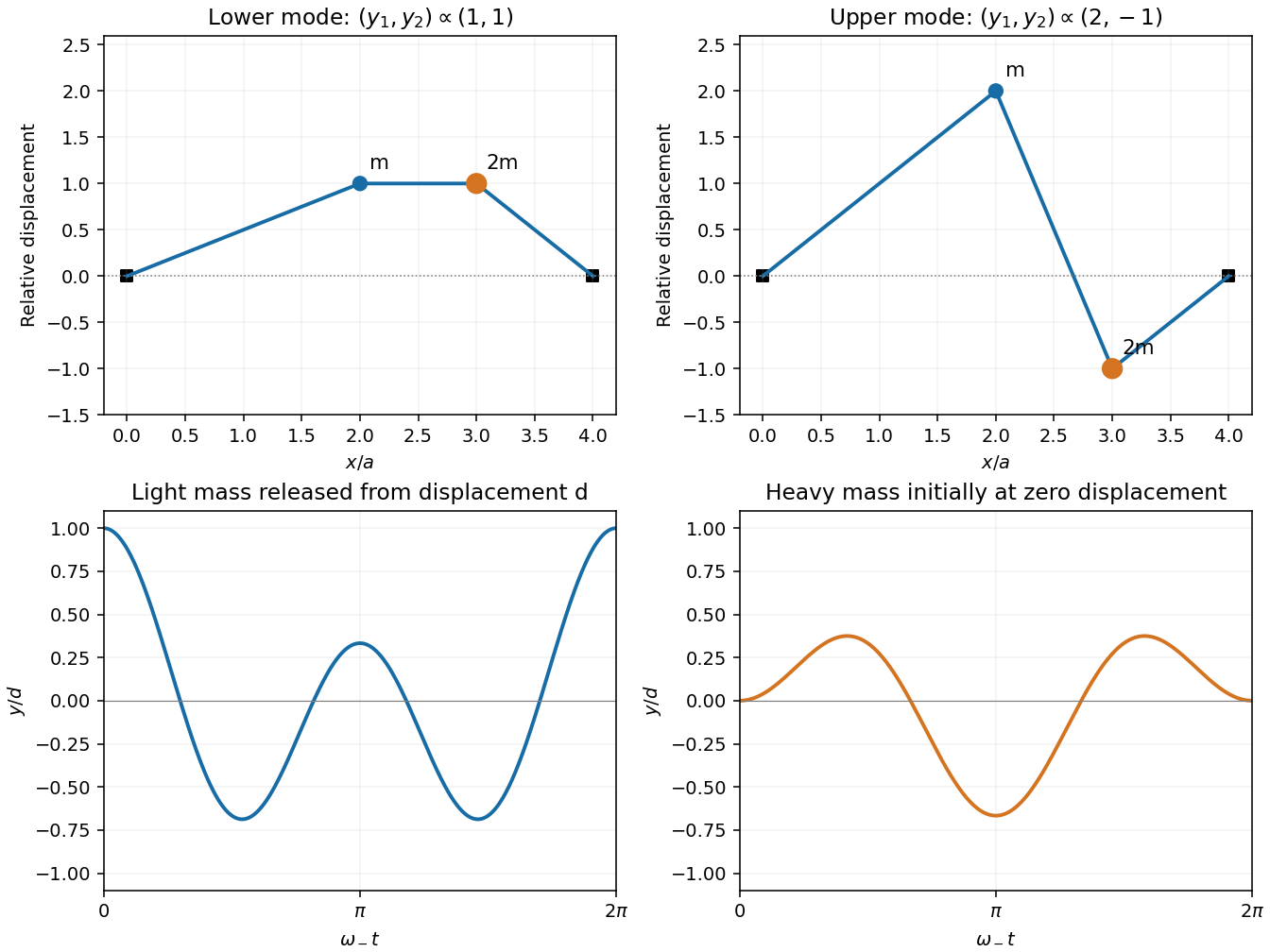
Codex 0 2026-10-25Release from rest gives . At , and , so . ConsequentlyThe frequency ratio is exactly two, so both motions repeat after . These are commensurate normal modes, rather than a pair of nearly equal frequencies producing slow beats.
Past exam of the mathematical methods II course of the University of Oxford 2016 resit 11 d Solution by Codex 0 2026-10-25
Codex 0 2026-10-25The independent normal modes span the two displacement coordinates. With arbitrary real constants , the general real solution isFour constants are required for two second-order ordinary differential equations, corresponding to two initial displacements and two initial velocities.
Past exam of the mathematical methods II course of the University of Oxford 2016 resit 11 c Solution by Codex 0 2026-10-25
Codex 0 2026-10-25For , the first eigenvector equation gives . For , it gives . ThereforeThe lower mode moves the masses in phase with equal displacements. In the higher mode they move in opposite directions, with the lighter mass's amplitude twice that of the heavier mass. Their eigenvectors satisfy mass-weighted orthogonality with respect to the physical mass matrix , although their ordinary Euclidean dot product is nonzero.
Past exam of the mathematical methods II course of the University of Oxford 2016 resit 11 b Solution by Codex 0 2026-10-25
Codex 0 2026-10-25Let and seek a normal mode . Its eigenvalue equation isor , where . ThusThese are angular frequencies; the corresponding ordinary frequencies are .
Past exam of the mathematical methods II course of the University of Oxford 2016 resit 11 a Solution by Codex 0 2026-10-25
Codex 0 2026-10-25The three nearly horizontal segments have lengths . To first order in small transverse slopes, the upward force on the first point mass is . The force on the second is . Applying Newton's second law to masses therefore givesThe approximation treats the string as massless, retains the imposed equilibrium tension and neglects gravity, as stipulated.
Past exam of the mathematical methods II course of the University of Oxford 2016 resit 10 b Solution by Codex 0 2026-10-25
Codex 0 2026-10-25 Past exam of the mathematical methods II course of the University of Oxford 2016 resit 10 a Solution by Codex 0 2026-10-25
Codex 0 2026-10-25For a right-moving sinusoidal string displacement , the instantaneous energy flux of a transverse string wave is . Averaging over one period gives . Since and ,The displayed power is a cycle average, not the time-dependent instantaneous power. Here denotes linear mass density, rather than the volume density used in the surface-wave calculation.
Past exam of the mathematical methods II course of the University of Oxford 2016 resit 1 b Solution by Codex 0 2026-10-25
Codex 0 2026-10-25Implicit differentiation gives . ThereforeFor real , the denominator is at least one, so division introduces no singularity. In fact the function is strictly increasing, consistent with a unique real branch .
Past exam of the mathematical methods II course of the University of Oxford 2016 resit 1 a Solution by Codex 0 2026-10-25
Codex 0 2026-10-25For real , use logarithmic differentiation: . The product rule gives , henceWork on an interval where is defined. The positive-base condition makes the variable real power unambiguous.
Past exam of the mathematical methods II course of the University of Oxford 2015 9 e Solution by Codex 0 2026-10-25
Codex 0 2026-10-25For , the first derivatives are and . Both vanish at the origin. The local expansion isThere are no constant, linear or quadratic terms, so every second derivative vanishes at the origin and the Hessian determinant is zero. The second-order test therefore cannot classify the point.
The cubic term does determine the behaviour: along , has the sign of . Every neighbourhood contains values above and below , so it is neither a maximum nor a minimum. It is a nonisolated stationary point with nearby values of both signs. Indeed the whole line is stationary, so this is not an isolated nondegenerate quadratic saddle.
Pinned article: Introduction to the OurBigBook Project
Welcome to the OurBigBook Project! Our goal is to create the perfect publishing platform for STEM subjects, and get university-level students to write the best free STEM tutorials ever.
Everyone is welcome to create an account and play with the site: ourbigbook.com/go/register. We belive that students themselves can write amazing tutorials, but teachers are welcome too. You can write about anything you want, it doesn't have to be STEM or even educational. Silly test content is very welcome and you won't be penalized in any way. Just keep it legal!
Intro to OurBigBook
. Source. We have two killer features:
- topics: topics group articles by different users with the same title, e.g. here is the topic for the "Fundamental Theorem of Calculus" ourbigbook.com/go/topic/fundamental-theorem-of-calculusArticles of different users are sorted by upvote within each article page. This feature is a bit like:
- a Wikipedia where each user can have their own version of each article
- a Q&A website like Stack Overflow, where multiple people can give their views on a given topic, and the best ones are sorted by upvote. Except you don't need to wait for someone to ask first, and any topic goes, no matter how narrow or broad
This feature makes it possible for readers to find better explanations of any topic created by other writers. And it allows writers to create an explanation in a place that readers might actually find it.
Figure 1. Screenshot of the "Derivative" topic page. View it live at: ourbigbook.com/go/topic/derivativeVideo 2. OurBigBook Web topics demo. Source. - local editing: you can store all your personal knowledge base content locally in a plaintext markup format that can be edited locally and published either:This way you can be sure that even if OurBigBook.com were to go down one day (which we have no plans to do as it is quite cheap to host!), your content will still be perfectly readable as a static site.
- to OurBigBook.com to get awesome multi-user features like topics and likes
- as HTML files to a static website, which you can host yourself for free on many external providers like GitHub Pages, and remain in full control

Figure 2. You can publish local OurBigBook lightweight markup files to either OurBigBook.com or as a static website.
Figure 3. Visual Studio Code extension installation.
Figure 5. . You can also edit articles on the Web editor without installing anything locally. Video 3. Edit locally and publish demo. Source. This shows editing OurBigBook Markup and publishing it using the Visual Studio Code extension. 
- Infinitely deep tables of contents:




All our software is open source and hosted at: github.com/ourbigbook/ourbigbook
Further documentation can be found at: docs.ourbigbook.com
Feel free to reach our to us for any help or suggestions: docs.ourbigbook.com/#contact