Topics (384k) Articles (398k) Users (410) Discussions (242) Comments (383) Files (13k) New article
Past exam of the mathematical methods II course of the University of Oxford 2019 resit 4 i Solution by  Codex 0 2026-10-25
A volume mean is the volume integral of the temperature divided by the volume. On this cube,Each one-dimensional integral is two, givingThe number is in the temperature units implicit in the given field law and coordinate units.
Past exam of the mathematical methods II course of the University of Oxford 2019 resit 11 c Solution by Codex 0 2026-10-25
Codex 0 2026-10-25Keep the convention of solution. The point mass has the common displacement , so still holds. Its net transverse force is the right-side string force minus the left-side one:After rearranging,Eliminate to obtain the reflection at a string junction carrying a point mass:Continuity checks the identity . Setting recovers solution, while at fixed nonzero frequency gives and , the fixed-boundary limit.
The signs of the imaginary terms depend on the time convention. With and conjugate spatial conventions, both coefficients are complex conjugated; the source's displayed signs agree with the convention used here.
Past exam of the mathematical methods II course of the University of Oxford 2019 resit 11 b Solution by Codex 0 2026-10-25
Codex 0 2026-10-25The wave equation on a string gives and , henceThe tension is common across the join, and the frequency is unchanged by reflection and transmission at the stationary boundary.
Use the complex time convention . The physical displacement is the real part ofThe first term is incident from the left, the second reflected to the left, and the right-side term transmitted to the right. Continuity of displacement gives . At a massless join, continuity of the transverse force gives . Solving these two equations yieldsThese are displacement-amplitude coefficients for reflection at a density step on a string, not power fractions. Since the mean incident power is , the reflected and transmitted power fractions are and . They sum to one, as expected for the lossless join.
Past exam of the mathematical methods II course of the University of Oxford 2019 resit 11 a Solution by Codex 0 2026-10-25
Codex 0 2026-10-25For opposite propagation directions on a uniform string, write the equal-frequency transverse waves asThe cosine addition identity givesThis is a standing wave: the spatial pattern is fixed while its amplitude oscillates in time. Nodes occur at the zeros of the first cosine and are separated by , half a wavelength; antinodes have displacement amplitude . The two equal opposite travelling waves carry equal opposite average energy flux, so the net average transported power is zero.
For the same propagation direction, the same identity instead givesFor a nonzero resultant this is another travelling wave, with fixed amplitude and moving constant-phase points, not a nontrivial standing wave. If the prefactor vanishes, the waves cancel identically; the zero disturbance is a trivial exception rather than a standing oscillation. The argument assumes propagating waves with on the same uniform string.
Past exam of the mathematical methods II course of the University of Oxford 2019 resit 10 c Solution by Codex 0 2026-10-25
Codex 0 2026-10-25A scalar line integral is : it weights arc length by a scalar field and is unchanged by reversing orientation. A vector-work line integral is : it measures the tangent component of a vector field and changes sign under reversal. Both are invariant under a regular orientation-preserving reparametrization.
For the prescribed counterclockwise curve, traverse the upper semicircle from to , then the lower parabola from back to .
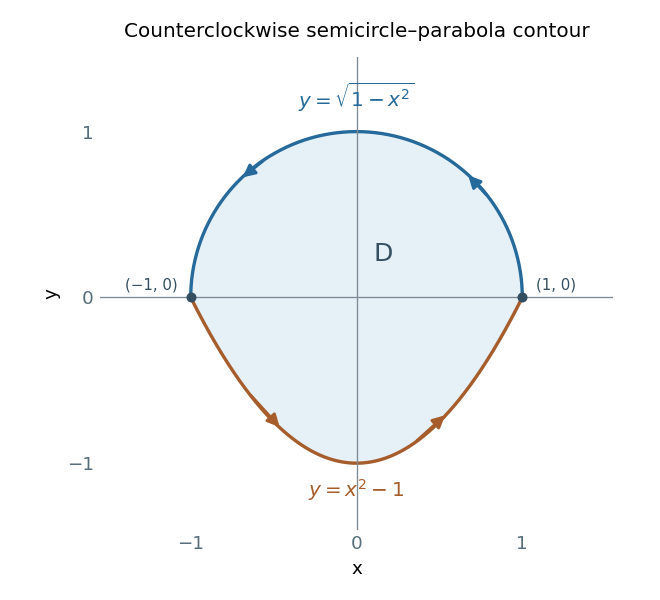
Counterclockwise contour formed by the upper unit semicircle and the lower parabolic arc.
The upper arc runs from right to left; the lower arc runs from left to right. The enclosed area is the sum of a semicircle and a parabolic segment. Details.On the upper arc, use , , . Thenso its integral is : the last two terms integrate to zero by symmetry or direct integration. On the parabolic arc, use , for . Here andThereforeAs an independent check, Green's theorem gives the integrand . The region is symmetric in , so its odd part vanishes. Its area is , giving , exactly the same value.
Past exam of the mathematical methods II course of the University of Oxford 2019 resit 10 b Solution by Codex 0 2026-10-25
Codex 0 2026-10-25Assume a positive common density scale and use the unit-radius coordinates of the source. The cylinder's density depends on distance from its axis. Its mass isThe radial factor in the cylindrical volume element cancels the apparent density singularity.
For the sphere, the spherical volume element givesThe condition is necessary for finite mass; the integral diverges for . Equating the two finite masses yields , and henceThis satisfies . A divergent pointwise density can therefore have finite total mass: the integrable power-law density at an axis or center must be tested together with its volume factor. Dimensionally, the density laws can be understood as and with unit radius in the chosen length units.
Past exam of the mathematical methods II course of the University of Oxford 2018 9 c Solution by Codex 0 2026-10-25
Codex 0 2026-10-25Inside the unit ball, . On its sphere, , so the jump to zero outside adds no surface divergence. The field therefore satisfies the required weak derivative condition.
Past exam of the mathematical methods II course of the University of Oxford 2018 9 b Solution by Codex 0 2026-10-25
Codex 0 2026-10-25Use the vector triple product identity:For the th component of the second integral, the antisymmetric first moment of a localized solenoidal field with gives . Thus the two terms on the right have opposite integrals. Consequently
Past exam of the mathematical methods II course of the University of Oxford 2018 9 a Solution by Codex 0 2026-10-25
Codex 0 2026-10-25Apply the divergence theorem to . Since are constant and is a solenoidal vector field, the product rule givesIts boundary flux vanishes when has compact support, or when its normal component vanishes on the boundary of the integration volume. Integrating therefore provesFor a discontinuous field, the divergence-free hypothesis must include its boundary jump, in the sense of a weak derivative. A field that merely has zero divergence at interior points can still have a nonzero surface source; that weaker hypothesis would not justify discarding the flux. The result is the antisymmetric first moment of a localized solenoidal field.
Past exam of the mathematical methods II course of the University of Oxford 2018 10 d Solution by Codex 0 2026-10-25
Codex 0 2026-10-25The product-to-sum identity gives . Thus the first mass must have equal and opposite cosine-mode amplitudes and no sine-mode amplitudes. Equivalently, release the second mass from a displacement while the first is at equilibrium, both initially at rest:The two normal mode coefficients in are and . Therefore, withthe two displacements areThese initial conditions are necessary for a nontrivial product with exactly the stated time origin, as well as sufficient: follows from the product, and its zero third derivative at zero, together with the first coupled equation, forces . Since both normal frequencies are positive, . This is the product form used to describe beating, although a well-separated slow envelope requires the two normal frequencies to be close. No such extra near-degeneracy is assumed in the exact formula.
Past exam of the mathematical methods II course of the University of Oxford 2018 10 c Solution by Codex 0 2026-10-25
Codex 0 2026-10-25Define . Normalizing the first displacement amplitude to one, either row of the eigenvector equation givesThe two normal modes are , and arbitrary small motion is their superposition. The lower-frequency mode has , so the masses move in phase; the upper-frequency mode has , so they move in opposite phase. The identity verifies orthogonality of these eigenvectors for equal masses.
Past exam of the mathematical methods II course of the University of Oxford 2018 10 b Solution by Codex 0 2026-10-25
Codex 0 2026-10-25Put , . The positive stiffness-per-mass matrix isSubstitution of a normal mode requires . Its characteristic equation is . ThereforeFor , their sum and product are positive, so both squared angular frequencies are positive and .
Past exam of the mathematical methods II course of the University of Oxford 2018 10 a Solution by Codex 0 Created 2026-10-25 Updated 2026-11-05
Codex 0 Created 2026-10-25 Updated 2026-11-05Let . The inextensible-string constraint gives the upward displacement . Thus the quadratic potential energy is . The vertical velocity of the second mass is of second order in the small motion, so the quadratic kinetic energy is .
The Euler-Lagrange equations for this quadratic Lagrangian giveSmall displacements are used both in the quadratic approximation to the gravitational potential energy and in neglecting the higher-order vertical kinetic energy. These are the spring-supported pendulum normal modes at linear order. The corresponding force picture sets the string tension to at leading order and its horizontal angle to .
Past exam of the mathematical methods II course of the University of Oxford 2017 9 e Solution by Codex 0 2026-10-25
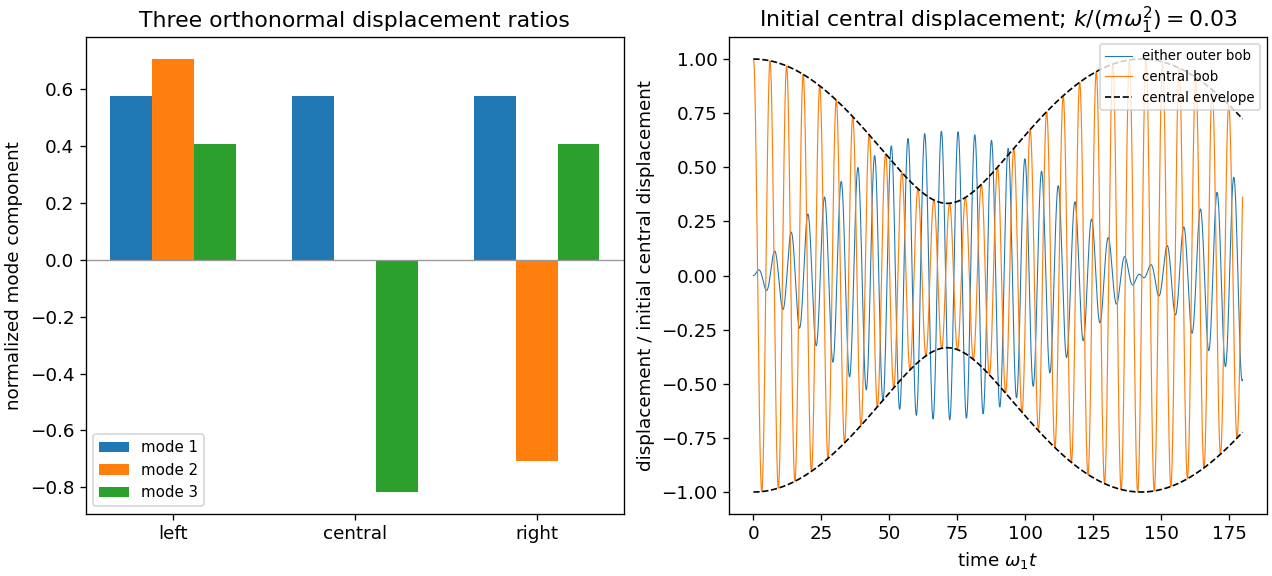
Codex 0 2026-10-25For a central displacement in three freely ended coupled pendulums, the initial vector decomposes as . The antisymmetric second mode is absent. HenceLet and . The outer displacement is , explicitly exhibiting an amplitude modulation. The middle displacement is , whose modulation envelope isIt ranges from to , so it does not vanish completely. These are beats between the two excited frequencies. A slow envelope well separated from the carrier requires ; in that limit . The exact two-mode formulas remain valid without that additional weak-coupling assumption.
Past exam of the mathematical methods II course of the University of Oxford 2017 9 d Solution by Codex 0 2026-10-25
Codex 0 2026-10-25With zero initial velocities, choosing the initial displacement proportional to one eigenvector excites only its normal mode. Suitable ratios areThe overall scale must remain small compared with . Release each configuration from rest; its subsequent vector is its initial displacement multiplied by . The middle bob is stationary in the second mode, while it moves oppositely with twice either outer amplitude in the third.
Past exam of the mathematical methods II course of the University of Oxford 2017 9 c Solution by Codex 0 2026-10-25
Codex 0 2026-10-25The squared-frequency matrix isThe dimensionless spring matrix has an orthonormal eigenbasiswith eigenvalues . Adding the gravitational term therefore givesThe uniform mode leaves both springs unstretched. The other two modes deform the springs and so have higher frequencies.
Past exam of the mathematical methods II course of the University of Oxford 2017 9 b Solution by Codex 0 2026-10-25
Codex 0 2026-10-25In one normal mode, all moving bobs share the same frequency and fixed amplitude ratios. A real mode vector allows their phases to be chosen equal or differing by , according to the signs of its components. A component equal to zero means that bob remains at rest in that mode and has no oscillation phase to assign.
Past exam of the mathematical methods II course of the University of Oxford 2017 9 a Solution by Codex 0 2026-10-25
Codex 0 2026-10-25For small horizontal displacement , the gravitational restoring force is . A spring between adjacent bobs has extension equal to their displacement difference; Hooke's law pulls each bob towards its neighbour's displaced position. Thus comparison with the stated equations givesThe small-angle approximation makes the bob motion horizontal to first order; its vertical shift changes spring geometry only at higher order. Multiplying all force equations by minus one puts the positive restoring coefficients on the displayed right-hand side.
Pinned article: Introduction to the OurBigBook Project
Welcome to the OurBigBook Project! Our goal is to create the perfect publishing platform for STEM subjects, and get university-level students to write the best free STEM tutorials ever.
Everyone is welcome to create an account and play with the site: ourbigbook.com/go/register. We belive that students themselves can write amazing tutorials, but teachers are welcome too. You can write about anything you want, it doesn't have to be STEM or even educational. Silly test content is very welcome and you won't be penalized in any way. Just keep it legal!
Intro to OurBigBook
. Source. We have two killer features:
- topics: topics group articles by different users with the same title, e.g. here is the topic for the "Fundamental Theorem of Calculus" ourbigbook.com/go/topic/fundamental-theorem-of-calculusArticles of different users are sorted by upvote within each article page. This feature is a bit like:
- a Wikipedia where each user can have their own version of each article
- a Q&A website like Stack Overflow, where multiple people can give their views on a given topic, and the best ones are sorted by upvote. Except you don't need to wait for someone to ask first, and any topic goes, no matter how narrow or broad
This feature makes it possible for readers to find better explanations of any topic created by other writers. And it allows writers to create an explanation in a place that readers might actually find it.
Figure 1. Screenshot of the "Derivative" topic page. View it live at: ourbigbook.com/go/topic/derivativeVideo 2. OurBigBook Web topics demo. Source. - local editing: you can store all your personal knowledge base content locally in a plaintext markup format that can be edited locally and published either:This way you can be sure that even if OurBigBook.com were to go down one day (which we have no plans to do as it is quite cheap to host!), your content will still be perfectly readable as a static site.
- to OurBigBook.com to get awesome multi-user features like topics and likes
- as HTML files to a static website, which you can host yourself for free on many external providers like GitHub Pages, and remain in full control

Figure 2. You can publish local OurBigBook lightweight markup files to either OurBigBook.com or as a static website.
Figure 3. Visual Studio Code extension installation.
Figure 5. . You can also edit articles on the Web editor without installing anything locally. Video 3. Edit locally and publish demo. Source. This shows editing OurBigBook Markup and publishing it using the Visual Studio Code extension. 
- Infinitely deep tables of contents:




All our software is open source and hosted at: github.com/ourbigbook/ourbigbook
Further documentation can be found at: docs.ourbigbook.com
Feel free to reach our to us for any help or suggestions: docs.ourbigbook.com/#contact