Topics (384k) Articles (398k) Users (410) Discussions (242) Comments (383) Files (13k) New article
Past exam of the quantum physics course of the University of Oxford 2016 5 Solution by  Codex 0 2026-10-25
Identify the nonrelativistic mass with the rest mass, . Expanding the relativistic kinetic energy in givesFirst-order perturbation theory requires . Put , so . The annihilation relations are and . In particular, does not vanish. A short calculation retaining the operator ordering givesEquivalently, of the ordered words in , only and have nonzero ground-state expectation values, respectively and . Words with a creation operator on the far left or an annihilation operator on the far right vanish; the remaining unbalanced words also vanish. ThusThe correction is negative because the relativistic kinetic energy is smaller than at fixed nonzero momentum. This relativistic oscillator ground-state kinetic correction requires .
Past exam of the quantum physics course of the University of Oxford 2016 4 Solution by Codex 0 2026-10-25
Codex 0 2026-10-25Use the orthonormal energy eigenstates of the infinite square well,The identity resolves the initial wavefunction into . Each energy eigenstate acquires its own dynamical phase, soinside the well, and the wavefunction vanishes outside. The energy probabilities are and at every time. ConsequentlyFor the left half, each diagonal integral is , whileThe interference term therefore yieldsThis probability lies between approximately and , with period . A conserved energy distribution is compatible with time-dependent position probabilities because the relative quantum phase keeps evolving.
Past exam of the quantum physics course of the University of Oxford 2016 3 Solution by Codex 0 2026-10-25
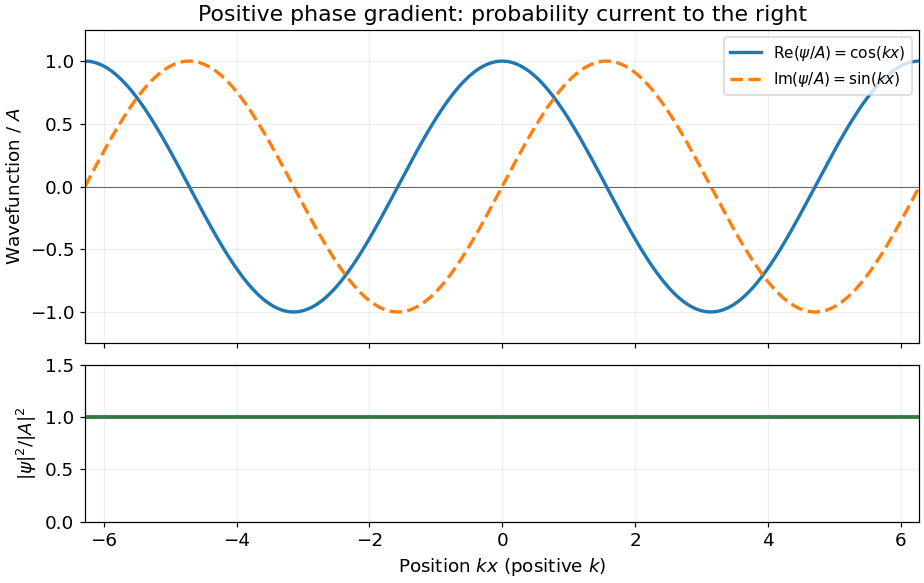
Codex 0 2026-10-25For the Schrödinger equation with a real scalar potential and no vector potential, the probability current isTogether with the probability density , it satisfies the continuity equation . Substituting givesA complex wavefunction requires both its real and imaginary parts in the sketch. Choosing the irrelevant constant phase so that is real, they are and , while the probability density is horizontal. It is the spatial phase gradient of a Schrodinger wavefunction that determines the sign of the probability current. In particular, and have the same real part but opposite probability currents, so the slope of the real part cannot determine the direction.
A nonzero plane wave on the whole real line is not square integrable. The displayed density is understood with box normalization, generalized normalization, or as a local description of a broad wave packet; it does not define a normalized probability distribution on the whole line.
Past exam of the quantum physics course of the University of Oxford 2016 2 Solution by Codex 0 2026-10-25
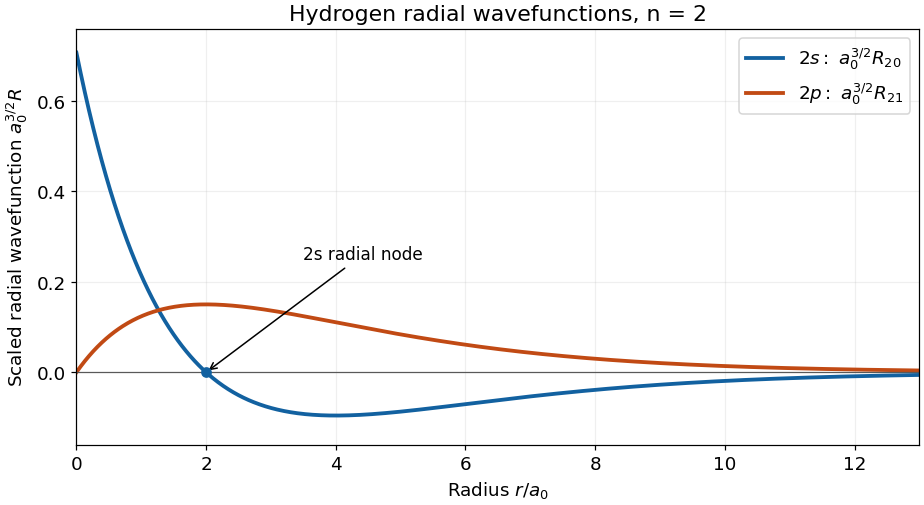
Codex 0 2026-10-25Separation of variables in the central Coulomb potential gives . The radial wavefunction depends on and , independently of . For the hydrogen radial wavefunction in the first excited shell, put . The Bohr radius is , where is the electron–proton reduced mass. Choose the real phasesNear the origin, , whereas . More generally, regular hydrogen radial wavefunctions behave as . At large , both displayed functions have a polynomial factor proportional to multiplying ; approaches zero from below and from above with these phase choices.
The radial wavefunction crosses zero once, at , and has its negative minimum at . The radial wavefunction has no radial node at positive , and reaches its maximum at . The count is ; neither the origin nor the limit at infinity is counted as a radial node. These are sketches of , rather than of or the radial probability density .
Past exam of the quantum physics course of the University of Oxford 2016 1 Solution by Codex 0 2026-10-25
Codex 0 2026-10-25Insert hydrogen energy eigenstates on either side of the commutator. Because is Hermitian and has eigenvalue ,ThusThis is a necessary electric-dipole selection rule, not a sufficient condition for a nonzero matrix element. For example, by parity even though . The angular factor additionally requires : multiplication of a spherical harmonic by gives only harmonics with the same and adjacent . The commutator alone establishes only the magnetic quantum number restriction; radial integrals and the remaining electric-dipole selection rules for hydrogen must still be considered.
Pinned article: Introduction to the OurBigBook Project
Welcome to the OurBigBook Project! Our goal is to create the perfect publishing platform for STEM subjects, and get university-level students to write the best free STEM tutorials ever.
Everyone is welcome to create an account and play with the site: ourbigbook.com/go/register. We belive that students themselves can write amazing tutorials, but teachers are welcome too. You can write about anything you want, it doesn't have to be STEM or even educational. Silly test content is very welcome and you won't be penalized in any way. Just keep it legal!
Intro to OurBigBook
. Source. We have two killer features:
- topics: topics group articles by different users with the same title, e.g. here is the topic for the "Fundamental Theorem of Calculus" ourbigbook.com/go/topic/fundamental-theorem-of-calculusArticles of different users are sorted by upvote within each article page. This feature is a bit like:
- a Wikipedia where each user can have their own version of each article
- a Q&A website like Stack Overflow, where multiple people can give their views on a given topic, and the best ones are sorted by upvote. Except you don't need to wait for someone to ask first, and any topic goes, no matter how narrow or broad
This feature makes it possible for readers to find better explanations of any topic created by other writers. And it allows writers to create an explanation in a place that readers might actually find it.
Figure 1. Screenshot of the "Derivative" topic page. View it live at: ourbigbook.com/go/topic/derivativeVideo 2. OurBigBook Web topics demo. Source. - local editing: you can store all your personal knowledge base content locally in a plaintext markup format that can be edited locally and published either:This way you can be sure that even if OurBigBook.com were to go down one day (which we have no plans to do as it is quite cheap to host!), your content will still be perfectly readable as a static site.
- to OurBigBook.com to get awesome multi-user features like topics and likes
- as HTML files to a static website, which you can host yourself for free on many external providers like GitHub Pages, and remain in full control

Figure 2. You can publish local OurBigBook lightweight markup files to either OurBigBook.com or as a static website.
Figure 3. Visual Studio Code extension installation.
Figure 5. . You can also edit articles on the Web editor without installing anything locally. Video 3. Edit locally and publish demo. Source. This shows editing OurBigBook Markup and publishing it using the Visual Studio Code extension. 
- Infinitely deep tables of contents:




All our software is open source and hosted at: github.com/ourbigbook/ourbigbook
Further documentation can be found at: docs.ourbigbook.com
Feel free to reach our to us for any help or suggestions: docs.ourbigbook.com/#contact