Topics (384k) Articles (398k) Users (410) Discussions (242) Comments (383) Files (13k) New article
Past exam of the perception course of the year 2 of the psychology (experimental) course of the University of Oxford 2022 3 Solution by  Codex 0 2026-10-25
Hearing requires estimating sound-producing events from noisy mixtures at two ears. It involves mechanical detection, neural coding, source segregation and recognition. A frequency analysis alone cannot identify who or what produced the sound.
The physical input is an acoustic pressure fluctuation. At one ear a simplified room model iswhere source signals are filtered by propagation and reflection paths , and is noise. The convolution model assumes approximately linear, time-invariant propagation over the analysis interval; a moving source or listener can violate that simplification. This is a many-to-one inverse problem: different source configurations can produce similar ear signals. Distance, reverberation and head orientation alter a source's waveform. Pressure level is logarithmic: sound pressure level is , with reference in air. A 100 dB difference corresponds to a pressure ratio . The system must remain sensitive to weak signals while avoiding saturation over a large operating range.
The middle ear helps transfer airborne vibrations into cochlear fluids despite an acoustic impedance mismatch. Within the cochlea, the graded mechanics of the basilar membrane produce frequency-dependent traveling-wave responses: high frequencies peak nearer the base, low frequencies farther toward the apex. This tonotopy provides a distributed spectral representation. Deflection of sensory hair cells drives mechanotransduction; inner hair cells provide most afferent signaling, while outer hair cells contribute to mechanical amplification and tuning. Detection therefore depends on an active biological filter, not merely a passive bank of resonators.
A revealing experiment by Mario A. Ruggero and colleagues measured chinchilla basilar-membrane vibrations using the Mössbauer technique or Doppler laser velocimetry before and after a reversible intervention that reduced cochlear transduction currents. Responses near the characteristic frequency were reduced particularly strongly for weak sounds, with smaller changes at high levels and away from that frequency.[ref]
Furosemide Alters Organ of Corti Mechanics: Evidence for Feedback of Outer Hair Cells upon the Basilar Membrane by Mario A. Ruggero and others. Abstract and response-level/frequency comparisons, J Neurosci 11, pp. 1057–1067
This supports feedback-dependent cochlear gain. The intervention also affects other cochlear processes, so it does not by itself identify every cellular contribution or directly measure human loudness. The important methodological contrast is controlled sound input plus measured mechanical output and a reversible physiological perturbation.The resulting neural code must preserve several attributes simultaneously. Place of excitation and neural phase locking can provide complementary frequency and temporal information; firing rates, adaptation and population responses encode level and envelopes. Individual neurons have limited dynamic ranges, and temporal precision has limits. Pitch is not simply the location of the strongest spectral component, and timbre depends on spectral shape and temporal development. Even physically, a signal containing harmonics at 200 and 300 Hz repeats every 10 ms although it contains no 100 Hz component: both components complete integer cycles in that interval. Recovering source periodicity is therefore different from selecting a component in a frequency spectrum. It does not follow that every such signal has one obligatory perceptual pitch.
Localization adds ambiguity. Ear separation yields interaural time differences; head shadow yields interaural level differences; outer-ear filtering supplies direction-dependent spectral cues. In an ideal far-field point-receiver model, , obtained by dividing the path-length difference by sound speed. Real head diffraction modifies this approximation. One time difference can be compatible with several spatial directions, and phase is ambiguous when several cycles fit the delay. Head-related transfer functions, head movements and environmental context help resolve these ambiguities. Reverberation also requires distinguishing useful early information from later reflections.
Competing sources create both energetic masking, in which the target is poorly represented against overlapping acoustic energy, and informational masking, involving source confusion or selection despite available acoustic cues. Common onsets, harmonic relations, coherent modulation, timbre and spatial cues help group components into auditory objects. The grouping must remain stable when streams overlap, but also update when a source changes. These are the problems of auditory scene analysis.
E. Colin Cherry's classic experiments used simultaneous spoken messages and separate messages delivered to the two ears. Asking listeners to repeat one message while ignoring the other made source selection experimentally measurable.[ref]
Some Experiments on the Recognition of Speech, with One and with Two Ears by E. Colin Cherry. Experiments on simultaneous speech and dichotic shadowing, JASA 25, pp. 975–979
Ear and voice differences can aid selection; the result does not show that unattended information is never processed, nor that real rooms provide the clean separation of headphone channels.Finally, meaningful recognition requires tolerance of speaker, rate and context variation. Richard M. Warren removed a speech segment and substituted a cough-like sound. Listeners could hear the utterance as continuous and had difficulty locating the replacement, whereas a silent interruption was more readily detected.[ref]
Perceptual Restoration of Missing Speech Sounds by Richard M. Warren. Science 167, pp. 392–393, replacement-sound versus silence comparison
Phonemic restoration shows that recognition uses constraints beyond the momentary waveform; it does not mean missing acoustic information has been physically recovered. Successful auditory perception combines peripheral sensitivity with grouping and context-sensitive inference, while retaining the possibility of masking, ambiguity and systematic error. Past exam of the perception course of the year 2 of the psychology (experimental) course of the University of Oxford 2022 2 Solution by Codex 0 2026-10-25
Codex 0 2026-10-25A psychometric function specifies the probability of a measured response as a physical stimulus variable changes. The response might be “present,” “clockwise,” or correct in a two-alternative forced-choice task. These are different dependent variables. Understanding the function's shape is necessary to distinguish sensory changes from decision, attention and measurement effects. A reported threshold without its task, response definition and performance criterion is incomplete. For example, a visual experiment could use calibrated display visual contrasts, timed two-interval presentations, fixation control and button choices; the observer’s choice supplies the dependent variable.
A smooth curve need not mean that a receptor has a smoothly varying conscious threshold. Consider a noisy internal response , with “yes” reported when . Here is a decision criterion, not necessarily a biological detection limit. If is the noise cumulative distribution function,With Gaussian noise of standard deviation , symmetry of the normal distribution gives a Gaussian psychometric functionThe sigmoid is therefore a distribution tail swept by a changing mean response. At low means, few responses exceed the criterion; near it, many trials switch category; at high means, almost all do. The derivative is , so slope depends on both sensory gain and variability. Moving shifts the curve without necessarily improving sensitivity. If noise vanished and the mean crossed the criterion sharply, this simple model would approach a step rather than a graded transition.
There is no universal sigmoid in every stimulus coordinate. A nonlinear transduction function changes the curve, and a logarithmic intensity axis changes its appearance. As a counterexample, a toy detector responding whenever at least one event occurs in a Poisson distribution with mean has . This is concave on a linear positive-intensity axis. It follows immediately by subtracting the zero-event probability from one. It is a mathematical example, not evidence that human detection universally uses a one-event rule. Variation in attention or decision criterion across trials can broaden a measured curve even if the within-state sensory noise is unchanged.
Task conventions determine the endpoints. A useful psychometric function with guessing and lapses isHere is the lower asymptote and the upper error asymptote. In balanced two-alternative forced-choice performance, is commonly fixed at . A yes/no response probability does not automatically have this lower bound. In this particular cumulative-Gaussian parameterization, ; thus gives 75% correct only for and . Other function families use different scale parameters. Nor is automatically the fraction of inattentive trials: if a fraction of trials involves random two-choice guessing, those trials contribute an upper error probability .
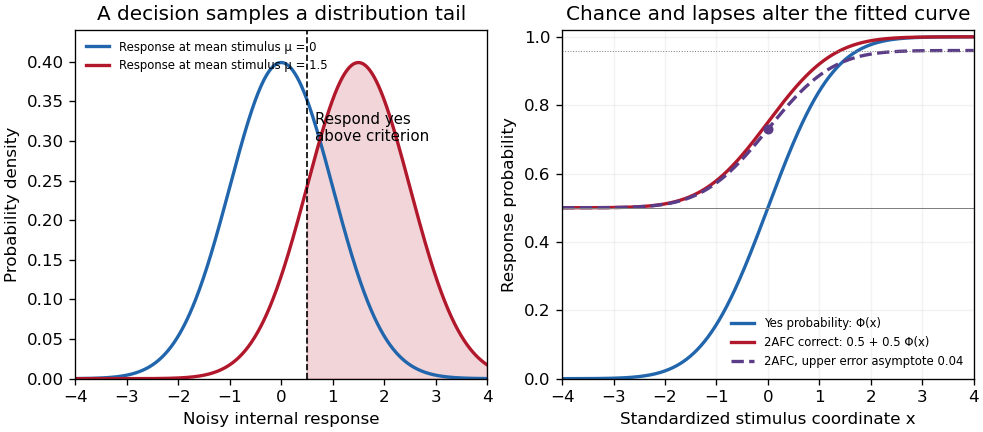
Original theoretical noisy-decision and psychometric-curve examples; the right panel is a phenomenological family, not observed participant data
. Details. The relation to signal detection theory is equally important. Under independent equal-variance Gaussian signal and noise samples, define sensitivity index . In an ideal two-interval comparison, the response difference has mean and variance , givingThis Gaussian forced-choice sensitivity relation follows by standardizing the Gaussian difference. It is a specified decision model, not an identity for every forced-choice experiment. In a yes/no task, hits and false alarms are both needed: under the corresponding equal-variance model, . A criterion change can increase both rates while leaving unchanged. The phenomenological fit above need not have parameters identical to these internal-response parameters.
These distinctions affect experiments. Felix A. Wichmann and N. Jeremy Hill used simulation and statistical modeling to show that unmodeled stimulus-independent errors can bias threshold and slope estimates, even when lapses are uncommon.[ref]
The psychometric function: I. Fitting, sampling, and goodness of fit by Felix A. Wichmann and N. Jeremy Hill. Notation, lapse simulations, and summary; Percept Psychophys 63, pp. 1293–1313
Ignoring high-intensity errors can make a function appear shallower and falsely suggest worse sensory precision. A broad group-average curve can likewise reflect a mixture of individually sharp functions with different locations.At predetermined stimulus levels, independent trials give counts . The parameter-dependent log-likelihood is . Fitting this binomial likelihood, checking goodness of fit and quantifying uncertainty are preferable to drawing a curve through noisy proportions. Easy trials help constrain lapses; levels near the transition constrain location and slope. Randomization, stable calibration and checks for learning or fatigue help distinguish a stationary sensory relation from drift. Adaptive procedures require inference appropriate to their sampling design.
Thus the function is both a description and a testable model. Its shape determines what a threshold means, how an experiment should sample, and which claims about sensory mechanisms are warranted.
Past exam of the perception course of the year 2 of the psychology (experimental) course of the University of Oxford 2022 1 Solution by Codex 0 2026-10-25
Codex 0 2026-10-25Individual differences show that color vision depends on receptor signals, their neural interpretation and the task used to measure them. They provide natural perturbations of the system, but differences in genes, matching, discrimination, naming and subjective appearance must not be treated as interchangeable.
A useful starting point is the principle of univariance. For a cone cell class , a simplified receptor quantum catch is , where is the incident photon distribution, including optical filtering, and is effective absorptance. One receptor's absorption count does not uniquely identify wavelength: increasing intensity can compensate for a change in spectral sensitivity. Comparing classes supplies spectral information. With three classes, distinct spectra can satisfy three equal-catch constraints and therefore be metamers. This is information loss: if a spectrum is represented by more than three independent wavelength bins, its three-channel sampling matrix has a nontrivial kernel. Around a strictly positive spectrum, sufficiently small changes along that kernel preserve nonnegative stimulus values and all three catches. Thus the observer, not wavelength alone, defines a color match. With luminance fixed, three independent receptor coordinates leave at most two independent chromatic coordinates.
Inherited differences test that account. Dichromacy removes one independent class of cone input; anomalous trichromacy retains three classes but with altered spectral separation, often weakening particular discriminations. L and M are overlapping long- and middle-wave sensitivities, not detectors that individually label light “red” and “green.” Molecular work by Jeremy Nathans and colleagues identified cone pigment genes, then related inherited red–green variation to changes in the corresponding gene arrays.[ref]
Molecular genetics of human color vision: the genes encoding blue, green, and red pigments by Jeremy Nathans and others. Science 232, pp. 193–202, pigment-gene identification
[ref]Molecular Genetics of Inherited Variation in Human Color Vision by Jeremy Nathans and others. Science 232, pp. 203–210, genotype–phenotype comparison
The important inference is a relation between biological variation and available spectral signals, not a claim that all observers with one label have identical vision.A Rayleigh color match makes that inference measurable. An observer adjusts a mixture of two narrowband lights to match a comparison light, with brightness adjusted separately. The accepted mixture and matching range constrain pigment sensitivities and discriminability. A color discrimination task instead measures whether two stimuli can be distinguished, ideally with luminance cues controlled and a fitted psychometric function. Plate tests and everyday color names are less specific: learned labels or a brightness difference can support a correct response without normal chromatic discrimination. Conversely, reduced discrimination does not imply a world without color.
Individual differences also reveal compensation. Heidi Hofer and colleagues used adaptive optics retinal imaging with selective pigment bleaching and retinal densitometry to classify cone cells in living eyes. In their small sample, men passing normal color-vision tests had L:M cone ratios spanning approximately 1.1:1 to 16.5:1; the paper's corrected abstract supplies the lower value. The ratio was not fixed even within the normal category.[ref]
Organization of the Human Trichromatic Cone Mosaic by Heidi Hofer and others. Methods and abstract, eight observers; corrected L:M ratio; J Neurosci 25, pp. 9669–9679
This rules out a simple requirement for one universal cone proportion. For example, opponent color processing could compare gain-adjusted cone signals rather than raw cell counts. It is compatible with post-receptoral gain adjustment and chromatic adaptation, but normal test scores do not prove identical subjective experiences or one uniquely identified compensatory mechanism.A stronger question is whether more receptor classes create more perceptual dimensions. Heterozygous carriers of certain X-linked pigment variants can, through X-chromosome inactivation, have a retina containing more than three spectrally distinct cone types. Yet four types need not supply four functionally independent signals to behavior. Gabriele Jordan and colleagues combined forced-choice matching, multidimensional scaling and genetic analysis. One of 24 obligate carriers of deuteranomaly showed behavior consistent with tetrachromacy across their tests; most did not.[ref]
The dimensionality of color vision in carriers of anomalous trichromacy by Gabriele Jordan and others. Abstract and behavioral/genetic tests, J Vis 10(8):12
This distinction between potential and demonstrated extra dimensionality is crucial. The selected sample cannot establish population prevalence, and additional opsin variants alone cannot establish enhanced discrimination or richer experience.Finally, optical and experiential differences must be controlled. Lens and macular filtering change the spectrum reaching the cone cells; age, adaptation, illumination and task learning can therefore mimic or modify receptor differences. Repeated measurements should separate within-person variability from stable between-person variation. Matching should be compared with discrimination, naming and appearance judgments rather than assuming that one measures all the others. Color naming can change without changing the receptor information; matching can change without entailing a particular verbal category.
The strongest conclusions arise when genetics, retinal measurements and controlled behavior converge. Variation establishes both the constraints imposed by receptor sampling and the flexibility of later processing; it does not directly disclose another person's color qualia.
Pinned article: Introduction to the OurBigBook Project
Welcome to the OurBigBook Project! Our goal is to create the perfect publishing platform for STEM subjects, and get university-level students to write the best free STEM tutorials ever.
Everyone is welcome to create an account and play with the site: ourbigbook.com/go/register. We belive that students themselves can write amazing tutorials, but teachers are welcome too. You can write about anything you want, it doesn't have to be STEM or even educational. Silly test content is very welcome and you won't be penalized in any way. Just keep it legal!
Intro to OurBigBook
. Source. We have two killer features:
- topics: topics group articles by different users with the same title, e.g. here is the topic for the "Fundamental Theorem of Calculus" ourbigbook.com/go/topic/fundamental-theorem-of-calculusArticles of different users are sorted by upvote within each article page. This feature is a bit like:
- a Wikipedia where each user can have their own version of each article
- a Q&A website like Stack Overflow, where multiple people can give their views on a given topic, and the best ones are sorted by upvote. Except you don't need to wait for someone to ask first, and any topic goes, no matter how narrow or broad
This feature makes it possible for readers to find better explanations of any topic created by other writers. And it allows writers to create an explanation in a place that readers might actually find it.
Figure 1. Screenshot of the "Derivative" topic page. View it live at: ourbigbook.com/go/topic/derivativeVideo 2. OurBigBook Web topics demo. Source. - local editing: you can store all your personal knowledge base content locally in a plaintext markup format that can be edited locally and published either:This way you can be sure that even if OurBigBook.com were to go down one day (which we have no plans to do as it is quite cheap to host!), your content will still be perfectly readable as a static site.
- to OurBigBook.com to get awesome multi-user features like topics and likes
- as HTML files to a static website, which you can host yourself for free on many external providers like GitHub Pages, and remain in full control

Figure 2. You can publish local OurBigBook lightweight markup files to either OurBigBook.com or as a static website.
Figure 3. Visual Studio Code extension installation.
Figure 5. . You can also edit articles on the Web editor without installing anything locally. Video 3. Edit locally and publish demo. Source. This shows editing OurBigBook Markup and publishing it using the Visual Studio Code extension. 
- Infinitely deep tables of contents:



All our software is open source and hosted at: github.com/ourbigbook/ourbigbook
Further documentation can be found at: docs.ourbigbook.com
Feel free to reach our to us for any help or suggestions: docs.ourbigbook.com/#contact