Topics (384k) Articles (398k) Users (410) Discussions (242) Comments (383) Files (13k) New article
Past exam of the philosophy of science supplementary subject of the University of Oxford 2016 8 Solution by  Codex 0 2026-10-25
Scientific underdetermination occurs when the available evidence does not uniquely select a theoretical account. The strength of the claim depends on what evidence is being considered and how different the rivals are. Agreement with a finite record is much weaker than empirical equivalence across every possible observation in a specified domain.
A straightforward finite-data example is interpolation. If at measured inputs, then reproduces those values for every , while generally predicting different values elsewhere. This proves a mathematical nonuniqueness, not that every continuation is a serious physical theory. Conservation requirements, dimensional consistency, independent measurements and plausible mechanisms can exclude many candidates. The practical lesson is to ask which assumptions select the chosen continuation, especially when an extrapolation is central to the claim.
Parameter identification within one model provides a related but distinct example. A linear experiment cannot identify a unique parameter vector if a nonzero vector lies in the null space of : both and predict the same response. A new measurement row with can distinguish them. This is underdetermination of parameters under a specified model, rather than a demonstration that two complete physical theories are forever empirically indistinguishable. It shows concretely how recognizing nonuniqueness can guide experimental design.
The Duhem problem concerns another source of ambiguity. Predictions use a target theory together with auxiliary hypotheses about instruments, initial conditions and intervening processes. A failed prediction rejects their conjunction. It does not logically specify which member should change. Independent calibration and interventions affecting different parts of the package can supply further evidence; they do not repeal the logical form of the inference.[ref]
The Aim and Structure of Physical Theory by Pierre Duhem. Part II, chapter VI, section 2: a test concerns a theoretical group rather than an isolated hypothesis
A stronger philosophical claim posits rival accounts with the same observable consequences for every relevant experiment. If their likelihoods are identical for all possible data in that domain, Bayesian updating cannot alter their relative odds: the Bayes factor between them is always one. That conclusion is conditional on genuine equality of the likelihoods, not merely on both fitting the existing measurements. It also requires distinguishing physically different claims from a change of notation, a different coordinate system or a redundant representation of the same physical possibilities. Not every mathematical rewriting generates a new rival ontology.
There are several practical implications. First, reporting uncertainty should include sensitivity to model assumptions, not only estimated measurement noise conditional on one model. Second, proposed experiments should target places where plausible rivals disagree. Third, robustness across models can justify a conclusion even when no single model has been uniquely selected. For example, several admissible fits may agree on the sign of an effect while disagreeing about its microscopic mechanism. The evidence for those two claims need not have the same strength.
Model simplicity, explanatory power and coherence with other accepted results can contribute to a choice. Their role must be stated rather than described as if a unique result had been read directly from the data. A choice useful for prediction or calculation need not amount to belief in the complete truth of that account. Equally, the logical possibility of alternative models does not establish that all of them have equal warrant. Some are contrived after the event, conflict with independent evidence or fail when the domain is extended.
The implications for scientific realism are therefore qualified. Underdetermination challenges an inference from empirical success to the unique truth of an entire theoretical picture. It can motivate selective commitments or constructive empiricism. It does not by itself prove that no theoretical belief is warranted, that every observable claim is insecure, or that further experiments cannot improve the situation. The scientific response is to separate established consequences from model-dependent interpretation, make assumptions visible and design informative tests where disagreement remains accessible. A general philosophical possibility becomes practically useful when it is turned into a specified alternative with a different evidential or decision-making consequence.
Past exam of the philosophy of science supplementary subject of the University of Oxford 2016 6 Solution by Codex 0 2026-10-25
Codex 0 2026-10-25The claim is defensible if it means that whether an object is observable does not change merely because an investigator adopts a different theory. It is indefensible if it means that one can identify every observable object without empirical knowledge or theoretical assumptions. Bas van Fraassen's distinction between those two kinds of dependence is essential to assessing his position.
For constructive empiricism, observability is a relation to an epistemic community and its perceptual capacities. An object need not actually have been seen to be observable: there may be circumstances in which members of that community would perceive it. This differs from the claim that everything which exists is observable, and from the claim that something exists merely because it would be observable if present. A hypothetical macroscopic animal can satisfy the latter conditional without existing. Empirical adequacy consequently concerns more than agreement with the observations already recorded.[ref]
The Scientific Image by Bas van Fraassen. Chapter 2, pp. 12–19, and chapter 3, pp. 57–59: observable phenomena, human capacities and the independence claim
There is a plausible objective component. Human eyes and nervous systems have physical capacities and limitations; changing one's account of them does not immediately change those capacities. Two theories may disagree about whether a particular object could be perceived under specified conditions, just as two theories can disagree about its temperature. The fact at issue need not be relative to the theories merely because the descriptions are theoretical. Confusing knowledge of a fact with the constitution of that fact would make almost every scientific question theory-dependent in an unhelpfully sweeping sense.
Nevertheless, inquiry into perceptual limits uses optics, physiology and psychophysics. It may involve assumptions about illumination, contrast, visual resolution and the relation between stimulus and response. An investigator cannot infer that every such assumption is harmless simply by declaring the underlying fact objective. Judgments about unperformed or impossible viewing situations are particularly demanding. Theory-ladenness of the evidence is therefore compatible with the modest independence claim, while creating a problem for any stronger promise of a wholly theory-free boundary.
Instruments sharpen the issue. A visible detector spot can be an observable event even when the particle inferred to have caused it is not itself perceived. Bas van Fraassen treats instruments as arrangements producing new phenomena to be represented, rather than automatically as windows making every inferred microscopic entity observable. His later discussion explicitly distinguishes detection by instruments from perception. Accepting that distinction does not require denying the reliability or scientific importance of the detection.[ref]
Constructive Empiricism Now by Bas van Fraassen. Section II: instruments as experimental arrangements producing observable effects, and detection distinguished from observation
A realist may object that the resulting boundary gives an undue epistemic privilege to unaided perception. Calibration and convergence among independent instruments can support a microscopic explanation as powerfully as some ordinary perceptual claims. That objection challenges the role of the distinction in governing belief, rather than showing that there are no objective facts about human perception. It is possible to accept the physiological distinction while denying that it marks the proper stopping point of scientific commitment.
There is also a reflexive question. If scientific theories disclose the boundary, how can an empiricist use those theories without already believing all their claims about unobservable mechanisms? A possible answer is to accept and use models while restricting belief to their adequate representation of observable capacities and effects. Whether that answer suffices depends on how much unobservable structure is indispensable to the particular boundary judgment. The issue cannot be resolved by either assuming all theory true or claiming that using a theory invariably amounts to believing every part of it.
The strongest conclusion distinguishes three propositions. Observability can be an objective but human-relative physical matter; our knowledge of its limits can remain theory-mediated and revisable; and the epistemic privilege assigned to that distinction can still be contested. Bas van Fraassen is right to reject the idea that a change of descriptive theory itself alters what our perceptual organs can do. He is not thereby entitled to a theory-free classification of every case or to a demonstration that belief about unobservables is always unwarranted. The disputed quotation supports the first distinction most plausibly, not those stronger conclusions.
Past exam of the philosophy of science supplementary subject of the University of Oxford 2016 5 Solution by Codex 0 2026-10-25
Codex 0 2026-10-25The no-miracles argument, in its familiar form, principally supports claims about the truth or approximate truth of successful theories. It is not naturally an argument for the bare existence of theoretical entities independently of the correctness of what is said about them. Entity realism can share its interest in scientific success while relying on a different and more local evidential argument.
Hilary Putnam's formulation treats the success of mature science as something requiring explanation. If theories describe relevant features of the world approximately correctly, their predictive and practical achievements become intelligible. If their central claims are far removed from reality, the same success appears surprising. The proposed inference uses abductive reasoning: accept the explanatory account which best makes sense of the achievements. It is not a valid deduction from successful prediction to truth, since a false theory can yield true consequences.[ref]
What Is Mathematical Truth? by Hilary Putnam. Chapter 4 of Mathematics, Matter and Method, especially printed p. 73: reference, approximate truth and the explanation of scientific success
The content of the explanandum matters. If the achievement is a quantitatively accurate prediction from equations about charges, fields and interactions, saying merely that electrons exist leaves most of that accuracy unexplained. Their existence is compatible with innumerable false accounts of their behaviour. A realist explanation of this success must therefore retain some trustworthy description of relevant properties or structure, not only an inventory of entities. This need not mean accepting every idealization or every speculative extension of the full theory.
Ian Hacking's intervention-based case for entity realism shifts the emphasis. Once investigators reliably use electrons to produce or investigate other phenomena, the entities are functioning as experimental tools rather than merely appearing in an explanatory story. Their causal powers can be supported across different apparatuses and theoretical descriptions. This provides a way of committing to particular entities while remaining selective about high-level theory. The argument rests on how the entities are manipulated, not simply on the statement that an encompassing theory has been successful.[ref]
Experimentation and Scientific Realism by Ian Hacking. Opening argument and discussion of electrons as experimental tools; original 1982 article, pp. 71–87
That position has limits too. Identifying the instrument, controlling its effects and distinguishing those effects from alternatives require some theoretical assumptions. Entity realism cannot plausibly mean that an investigator believes literally nothing about the properties or causal roles of an entity. Its more defensible form distinguishes localized, repeatedly usable knowledge from commitment to a complete theoretical picture. One can accept robust causal regularities about an electron source without treating every claim of a fundamental theory as equally established.
The principal challenge to the general no-miracles argument is that history contains successful theories with rejected central posits. The pessimistic induction presses the example of theories of light which retained a mechanical luminiferous aether, or accounts of combustion which included phlogiston. Such cases defeat an unrestricted inference from some success to the truth of every central assertion. A selective realist may ask which parts produced the successful predictions and which relations survived change. That reply must identify those parts with evidence; labelling an entire abandoned theory approximately true without explaining the retained content would merely rename the problem.[ref]
A Confutation of Convergent Realism by Larry Laudan. Historical counterexamples to success entailing reference or truth
[ref]Structural Realism: The Best of Both Worlds? by John Worrall. Discussion of retained quantitative structure in theory change
A constructive empiricist can also agree that theories are successful while treating empirical adequacy, rather than full truth about unobservables, as the appropriate aim of acceptance. The dispute then includes whether explanatory superiority licenses belief in the proposed unobservable account. Calling alternatives miraculous does not settle that epistemic issue by definition.[ref]
The resulting judgment is selective. The original explanatory form reaches beyond entity existence toward a trustworthy representation of how nature works. It can support entity commitments as part of that representation, but cannot by itself isolate entity realism from all theory realism. Conversely, experimental manipulation can provide particular reasons for entity belief without establishing the whole no-miracles inference. Both arguments are strongest when they specify the achievement, the alternatives and the exact realist commitment being defended.
Past exam of the philosophy of science supplementary subject of the University of Oxford 2016 4 Solution by Codex 0 2026-10-25
Codex 0 2026-10-25Bayes' theorem solves a precise part of the scientific confirmation problem: it gives a coherent relation between prior commitments, evidential likelihoods and updated probabilities. It does not select those commitments from no premises, and it should not be identified with every meaning of confirmation.
For background information , a hypothesis and newly considered evidence , let , and . With a positive denominator,The first formula requires a positive denominator; the odds formula additionally assumes and . The second equation separates prior odds from the Bayes factor. For , the evidence raises the probability of exactly when . It is not enough that is likely under ; it must be more likely than under the relevant alternative mixture. This guards against an inverse-probability error in evaluating scientific tests.
For example, let the prior be 0.01 and the two likelihoods be 0.8 and 0.08. The Bayes factor is ten, but the posterior probability is only . The evidence strongly favours relative to its previous odds without making probable in an absolute sense. Evidence can therefore confirm a hypothesis while leaving a rational investigator doubtful. The comparison also depends on which alternatives are included in and how their probabilities are distributed.
The raven paradox shows another benefit. Logically equivalent claims receive identical probabilities in the same probabilistic model, but this does not force every investigation of a white object to provide the same evidence about ravens. If an object is selected because it is already known to be a shoe, observing that it is not a raven may have equal likelihood under the rival hypotheses and provide a Bayes factor of one. Random selection from a specified population can give different likelihoods. The sampling procedure and background information must be represented, rather than letting a grammatical positive-instance rule determine evidential support.[ref]
Studies in the Logic of Confirmation I by Carl Hempel. Section 5: equivalence and the paradox of positive-instance confirmation
[ref]How Bayesian Confirmation Theory Handles the Paradox of the Ravens by Branden Fitelson and James Hawthorne. Analysis of dependence on background knowledge, sampling assumptions and alternative hypotheses
The problem of old evidence is a genuine limit of the simplest updating account. If already belongs to , conditioning on it again produces no increase. Yet an old measurement can be important support for a newly formulated theory. One may assess support relative to a specified earlier or counterfactual background, or model learning a previously unrecognized connection between theory and evidence. These are substantive additions. Simply applying the same conditioning rule to an already certain fact does not represent the new intellectual achievement.[ref]
Why I Am Not a Bayesian by Clark Glymour. Chapter 3 of Theory and Evidence: old evidence and newly considered theory
Other limitations concern model construction and priors. A hypothesis assigned zero prior probability remains at zero after ordinary conditioning on evidence of positive total probability. A badly specified likelihood can generate confident but unreliable results. Different reasonable priors need not disappear under finite or non-discriminating evidence. Nor does the theorem supply a noncircular solution to the problem of induction: the model's connection to future physical events remains an empirical commitment.
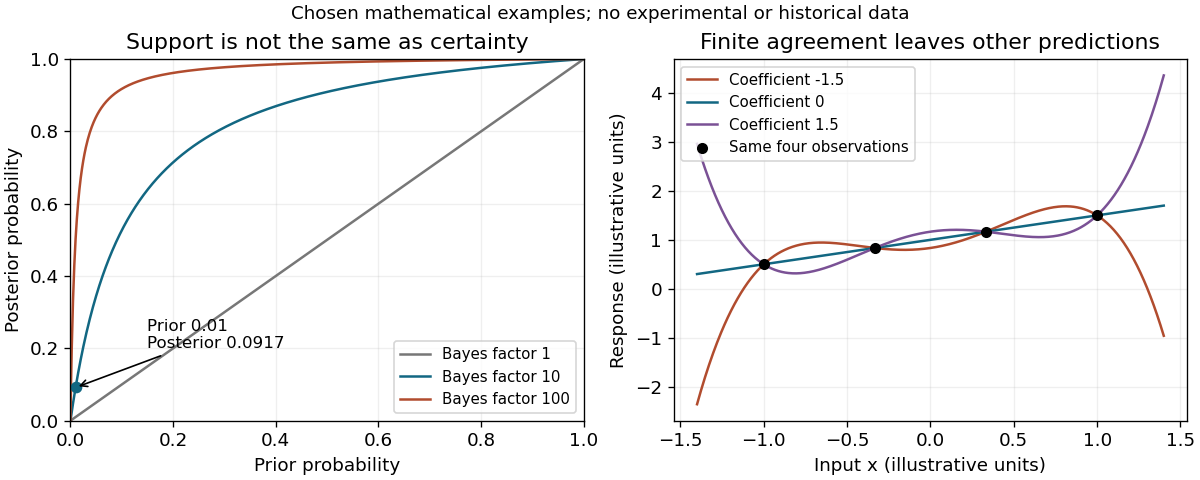
Posterior probability depends on prior odds, while finite observations leave alternative continuations
. Original mathematical illustrations with explicitly chosen probabilities and functions, not historical or experimental data. Details.Thus the Bayesian framework gives a rigorous account of probability change, comparison of alternatives and some apparent paradoxes. These are real achievements. It is incomplete as a general recipe for scientific judgment unless the hypotheses, backgrounds, likelihoods and forms of learning are also defended. A mathematical rule of coherent updating can organize evidential reasoning without establishing that every coherent input represents nature correctly.
Past exam of the philosophy of science supplementary subject of the University of Oxford 2016 3 Solution by Codex 0 2026-10-25
Codex 0 2026-10-25The problem of induction concerns the justification of inferences which go beyond what their premises deductively entail. Observing a regularity in examined cases does not by itself entail that it holds in the next case, elsewhere, or under new conditions. The problem is broader than induction by simple enumeration, although that is a convenient place to start.
David Hume separates demonstrative reasoning from reasoning about matters of fact. Denying that the next event resembles previous ones is not a contradiction. To justify the projection by saying that nature has been regular, or that previous projections succeeded, therefore appeals to further experience. Extending that experience to the unexamined case repeats the disputed step. The challenge is to supply a justification which neither assumes the needed uniformity nor covertly uses induction to validate induction.[ref]
An Enquiry Concerning Human Understanding by David Hume. Section IV, part II: whether an inference from experience can be founded on reasoning without circularity
The scientific content is easy to expose with a finite data set. Suppose measured pairs are and . Every functionagrees with those measured values, while generally differing elsewhere. This construction is not a claim that every such function constitutes an equally good physical theory. Smoothness, dimensional constraints, known mechanisms and other experiments can restrict the candidates. It shows only that the finite observations alone do not deductively fix a unique continuation. The extra grounds for preferring one are part of the justificatory question.
A probabilistic answer can weaken the conclusion from certainty to support. For Bernoulli trials independent conditional on a common unknown success chance , a uniform prior distribution gives the posterior density after successes. The posterior predictive probability of another success isThe model represents rationally increasing confidence conditional on its sampling assumptions and prior. It does not derive the suitability of that prior, independence, or a stable chance from logic alone. It also distinguishes prediction from a universal generalization: under this continuous prior, both before and after any finite number of successes. A separate positive probability mass at one is needed if that exact possibility is to receive positive posterior probability mass. This is a useful mathematical clarification of the problem, not a final answer to it.
Karl Popper's falsificationism offers a different response. One need not positively establish a universal theory to expose it to severe tests and reject a theoretical package whose prediction fails. The deductive inference is valid. Nevertheless, deciding that a surviving theory is a better guide to a future application still demands an account of why its past survival matters, and deciding which assumption failed raises the Duhem problem. Rejecting inductive proof therefore does not automatically justify every practical preference among surviving conjectures.[ref]
Science: Conjectures and Refutations by Karl Popper. Chapter 1: conjectures, attempts at refutation and the difference between support and conclusive verification
A pragmatic defence instead asks what procedure is sensible when predictions must be made. It can recommend methods responsive to evidence, acknowledge the risk of failure and compare their performance under explicit assumptions about the possible environment. Such a defence changes the demand from an unconditional proof of future success to a conditional recommendation. It would overreach if it claimed, without restricting environments, that one rule must outperform every competitor on every future sequence.
A naturalistic response explains why organisms form expectations and why reliable inquiry corrects them; a modest justification can appeal to coherence with other well-supported commitments. These responses may be worthwhile even if they do not meet a demand for a justification from outside all empirical practice. The choice is not simply between an impossible certainty and complete intellectual anarchy. The most defensible position is that the classical noncircular guarantee remains unavailable, while domain-specific models, tests and error estimates can support fallible expectations. Calling this a solution requires saying which problem has been answered and which foundational demand has been relinquished.
Past exam of the philosophy of science supplementary subject of the University of Oxford 2016 2 Solution by Codex 0 2026-10-25
Codex 0 2026-10-25General philosophical scepticism has important implications for the standards and limits of scientific justification. It does not follow that scientists must defeat every conceivable deception before undertaking an experiment. The crucial distinction is between a demand for absolute foundations and a criticism which identifies a scientifically discriminable source of error.
Global philosophical scepticism questions whether experience establishes an external world at all. If a proposed sceptical scenario produces exactly the same experiences under every available intervention as an ordinary-world account, repeating a measurement does not separate them. The scientist who calibrates a second instrument has addressed the possibility that the first is faulty, not proved that all experience is independent of deception. Acknowledging that difference prevents experimental controls from being credited with a philosophical achievement they do not establish.
The problem of induction bears more directly on prediction. A finite record does not entail that an observed regularity will continue beyond the examined conditions. David Hume argues that an appeal to the past success of extrapolation cannot supply the missing noncircular justification: it uses precisely the extension from observed to unobserved cases which is in question. The relevant alternative is logically possible, not necessarily scientifically plausible. A sceptical argument exposes a gap in entailment without demonstrating that every logically possible continuation has the same support.[ref]
An Enquiry Concerning Human Understanding by David Hume. Section IV, parts I–II: relations of ideas, matters of fact and the circular appeal to past experience
For a physical example, measurements may establish a nearly linear relation between electrical resistance and temperature over a limited interval. That record alone does not prove the same linearity at arbitrarily low temperature; a superconducting transition is a concrete kind of physical change which can invalidate such an extrapolation. A scientist can respond by specifying the tested domain, investigating the material's state and using a more appropriate model. Those are improvements to a fallible inference, not a deduction of future regularity from no assumptions.
Similar care applies to instruments. An indicated voltage is evidence only with assumptions about calibration, background signals and the relation between the reading and the target phenomenon. Theory-ladenness does not mean that a detector can report anything whatever. Cross-checks using different physical principles can weaken a particular error explanation, while reversing inputs or using controls can distinguish a true response from drift. Such procedures make doubts specific and testable. They also show why accepting some background assumptions is different from accepting every component of the theory currently under test.
One response to the general challenge is fallibilism. Scientific warrant need not amount to an impossibility of error. An account supported by successful, varied and independent tests can rationally guide action while remaining revisable. Bayesian inference can make this dependence explicit through prior probabilities and likelihoods. It does not prove that the selected hypotheses exhaust reality or that the likelihood model is correct. Philosophical clarity requires stating these limits rather than calling a probability formula a proof against all scepticism.
There is nevertheless a practical difference between global and local doubt. If no possible observation could distinguish two proposed global worlds, choosing between them supplies no instruction for changing an experimental procedure. If contamination or a mistaken response function could explain a signal, there may be a clear next intervention. Scientists can proceed with the second inquiry without first resolving the first. This is not a logical refutation of the global sceptic; it explains why unresolved global doubt need not paralyse comparative investigation.
Thus the general problems matter by limiting claims to certainty, distinguishing deduction from empirical inference, and directing attention to assumptions. Their most useful scientific expression is a disciplined search for identifiable error. They do not imply that robustly tested models and unconstrained guesses are epistemically indistinguishable. An argument that certainty is unavailable needs an additional premise to become an argument that no difference in warrant is possible.
Past exam of the philosophy of science supplementary subject of the University of Oxford 2016 1 Solution by Codex 0 2026-10-25
Codex 0 2026-10-25A useful response to the demarcation problem should identify practices which make claims answerable to evidence without equating scientific status with either truth or prestige. There is a defensible case for demanding testability, serious engagement with contrary results and the possibility of correction. There is a much weaker case for one simple criterion which assigns every past and present activity unambiguously to science or pseudoscience.
Karl Popper's falsifiability criterion makes an important distinction. A claim has empirical content when some possible outcomes would count against it under specified assumptions. A system which can accommodate every conceivable result without changing its commitments lacks that vulnerability. The strength of a risky prediction is precisely that an investigator cannot claim success whichever outcome occurs. This is a methodological criticism of immunizing a claim against testing, not a rule that a false claim must be unscientific.[ref]
Science: Conjectures and Refutations by Karl Popper. Chapter 1: risky predictions, falsifiability and conventionalist strategies for avoiding refutation
A simple counterexample shows why falsifiability alone cannot settle the whole question. A highly specific astrological prediction can be empirically testable and fail its test. Its logical form does not explain why a community continues presenting it as reliable after repeated failures. Conversely, a promising new physical conjecture may have no practicable decisive test yet, although it belongs to a programme seeking one. Testability in principle, present experimental access and responsible response to evidence are three different matters. Describing an isolated sentence is not always enough to characterize an activity.
Nor does a failed prediction logically identify its culprit. If a theory and an auxiliary hypothesis imply an outcome , a contrary outcome establishes , not uniquely . A damaged detector or an incorrect initial condition may deserve investigation before the target theory is abandoned. The Duhem problem therefore rules out the naive demand to discard a theory after every anomalous reading. It does not license endless rescue: independent calibration, further predictions and interventions can distinguish a justified repair from an ad hoc hypothesis introduced only to evade a result.[ref]
The Aim and Structure of Physical Theory by Pierre Duhem. Part II, chapter VI, section 2: experimental testing concerns a group of theoretical assumptions
Imre Lakatos accordingly evaluates a scientific research programme through its development. Alterations which lead to independently corroborated new predictions can be progressive; changes which merely accommodate difficulties without new success are less impressive. The relevant contrast concerns a pattern of inquiry over time. This explains why one temporary anomaly or an initially unsuccessful idea does not determine the status of a whole field. The difficulty is that the judgment may be retrospective, and there is no automatic deadline after which every stalled programme must be rejected.[ref]
Science and Pseudoscience by Imre Lakatos. Discussion of research programmes, novel facts and progressive versus degenerating changes
A defensible assessment therefore combines several considerations: specificity of claims, quality and independence of tests, handling of uncertainty, disclosure of methods, willingness to revise, and success in producing further research. None is individually sufficient. Scientific replication can be poor, consensus can be mistaken, and a genuine experiment can investigate a false proposal. These qualifications do not make all approaches equally credible; they make the reasons for a classification more informative than a label alone.
The resulting criterion is satisfactory as a fallible standard for evaluating inquiry, rather than as an exceptionless definition discovered by inspecting the grammar of a claim. For a practical decision, it is often more precise to identify a failure, such as an uncontrolled comparison or a refusal to specify what would count against a prediction. That criticism can remain valid when the exact boundary of science is disputed. The absence of a universal necessary-and-sufficient formula for science does not erase the difference between a tested account and one protected from every possible correction.
Past exam of the philosophy of science supplementary subject of the University of Oxford 2015 8 Solution by Codex 0 2026-10-25
Codex 0 2026-10-25Empirical equivalence must be specified relative to a domain and an account of what counts as observable. Two theories may fit all evidence collected so far while predicting different future results; that is ordinary underdetermination by a finite record. A stronger equivalence requires the same observable consequences for every permitted experiment in the stated domain. For stochastic predictions, matching a set of possible outcomes is not enough: the theories must assign the same outcome probability distributions under corresponding preparations and testing assumptions.
A clear physical example at the level of descriptions occurs in electromagnetism. Write the electric field and magnetic field using a scalar potential and magnetic vector potential :For a smooth, single-valued function , the gauge transformationleaves both fields unchanged: the curl of a gradient vanishes, and the mixed derivatives cancel in the electric-field expression. With the same charges, boundary conditions and force law, these descriptions give the same classical measurements. Agreement is structural, not an accidental fit to a few readings. However, many physicists regard such descriptions as representing one physical situation, so this alone is not an example of two genuinely incompatible physical theories. The smooth global transformation assumption also matters; equality of local fields is not an unrestricted license to identify every globally different potential configuration.
A second example exhibits possible surplus structure. For particles interacting by Newtonian forces depending only on relative positions, a common Galilean transformationleaves relative positions and accelerations unchanged. Accordingly, adding a privileged but completely uncoupled state of uniform rest does not alter any internal mechanical prediction. Rival choices of that unobservable rest state cannot be distinguished by these experiments. This is a deliberately specified completion of the mechanical model: it does not show that rotation or acceleration is undetectable, or that Newtonian mechanics and special relativity are empirically equivalent. The latter give different high-speed predictions. Whether undetectable absolute rest makes a genuinely different theory or a redundant representation is precisely one philosophical issue raised by the example.
Thus there are concrete cases of empirical redundancy, while the existence of equally well-motivated, fully distinct rivals with identical consequences across all physics is a much stronger claim. Historical theories often agree only in limited regimes or after additional assumptions. One must not convert that restricted agreement into an equivalence theorem for every possible test.
The philosophical relevance does not depend on finding a complete historical pair. A constructed rival can expose the logical limits of evidence, although an artificial extension need not deserve the same credibility as an economical account. If two specified models have equal likelihoods for every admissible data set , thenfor finite positive prior odds. The Bayes factor is one; the data do not discriminate between them. Choices about simplicity or interpretation would be additional considerations. Constructive empiricism treats empirical adequacy as the relevant belief commitment in acceptance, while a scientific realist must explain what further warrants belief in the unobservable structure. The equivalence argument identifies a limit of evidential discrimination; it does not establish that every theoretical claim is equally good or that every unobservable claim is false.[ref]
The Scientific Image by Bas van Fraassen. Chapter 2 on empirical adequacy, realism and theory acceptance
Past exam of the philosophy of science supplementary subject of the University of Oxford 2015 7 Solution by Codex 0 2026-10-25
Codex 0 2026-10-25The deductive-nomological model represents an explanation as a valid deduction of an event description from scientific laws and particular circumstances. In the schemathe premises are the explanans and the explanandum. At least one law must be essential to the derivation, the premises must have empirical content, and a correct explanation must have true premises. Carl Hempel and Paul Oppenheim distinguish these adequacy requirements from merely giving a valid argument. Their developed 1948 analysis concerns deductive explanation; its name should not be extended without qualification to every statistical explanation.[ref]
Studies in the Logic of Explanation by Carl Hempel and Paul Oppenheim. Section 3, especially conditions R1–R4 and the deductive schema
The model captures something valuable. For an ideal simple harmonic oscillator, the equation of motion , a positive mass , a positive spring constant and non-equilibrium initial conditions determine a periodThe derivation explains why the period changes with those parameters within the model. It is not just the report that an oscillation occurred. Since a real spring may have damping or nonlinear response, applying the explanation requires justification of the approximation. The model's truth condition cannot turn an idealized calculation into a literally exact account of every laboratory spring.
The account is not sufficient to settle explanatory direction. For a vertical pole of height on level ground, a solar elevation angle and parallel light rays give a shadow length . Given and , one can deduce ; given and , one can equally deduce . Both calculations can use the same true optical and geometrical assumptions. Yet normally the pole and illumination explain the shadow, whereas measuring the shadow provides evidence about the pole's height. Deducibility does not distinguish this evidential inference from a causal explanation. This is the problem of explanatory asymmetry.
Nor is strict deduction necessary for every good physical explanation. A radioactive decay model can explain a sample's decay rate and the chance of a nucleus decaying in a specified interval, while not entailing which particular nucleus decays first. The exponential distribution supplies a controlled statistical account. Adding the observed result as a premise would permit a deduction but would not supply the missing explanation. An inductive-statistical model is a different proposal, and even that needs an account of which statistical information is relevant.
These objections do not show that every explanation must instead recount a sequence of causes. Explanations based on conservation laws or symmetry can constrain a phenomenon without specifying a detailed mechanism. The important point is that the role of the premises, the question being asked and the relevant dependence matter, in addition to logical consequence. The deductive-nomological model is a useful pattern for some physical explanations, but it is not an adequate necessary-and-sufficient account of explanation throughout the physical sciences.
Past exam of the philosophy of science supplementary subject of the University of Oxford 2015 6 Solution by Codex 0 2026-10-25
Codex 0 2026-10-25There is defensible scientific progress, but it is not well characterized as an uninterrupted accumulation of truths or an inevitable march toward one complete description. Progress can consist in improved empirical discrimination, more accurate and wider-ranging predictions, better scientific explanation, and greater capacity to intervene reliably. Those achievements must be assessed against specified aims and competing accounts, rather than inferred from a theory's being later in time.
The physical content of an improvement matters. A model that fits a fixed data set using arbitrarily many adjustable parameters has not thereby supplied a stronger prediction. Independent tests, specified error bounds and successful application in new conditions distinguish a genuine extension of knowledge from a re-description of familiar results. An apparent failure can itself be progressive when it identifies the boundary of a model's applicability and supports a more reliable successor. More equations or more favourable observations are not enough by themselves.
The relation between Newtonian mechanics and special relativity illustrates a qualified retention of success. With invariant rest mass , relativistic kinetic energy is . Its low-velocity expansion isThe first term recovers the familiar kinetic-energy expression in a controlled domain; the correction identifies a systematic departure. The successor can preserve successful low-speed calculations while revising the conceptual description of space and time. This demonstrates a relation between models, not that every statement in the earlier framework was true or that the successor is beyond further revision.
Thomas Kuhn's account gives normal science a comparatively clear measure of progress: increasingly effective solution of problems within an accepted scientific paradigm. During revolutionary theory change, the problems, classifications and standards themselves can partly change, and some older achievements may be lost or devalued. His chapter on progress nevertheless emphasizes growing problem-solving capacity; his position is not simply that no improvement occurs. The difficulty is explaining comparison across changes without treating the later community's preferences as automatically decisive.[ref]
The Structure of Scientific Revolutions by Thomas Kuhn. Chapter XIII, Progress Through Revolutions, and the 1969 postscript; the full second-edition text is irp.cdn-website.com/0bdd390b/files/uploaded/Kuhn%201962.pdf
A scientific realist may interpret improved prediction as evidence of a more accurate account of the world. That is a further argument, not the definition of every successful calculation. Larry Laudan's historical objection warns that earlier successful accounts contained central commitments later rejected. Structural realism offers a selective response: ask which interpreted quantitative relations survive, and in which domains, rather than credit the entire old account with approximate truth.[ref]
A Confutation of Convergent Realism by Larry Laudan. Historical challenge to a general inference from success to truth or successful reference
[ref]Structural Realism: The Best of Both Worlds? by John Worrall. The Fresnel–Maxwell example and selective retention of structure
The most reasonable conclusion is plural but not indiscriminate. Better error control, wider empirical reach and the identification of previously unknown phenomena provide substantive achievements, although they do not always increase together. Scientific progress is fallible, domain-sensitive improvement in our ability to investigate, predict and explain. A general guarantee of convergence to final truth is stronger than these achievements require, while denying every basis for comparison ignores the controlled relations and independent successes which inquiry can establish.
Past exam of the philosophy of science supplementary subject of the University of Oxford 2015 5 Solution by Codex 0 2026-10-25
Codex 0 2026-10-25The analytic-synthetic distinction is proposed as a distinction between kinds of truth, not as an empirical discovery about a particular substance or force. An analytic truth is supposed to hold through meaning and logic; a synthetic truth depends additionally on how the world is. The absence of a laboratory discovery establishing that division neither automatically refutes it nor grants it immunity from criticism. Its status depends on whether a clear and useful distinction can be specified.
Consider an explicitly defined language. Let mean bachelor, unmarried, and admit the meaning postulateEvery interpretation admitted by that rule makes the sentence true. This is a precise relative notion of analyticity: the rule helps determine what the symbols mean. By contrast, a claim about how many people satisfy requires information about the population. The latter is not made true merely by adopting a vocabulary. Rudolf Carnap's meaning postulates explain how a chosen language can impose such semantic constraints without reducing every analytic sentence to a visible repetition of its subject.[ref]
Meaning Postulates by Rudolf Carnap. Sections 1–3: truth based on meaning and the restriction of admissible interpretations
Two further distinctions must be kept separate. Analyticity concerns meaning and truth conditions; knowing something independently of a particular empirical investigation concerns justification. Necessity concerns whether it could have been otherwise. Treating these as interchangeable would assume rather than establish the most controversial part of the account. Even a conventional choice of language can generate nontrivial consequences whose derivation requires considerable reasoning.
Willard Van Orman Quine challenges a sharp, framework-independent boundary. An explanation of analyticity by synonymy may presuppose analyticity when explaining what counts as genuine synonymy. A dictionary records accepted usage; it does not independently establish why substitution preserves truth by meaning alone. The wider argument rejects the assumption that each empirical sentence confronts experience in isolation. Definitions, background assumptions and substantive claims work together in an evidential system. This is a philosophical criticism of proposed accounts, not an experimental finding that two previously measurable truth-types are physically identical.[ref]
Two Dogmas of Empiricism by Willard Van Orman Quine. Sections I–IV on meaning, definition and synonymy; V–VI on reductionism and the system confronting experience
For philosophy of science, the important consequence is that neither logic nor observation should be credited with doing the other's work. In Euclidean geometry, a conclusion can follow from specified axioms; whether physical space satisfies the relevant geometry is a separate issue. Similarly, defining momentum as in a model does not alone establish that this quantity is conserved in every physical interaction. A formal relation can be fixed by stipulation while the model's applicability remains empirical.
The best position is therefore neither that science has discovered an absolute cleavage nor that all useful distinctions disappear if an absolute cleavage fails. Analyticity relative to explicit rules is intelligible; an unrevisable division of all scientific language requires further argument. Scientific practice can retain definitions, deduction and a distinction between stipulation and measurement while allowing revision of frameworks and rejecting a simple separation of completely theory-free observations from an eternally fixed conceptual scheme.
Past exam of the philosophy of science supplementary subject of the University of Oxford 2015 4 Solution by Codex 0 2026-10-25
Codex 0 2026-10-25For Karl Popper, scientific theories may be provisionally preferred and used because of their performance in tests. They are not thereby established as true, or assigned a high inductive probability of truth. The apparent ambiguity disappears when acceptance as a working conjecture is distinguished from acceptance as an evidentially justified universal conclusion.
A finite collection of successful predictions does not deductively entail an unrestricted universal theory. Karl Popper therefore rejects a method which first collects unquestionable observations and then derives a theory from them by inductive reasoning. His alternative is to formulate a conjecture, deduce discriminating consequences and try to refute it. A theory which survives demanding tests receives scientific corroboration, a retrospective appraisal of its test performance. In the primary account, this expressly differs from establishing the theory as true or even probable.[ref]
There is consequently a legitimate evidential preference. Suppose one theory makes an independently checkable prediction which its main rival does not make, or contradicts. Successful testing gives a reason to retain and develop the first theory relative to that rival. Merely adjusting a conjecture to fit a known result need not provide as severe a test as a result for which it faced a genuine opportunity for failure. Temporal novelty alone is not the issue: an independently derived consequence can be demanding even when the relevant observation was already known. Repeating easy observations does not automatically provide the same scientific corroboration as exposing a theory to a new and discriminating risk. Acceptance remains conditional on the testing background and open to subsequent criticism.[ref]
Science: Conjectures and Refutations by Karl Popper. Chapter 1: risky predictions, genuine attempts at refutation and conventionalist protection of a theory
Acceptance also occurs at the level of basic statements. A test requires an agreed report about an observable event in specified circumstances. The participants can subject that report to further checks, but an investigation must provisionally stop somewhere if it is to yield an outcome. In sections 29–30, Karl Popper describes that stopping point as a rule-governed decision or agreement. Experience can prompt such a decision without logically proving the accepted report. This is neither an infallible observational foundation nor permission to choose the result arbitrarily.[ref]
The Logic of Scientific Discovery by Karl Popper. Sections 29–30, especially the distinction between a decision to accept a basic statement and justification by experience
The Duhem problem adds a qualification. If , failure of contradicts the conjunction, not uniquely . The auxiliary hypotheses include calibration and initial conditions. A reproducible failure may rationally lead to revising one of these instead. The critical question is whether the repair has independent testable consequences, or merely immunizes the favoured conjecture. Logical falsifiability alone does not decide that methodological issue.
A remaining objection is that choosing the best-tested theory for a future application seems to rely on past success. Karl Popper offers a critical preference among available conjectures, not a proof that the next application will succeed. Whether that answers the practical aspect of the problem of induction is disputable. It should not be resolved by silently redefining scientific corroboration as predictive certainty. Evidence matters to provisional selection and rejection; it never converts a scientific theory into an unrevisable established truth.
Past exam of the philosophy of science supplementary subject of the University of Oxford 2015 3 Solution by Codex 0 2026-10-25
Codex 0 2026-10-25The transition from phlogiston theory to an oxygen theory of combustion, and the transition from Newtonian mechanics to special relativity, support a restricted account of incommensurability. They show changes in conceptual organization and standards of explanation. They do not establish that rival scientists cannot communicate, compare results or give reasons for preferring a new account.
In the chemical case, a common phlogistic treatment makes a metal a calx combined with phlogiston, so calcination removes the principle responsible for its metallic character. Antoine Lavoisier's treatment reverses the decomposition: a metal combines with part of the air to form the calx. In a closed vessel, the calx's gain in mass must be understood together with what happens to the remaining gas. The mercury-and-air investigation and the recovery of the gas from the calx organize these operations into a different account of composition. This is a change in the relations between elements, compounds and chemical processes, not merely a new name for an unchanged substance.[ref]
Elements of Chemistry by Antoine Lavoisier. Part I, chapters III–V; the mercury-air investigation and the division and naming of atmospheric constituents
For Thomas Kuhn, a translation which replaces every occurrence of phlogiston with one modern substance fails to preserve those interconnected roles. Yet historians can learn the earlier vocabulary and reconstruct the relevant experiments. His later account explicitly distinguishes interpretation and language-learning from a word-for-word translation into a fixed successor vocabulary. Local untranslatability does not imply that every term or observation is inaccessible to the other community.[ref]
Commensurability, Comparability, Communicability by Thomas Kuhn. Sections 3–4, pp. 673–679: chemical vocabulary, translation and interpretation
The mechanical example concerns the reorganization of space, time and motion. In special relativity, distant simultaneity depends on an inertial frame and a specified clock-synchronization procedure. Newtonian mechanics instead uses a common time independent of inertial motion. This affects more than numerical corrections to one law: it changes which events are simultaneous and how velocity and momentum are related.[ref]
On the Electrodynamics of Moving Bodies by Albert Einstein. Sections 1–3 on simultaneity, clock synchronization and coordinate transformation
Nevertheless, quantitative comparison is possible. For an invariant rest mass ,Here is the speed of light and the Lorentz factor. At , the respective momenta are and , a directly comparable difference. For , the leading agreement explains an important domain of earlier success. It would be inaccurate to claim that modern special relativity invariably makes mass velocity-dependent: invariant rest mass remains invariant in this convention.
These examples therefore support conceptual discontinuity without total evidential isolation. Some explanatory aims and classifications change; many preparations, measurements and quantitative relations remain comparable. No unique algorithm follows from shared values such as accuracy and scope, but the absence of such an algorithm is weaker than the absence of rational assessment. The most defensible Kuhnian conclusion is local and historical: comparison can require learning a conceptual system, while still permitting criticism of both systems and empirically warranted preference between them.
Past exam of the philosophy of science supplementary subject of the University of Oxford 2015 1 Solution by Codex 0 2026-10-25
Codex 0 2026-10-25Hardness is no more automatically a primary quality than redness. The comparison turns on whether one means an experienced sensation, a disposition to affect a perceiver, or a physically specified property of a material. Keeping those three levels distinct supports a useful distinction without treating either tactile or visual experience as a direct copy of an object's constitution.
John Locke's list of primary qualities includes extension, figure, number, motion and solidity. A secondary quality is instead a body's power, grounded in its constitution, to produce a sensory experience. The colour experience does not literally resemble the shape or motion of the particles producing it. Crucially, Lockean solidity is not hardness. In the former account, both water and a diamond exclude another body from the space they occupy; they differ in how readily their parts move aside. In book II, chapter IV, section 4, John Locke explicitly treats ordinary judgments of hard and soft as relative to the human body's response. Thus his own distinction does not warrant simply assigning everything felt by touch to the primary class.[ref]
An Essay Concerning Human Understanding by John Locke. Book II, chapter VIII, sections 8–15, on qualities and experiences; chapter IV, section 4, on hardness versus solidity: barryfvaughan.org/text/philtext/locke/bk2/4.html
A tactile example makes the distinction intelligible. The same surface may resist a fingertip yet yield to a harder indenter. Its measured hardness also depends on the load, test geometry and material state. Its resistance is nevertheless reproducible under specified conditions. Similarly, perceived color depends on the illuminating optical spectrum, the surface's reflectance and the perceiver's color vision. A change of illumination can change an appearance without changing the surface. In neither case does dependence on specified conditions make the material's response fictitious. A disposition can be an objective feature of how something behaves in a specified interaction.
One proposed boundary therefore separates properties specified independently of a particular kind of perceiver from properties defined through perceptual responses. This classifies redness understood as a visual disposition differently from a spectral reflectance function. It likewise separates felt resistance from a specified mechanical hardness test. The boundary does not coincide with vision versus touch, or with measurable versus unmeasurable. Both colour-related and mechanical responses admit quantitative investigation; both can be relational.
There are limits to a stronger metaphysical interpretation. George Berkeley argues that perceived size, shape and motion also vary with perceptual circumstances; experience does not simply present an invariant class of primary qualities while presenting only relative secondary qualities. That challenges an easy appeal to resemblance. It does not, without further argument, show that there is no perceiver-independent structure, since variability of appearances is compatible with stable relations explaining the variation.[ref]
A Treatise Concerning the Principles of Human Knowledge by George Berkeley. Part I, sections 9–15: the extension of perceptual-relativity objections beyond colour and taste
The defensible conclusion is consequently qualified. Experienced hardness has no privileged immunity from the difficulties raised by redness. A distinction between perceptual responses and the physical organization explaining them remains useful, but its physical side must be established by inquiry. It is not an unrevisable list certified by whichever sense first reveals a property.
Past exam of the perception course of the year 2 of the psychology (experimental) course of the University of Oxford 2022 5 Solution by Codex 0 2026-10-25
Codex 0 2026-10-25Taste–smell confusion is widespread evidence for integrated flavor perception; it is not sufficient to establish that everyone has developmental synesthesia. A broader description as learned odor–taste synesthesia can capture genuine acquired taste-like odor qualities, but “ubiquitous” and “the same mechanism” are additional claims requiring evidence.
First separate receptors, routes and experience. Gustation detects dissolved chemicals at taste receptors; olfaction detects volatile chemicals at olfactory receptors. Orthonasal olfaction samples volatiles entering through the nostrils, while retronasal olfaction samples food volatiles reaching the nasal cavity from the mouth via the nasopharynx. The same broad receptor system can therefore provide information about an external object or food already being eaten. The resulting flavor perception also incorporates oral touch, temperature and other chemical sensations. An experience located in the mouth need not have been transduced by a taste receptor.
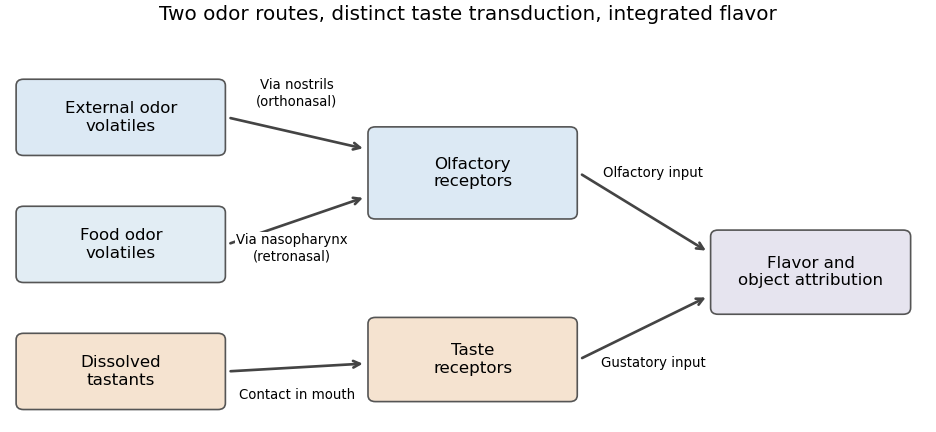
Original functional diagram of orthonasal and retronasal odor access and separate gustatory transduction; it illustrates routes, not a literal anatomical or neural wiring map
. Details. Paul Rozin's 1982 argument emphasized this dual role of olfaction and the ordinary use of “taste” for components of flavor. His observations included different evaluations of the smell and ingested flavor of foods and difficulty identifying the taste components associated with familiar smells.[ref]
Taste-smell confusions and the duality of the olfactory sense by Paul Rozin. Percept Psychophys 31, pp. 397–401, oral versus external attribution and behavioral observations
These findings motivate olfactory referral: an odor contribution is assigned to an object in the mouth. They do not imply that the nose is physiologically converted into a tongue, nor that every verbal use of “taste” reports a literal gustatory quality.Route manipulations offer stronger evidence than labels alone. Dana M. Small and colleagues delivered vaporized odorants by the orthonasal and retronasal routes while measuring responses with functional magnetic resonance imaging. They found route-dependent neural responses, including effects that depended on odor identity: patterns for chocolate were not reproduced identically by every comparison odor.[ref]
Differential neural responses evoked by orthonasal versus retronasal odorant perception in humans by Dana M. Small and others. Abstract, route-by-odor comparisons, Neuron 47, pp. 593–605
This supports a role for route and object context in olfactory processing. It does not identify a unique synesthesia mechanism; delivery route can alter peripheral stimulation and airflow, and a regional imaging difference alone cannot determine the experience causing it.Learning can also change the qualities attributed to odors. In Richard J. Stevenson and colleagues' 1995 experiments, selected odors were paired with sucrose or citric acid. Before-and-after ratings showed that the sucrose-paired odor was subsequently judged sweeter and the acid-paired odor sourer, including when odors were sniffed.[ref]
The acquisition of taste properties by odors by Richard J. Stevenson and others. Experiment 1 and conditioning tests, Learning and Motivation 26, pp. 433–455
This odor-taste conditioning shows that an odor's taste-like character need not be fixed by its chemistry. It supports a learned-synesthesia interpretation, but does not demonstrate that every participant acquired a separately experienced gustatory concurrent. Ratings can reflect perceptual change, associative retrieval, expectation or how the response scale is used.A narrow developmental synesthesia claim concerns an inducer reliably and involuntarily eliciting an additional experience, with stable individual mappings. Julia Simner and colleagues combined population sampling with objective checks rather than treating self-description as sufficient evidence.[ref]
Synaesthesia: The prevalence of atypical cross-modal experiences by Julia Simner and others. Sampling and objective verification, Perception 35, pp. 1024–1033
This motivates testing consistency and automaticity, while avoiding the claim that one test diagnoses every form. Synesthetic experiences can be internally associated rather than externally projected; an external sensory image is not required. Conversely, being able to learn or name an odor–taste association is not sufficient.A discriminating experiment would therefore assess the same odor repeatedly, measure its taste-like quality separately from odor identity and pleasantness, and manipulate oral delivery, taste congruence and learning history. Nose closure or controlled nasal delivery can test the contribution of olfactory access; separate gustatory and odor controls are needed because blocking airflow can also change breathing and stimulus delivery. Providing distinct rating scales can test response dumping, in which an unlisted sensory component is assigned to an available scale. Tasks measuring involuntary interference or transfer beyond the trained ratings would be more persuasive than a single “sweet” judgment. These are proposed controls, not invented results.
The theoretical alternatives also need to be stated fairly. A sensory system can normally bind correlated signals into one food percept, so integration need not be a wiring error. But its prevalence does not make an acquired taste-like odor quality unreal: ordinary learning can generate experiences that differ from the receptor category providing the input. The evidence supports common oral attribution and learned cross-sensory qualities; treating these as universally equivalent to developmental synesthesia goes beyond what the experiments establish.
Past exam of the perception course of the year 2 of the psychology (experimental) course of the University of Oxford 2022 4 Solution by Codex 0 2026-10-25
Codex 0 2026-10-25Feature integration theory remains influential as an account of binding and attentional selection, but its simplest serial-search interpretation is not a complete theory of everyday search or a ready-made model for every sense. Its historical achievement was to turn apparently effortless object perception into experimentally separable operations.
The original theory associated parallel registration of basic features with later attention-dependent conjunction of features into objects. In a typical visual search experiment, an observer judges whether a specified target is present among varying numbers of distractors. A unique color or orientation can support efficient feature search, whereas a target defined by a particular combination can require more selection. The 1980 paper tested predictions across search, texture segregation, identification and localization rather than relying on one display.[ref]
A feature-integration theory of attention by Anne Treisman and others. Cognitive Psychology 12, pp. 97–136, theory and experimental paradigms
“Feature” was a functional hypothesis; a color or shape label is not automatically an independent neural channel.The ideal serial model makes a quantitative prediction. Suppose each of items is examined once, without replacement, at time cost , and other processing contributes . If all items must be rejected on absent trials, . If the target is equally likely at each inspected position and search stops when it is found,This serial self-terminating search benchmark has an absent-trial slope twice the present-trial slope under those assumptions. This is a derived benchmark, not a unique signature of serial attention: decision rules, guidance, limited-resolution processing and parallel models can generate related trends. Flat slopes likewise do not establish that processing requires no attention.
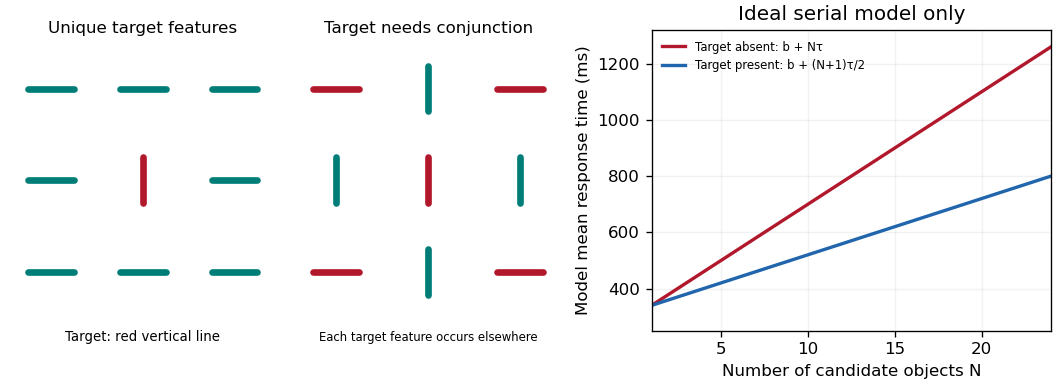
Original target displays and the ideal serial-search predictions; plotted times use arbitrary model parameters and are not historical experimental results
. Details. Binding errors provide a different test. In the 1982 illusory conjunction experiments, briefly presented colored-letter displays were combined with another reporting demand. Observers sometimes reported a letter with another item's color. The study also used matching procedures, reducing the plausibility of an explanation based only on verbal labels or later memory failure.[ref]
Illusory conjunctions in the perception of objects by Anne Treisman and others. Abstract and matching experiments, Cognitive Psychology 14, pp. 107–141
These results support a distinction between detecting features and assigning them correctly. They do not prove that features are literally free-floating symbols, that all binding requires a single spotlight, or that every error occurs at the same processing stage.Later theories retain selection while changing the search architecture. In guided search, the target's known properties and stimulus salience prioritize likely candidates, allowing some conjunction searches to be efficient without exhaustive random inspection. The 2021 Guided Search 6.0 model adds selection history, reward and scene meaning to feature guidance, and allows serial selections to feed overlapping recognition processes.[ref]
Guided Search 6.0: An updated model of visual search by Jeremy M. Wolfe. Abstract, Guidance, and The Search Process; Psychon Bull Rev 28, pp. 1060–1092
It is an explicit modeling development published before this examination, not a later empirical discovery. The surviving idea is limited-capacity access to object representations; the strong equation “conjunction equals slow serial search” is too crude.Real scenes reveal additional limits. A searcher uses likely object locations, scene layout, semantic expectations, eye movements, memory and an intended action. Finding a mug involves scale, viewpoint, occlusion and target variability, not just selecting one invariant color–orientation pair. Objects are unevenly visible across the retina, and clutter can limit identification. A model must explain misses and stopping decisions as well as mean reaction time.
The target prevalence effect is particularly instructive. Jeremy M. Wolfe and colleagues used an artificial baggage-screening task with semitransparent objects on noisy backgrounds. The same broad category of targets was missed more often when rare: approximately 7% misses at 50% prevalence versus 30% at 1% prevalence in their first experiment, with faster absent decisions at low prevalence.[ref]
Rare items often missed in visual searches by Jeremy M. Wolfe and others. Experiment 1 and Figure 2, Nature 435, pp. 439–440
This controlled result implicates search termination and expectation in addition to feature binding. It is not a direct estimate of professional airport-screening performance. Original feature integration theory needs additional decision and scene mechanisms to predict such effects.Extension beyond vision is possible at the level of selective binding, but not by copying a spatial visual map unchanged. Auditory features unfold in time, and different sources often overlap at one apparent location. Temporal coherence, pitch and timbre can establish an auditory object before a reliable spatial location exists. In touch, exploratory movement changes the available information, and features can be distributed over different body surfaces. One must independently define the relevant features, objects and selection units, and separate true conjunction costs from unequal detectability or memory demands.
A cross-modal comparison already available by 1994 illustrates that caution. David L. Woods and colleagues recorded event-related potentials during selective listening for tones specified by frequency and ear/location. Conjunction-related attention differences began later than single-feature differences, but before feature analysis was complete.[ref]
Stages of auditory feature conjunction: an event-related brain potential study by David L. Woods and others. Abstract, timing of feature and conjunction Nd responses, J Exp Psychol Hum Percept Perform 20, pp. 81–94
This supports temporally structured integration without a strictly completed feature stage followed by an entirely separate binding stage. Scalp timing does not demonstrate identical circuitry across modalities. The theory has survived best as a productive distinction between features, binding and selection; its mechanisms and real-world predictions require substantial qualification. Pinned article: Introduction to the OurBigBook Project
Welcome to the OurBigBook Project! Our goal is to create the perfect publishing platform for STEM subjects, and get university-level students to write the best free STEM tutorials ever.
Everyone is welcome to create an account and play with the site: ourbigbook.com/go/register. We belive that students themselves can write amazing tutorials, but teachers are welcome too. You can write about anything you want, it doesn't have to be STEM or even educational. Silly test content is very welcome and you won't be penalized in any way. Just keep it legal!
Intro to OurBigBook
. Source. We have two killer features:
- topics: topics group articles by different users with the same title, e.g. here is the topic for the "Fundamental Theorem of Calculus" ourbigbook.com/go/topic/fundamental-theorem-of-calculusArticles of different users are sorted by upvote within each article page. This feature is a bit like:
- a Wikipedia where each user can have their own version of each article
- a Q&A website like Stack Overflow, where multiple people can give their views on a given topic, and the best ones are sorted by upvote. Except you don't need to wait for someone to ask first, and any topic goes, no matter how narrow or broad
This feature makes it possible for readers to find better explanations of any topic created by other writers. And it allows writers to create an explanation in a place that readers might actually find it.
Figure 1. Screenshot of the "Derivative" topic page. View it live at: ourbigbook.com/go/topic/derivativeVideo 2. OurBigBook Web topics demo. Source. - local editing: you can store all your personal knowledge base content locally in a plaintext markup format that can be edited locally and published either:This way you can be sure that even if OurBigBook.com were to go down one day (which we have no plans to do as it is quite cheap to host!), your content will still be perfectly readable as a static site.
- to OurBigBook.com to get awesome multi-user features like topics and likes
- as HTML files to a static website, which you can host yourself for free on many external providers like GitHub Pages, and remain in full control

Figure 2. You can publish local OurBigBook lightweight markup files to either OurBigBook.com or as a static website.
Figure 3. Visual Studio Code extension installation.
Figure 5. . You can also edit articles on the Web editor without installing anything locally. Video 3. Edit locally and publish demo. Source. This shows editing OurBigBook Markup and publishing it using the Visual Studio Code extension. 
- Infinitely deep tables of contents:




All our software is open source and hosted at: github.com/ourbigbook/ourbigbook
Further documentation can be found at: docs.ourbigbook.com
Feel free to reach our to us for any help or suggestions: docs.ourbigbook.com/#contact