Topics (384k) Articles (398k) Users (410) Discussions (242) Comments (383) Files (13k) New article

A galaxy with a stellar disc and a central bulge, but little of the prominent spiral structure characteristic of a spiral galaxy. Together with elliptical galaxies, lenticular galaxies are conventionally grouped as early-type galaxies.
An approximately extended component surrounding a galactic disk, distinguished according to whether one means the stellar halo, gaseous halo or dark matter halo. These components have different constituents and scales.
An empirical relation between the luminosity of a disk galaxy and its rotation speed. A simple virial and surface-brightness argument gives , so changes in mass-to-light ratio or surface brightness change the slope.
A magnetic-resonance signal sensitive to blood oxygenation and related vascular changes. It is an indirect correlate of local neural processing, with slower dynamics than individual spikes.
A compact embedding of Banach spaces is an injective continuous linear map that sends every bounded set to a relatively compact subset. Equivalently, every bounded sequence in has a subsequence converging in . One identifies with its image when is the natural inclusion. The Rellich-Kondrachov theorem supplies many compact embeddings between Sobolev spaces and Lp spaces on bounded domains.
For normed vector spaces of functions on the same domain, a continuous embedding is an injective inclusion satisfying .
If and , a function of type safely supplies a contract of type . Every input permitted by the new contract is already accepted, and every possible returned value meets the weakened result promise. The input constraint reverses subtyping, while the output constraint preserves subtyping. Reversing either direction can respectively supply an unsupported input or promise a result more specific than the implementation returns. A language's generic type type constructor may nevertheless be invariant unless its declaration exposes the appropriate type variance.
The equation of state makes the cosmological continuity equation imply constant energy density . For , put . Solving both the Friedmann equation and Friedmann acceleration equation givesUp to shifts of cosmic time and time reversal, the positive scale factors are for , for , and on for . They are the flat, closed and open slicings of de Sitter spacetime. The open zero is a coordinate boundary with finite Ricci scalar and finite Kretschmann scalar .
For the expanding flat branch, the cosmological event horizon has comoving radial distance and proper distance in cosmology . An event on the horizon reaches the central comoving observer only at infinite reception time; events beyond it never do.
A smooth cosmological bounce is a positive minimum of the scale factor: contraction changes to expansion, with , and in the nondegenerate case. The closed slicing of de Sitter spacetime gives , whose minimum is . The Friedmann acceleration equation with zero separate cosmological constant requires there.
For a spatially flat FLRW metric containing conserved pressureless matter and radiation in cosmology, with and conformal time zero at the Big Bang, the Friedmann equation gives . Separating the positive square root gives the displayed scale factor. At matter-radiation equality, and . Here the prime denotes differentiation with respect to , not .
For FRET efficiency and distinct positive reporter distances A and B, the absolute contrast is maximized at the geometric mean Förster distance . Substitution of makes the derivative have the sign of . The maximum is and the two efficiencies then sum to one. If , every choice gives zero contrast and there is no unique optimum.
For n identical independent available FRET acceptors, transfer rates add. With single-pair FRET efficiency E, the donor exit probability is . It is not nE; competition with the donor's other decay routes must be retained.
The surface elevation is the signed height of a free surface relative to a chosen reference level, commonly its undisturbed position. With upward coordinate , the surface is the graph . Its evolution obeys the kinematic boundary condition for a free-surface graph.
Choose a strictly decreasing positive sequence . Begin with and at step keep two closed end intervals of length from every component interval of . This constructs a compact set withThe second equality is continuity from above of a measure. Every stage has positive gaps and maximum component length at most , so contains no nondegenerate interval and is a nowhere dense set. It has no isolated points: both endpoints of the stage- component containing a point remain in , and at least one distinct endpoint is within . Thus its topological sparseness is compatible with positive Lebesgue measure.
Taking gives the usual Cantor set of measure zero. Taking gives a generalized construction of measure . This is one useful family of generalized constructions; the removed intervals need not have the same proportions at every stage.
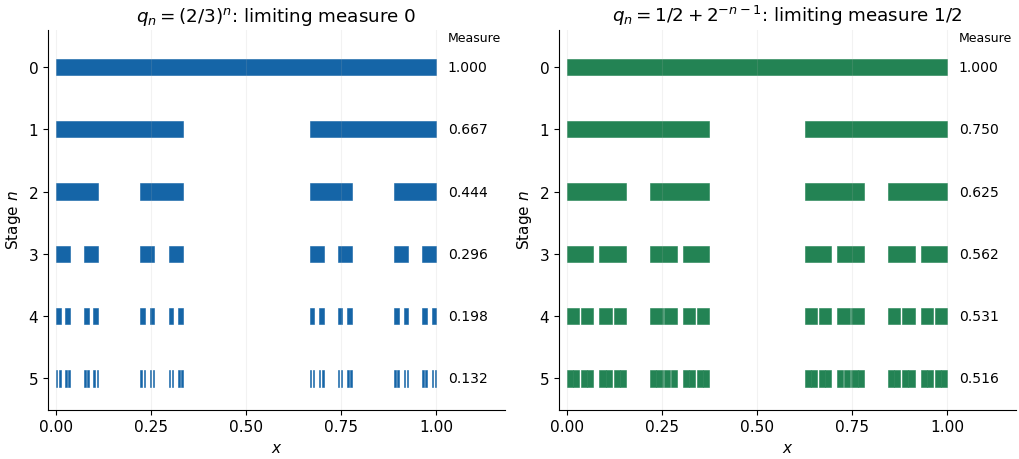
Generalized Cantor constructions with zero and positive limiting Lebesgue measure
. Each row shows the retained closed intervals at one stage. The two constructions have the same binary splitting pattern but different limits of the total retained length. Details.For , put . The regular distribution of is a tempered distribution, since the function is bounded. Its Fourier transform is the integrable functionwith arbitrary finite value at zero when the displayed integral diverges there. To prove the identity, the gamma function gives . Pair this with a Schwartz function, use the Fourier transform of a Gaussian, and interchange integrals by Fubini's theorem. The absolute bound for the transformed pairing follows from Tonelli's theorem:The positive kernel and dominated convergence give positivity and continuity away from zero. It has a continuous representative at zero exactly when , in which case . For , Fatou's lemma gives as , so no change on a set of zero Lebesgue measure can give continuity.
A time-dependent response can be represented by its Fourier transform in angular frequency. With , a time derivative transforms to when boundary terms vanish. A time-translation-invariant response convolution becomes multiplication by a frequency-dependent response coefficient. This is why a dispersive electrical conductivity is naturally specified in the frequency domain. The inverse-transform modes use .
One standard sufficient form states that the Fourier series of a piecewise continuously differentiable periodic function converges at to . At a continuity point it equals . This modern sufficient form should be distinguished from the exact hypotheses of the 1829 original.[ref]
For positive integers , the sine functions form an orthogonal family on :The same formula holds for the corresponding cosine functions when both indices are positive. Product-to-sum identities reduce the distinct-index products to cosines with nonzero integer frequencies, each with zero integral; for matching indices, the squared sine or cosine has mean . This proves the formula and explains why separate normal modes of a uniform fixed-end string make additive contributions to its kinetic energy and potential energy. The constant cosine has squared norm rather than .
For a sequence indexed by the integers, its semidiscrete Fourier transform is the displayed Fourier series in . For square-summable data the series is interpreted in the L2 norm. Its inversion and Parseval identity areThe physical-frequency convention uses and on . This is distinct from the discrete Fourier transform of a finite vector. Translation-invariant finite difference operators become Fourier multipliers, making Fourier stability analysis possible.
The average of future-directed normalized four-velocities is generally timelike but is not normalized. For an isotropic ensemble with common Lorentz factor , the mean is and has squared norm . A normalized bulk velocity instead equals . In a perfect fluid in general relativity its rest-frame energy eigenvector is the natural bulk choice; the rest-frame energy density includes random kinetic energy.
Pinned article: Introduction to the OurBigBook Project
Welcome to the OurBigBook Project! Our goal is to create the perfect publishing platform for STEM subjects, and get university-level students to write the best free STEM tutorials ever.
Everyone is welcome to create an account and play with the site: ourbigbook.com/go/register. We belive that students themselves can write amazing tutorials, but teachers are welcome too. You can write about anything you want, it doesn't have to be STEM or even educational. Silly test content is very welcome and you won't be penalized in any way. Just keep it legal!
Intro to OurBigBook
. Source. We have two killer features:
- topics: topics group articles by different users with the same title, e.g. here is the topic for the "Fundamental Theorem of Calculus" ourbigbook.com/go/topic/fundamental-theorem-of-calculusArticles of different users are sorted by upvote within each article page. This feature is a bit like:
- a Wikipedia where each user can have their own version of each article
- a Q&A website like Stack Overflow, where multiple people can give their views on a given topic, and the best ones are sorted by upvote. Except you don't need to wait for someone to ask first, and any topic goes, no matter how narrow or broad
This feature makes it possible for readers to find better explanations of any topic created by other writers. And it allows writers to create an explanation in a place that readers might actually find it.
Figure 1. Screenshot of the "Derivative" topic page. View it live at: ourbigbook.com/go/topic/derivativeVideo 2. OurBigBook Web topics demo. Source. - local editing: you can store all your personal knowledge base content locally in a plaintext markup format that can be edited locally and published either:This way you can be sure that even if OurBigBook.com were to go down one day (which we have no plans to do as it is quite cheap to host!), your content will still be perfectly readable as a static site.
- to OurBigBook.com to get awesome multi-user features like topics and likes
- as HTML files to a static website, which you can host yourself for free on many external providers like GitHub Pages, and remain in full control

Figure 2. You can publish local OurBigBook lightweight markup files to either OurBigBook.com or as a static website.
Figure 3. Visual Studio Code extension installation.
Figure 5. . You can also edit articles on the Web editor without installing anything locally. Video 3. Edit locally and publish demo. Source. This shows editing OurBigBook Markup and publishing it using the Visual Studio Code extension. 
- Infinitely deep tables of contents:



All our software is open source and hosted at: github.com/ourbigbook/ourbigbook
Further documentation can be found at: docs.ourbigbook.com
Feel free to reach our to us for any help or suggestions: docs.ourbigbook.com/#contact