Topics (384k) Articles (398k) Users (410) Discussions (242) Comments (383) Files (13k) New article

A computer scientist whose research includes computational intelligence and the neural basis of constructing imagined experiences.[ref]
Patients with hippocampal amnesia cannot imagine new experiences by Demis Hassabis and others. Author identification and the research contribution described in this paper

Portrait of Demis Hassabis
. John Sears. CC BY-SA 4.0, via Wikimedia Commons. Source.A computer scientist studying reinforcement learning and its connections with neuroscience.[ref]
https://willdabney.com/. Identity and authorship record
Computer scientist and coauthor of Gradient Estimation Using Stochastic Computation Graphs by John Schulman and others. The 2015 paper gives a common framework for score-function gradient estimators and pathwise gradients. Publication identifying the author and affiliation.
Stuart J. Russell is a computer scientist whose work concerns artificial intelligence and the design of systems that choose actions from available information. With Peter Norvig, he wrote Artificial Intelligence: A Modern Approach by Stuart Russell and Peter Norvig. Its agent perspective connects search algorithms, first-order logic, probabilistic reasoning, decision theory and machine learning.[ref]
Artificial Intelligence: A Modern Approach by Stuart Russell and Peter Norvig. Author byline and chapters 2–22 in the fourth-edition contents
His research and lectures also examine uncertainty about an intelligent system's objectives. That question differs from uncertainty about its observations: even a system that predicts its environment accurately can need information about what outcome its user wants.[ref]
Stuart Russell's Berkeley research profile. Research areas; Uncertainty in Objectives and Human Compatible links

Peter Norvig is a computer scientist whose work combines artificial intelligence, computer programming and technical education. With Stuart J. Russell, he wrote Artificial Intelligence: A Modern Approach by Stuart Russell and Peter Norvig, which connects search algorithms, logical reasoning, probabilistic reasoning and machine learning through the design of intelligent agents.[ref]
Artificial Intelligence: A Modern Approach by Stuart Russell and Peter Norvig. Author byline and fourth-edition table of contents
His programming explanations also connect compact working examples with general ideas: his spelling-correction tutorial illustrates how candidate generation and a probability model can cooperate in selecting a correction.[ref]

Portrait of Peter Norvig in 2019
. Christopher Michel, photograph; Filetime, existing Commons crop. CC BY-SA 4.0. Source.Primary profile: anon.cs.rochester.edu/people/faculty/kautz_henry/index.html

Portrait of Henry Kautz
. Portrait hosted on the University of Rochester Department of Computer Science faculty profile. Source.A computer scientist working on Boolean satisfiability and automated planning, including SATPlan with Henry Kautz.
Primary profile: carlsaganinstitute.cornell.edu/bart-selman

Portrait of Bart Selman
. Photograph from Bart Selman’s Cornell University homepage. Source.A computer scientist working on game theory, algorithms and computational complexity theory. Co-author with Christos Papadimitriou of On the Complexity of Cooperative Solution Concepts by Xiaotie Deng and Christos Papadimitriou, which studies induced subgraph games.

Portrait displayed on the Peking University profile of Xiaotie Deng
. External institutional image credited to its source profile. The individual photographer and image licence are not stated in the inspected material. Source.A computer scientist working on algorithms, computational complexity theory and game theory. Co-author with Xiaotie Deng of On the Complexity of Cooperative Solution Concepts by Xiaotie Deng and Christos Papadimitriou.
Primary profile: Columbia University faculty profile.

Christos Papadimitriou speaking at EPFL on 30 June 2009
. Photograph by Rama, via Wikimedia Commons. CC BY-SA 2.0 France. Source.Computer scientist and coauthor of End-to-end arguments in system design by Jerome H. Saltzer and others.
Institutional profile: www.csail.mit.edu/person/jerry-saltzer

Portrait of Jerry Saltzer
. Source: MIT Computer Science and Artificial Intelligence Laboratory, Jerry Saltzer profile. Photographer not established. External portrait hosted by MIT Computer Science and Artificial Intelligence Laboratory. Source.Computer scientist and coauthor of End-to-end arguments in system design by Jerome H. Saltzer and others.

Portrait of David P. Reed
. Source: David P. Reed's author biography, Deep Plum Research. Photographer not established. External portrait hosted by Deep Plum Research. Source.
William Giauque investigated chemical thermodynamics at very low temperatures. Calorimetry and magnetic cooling connect accessible microscopic states with entropy and thermal response.
A reduction in temperature makes previously negligible level spacings relevant to state populations. Low-temperature measurements therefore test how molecular rotation, spin, and crystal structure contribute to thermodynamic quantities.[ref]
A chemist at Berkeley whose research and teaching focused on chemical thermodynamics.[ref]
William Francis Giauque by D. N. Lyon and others. Teaching paragraphs: chemistry instructor in 1922; Advanced Physical Chemistry and Chemical Thermodynamics courses

Portrait of William Giauque
. The Nobel Foundation, 1949 copyright notice; photographer and capture date unspecified. English Wikipedia identifies the photograph as public domain in Sweden with its United States copyright status unconfirmed. Source.Robert Robinson (chemist) investigated the structures and synthesis of plant natural products, especially alkaloids. His synthesis of tropinone used a proposed biological pattern of assembly to guide laboratory construction, an influential example of connecting chemical synthesis with ideas about biosynthesis.[ref]
A Synthesis of Tropinone by Robert Robinson. A synthesis of tropinone, 1917, pp.762–768; historical proposal distinguished from a proven biosynthetic pathway

Portrait of Robert Robinson (chemist)
. Unknown author; Nobel Foundation. Public domain. Source usage terms, via Wikimedia Commons. Source.Alan MacDiarmid coauthored research on the synthesis and structure of polythiazyl and its precursor. The sulfur-nitrogen polymer provides an example of electronic conduction in a material whose backbone is not a carbon chain.
Its behaviour depends on the extended solid and its electronic states, rather than solely on counting lone pairs in an isolated repeating unit.[ref]
Synthesis and structure of the polymeric metal, (SN)x, and its precursor, S2N2 by Alan G. MacDiarmid and others. 1975, polymeric sulfur nitride and its precursor
Portrait of Alan MacDiarmid
. Collection: Science History Institute; photographer not established in this pass. Via Wikimedia Commons; credits and usage information are on the linked source file page. Source.Narayan Sadashiv Hosmane coauthored synthetic routes to small nido carboranes using borane-derived starting materials and Lewis-base adducts. The work connects boron-hydride chemistry with incorporation of carbon into an open cluster framework.
A carborane is specified by both its vertex inventory and its cage connectivity. Retaining a small open cage differs from simply producing any compound with the same elemental ingredients.[ref]

Portrait of Narayan Sadashiv Hosmane
. External portrait hosted by Northern Illinois University Department of Chemistry and Biochemistry. Source.Rainer Ludwig Claisen investigated rearrangements that make new carbon–carbon chemical bonds. His 1912 paper describes conversion of phenol allyl ethers into carbon-allylated phenols, a transformation now associated with the Claisen rearrangement. The product moves the allyl attachment from oxygen to the aromatic carbon skeleton.[ref]
Über Umlagerung von Phenol-allyläthern in C-Allyl-phenole by Rainer Ludwig Claisen. Über Umlagerung von Phenol-allyläthern in C-Allyl-phenole, 1912, pp.3157–3166

Portrait of Rainer Ludwig Claisen
. Unknown author; University of Kiel. Public domain. Source usage terms, via Wikimedia Commons. Source.Mario Molina coauthored low-temperature experiments on the self-reaction of chlorine monoxide. Infrared and ultraviolet measurements identified formation of the dimer associated with the chlorine monoxide dimer cycle.
A laboratory intermediate supplies a concrete link between a proposed catalytic cycle and an atmospheric ozone budget. Dimer formation, thermal dissociation, and photodissociation compete, so its abundance and its ozone-loss effect are separate quantities.[ref]
Production of chlorine oxide (Cl2O2) from the self-reaction of the chlorine oxide (ClO) radical by L. T. Molina and M. J. Molina. Flow-system dimer production at 220–240 K and infrared/ultraviolet identification
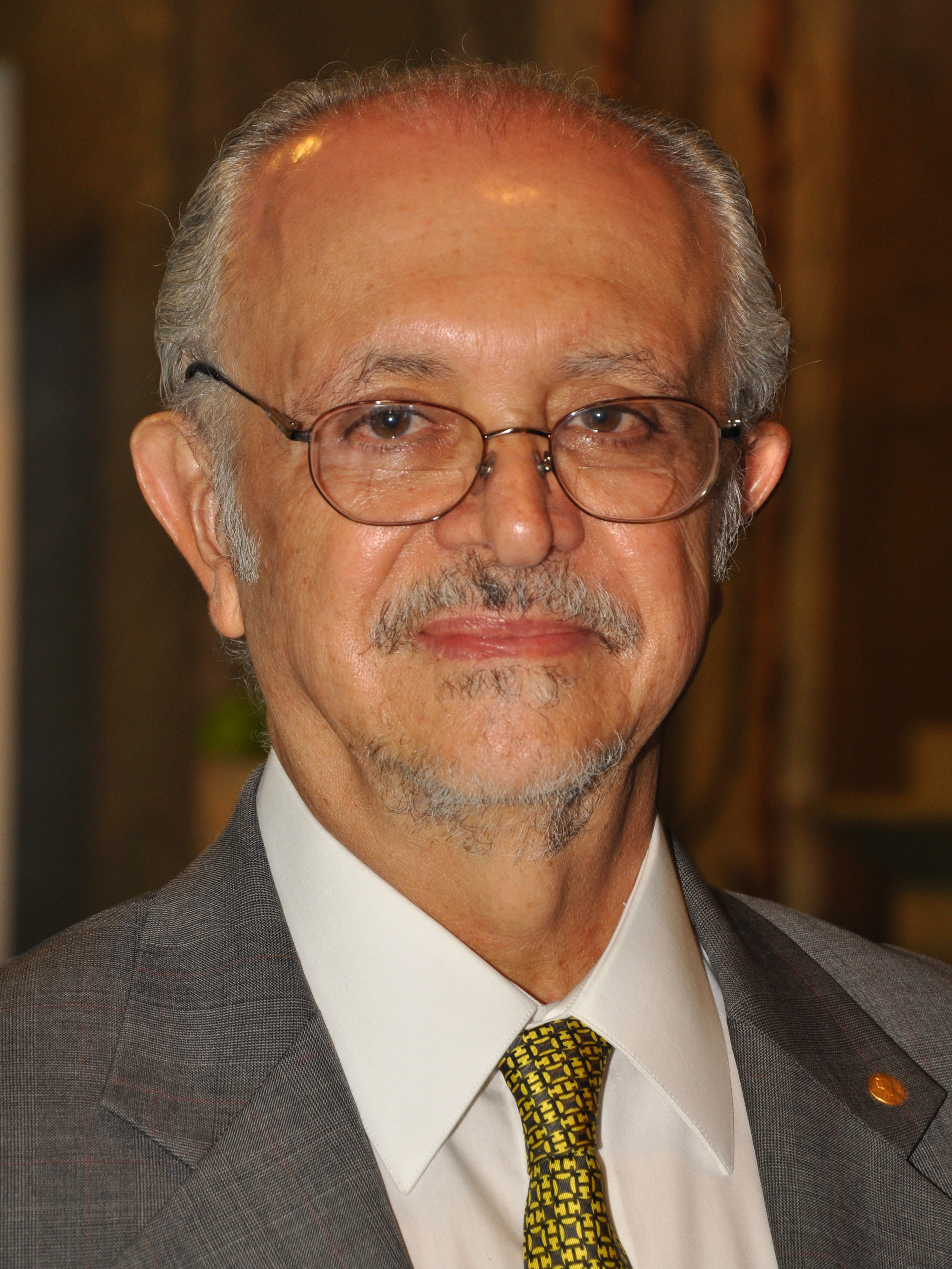
Portrait of Mario Molina
. Janwikifoto; science.in2pic.com. CC BY-SA 3.0, via Wikimedia Commons. Source.Karl Barry Sharpless developed methods for asymmetric oxidation, including Sharpless asymmetric epoxidation and asymmetric dihydroxylation. A chiral catalyst makes one enantiomer form preferentially, giving synthetic chemists control over molecular handedness as well as molecular connectivity.[ref]
https://www.nobelprize.org/uploads/2018/06/sharpless-lecture.pdf. 2001 Nobel lecture: asymmetric epoxidation and dihydroxylation, geraniol examples

Portrait of Karl Barry Sharpless
. Bengt Oberger; cropped by JB Hoang Tam. CC BY-SA 4.0, via Wikimedia Commons. Source.Norman Greenwood coauthored research on the reactions of boron-hydride clusters with cobalt, rhodium, and iridium complexes. A reported borallyl iridium product illustrates how a cluster can become a multidentate ligand.
Pinned article: Introduction to the OurBigBook Project
Welcome to the OurBigBook Project! Our goal is to create the perfect publishing platform for STEM subjects, and get university-level students to write the best free STEM tutorials ever.
Everyone is welcome to create an account and play with the site: ourbigbook.com/go/register. We belive that students themselves can write amazing tutorials, but teachers are welcome too. You can write about anything you want, it doesn't have to be STEM or even educational. Silly test content is very welcome and you won't be penalized in any way. Just keep it legal!
Intro to OurBigBook
. Source. We have two killer features:
- topics: topics group articles by different users with the same title, e.g. here is the topic for the "Fundamental Theorem of Calculus" ourbigbook.com/go/topic/fundamental-theorem-of-calculusArticles of different users are sorted by upvote within each article page. This feature is a bit like:
- a Wikipedia where each user can have their own version of each article
- a Q&A website like Stack Overflow, where multiple people can give their views on a given topic, and the best ones are sorted by upvote. Except you don't need to wait for someone to ask first, and any topic goes, no matter how narrow or broad
This feature makes it possible for readers to find better explanations of any topic created by other writers. And it allows writers to create an explanation in a place that readers might actually find it.
Figure 1. Screenshot of the "Derivative" topic page. View it live at: ourbigbook.com/go/topic/derivativeVideo 2. OurBigBook Web topics demo. Source. - local editing: you can store all your personal knowledge base content locally in a plaintext markup format that can be edited locally and published either:This way you can be sure that even if OurBigBook.com were to go down one day (which we have no plans to do as it is quite cheap to host!), your content will still be perfectly readable as a static site.
- to OurBigBook.com to get awesome multi-user features like topics and likes
- as HTML files to a static website, which you can host yourself for free on many external providers like GitHub Pages, and remain in full control

Figure 2. You can publish local OurBigBook lightweight markup files to either OurBigBook.com or as a static website.
Figure 3. Visual Studio Code extension installation.
Figure 5. . You can also edit articles on the Web editor without installing anything locally. Video 3. Edit locally and publish demo. Source. This shows editing OurBigBook Markup and publishing it using the Visual Studio Code extension. 
- Infinitely deep tables of contents:




All our software is open source and hosted at: github.com/ourbigbook/ourbigbook
Further documentation can be found at: docs.ourbigbook.com
Feel free to reach our to us for any help or suggestions: docs.ourbigbook.com/#contact