Topics (384k) Articles (398k) Users (410) Discussions (242) Comments (383) Files (13k) New article

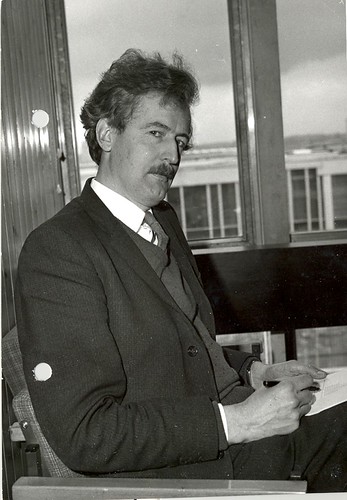
A mathematician whose work includes graph theory and matroids; Tutte's theorem on perfect matchings is one of his fundamental results.

William Thomas Tutte, portrait hosted by the University of St Andrews MacTutor archive
. A mathematician associated with Broyden's method and quasi-Newton methods in numerical analysis. An institutional portrait is catalogued by the University of Essex Library Services: www.flickr.com/photos/149590996@N07/31601668406/

Volker Strassen in 1970
. Photograph credited to Konrad Jacobs, via the Oberwolfach Photo Collection. The file page states Creative Commons Attribution-ShareAlike 2.0 Germany, CC BY-SA 2.0 DE. The remote photograph is linked without a local copy. Source.A mathematician working in probability theory and ergodic theory, whose photographic collection became a foundation of the Oberwolfach Photo Collection.[ref]
https://www.nat.fau.de/2015/07/29/zum-gedenken-an-prof-dr-konrad-jacobs/. FAU obituary, 29 July 2015, research areas and transfer of the collection in 2005
[ref]https://opc.mfo.de/. Oberwolfach Photo Collection, introductory history and attribution to Konrad Jacobs

Portrait of Konrad Jacobs
. Via Wikimedia Commons; credits and usage information are on the linked source file page. Source.
Edwin Bidwell Wilson was a mathematician and statistician, remembered in statistics for the Wilson score interval. His 1931 paper with Margaret M. Hilferty introduced an influential approximation to the chi-squared distribution. His firsthand National Academy of Sciences memoir lists the paper under his full name.[ref]
https://www.nasonline.org/wp-content/uploads/2024/06/wilson-edwin-b.pdf. Hunsaker and Mac Lane, memoir title and bibliography p313, The distribution of chi-square
Their Wilson-Hilferty transformation uses for a chi-squared distribution with statistical degrees of freedom. Its approximate mean and variance give a normal approximation useful for converting quantiles between the two distributions.[ref]
Mathematician associated with the Bellman-Ford algorithm.
A mathematician whose work includes the minimax theorem and, with Oskar Morgenstern, the foundations of expected utility and game theory.

Portrait of John von Neumann
. Portrait credited to wikispaces in the Wikimedia Commons file record. CC BY-SA 3.0. Source.Mathematician working in probability theory and stochastic calculus; author of Markov Chains by James R. Norris. Author's Cambridge page.

James R. Norris at Oberwolfach in 2007. Photograph credited to Renate Schmid; Wikimedia Commons and the Oberwolfach Photo Collection.
Photograph by Renate Schmid. Verified file and source credit, licensed CC BY-SA 2.0 Germany. No changes. Source.A mathematician specializing in algebraic number theory. The Hasse diagram is named after him.[ref]
https://en.wikipedia.org/wiki/Helmut_Hasse. Biographical identity and field
[ref]
Portrait of Helmut Hasse by Konrad Jacobs
. Oberwolfach Photo Collection, photograph by Konrad Jacobs, via Wikimedia Commons. CC BY-SA 2.0 Germany. The linked file page identifies the sitter and the photographer. Source.A Colombian mathematician known for Recamán's sequence. The primary sequence record cites his 1991 correspondence; an institution-hosted interview independently identifies him as the mathematician and educator.[ref]
OEIS entry A005132. References: letter of 29 January 1991
[ref]https://eduteka.icesi.edu.co/articulos/EntrevistaBernardoRecaman. Eduteka interview, hosted by Universidad Icesi
Verified Spanish-language identity page: es.wikipedia.org/wiki/Bernardo_Recam%C3%A1n_Santos. An exact usable portrait URL was not established in the bounded Commons/Wikipedia and institutional-source check; the report records that gap without inferring that no portrait exists.
W. J. M. Rankine was a Scottish engineer and physicist who contributed to thermodynamics, classical mechanics and the teaching of engineering. As professor of civil engineering and mechanics at Glasgow from 1855 to 1872, he emphasized connecting theory with practice and worked with shipbuilders on vessels and engines.[ref]
Macquorn Rankine in the University of Glasgow Story. Biographical account: professorship, research and collaboration with shipbuilders
The Rankine cycle connects his name with the analysis of heat engines using a working fluid that undergoes vaporization and condensation. Its idealized sequence of pumping, heating, expansion and cooling connects a practical steam engine to a calculation of mechanical work and thermal efficiency. The broader importance of his work lies in making quantitative physical theory part of systematic engineering design.
Institutional historical profile: Imperial College historical plaque booklet: William John Macquorn Rankine.

Portrait of William John Macquorn Rankine
. Thomas Annan, photograph made before his death in 1887; National Galleries of Scotland, PGP R 2115.24. Restoration by Adam Cuerden. Commons marks the photograph and faithful reproduction public domain, including expired U.S. copyright; Public Domain Mark. The restoration's stated unrestricted permission requests attribution where possible. Source.Christian Otto Mohr was an engineer whose work connected graphical methods with the analysis of stressed materials. Mohr's circle represents the normal stress and shear stress on differently oriented planes by points on a circle, turning a change of coordinates into a geometric construction. TU Dresden's historical account relates this construction to his 1882 work on the representation of stress and deformation.[ref]
Der Mohrsche Spannungskreis wird 125 Jahre alt by Günter Zumpe. Dresdner Universitätsjournal 12/2008, page 9; discussion of Mohr's 1882 Civilingenieur article
For a two-dimensional stress tensor, the circle has centre and radiusIts horizontal intercepts give the principal stresses. This makes Mohr's circle useful for seeing both extremal stresses and the relation between plane orientation and the components of stress.

Portrait of Christian Otto Mohr
. Wilhelm Höffert, 1897; scan via Wikimedia Commons. Public domain according to the Wikimedia Commons file page (PD-old-100 and Public Domain Mark). Source usage terms, via Wikimedia Commons. Source.An electrical engineer whose research includes optimization and control theory.[ref]
https://www.eecs.mit.edu/people/pablo-parrilo/. MIT EECS profile: engineering professorship; Optimization and Game Theory; Systems Theory, Control, and Autonomy
Homepage: www.mit.edu/~parrilo/

Pinned article: Introduction to the OurBigBook Project
Welcome to the OurBigBook Project! Our goal is to create the perfect publishing platform for STEM subjects, and get university-level students to write the best free STEM tutorials ever.
Everyone is welcome to create an account and play with the site: ourbigbook.com/go/register. We belive that students themselves can write amazing tutorials, but teachers are welcome too. You can write about anything you want, it doesn't have to be STEM or even educational. Silly test content is very welcome and you won't be penalized in any way. Just keep it legal!
Intro to OurBigBook
. Source. We have two killer features:
- topics: topics group articles by different users with the same title, e.g. here is the topic for the "Fundamental Theorem of Calculus" ourbigbook.com/go/topic/fundamental-theorem-of-calculusArticles of different users are sorted by upvote within each article page. This feature is a bit like:
- a Wikipedia where each user can have their own version of each article
- a Q&A website like Stack Overflow, where multiple people can give their views on a given topic, and the best ones are sorted by upvote. Except you don't need to wait for someone to ask first, and any topic goes, no matter how narrow or broad
This feature makes it possible for readers to find better explanations of any topic created by other writers. And it allows writers to create an explanation in a place that readers might actually find it.
Figure 1. Screenshot of the "Derivative" topic page. View it live at: ourbigbook.com/go/topic/derivativeVideo 2. OurBigBook Web topics demo. Source. - local editing: you can store all your personal knowledge base content locally in a plaintext markup format that can be edited locally and published either:This way you can be sure that even if OurBigBook.com were to go down one day (which we have no plans to do as it is quite cheap to host!), your content will still be perfectly readable as a static site.
- to OurBigBook.com to get awesome multi-user features like topics and likes
- as HTML files to a static website, which you can host yourself for free on many external providers like GitHub Pages, and remain in full control

Figure 2. You can publish local OurBigBook lightweight markup files to either OurBigBook.com or as a static website.
Figure 3. Visual Studio Code extension installation.
Figure 5. . You can also edit articles on the Web editor without installing anything locally. Video 3. Edit locally and publish demo. Source. This shows editing OurBigBook Markup and publishing it using the Visual Studio Code extension. 
- Infinitely deep tables of contents:




All our software is open source and hosted at: github.com/ourbigbook/ourbigbook
Further documentation can be found at: docs.ourbigbook.com
Feel free to reach our to us for any help or suggestions: docs.ourbigbook.com/#contact