Topics (384k) Articles (398k) Users (410) Discussions (242) Comments (383) Files (13k) New article

Biologist whose Silent Spring by Rachel Carson connected chemical pest control with ecological consequences.

Portrait of Rachel Carson
. U.S. Fish and Wildlife Service. Public domain (U.S. federal government; PD-USGov-FWS). Source usage terms, via Wikimedia Commons. Source.
Portrait of Paul R. Ehrlich
. Ilka Hartmann. Public domain in the United States (published 1931–1977 without copyright notice). Source usage terms, via Wikimedia Commons. Source.Researcher in single-molecule transcription measurements. Revyakin and collaborators used DNA nanomanipulation to distinguish promoter unwinding from other changes in DNA shape, connecting mechanical measurements with stages of transcription initiation.[ref]
Researcher in systems biology. Elowitz and collaborators investigated stochastic gene expression within individual cells, connecting molecular fluctuations with variation that is hidden by a population average.[ref]
Stochastic Gene Expression in a Single Cell by Michael B. Elowitz and others. Author list and described study
Researcher in ion channel biophysics. Seoh and collaborators measured gating charge after neutralizing charged residues in a potassium channel, connecting particular amino acids with the channel’s response to voltage.[ref]
Voltage-sensing residues in the S2 and S4 segments of the Shaker K+ channel by S. A. Seoh and others. Author list and described study
Researcher in structural biology. Long and collaborators determined the architecture of a mammalian voltage-dependent potassium channel, connecting the positions of pore and voltage-sensing components with the mechanism of electrical activation.[ref]
Researcher in ion channel biophysics. Hoshi and collaborators perturbed the amino-terminal region of Shaker potassium channels to investigate rapid inactivation, connecting a structural region with a time-dependent change in current.[ref]
Researcher in ion channel biophysics. Zagotta and collaborators restored inactivation of mutant potassium channels with an introduced peptide, experimentally testing the pore-blocking interpretation of ball-and-chain inactivation.[ref]
Researcher in quantitative fluorescence microscopy. Thompson and collaborators investigated how photon statistics, background and pixel size affect localization of individual probes, connecting a recorded optical image with uncertainty in an inferred molecular position.[ref]
Researcher in cardiac genetics. Wang and collaborators identified voltage-gated sodium channel mutations in patients with long QT syndrome, connecting an inherited cardiac rhythm disorder with changes in a specific molecular channel.[ref]
Researcher in cardiac electrophysiology. Berecki and collaborators used a dynamic action potential clamp to investigate voltage-gated sodium channel variants associated with long QT syndrome, connecting measured mutant currents with their consequences for ventricular electrical activity.[ref]
Researcher in human genetics. Koch and collaborators linked skeletal-muscle chloride channel defects with dominant and recessive myotonia congenita, connecting an inherited disease pattern with a molecular candidate mechanism.[ref]
Researcher in ion channel physiology. Pusch and collaborators studied how mutations associated with dominant myotonia congenita change chloride channel voltage dependence, connecting inherited sequence differences with altered muscle excitability.[ref]
Researcher in ion channel physiology. Saviane and collaborators used single-channel recordings and noise analysis to resolve the double-barreled behavior of a skeletal-muscle chloride channel and its alteration in myotonia congenita.[ref]
Researcher in comparative anatomy and natural history. Cuvier organized collections so that structures from different vertebrates could be compared systematically, and his work on fossils helped establish that some represented extinct species.[ref]
https://www.mnhn.fr/fr/collection-d-anatomie-comparee. Muséum national d’histoire naturelle, collection history
[ref]
Portrait of Georges Cuvier
. Nicolas-Eustache Maurin (1832); Bibliothèque interuniversitaire de la Sorbonne / NUBIS, ark:/15733/m68h. CC BY-SA 4.0, via Wikimedia Commons. Source.Alex Filippenko studies exploding stars and the use of supernovae as cosmological probes. He coauthored both major late-1990s analyses that compared distant Type Ia supernovae with nearby reference samples.
The technique connects a standardized supernova luminosity to its measured brightness, then compares the inferred luminosity distance with cosmological redshift. The distant events favored models with an accelerating cosmic expansion. Their interpretation required checking extinction and other systematic changes that could also make distant sources appear faint.[ref]
Observational Evidence from Supernovae for an Accelerating Universe and a Cosmological Constant by Adam Riess and others. Author list and abstract: supernova distances, cosmological fits and systematic tests
[ref]Measurements of Omega and Lambda from 42 High-Redshift Supernovae by Saul Perlmutter and others. Author list and abstract: independent standardized supernova sample

Portrait of Alex Filippenko
. Jeffrey Silverman. CC BY-SA 3.0, via Wikimedia Commons. Source.Jayant Narlikar investigated cosmology and alternative theories of gravity, including work with Fred Hoyle. As founding director of IUCAA, he also built an institutional setting in which differing cosmological models could be investigated.[ref]
Jayant V. Narlikar: tribute by R. Srianand. Signed opening tribute: scientific contributions and founding direction of IUCAA
His scientific writing makes the role of mathematical assumptions particularly clear. In his memoir of Amal Kumar Raychaudhuri, he explains how highly symmetric cosmological models simplify Einstein field equations, and why a general evolution equation can test conclusions that might otherwise depend on that symmetry. The distinction is between a singularity inferred in a special model and one established under a wider set of explicit conditions.[ref]
Amal Kumar Raychaudhuri by Jayant Vishnu Narlikar. Research discussion, pp. 171–175: cosmological assumptions, Raychaudhuri equation and singularity arguments

Portrait of Jayant Narlikar
. Biswarup Ganguly. CC BY 3.0, via Wikimedia Commons. Source.Simon White studies the formation of galaxies and cosmic structure. With Martin Rees, he proposed a two-stage account in which extended dark haloes assemble gravitationally and luminous galaxies form through cooling and concentration of gas within them.
The key distinction is dissipative: gas can radiate away energy, whereas collisionless halo material does not cool in the same way. The cooling requirement helps determine which dark structures can host concentrated luminous systems. Their 1978 model thereby connected the dark gravitational framework to the observed scale of galaxies.[ref]
Core condensation in heavy halos by Simon D. M. White and Martin J. Rees. Abstract: hierarchical dark clustering and formation of luminous cores through dissipative cooling

Portrait of Simon White
. Photograph by Mike Peel (www.mikepeel.net). CC BY-SA 4.0, via Wikimedia Commons. Source.Martin Rees develops theoretical accounts of cosmic structure. In a 1978 paper with Simon White, he separated the assembly of extended dark haloes from the dissipative concentration of luminous material within them.
Collisionless matter can build a large gravitationally bound halo, while gas can lose energy through radiative cooling and settle into a much denser luminous component. Their two-stage model connected the characteristic sizes and luminosities of galaxies to the cooling of gas inside a hierarchically assembled dark structure. It made the different physical behavior of the components central to the explanation.[ref]
Core condensation in heavy halos by Simon D. M. White and Martin J. Rees. Abstract and model formulation: hierarchical clustering, dissipative gas and concentrated luminous cores

Portrait of Martin Rees
. IAU/B. Tafreshi (twanight.org). CC BY 4.0, via Wikimedia Commons. Source.Michael Dopita modeled the physical processes producing emission from ionized astronomical gas. With David C. Nicholls and Ralph S. Sutherland, he investigated why different spectral lines can give discrepant electron temperatures and chemical abundances in H II regions and planetary nebulae.
Their proposed explanation changed the assumed electron kinetic energy distribution from a Maxwell-Boltzmann distribution to a Kappa distribution, which has a more populated high-energy tail. Because different atomic transitions sample different electron energies, this change affects their inferred temperatures differently. The paper presented a testable interpretation of the diagnostic discrepancy.[ref]
Resolving the electron temperature discrepancies in H II regions and planetary nebulae: kappa-distributed electrons by David C. Nicholls and others. Abstract: nebular temperature discrepancies and consequences of a kappa electron distribution
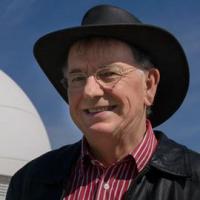
Portrait of Michael Dopita
. External portrait hosted by Australian Academy of Science. Source. Pinned article: Introduction to the OurBigBook Project
Welcome to the OurBigBook Project! Our goal is to create the perfect publishing platform for STEM subjects, and get university-level students to write the best free STEM tutorials ever.
Everyone is welcome to create an account and play with the site: ourbigbook.com/go/register. We belive that students themselves can write amazing tutorials, but teachers are welcome too. You can write about anything you want, it doesn't have to be STEM or even educational. Silly test content is very welcome and you won't be penalized in any way. Just keep it legal!
Intro to OurBigBook
. Source. We have two killer features:
- topics: topics group articles by different users with the same title, e.g. here is the topic for the "Fundamental Theorem of Calculus" ourbigbook.com/go/topic/fundamental-theorem-of-calculusArticles of different users are sorted by upvote within each article page. This feature is a bit like:
- a Wikipedia where each user can have their own version of each article
- a Q&A website like Stack Overflow, where multiple people can give their views on a given topic, and the best ones are sorted by upvote. Except you don't need to wait for someone to ask first, and any topic goes, no matter how narrow or broad
This feature makes it possible for readers to find better explanations of any topic created by other writers. And it allows writers to create an explanation in a place that readers might actually find it.
Figure 1. Screenshot of the "Derivative" topic page. View it live at: ourbigbook.com/go/topic/derivativeVideo 2. OurBigBook Web topics demo. Source. - local editing: you can store all your personal knowledge base content locally in a plaintext markup format that can be edited locally and published either:This way you can be sure that even if OurBigBook.com were to go down one day (which we have no plans to do as it is quite cheap to host!), your content will still be perfectly readable as a static site.
- to OurBigBook.com to get awesome multi-user features like topics and likes
- as HTML files to a static website, which you can host yourself for free on many external providers like GitHub Pages, and remain in full control

Figure 2. You can publish local OurBigBook lightweight markup files to either OurBigBook.com or as a static website.
Figure 3. Visual Studio Code extension installation.
Figure 5. . You can also edit articles on the Web editor without installing anything locally. Video 3. Edit locally and publish demo. Source. This shows editing OurBigBook Markup and publishing it using the Visual Studio Code extension. 
- Infinitely deep tables of contents:




All our software is open source and hosted at: github.com/ourbigbook/ourbigbook
Further documentation can be found at: docs.ourbigbook.com
Feel free to reach our to us for any help or suggestions: docs.ourbigbook.com/#contact