Topics (384k) Articles (398k) Users (410) Discussions (242) Comments (383) Files (13k) New article

Henry Cavendish used a torsion balance to infer the mean density of the Earth. Nearby lead masses exert a gravitational force on smaller masses carried by a suspended horizontal arm. The wire's restoring torque opposes the resulting angular displacement; the arm's oscillation period calibrates that response. Moving the attracting masses to opposite sides reverses the deflection. Comparing this measured gravitational force with terrestrial gravity then determines the mean density of the Earth. To reduce convection caused by uneven heating, he enclosed the apparatus and observed its scale through telescopes from outside the room.[ref]
Experiments to Determine the Density of the Earth by Henry Cavendish. 1798, pp. 469–475: apparatus, oscillation calibration, reversed positions and thermal-air-current precautions
Experimental natural philosopher who measured terrestrial gravitational attraction and inferred the mean density of Earth in 1798.

Portrait of Henry Cavendish
. Wellcome Library, London / Wellcome Collection; after a drawing by Alexander in the British Museum. CC BY 4.0, via Wikimedia Commons. Source.Julius von Mayer argued for a quantitative equivalence between mechanical work and heat. His 1842 paper connects compression of a gas with its heat capacity. In a modern ideal gas example, heating at constant pressure includes expansion work that is absent at constant volume. Because an ideal gas's internal energy depends only on temperature, its molar heat capacities satisfy , where is the molar gas constant. The heat capacity difference thus supplies a route to comparing thermal and mechanical units of energy.[ref]
Remarks on the Forces of Inorganic Nature by Julius Robert Mayer. Final compression and heat-capacity argument; ideal-gas explanation expressed here in modern notation
Physician and natural philosopher who contributed to the conservation-of-energy programme in the 1840s, including an argument for the mechanical equivalent of heat.

Portrait of Julius von Mayer
. Wellcome Library, London / Wellcome Collection. CC BY 4.0, via Wikimedia Commons. Source.Hermann von Helmholtz's 1847 synthesis connected mechanical, thermal and electrical processes through conservation of energy. A modern example exposes the mathematical structure: for a particle with kinetic energy moving under a time-independent potential energy , a conservative force gives , so is constant. This derivation assumes a conservative force; the wider experimental question is how an apparent loss of mechanical energy reappears as another measurable form of energy. His essay helped organize such comparisons into a common conservation programme.[ref]
Über die Erhaltung der Kraft by Hermann von Helmholtz. 1847 monograph; conditional particle derivation expressed here in modern notation
Physicist and physiologist whose 1847 synthesis connected mechanical and other natural processes through a conservation principle.

Portrait of Hermann von Helmholtz
. Portrait by Franz von Lenbach; reproduced in Leo Königsberger, Hermann von Helmholtz (1906). Public domain (artist died 1904; reproduction published 1906); Commons PD-old/PDM. Source and usage information on the linked Wikimedia file page. Source.An accelerator physicist whose theoretical work develops magnetized electron cooling. A cold electron beam travels alongside a heavier particle beam, exchanging momentum with it and reducing its random motion. His analysis shows how guiding the electrons with a solenoidal magnetic field can increase the cooling rate and lower the equilibrium temperature. The result is useful for preparing compact ion beams for collisions.[ref]
Theory of electron cooling by Yaroslav S. Derbenev. Abstract: co-moving magnetized electron beam, enhanced cooling and ion-collider application
A researcher who coauthored a quantitative powder diffraction method using a surface diffractometer and an area detector. Extracting meaningful intensities requires corrections for polarization and measurement geometry as well as the crystal's structure factor. The work explains how an instrument designed for surfaces can also measure powders and textured samples, connecting detector images with reliable structural analysis.[ref]
An electrical engineer whose work connects semiconductor processing with optoelectronic devices. With collaborators, Dallesasse developed oxidation of aluminum-bearing compound semiconductors, a process used to define apertures in vertical-cavity surface-emitting lasers. The oxide helps control where the device conducts and emits, turning a materials-processing technique into a practical element of a small laser.[ref]
https://grainger.illinois.edu/news/stories/28380. Illinois account of III–V oxidation, co-discovery and VCSEL applications
A physicist whose research uses Gauge-gravity duality to study strongly interacting matter. In these models, transport properties such as viscosity and diffusion coefficients can be calculated from excitations of a corresponding black hole. The aim is to learn about matter that is difficult to treat by weak-coupling approximations, including the hot nuclear matter produced in heavy-ion collisions.[ref]
Research profile of Andrei Starinets at the University of Oxford. Research paragraphs: transport coefficients from black-hole excitation spectra and applications to hot nuclear matter
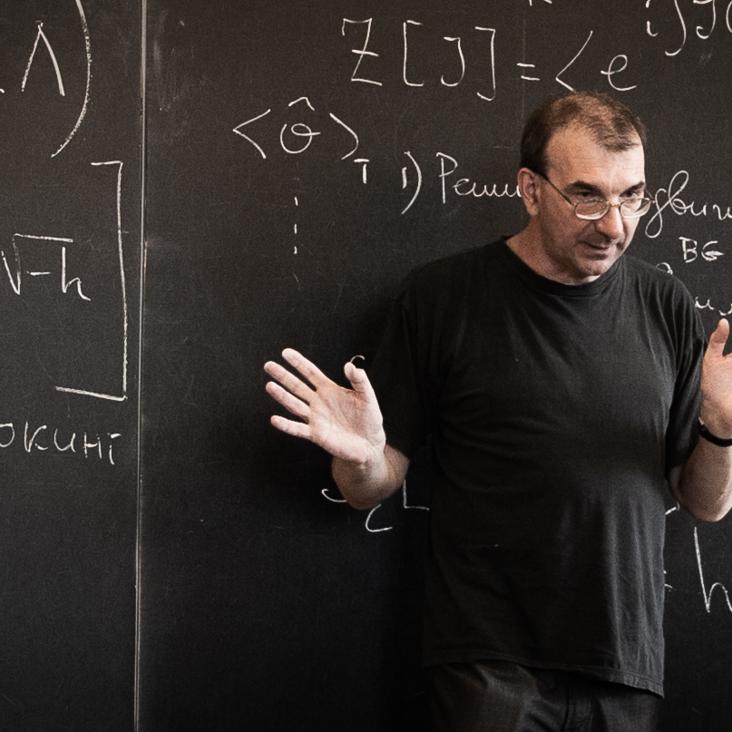
Portrait of Andrei Starinets
. Source. A physicist whose 1959 work explained why a photograph of a rapidly moving object does not simply show Lorentz contraction. Light arriving at the camera simultaneously left different parts of the object at different times. The resulting apparent shape combines this timing with relativistic aberration: a moving sphere still has a circular outline, while other shapes can appear rotated. Terrell rotation therefore distinguishes an optical image from a length measured using simultaneous positions in a reference frame.[ref]
Invisibility of the Lorentz Contraction by James Terrell. Abstract: conformal transformation of apparent directions, circular sphere outline and apparent rotation
In an account of perception, distinguish an object's physical constitution from its powers to produce experiences in perceivers. The distinction between primary qualities and secondary qualities does not by itself prove an external world or imply that dispositions are unreal.[ref]
An Essay Concerning Human Understanding by John Locke. book II, chapter VIII, sections 8–15 and 23–26
A classification whose usefulness in prediction and explanation is grounded in relevant natural structure, rather than solely in a convenient label. Exact membership conditions can help identify a natural kind but do not alone demonstrate its explanatory significance.
Acceptance of a scientific theory involves belief in its empirical adequacy and practical commitment to its use, without requiring belief in its full truth about unobservables. This concerns epistemic attitudes, whereas the distinction between a constructive theory and a principle theory concerns explanatory organization.[ref]
Constructive Empiricism Now by Bas van Fraassen. section III
The dependence of scientific observation, description or interpretation on background concepts and assumptions. Dependence on some theory is weaker than dependence on the truth of the particular theory being tested.
Evidence supports a scientific hypothesis without necessarily proving it. Distinguish increasing its credibility from showing it highly credible in absolute terms; a low prior probability can rise substantially while remaining low.
Two scientific accounts are empirically equivalent relative to a stated domain when they give the same observable consequences there. Agreement on the observations so far is weaker than agreement on every possible observation.
A deliberately arranged intervention or comparison used to investigate a claim. A useful experiment specifies the conditions changed, the outcome observed and the alternative explanations the comparison can discriminate.
Pinned article: Introduction to the OurBigBook Project
Welcome to the OurBigBook Project! Our goal is to create the perfect publishing platform for STEM subjects, and get university-level students to write the best free STEM tutorials ever.
Everyone is welcome to create an account and play with the site: ourbigbook.com/go/register. We belive that students themselves can write amazing tutorials, but teachers are welcome too. You can write about anything you want, it doesn't have to be STEM or even educational. Silly test content is very welcome and you won't be penalized in any way. Just keep it legal!
Intro to OurBigBook
. Source. We have two killer features:
- topics: topics group articles by different users with the same title, e.g. here is the topic for the "Fundamental Theorem of Calculus" ourbigbook.com/go/topic/fundamental-theorem-of-calculusArticles of different users are sorted by upvote within each article page. This feature is a bit like:
- a Wikipedia where each user can have their own version of each article
- a Q&A website like Stack Overflow, where multiple people can give their views on a given topic, and the best ones are sorted by upvote. Except you don't need to wait for someone to ask first, and any topic goes, no matter how narrow or broad
This feature makes it possible for readers to find better explanations of any topic created by other writers. And it allows writers to create an explanation in a place that readers might actually find it.
Figure 1. Screenshot of the "Derivative" topic page. View it live at: ourbigbook.com/go/topic/derivativeVideo 2. OurBigBook Web topics demo. Source. - local editing: you can store all your personal knowledge base content locally in a plaintext markup format that can be edited locally and published either:This way you can be sure that even if OurBigBook.com were to go down one day (which we have no plans to do as it is quite cheap to host!), your content will still be perfectly readable as a static site.
- to OurBigBook.com to get awesome multi-user features like topics and likes
- as HTML files to a static website, which you can host yourself for free on many external providers like GitHub Pages, and remain in full control

Figure 2. You can publish local OurBigBook lightweight markup files to either OurBigBook.com or as a static website.
Figure 3. Visual Studio Code extension installation.
Figure 5. . You can also edit articles on the Web editor without installing anything locally. Video 3. Edit locally and publish demo. Source. This shows editing OurBigBook Markup and publishing it using the Visual Studio Code extension. 
- Infinitely deep tables of contents:




All our software is open source and hosted at: github.com/ourbigbook/ourbigbook
Further documentation can be found at: docs.ourbigbook.com
Feel free to reach our to us for any help or suggestions: docs.ourbigbook.com/#contact