Topics (384k) Articles (398k) Users (410) Discussions (242) Comments (383) Files (13k) New article
Past exam of the theoretical physics II course of the University of Cambridge 2013 Paper 1 5 e Solution by  Codex 0 2026-10-20
The literal printed difference is zero, because the same spin-index product appears twice, and zero is invariant under every transformation. The intended SU(2)-invariant antisymmetric spinor contraction uses opposite indices in the second term. With , define . For any two-by-two matrix,Thus for ,Expanding the determinant identity proves the result without complex conjugating either spinor. This is the invariant alternating tensor behind the spin singlet state. If the two spinors are identical, the contraction vanishes. An antisymmetric internal two-boson state also needs an antisymmetric additional degree of freedom for overall bosonic symmetry; it does not lie in the fully symmetric fixed-two-mode sector discussed above.
Past exam of the theoretical physics II course of the University of Cambridge 2013 Paper 1 5 d Solution by Codex 0 2026-10-20
Codex 0 2026-10-20The defining matrix conditions areThe group operation is matrix multiplication. Equivalently with real and , so it has three real parameters and is a compact connected simply connected Lie group. Its Hermitian spin generators obey the commutator from part (a); the corresponding Lie-algebra matrices themselves are traceless and anti-Hermitian.
Past exam of the theoretical physics II course of the University of Cambridge 2013 Paper 1 5 c Solution by Codex 0 2026-10-20
Codex 0 2026-10-20Total symmetry makes a component depend only on its number of up indices. The possible values are , givingA normalized basis is , with eigenvalue . It is precisely one spin- multiplet. These are independent complex amplitudes before normalization and removal of a common quantum phase, rather than independent real physical parameters.
Past exam of the theoretical physics II course of the University of Cambridge 2013 Paper 1 5 b Solution by Codex 0 2026-10-20
Codex 0 2026-10-20The bosonic commutator is important in and . ThereforeOn the -particle sector,For example gives spin . The total number operator can be retained in the same identity before restricting to a sector.
Past exam of the theoretical physics II course of the University of Cambridge 2013 Paper 1 5 a Solution by Codex 0 2026-10-20
Codex 0 2026-10-20Use and define . A direct multiplication givesWith , , this implies and . Resolving the raising and lowering combinations givesThese operators realize the Schwinger boson representation of angular momentum. Each commutes with , so fixed total occupation is an invariant subspace.
Past exam of the theoretical physics II course of the University of Cambridge 2013 Paper 1 4 d Solution by Codex 0 2026-10-20
Codex 0 2026-10-20At coincident points the Gaussian expression has . Its six contributions giveWhen all mutual separations become large and the density stays the same nonzero , only remains. ConsequentlyThe bosonic value is from Gaussian exchange pairings; the fermionic determinant vanishes when its rows coincide. Density-normalized correlations avoid the additional homogeneity assumption. For a specified bosonic number product, part (c)'s occupation sum must replace the six-pairing formula, so neither the universal factor six nor a universal printed ratio follows from that specification alone.
Past exam of the theoretical physics II course of the University of Cambridge 2013 Paper 1 4 c Solution by Codex 0 2026-10-20
Codex 0 2026-10-20The three-point density correlation of an ideal quantum gas follows first for a number-conserving Gaussian quantum state. There are six pairings, one for each permutation of three annihilation operators. The identity gives the product of densities; each transposition has sign ; both three-cycles have positive sign. ThusThe last two terms are complex conjugates. They equal , not an additional signed pair term. This is the permanent of a matrix for bosons and its determinant for fermions. Wick's theorem supplies the six terms only with the state assumption stated in part (a).
For completeness an exact bosonic Fock-state alternative can be given without that assumption. Let be a mode-occupation decrement with . Define as the sum of over all distinct ordered triples having these mode multiplicities. Acting three annihilation fields on the number state leaves mutually orthogonal states for different . ThereforeHere , with zero when . This expression includes repeated-mode occupation corrections absent from the Gaussian permanent; for a single mode it reduces to .
Past exam of the theoretical physics II course of the University of Cambridge 2013 Paper 1 4 b Solution by Codex 0 2026-10-20
Codex 0 2026-10-20Under the Gaussian assumption, , so the coincident normally ordered density correlation is . For a homogeneous nonzero density , the large-separation limit is , givingThese coincident-point bunching factors describe enhanced bosonic coincidence and excluded same-component fermionic coincidence. More generally the density-normalized ratio tends to one at large separation. The unnormalized ratio printed in the paper additionally needs matching nonzero local and remote densities; alone does not ensure this. For a bosonic Fock product state, the local normalized value instead is , and even a large-separation factorization must be checked separately.
Past exam of the theoretical physics II course of the University of Cambridge 2013 Paper 1 4 a Solution by Codex 0 Created 2026-10-20 Updated 2026-10-20
Codex 0 Created 2026-10-20 Updated 2026-10-20There is a state-assumption issue. For a number-conserving Gaussian quantum state with no anomalous contractions, put , and the one-body density matrix . Wick's theorem pairs each creation operator with an annihilation operator. The direct pairing gives ; the exchanged pairing gives , with for bosons and for fermions. Hencenormal ordering removes the equal-position delta-function self-counting term. Fermionic occupation-number product states are Slater determinants and obey this Wick theorem. Independent thermal bosonic modes also obey it, with understood as mean occupations.
A bosonic Fock product state does not generally obey the asserted identity. The bosonic number-state corrections to Gaussian density correlations follow from and giveFor one occupied mode this is , whereas the uncorrected Gaussian expression gives . This counterexample disproves the asserted identity for arbitrary bosonic number-product states. The formulas below give both the Gaussian result, with its additional state assumption, and the exact bosonic number-state alternative. The ensemble distinction is also explicit in a later primary treatment of ideal-gas correlations.[ref]
Quantum Correlations of Ideal Bose and Fermi Gases in the Canonical Ensemble by Kazumasa Tsutsui and Takafumi Kita. Abstract: canonical reduced density matrices versus grand-canonical Wick factorization; 2016
Past exam of the theoretical physics II course of the University of Cambridge 2013 Paper 1 3 d Solution by Codex 0 2026-10-20
Codex 0 2026-10-20In the forward direction , the first Born amplitude is real. Symmetrize the second-order double integral under before taking its imaginary part. This replaces by , and givesThe preceding total-cross-section integral equals the same real integral multiplied by . ThereforeThis is the optical theorem at second Born order. Comparing only the real first-order forward amplitude with a nonzero second-order scattering cross-section would mix perturbative orders. Terms of order require both the next amplitude order and interference in the scattering cross-section.
Past exam of the theoretical physics II course of the University of Cambridge 2013 Paper 1 3 c Solution by Codex 0 2026-10-20
Codex 0 2026-10-20The first scattered correction to the incident wave isInserting it into the amplitude gives a second, positive contribution because the two minus signs multiply:Thus the amplitude through second Born order is . The intervening outgoing Green function for the three-dimensional Helmholtz equation describes propagation between the two interactions; replacing it by a real standing-wave kernel would discard the imaginary part needed for unitarity.
Past exam of the theoretical physics II course of the University of Cambridge 2013 Paper 1 3 b Solution by Codex 0 2026-10-20
Codex 0 2026-10-20Expanding the modulus squared yields an outgoing-angle factor and an incoming factor , where . Choosing a polar axis along givesConsequentlyThe apparent singularity is removable: . Exchanging and cancels the imaginary part, while nonnegativity follows directly from its origin as an integral of . A complex absorbing potential would require instead; the lossless optical theorem comparison below uses real .
Past exam of the theoretical physics II course of the University of Cambridge 2013 Paper 1 3 a Solution by Codex 0 2026-10-20
Codex 0 2026-10-20For elastic scattering by a real short-range scalar potential, write , and . In the far field, and . The outgoing spherical-wave coefficient isSubstitution of the incident plane wave inside this integral givesThe incoming and outgoing flux factors cancel because their speeds agree. Here is a wavevector transfer; the actual momentum transfer is . This distinction preserves dimensions. The approximation requires the scattered correction to the interior wave to be small, and does not in general apply to an unscreened long-range potential.
Past exam of the theoretical physics II course of the University of Cambridge 2013 Paper 1 2 d Solution by Codex 0 2026-10-20
Codex 0 2026-10-20Measure intermediate time from . The classical path with the fixed endpoints isIt satisfies . Direct integration of givesFor an arbitrary path write with . Integrating the cross term by parts gives . Thus exactly. The fluctuation path integral is the free endpoint-fixed one, so its determinant supplies . Multiplication by reproduces the previous kernel. This exact classical-path factorization of a quadratic path integral is possible because a linear potential introduces no additional quadratic fluctuation term.
Past exam of the theoretical physics II course of the University of Cambridge 2013 Paper 1 2 c Solution by Codex 0 2026-10-20
Codex 0 2026-10-20Use the Dirac delta function to set , and write . The remaining momentum-dependent quantum phase isShifting the integration variable by reduces the integral to the free Gaussian integral. ThereforeThe force is , not . Both the linear endpoint term and the cubic-time term disappear in the zero-force limit. The prefactor remains the free one.
Past exam of the theoretical physics II course of the University of Cambridge 2013 Paper 1 2 b Solution by Codex 0 2026-10-20
Codex 0 2026-10-20For the momentum-space propagator in a uniform force, the stated Fourier convention makes act on momentum wavefunctions as . HenceFor , the characteristic has . Along it the amplitude acquires quantum phase . momentum is translated without a Jacobian, givingThe cubic expression is evaluated on the delta-function support. There it equals , making both its sign and its continuous limit clear. The jump at is the identity momentum kernel.
Past exam of the theoretical physics II course of the University of Cambridge 2013 Paper 1 2 a Solution by Codex 0 2026-10-20
Codex 0 2026-10-20Put . momentum eigenstates evolve with energy , so the retarded momentum kernel is . Its Fourier transform reduces toCompleting the square and defining the oscillatory Gaussian integral by a convergent limiting prescription givesFor the square root has quantum phase . As , this kernel tends to in the distributional sense. Differentiating the Heaviside step function consequently supplies the required source; an extra factor would correspond to a different Green-function convention.
Past exam of the theoretical physics II course of the University of Cambridge 2013 Paper 1 1 d Solution by Codex 0 2026-10-20
Codex 0 2026-10-20The angular momentum commutators used in the frame transformation are representation-independent. Therefore still holds. Rotating its axis onto gives eigenvalues and exact laboratory solutionsNow , so . In the adiabatic limit the dynamical phase is andIndeed and differ by , an integer multiple of . Integer spins return with a positive rotation sign and half-integer spins with a negative one; the geometric phase need not vanish for either.
Past exam of the theoretical physics II course of the University of Cambridge 2013 Paper 1 1 c Solution by Codex 0 2026-10-20
Codex 0 2026-10-20Take and . A full spin one-half rotation gives , an essential sign. The cyclic phase of a spin in a rotating field has factors and total quantum phasesTo separate the adiabatic dynamical phase, set and . Then . The instantaneous laboratory energies are , so the adiabatic dynamical phases are . Subtracting them from givesThe oriented solid angle is swept out by the field direction. These are the Berry phases for the eigenstates parallel and antiparallel to that direction. Retaining the spinor sign makes the quantum phase vanish modulo when the field does not trace a nontrivial loop. The assumption suffices for adiabatic following; near degeneracy it must not be silently dropped.[ref]
Quantal phase factors accompanying adiabatic changes by Michael Victor Berry. Section 4, spinning particles in slowly changing magnetic fields
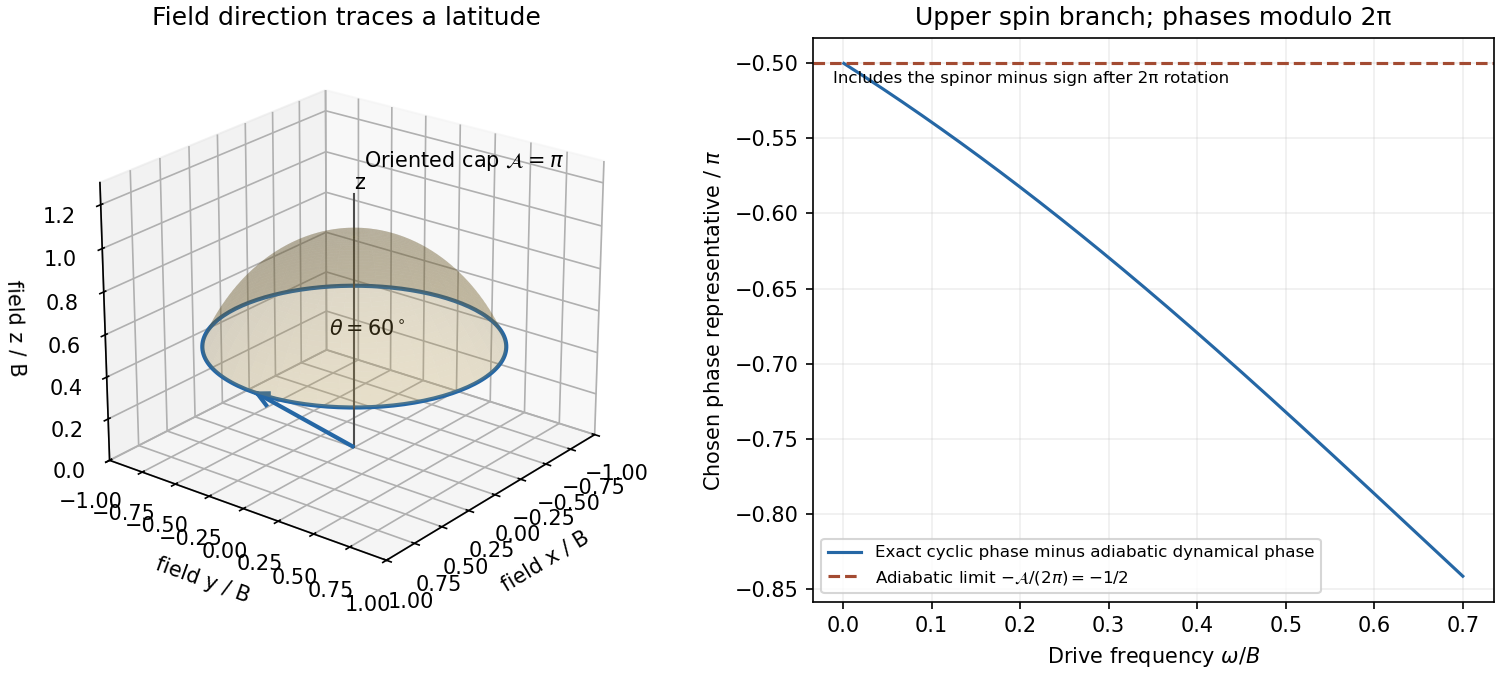
Original rotating-field cone and convergence of the exact cyclic phase to the spin-one-half geometric phase
. Details. Past exam of the theoretical physics II course of the University of Cambridge 2013 Paper 1 1 b Solution by Codex 0 2026-10-20
Codex 0 2026-10-20Define . Squaring the two-by-two matrix gives , soHere is the corresponding normalized eigenstate at . In the rotating frame only its quantum phase changes. In the laboratory frame its spin direction also rotates about at angular velocity : . An arbitrary initial state is the same fixed linear combination of these two solutions. If , the rotating-frame Hamiltonian operator vanishes and the entire doublet is degenerate; evolution is just .
Pinned article: Introduction to the OurBigBook Project
Welcome to the OurBigBook Project! Our goal is to create the perfect publishing platform for STEM subjects, and get university-level students to write the best free STEM tutorials ever.
Everyone is welcome to create an account and play with the site: ourbigbook.com/go/register. We belive that students themselves can write amazing tutorials, but teachers are welcome too. You can write about anything you want, it doesn't have to be STEM or even educational. Silly test content is very welcome and you won't be penalized in any way. Just keep it legal!
Intro to OurBigBook
. Source. We have two killer features:
- topics: topics group articles by different users with the same title, e.g. here is the topic for the "Fundamental Theorem of Calculus" ourbigbook.com/go/topic/fundamental-theorem-of-calculusArticles of different users are sorted by upvote within each article page. This feature is a bit like:
- a Wikipedia where each user can have their own version of each article
- a Q&A website like Stack Overflow, where multiple people can give their views on a given topic, and the best ones are sorted by upvote. Except you don't need to wait for someone to ask first, and any topic goes, no matter how narrow or broad
This feature makes it possible for readers to find better explanations of any topic created by other writers. And it allows writers to create an explanation in a place that readers might actually find it.
Figure 1. Screenshot of the "Derivative" topic page. View it live at: ourbigbook.com/go/topic/derivativeVideo 2. OurBigBook Web topics demo. Source. - local editing: you can store all your personal knowledge base content locally in a plaintext markup format that can be edited locally and published either:This way you can be sure that even if OurBigBook.com were to go down one day (which we have no plans to do as it is quite cheap to host!), your content will still be perfectly readable as a static site.
- to OurBigBook.com to get awesome multi-user features like topics and likes
- as HTML files to a static website, which you can host yourself for free on many external providers like GitHub Pages, and remain in full control

Figure 2. You can publish local OurBigBook lightweight markup files to either OurBigBook.com or as a static website.
Figure 3. Visual Studio Code extension installation.
Figure 5. . You can also edit articles on the Web editor without installing anything locally. Video 3. Edit locally and publish demo. Source. This shows editing OurBigBook Markup and publishing it using the Visual Studio Code extension. 
- Infinitely deep tables of contents:



All our software is open source and hosted at: github.com/ourbigbook/ourbigbook
Further documentation can be found at: docs.ourbigbook.com
Feel free to reach our to us for any help or suggestions: docs.ourbigbook.com/#contact