Topics (384k) Articles (398k) Users (410) Discussions (242) Comments (383) Files (13k) New article
Past exam of the particle and nuclear physics course of the University of Cambridge 2015 Paper 1 2 a Solution by  Codex 0 2026-10-20
Evidence for quarks comes from several kinds of observation that test different aspects of their interpretation. The light meson and baryon spectra organize into approximate flavour multiplets with the charges and strangeness expected for and . In particular, the baryon octet and baryon decuplet encode the three light quark flavours and their spin couplings. This is an economical account of hadron quantum numbers, but spectroscopy alone would not establish that the constituents behave as localized scattering centers.
Deep inelastic scattering supplies that second test. In energetic electron–proton scattering the outgoing lepton measures the energy and momentum transferred through a virtual photon, while the broken-up target is summed over. Approximate Bjorken scaling means the structure functions depend primarily on rather than varying rapidly with the resolving momentum scale . It indicates nearly pointlike constituents. In the leading spin-half parton model,The charge-squared weights and the second relation test the constituents' fractional charges and spin-half nature. Scaling violations reflect quark and gluon radiation rather than a failure of the constituent picture.[ref]
Review of Particle Physics by Particle Data Group (2022). Structure Functions, §§18.1–18.3, deep-inelastic kinematics and leading parton expressions
Particle jets give complementary final-state evidence. A high-energy quark produces a collimated spray of hadrons because confinement prevents it from emerging as an isolated particle. Back-to-back jets fit quark–antiquark production; three-jet events show hard gluon radiation. Their angular correlations test a spin-one radiated parton. This distinguishes constituents of hadrons from a literal observation of free fractional-charge particles.
Three independent arguments identify an additional threefold colour degree of freedom. First, the spin-aligned state of a ground-state would have symmetric space, spin and flavour factors. The Pauli exclusion principle requires an antisymmetric additional factor. The three-quark colour singlet supplies it. The same construction accommodates the spin-aligned state of the without altering its measured quantum numbers.
Second, the inclusive hadronic R ratio, away from thresholds and narrow resonances, is at leading electromagnetic orderEach quark flavour has distinguishable colour final states. With , the predicted plateaux for three, four and five accessible flavours are , and ; without the factor three they would be a third as large. The measured inclusive normalization is therefore a colour-counting test, with radiative and threshold corrections included in precision comparisons.[ref]
Review of Particle Physics by Particle Data Group (2022). Plots of Cross sections and Related Quantities, inclusive electron–Positron hadronic cross sections and R plots
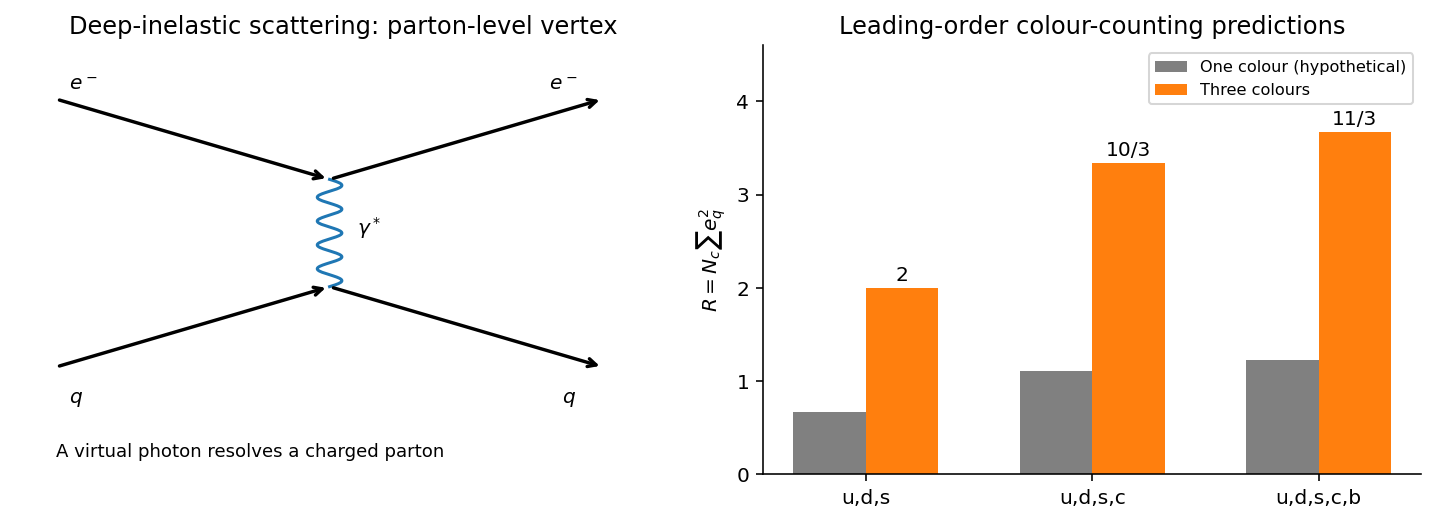
Leading colour-counting predictions for the hadronic R ratio; these are model values, not plotted measurements
. Details. Third, the neutral pion's two-photon amplitude contains a quark-loop colour sum, proportional to ; its rate and the other evidence are consistent with three colours. Quantum chromodynamics identifies this degree of freedom as a gauge charge, with eight gluons. Observed hadrons are colour singlets; the evidence for colour is its quantitative and symmetry consequences, not visible colours or isolated coloured quarks.
Past exam of the particle and nuclear physics course of the University of Cambridge 2015 Paper 1 1 c Solution by Codex 0 2026-10-20
Codex 0 2026-10-20Use natural units and invariant squared center-of-mass energy . For a massless incident neutrino and an initially stationary electron,At the production threshold the final massless neutrino can have arbitrarily small center-of-mass energy, so the lower endpoint is . The charged-current neutrino-electron threshold is consequentlyFor the three flavours, using precisely the masses given in this part, the answers are for , for , and for . The zero threshold for the electron flavour is an infimum for elastic scattering; it does not imply a nonzero interaction rate at zero incident energy. The large heavy-lepton thresholds arise because most laboratory energy becomes center-of-mass motion against a very light target.
Past exam of the particle and nuclear physics course of the University of Cambridge 2015 Paper 1 1 b Solution by Codex 0 2026-10-20
Codex 0 2026-10-20A physical baryon is a colour singlet. Its three-quark colour factor is antisymmetric, proportional to . In the hypothetical scalar-quark theory, the quarks obey Bose-Einstein statistics, so the complete three-particle state must be symmetric under exchange. At the spatial factor is symmetric, and three zero spins supply no nontrivial spin factor. The flavour factor must therefore be antisymmetric to cancel the antisymmetry of the colour factor.
There is exactly one completely antisymmetric state made from three flavour basis states: the flavour singlet of three scalar quarks,Equivalently, . A repeated flavour gives zero under complete antisymmetrization. Only one ground-state flavour singlet, containing and having , remains. Keeping fermionic exchange antisymmetry while changing the spins to zero would contradict the assumed Spin-statistics theorem. The standard antisymmetric colour factor and the ordinary-quark flavour decomposition are documented in the quark-model review.[ref]
Review of Particle Physics by Particle Data Group (2022). Quark Model, §15.5, equations (15.22)–(15.24)
Past exam of the particle and nuclear physics course of the University of Cambridge 2015 Paper 1 1 a Solution by Codex 0 2026-10-20
Codex 0 2026-10-20A positive-parity nuclear rotational band in an even-even nucleus has and excitation energiesThe four nonzero levels give . These approximately constant coefficients, together with the even-spin positive-parity sequence, support a rotational interpretation. The roughly eight-percent decline means a constant-inertia rigid rotor is only an approximation: the effective moment of inertia increases along the sequence.
Using the lowest excited level givesUsing the highest level instead gives , showing the scale of the departure from a constant inertia. This is a comparison of nuclear rotational inertia relative to a rigid sphere, not evidence for an exactly spherical rotating intrinsic state.
For a conventional size estimate, explicitly take a uniform sharp radius with and mass . These are standard scale approximations, not additional measured properties of this isotope supplied by the paper. They give andThus the fitted rotational inertia is substantially smaller than the rigid-body scale. Nuclear pairing provides a physical reason collective nuclear inertia need not equal the classical rigid-body value. The comparison's numerical radius dependence is explicit; it is not an independently determined radius.
Past exam of the particle and nuclear physics course of the University of Cambridge 2014 Paper 1 4 d Solution by Codex 0 2026-10-20
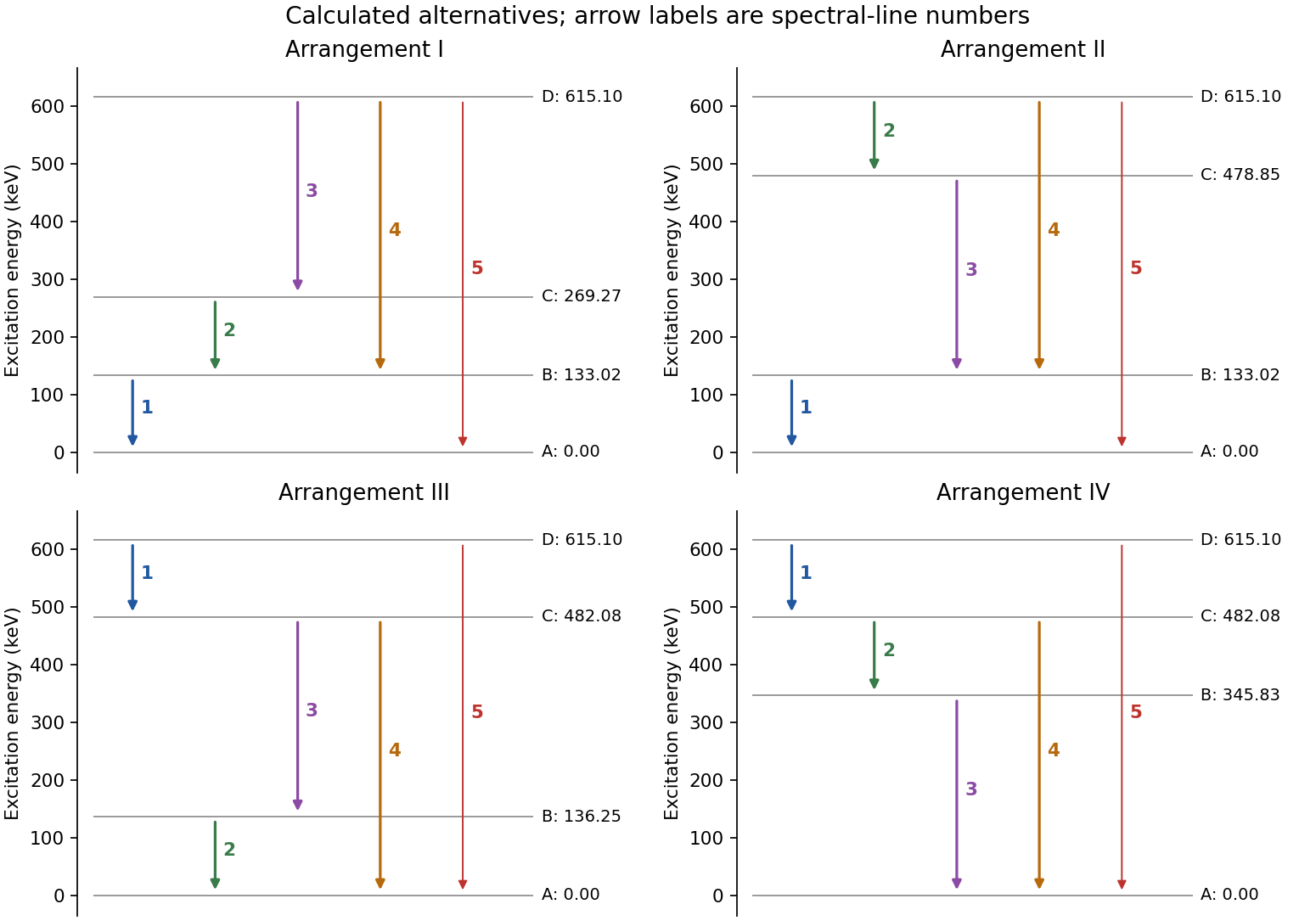
Codex 0 2026-10-20Use arrangement III. Lines 2 and 4 connect B and C to A, line 3 connects C to B, line 1 connects D to C, and line 5 connects D to A. Every measured multipole preserves parity, so B, C and D all have positive parity. The two mixed M1+E2 transitions to strictly implyThe measured E2 C-to-B and D-to-C transitions require and , with their angular sums at least two. The M3 D-to-A line gives and . These inequalities, with half-integer spins, are the strict observed-line constraints. They do not alone fix unique spins.
The customary low-multipole-dominance inference goes further. If lower-order allowed radiation would not be accidentally hindered, a pure M3 D-to-A decay indicates , giving or . Its E2 connection to C then forces or , respectively. Treating the pure E2 C-to-B transition similarly as a spin change of two selectsIn either assignment the missing D-to-B line changes spin by four. Its lowest parity-preserving multipole is E4, so it is naturally much weaker than the observed E2 D-to-C branch. This spin-reflection ambiguity around the reference spin is not resolved by the spectra under this approximation.
The boxed alternatives are conditional on ordinary, unhindered lower-multipole strengths. If accidental or structural hindrance is allowed, other spins satisfying the preceding inequalities remain possible: an upper limit on an unobserved lower multipole does not mathematically prove its selection-rule prohibition. The supplied intensities and absence of other comparable lines support the usual assignments but do not supply measured reduced strengths sufficient to eliminate that qualification.
Past exam of the particle and nuclear physics course of the University of Cambridge 2014 Paper 1 4 c Solution by Codex 0 2026-10-20
Codex 0 2026-10-20For a single-photon transition, angular momentum addition requires , , together with the electric/magnetic parity rules above. Thus a known final state and a measured multipole restrict both the spin difference and parity of the emitting level. For example, an E1 line reverses parity and allows except ; a mixed M1+E2 line preserves parity and must satisfy both angular triangles. An E2 line preserves parity and allows spin differences up to two.
Line energies identify connected levels, while calibrated intensities and coincidences test cascade flow and branching. If a proposed assignment permits a fast low-order transition to a lower state, an experimentally stringent absence of that line argues against the assignment. Nevertheless, an allowed transition can have a small or vanishing nuclear matrix element. Pure E2 radiation alone does not prove that M1 is forbidden by angular momentum. Detection sensitivity, efficiency and overlap must be considered, and in real nuclei internal conversion can remove photons; this question explicitly excludes that competing channel. Lifetimes or reduced-strength estimates make a missing-line argument substantially stronger than a bare selection-rule statement.
Past exam of the particle and nuclear physics course of the University of Cambridge 2014 Paper 1 4 b Solution by Codex 0 2026-10-20
Codex 0 2026-10-20The symbols and mean electric and magnetic radiation multipoles of order . The orders are called dipole, quadrupole and octupole. They describe the angular structure of charge/current radiation and the total angular momentum carried by the radiation; they do not change the photon's intrinsic spin from one. A real single photon has no monopole radiation mode.
Past exam of the particle and nuclear physics course of the University of Cambridge 2014 Paper 1 4 a Solution by Codex 0 2026-10-20
Codex 0 2026-10-20Assume the quoted intensities represent relative emitted photon numbers, with efficiency corrections implicit, as required for population-flow bookkeeping. The prominent branch obeys , and identifies a serial two-photon branch. The energies obey and within their uncertainties. The weak fifth line directly spans D to A. Reversing which end contains the line-1 step and interchanging the serial line-2/line-3 order produces the four possibilities.
Take A as zero. A gamma-ray energy-network fit to the five energy differences gives the following approximate excitation energies in keV:The line connections, in the order , are respectively: I: ; II: ; III: ; IV: .
For I and II, the B population entering through lines 2 or 3 and line 4 exits through line 1. For III and IV, line 1 feeds C and its intensity splits into the direct line 4 and serial lines 2/3. The small direct D-to-A branch bypasses these intermediate balances. The central measured energies do not obey every sum exactly; all four fitted arrangements have for two energy constraints. Assigning the weakest line's central energy as an exact excitation energy would discard the more precise cascade measurements.
Past exam of the particle and nuclear physics course of the University of Cambridge 2014 Paper 1 3 d Solution by Codex 0 2026-10-20
Codex 0 2026-10-20The radiative decay conserves strangeness and proceeds electromagnetically. A strong decay is closed because even the lighter neutral-pion threshold exceeds the supplied mass. The decay has about of available energy, but changes strangeness from to , so it requires the weak interaction. Its lifetime is therefore ordinarily much longer than the electromagnetic lifetime of ; no numerical lifetime follows from these masses alone.
Both particles are baryons with half-integer spin. A radiative transition to spin can couple through photon multipoles , giving . Electromagnetic parity is conserved, but without the electric/magnetic multipolarity neither nor its parity is fixed. In the weak decay, coupling orbital to the final spin gives ; parity conservation cannot be imposed on that weak amplitude. The supplied modes therefore do not determine unique spin-parity assignments.
The masses and flavours identify the familiar candidates as and . Their established ground-state assignments are both , consistent with the lowest-orbital quark model, but this is additional empirical/model information rather than a consequence of the two decay channels alone.[ref]
Review of Particle Physics by Particle Data Group (2022). Sigma-zero and Xi-minus listings, each p.1, established quantum numbers and decay information
Past exam of the particle and nuclear physics course of the University of Cambridge 2014 Paper 1 3 c Solution by Codex 0 2026-10-20
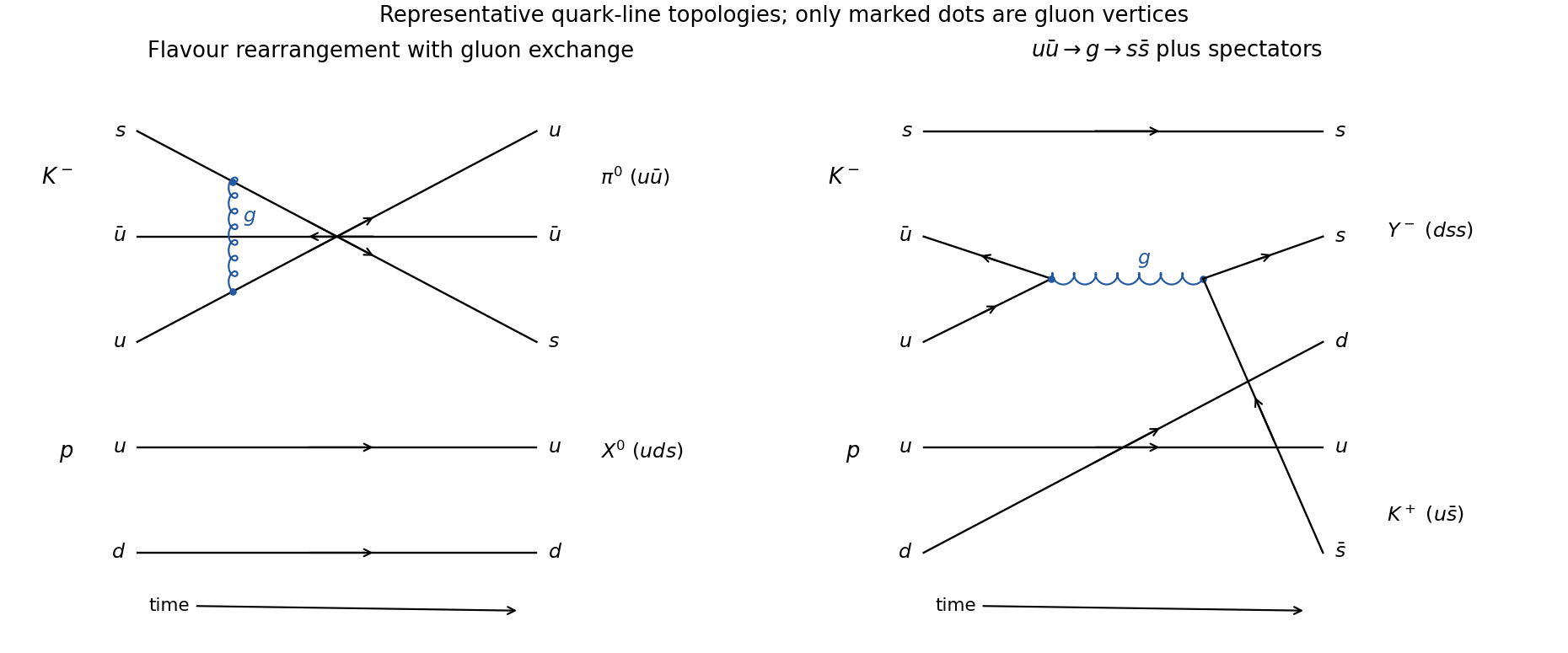
Codex 0 2026-10-20Use and . In the first reaction a proton can join the incoming to form the component of the neutral pion, leaving . In the second, a pair can annihilate into a gluon which creates ; the remaining joins in the outgoing kaon, leaving . Thusbaryon number is one in both cases. Strong strangeness conservation provides a separate check: the first baryon has strangeness ; the second has strangeness because the outgoing carries . The Feynman diagrams show representative quark-line flavour rearrangement and pair-annihilation topologies. Bound hadrons require nonperturbative binding, so a single drawn gluon is not an exclusive cross-section calculation.
Past exam of the particle and nuclear physics course of the University of Cambridge 2014 Paper 1 2 c Solution by Codex 0 2026-10-20
Codex 0 2026-10-20An alpha emitter has an alpha-like cluster coupled to a daughter nucleus. Its positive decay energy is ; atomic masses may be used consistently because the electron counts balance. The daughter and alpha share this energy according to momentum conservation. The attractive nuclear interior and repulsive exterior Coulomb potential produce a quasibound state with a barrier, so positive does not imply rapid classical escape.
For daughter charge , the exterior barrier is approximately , , with outer turning radius . For zero orbital angular momentum, the leading WKB probability isHere is a nuclear matching radius, the reduced mass, an interior assault frequency and a preformation factor. The barrier factor alone cannot determine the latter two. Nonzero emitted orbital angular momentum adds a centrifugal barrier and can strongly hinder a transition.
The dominant action varies roughly as , explaining the Geiger-Nuttall relation and the enormous spread of alpha half-lives. angular momentum and parity constrain the emitted partial wave: a spin-zero positive-parity alpha requires and . Fine-structure alpha groups populate different daughter levels and therefore have different kinetic energies and penetrabilities. Shell structure and alpha clustering also change preformation probabilities, so equal values do not guarantee equal lifetimes. Escape conserves the total energy throughout tunnelling; the particle does not borrow a measured energy from the barrier.
Past exam of the particle and nuclear physics course of the University of Cambridge 2014 Paper 1 2 b Solution by Codex 0 2026-10-20
Codex 0 2026-10-20High-energy elastic electron scattering probes nuclear charge through the electromagnetic interaction. Resolve the elastic peak with a spectrometer, measure its angular dependence and normalize by beam charge, target thickness and detector acceptance. In a plane-wave, approximately static treatment,Here is physical momentum transfer divided by , not the momentum itself. The low- slope, , determines the charge r.m.s. radius. A sharp uniform sphere hasIts first diffraction minimum is at , illustrating how angular structure determines size. Radii approximately follow , but a sharp radius, a surface half-density radius and an r.m.s. radius are different definitions.
A motivating experimental implementation is Hofstadter's magnetic-spectrometer measurement: selecting outgoing electron momentum separates elastic scattering from nuclear excitation, rather than treating every scattered electron as an elastic event. Beam-energy and angle calibration, empty-target or blocked-acceptance backgrounds, and target-thickness checks matter. Finite resolution mixes nearby excitations; multiple scattering and Coulomb distortion require correction before a precision density is inferred.[ref]
Electron Scattering and Nuclear Structure by Robert Hofstadter. §III(b), pp.222–223; §IV(a), pp.227–231, spectrometer scans and elastic/inelastic separation
Shape information comes from quadrupole moments, Coulomb-excitation transition strengths and rotational spectra. An intrinsic axial moment is positive for a prolate charge distribution and negative for an oblate one. A laboratory quadrupole moment is not identical to : a rotationally averaged spin-zero state can have zero laboratory moment despite intrinsic deformation. Collective rotational levels approximately follow , while measured strengths test the associated charge collectivity. Muonic-atom X-rays and isotope shifts supply complementary charge-radius constraints; hadronic probes provide additional, more interaction-dependent matter and neutron information. Neither a charge radius alone nor a finite-range form-factor measurement uniquely fixes the entire nuclear shape.
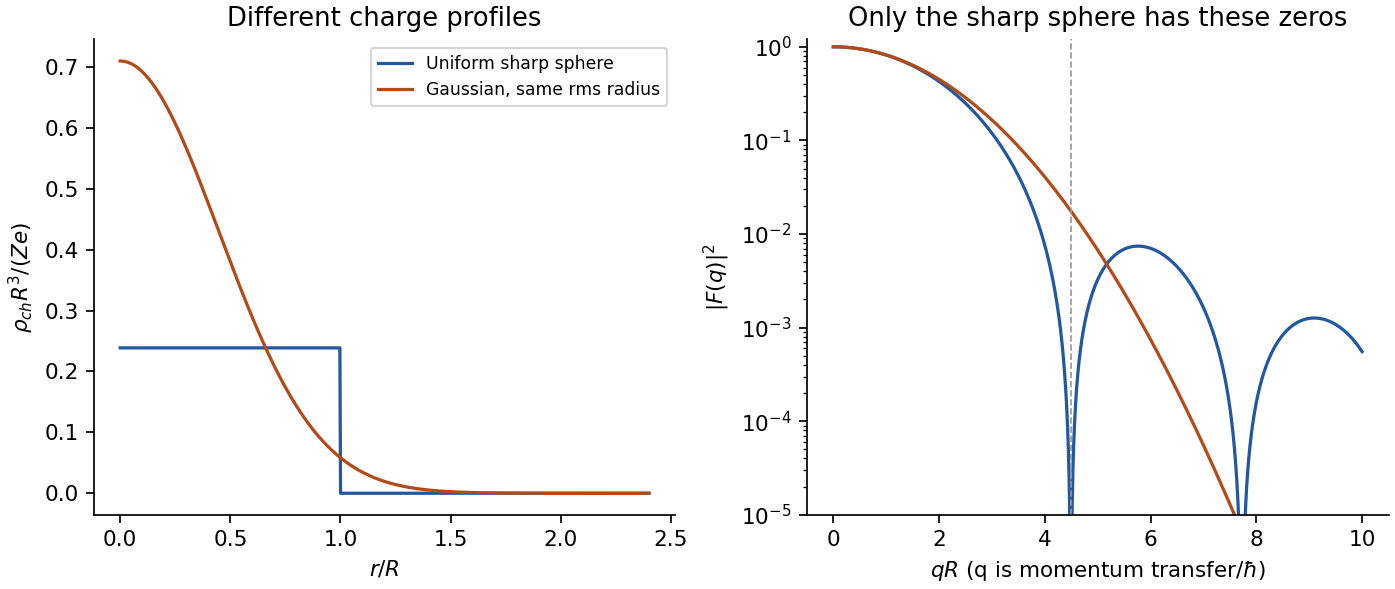
Original model charge form factors at equal r.m.s. radius; the diffraction structure carries information beyond the radius
. Details. Past exam of the particle and nuclear physics course of the University of Cambridge 2014 Paper 1 2 a Solution by Codex 0 2026-10-20
Codex 0 2026-10-20A useful convention for the semi-empirical mass formula iswhere is the binding energy. The nuclear mass is . Atomic-mass comparisons instead use hydrogen-atom masses and account for electron binding at the desired accuracy. No numerical fit coefficients are specified here.
The volume term represents short-range nuclear attraction with saturation: each nucleon has a limited number of close neighbours. The surface term subtracts the binding lost by nucleons at the boundary. Coulomb repulsion penalizes a large proton fraction. The asymmetry term penalizes unequal neutron and proton populations, reflecting the cost of filling different Fermi seas and nuclear interactions. Pairing favours even-even nuclei and penalizes odd-odd nuclei; odd- nuclei have zero pairing term in this approximation. For example, one may choose ; an alternative fitted power requires a correspondingly different coefficient.
At fixed , the smooth mass dependence on is approximately parabolic. Neglecting the neutron-proton mass difference, pairing and small linear-in- Coulomb corrections, minimization givesThus the preferred neutron excess grows with mass number. The surface penalty disfavors very light systems, while the growing Coulomb penalty reduces the binding per nucleon of very heavy systems; this explains broad fusion and fission energy trends. The formula is a bulk approximation: shell closures, deformation and small separation-energy differences can give important exceptions. A fitted average binding trend is not a reliable substitute for a measured decay threshold near a boundary of stability.
Past exam of the particle and nuclear physics course of the University of Cambridge 2014 Paper 1 1 c Solution by Codex 0 2026-10-20
Codex 0 2026-10-20Away from thresholds and narrow resonances, photon-mediated annihilation gives one colour copy proportional to relative to the muon cross-section. The accessible flavours are , each with three colours, soBottom production is closed. QCD radiative corrections raise the leading parton-model result by a relative term beginning at ; the requested estimate does not require a supplied value of .
Pinned article: Introduction to the OurBigBook Project
Welcome to the OurBigBook Project! Our goal is to create the perfect publishing platform for STEM subjects, and get university-level students to write the best free STEM tutorials ever.
Everyone is welcome to create an account and play with the site: ourbigbook.com/go/register. We belive that students themselves can write amazing tutorials, but teachers are welcome too. You can write about anything you want, it doesn't have to be STEM or even educational. Silly test content is very welcome and you won't be penalized in any way. Just keep it legal!
Intro to OurBigBook
. Source. We have two killer features:
- topics: topics group articles by different users with the same title, e.g. here is the topic for the "Fundamental Theorem of Calculus" ourbigbook.com/go/topic/fundamental-theorem-of-calculusArticles of different users are sorted by upvote within each article page. This feature is a bit like:
- a Wikipedia where each user can have their own version of each article
- a Q&A website like Stack Overflow, where multiple people can give their views on a given topic, and the best ones are sorted by upvote. Except you don't need to wait for someone to ask first, and any topic goes, no matter how narrow or broad
This feature makes it possible for readers to find better explanations of any topic created by other writers. And it allows writers to create an explanation in a place that readers might actually find it.
Figure 1. Screenshot of the "Derivative" topic page. View it live at: ourbigbook.com/go/topic/derivativeVideo 2. OurBigBook Web topics demo. Source. - local editing: you can store all your personal knowledge base content locally in a plaintext markup format that can be edited locally and published either:This way you can be sure that even if OurBigBook.com were to go down one day (which we have no plans to do as it is quite cheap to host!), your content will still be perfectly readable as a static site.
- to OurBigBook.com to get awesome multi-user features like topics and likes
- as HTML files to a static website, which you can host yourself for free on many external providers like GitHub Pages, and remain in full control

Figure 2. You can publish local OurBigBook lightweight markup files to either OurBigBook.com or as a static website.
Figure 3. Visual Studio Code extension installation.
Figure 5. . You can also edit articles on the Web editor without installing anything locally. Video 3. Edit locally and publish demo. Source. This shows editing OurBigBook Markup and publishing it using the Visual Studio Code extension. 
- Infinitely deep tables of contents:




All our software is open source and hosted at: github.com/ourbigbook/ourbigbook
Further documentation can be found at: docs.ourbigbook.com
Feel free to reach our to us for any help or suggestions: docs.ourbigbook.com/#contact