Topics (384k) Articles (398k) Users (410) Discussions (242) Comments (383) Files (13k) New article
Past exam of the chemistry B course of the University of Cambridge 2021 Paper 1 B1 a iii Solution by  Codex 0 2026-10-20
The methoxy groups activate the aromatic ring by electron donation through chemical resonance and direct electrophilic substitution ortho and para. Their para positions are already occupied by one another, so the first alkylation occurs at an available ortho position; the four initially vacant positions are equivalent by symmetry.
After placing the first tert-amyl group at position 2, position 5 is favored for the second substitution. It is para to that bulky group and ortho to the other methoxy group. Position 3 is crowded between methoxy and tert-amyl substituents, while position 6 is near the first tert-amyl group across the intervening methoxy-bearing carbon. The 2,5 arrangement distributes the bulky groups on opposite parts of the ring and preserves the equivalence seen in the spectrum.
Alkyl groups do not electronically deactivate the ring, so the stopping point needs a steric explanation. After two such substitutions the remaining positions are much more congested, each adjacent to a bulky tert-amyl group and a methoxy group. Two large substituents are accommodated much more readily than a third, despite excess alcohol. The formula and NMR identify this sterically favored disubstitution; they do not imply that a Friedel-Crafts reaction always stops after two alkylations.
Past exam of the chemistry B course of the University of Cambridge 2021 Paper 1 B1 a ii Solution by Codex 0 2026-10-20
Codex 0 2026-10-20protonation of the alcohol converts its OH group into a water leaving group. Departure of water initially gives the secondary carbocation . A 1,2-hydride shift from the neighboring methine group transfers its C–H bonding pair to the electron-deficient carbon:The resulting tertiary carbocation is the tert-amyl electrophile. An aromatic bond of the dimethoxybenzene attacks that carbon, producing a Wheland intermediate. Removal of the proton from the attacked ring carbon restores aromaticity and regenerates acid. Repeating this Friedel-Crafts alkylation at the symmetry-related second site gives the disubstituted product.
The hydride migration explains the new ethyl group and the absence of a benzylic methine group proton. Simply attaching the original alcohol skeleton at its OH-bearing carbon would not explain the twelve-proton NMR singlet.
Past exam of the chemistry B course of the University of Cambridge 2021 Paper 1 B1 a i Solution by Codex 0 2026-10-20
Codex 0 2026-10-20The product is 1,4-dimethoxy-2,5-bis(2-methylbutan-2-yl)benzene. Each new substituent is , a tert-amyl group, rather than the unrearranged secondary alkyl group of the alcohol. The two substituents are related by the symmetry of the ring.
The proton assignments are:
| chemical shift / ppm | Assignment | Reason |
|---|---|---|
| Two aromatic H, at positions 3 and 6 | symmetry makes them equivalent; neither has an adjacent aromatic H to give a resolved ordinary ortho splitting. | |
| Two methoxy groups, six H | Equivalent groups give a NMR singlet. | |
| Two ethyl groups, four H | Each couples to a terminal three-proton methyl group, giving a NMR quartet. | |
| Four methyl groups attached to the two quaternary benzylic carbons, twelve H | These methyl groups have no neighboring methine group proton and give a NMR singlet. | |
| Two terminal ethyl methyl groups, six H | Each couples to two methylene group protons, giving a NMR triplet with the same coupling constant as the NMR quartet. |
The integrals add to 30 H. The unusually shielded terminal ethyl methyl signal is compatible with an aryl-containing environment; its NMR quartet–NMR triplet partner and integral are the decisive assignment evidence. The molecular formula and degree of unsaturation, , fit a benzene ring with saturated side chains.
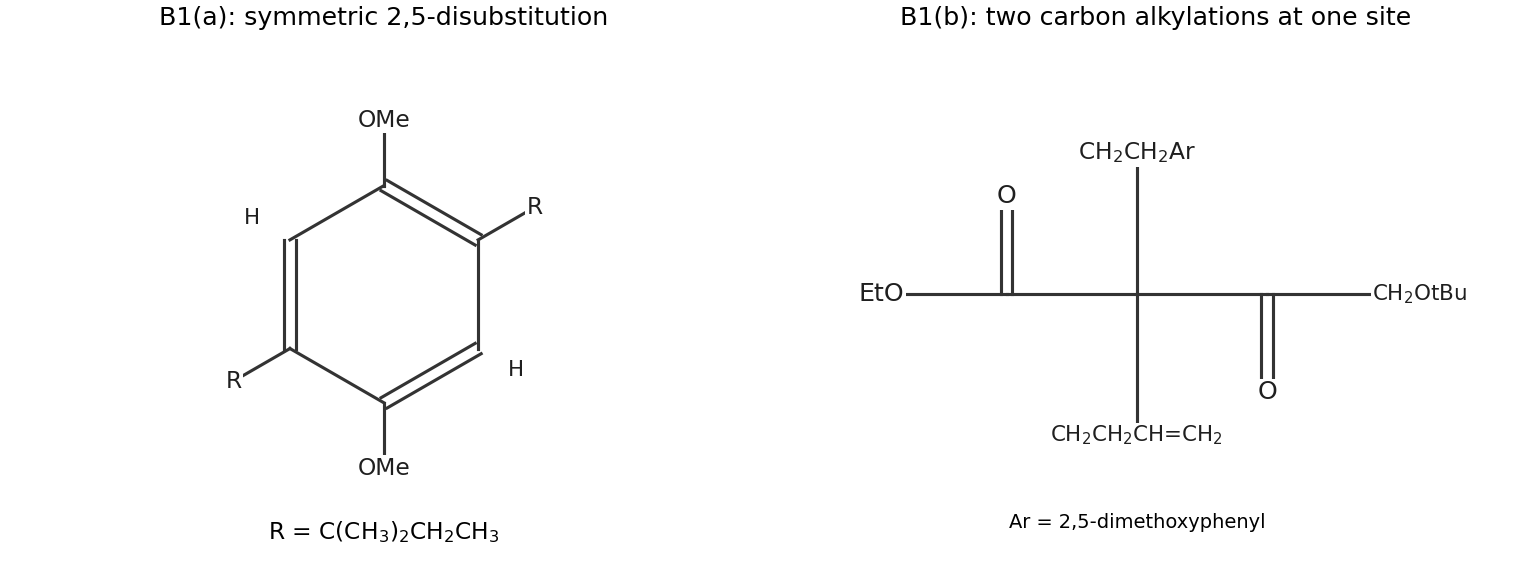
Original structures of the rearranged aromatic alkylation product and dialkylated beta-ketoester
. Details. Past exam of the chemistry A course of the University of Cambridge 2025 Paper 2 A8 c i Solution by Codex 0 2026-10-20
Codex 0 2026-10-20Write and . An atom has no rotational or vibrational internal factor under the stated electronic assumption. The transition-state moment of inertia is , so the high-temperature rigid rotor result isThe translational factors therefore giveSubstituting into the transition state theory expression and simplifying,For distinct atoms, . This is a number-density rate coefficient, with units of volume per time. A rate law in molar concentrations uses . The derivation assumes a classical high-temperature rotor at the dividing surface and a transmission coefficient of one.
Past exam of the chemistry A course of the University of Cambridge 2025 Paper 2 A8 b iii Solution by Codex 0 2026-10-20
Codex 0 2026-10-20The barrier is the energy difference between the transition-state reference level and the separated reactant reference levels. Consistent zero-point energies of stable transverse modes belong in this reference-level difference. It is an energy per reacting pair; a molar activation energy uses instead of in the exponential.
Past exam of the chemistry A course of the University of Cambridge 2025 Paper 2 A8 b ii Solution by Codex 0 2026-10-20
Codex 0 2026-10-20The primed is the corresponding transition state partition function per unit volume with the unstable reaction-coordinate degree of freedom omitted. Its replacement by the crossing-frequency factor is already outside the partition-function ratio. For a diatomic atom-pair transition state, the omitted coordinate is the bond stretch, leaving translation and rotation.
Past exam of the chemistry A course of the University of Cambridge 2025 Paper 2 A8 b i Solution by Codex 0 2026-10-20
Codex 0 2026-10-20The quantities and are molecular partition functions per unit volume for the two reactants, with their internal rotational, vibrational and electronic factors included. Thus their translational factors are , rather than those factors multiplied by . Their energy zeros must match the separately displayed barrier convention.
Past exam of the chemistry A course of the University of Cambridge 2025 Paper 2 A8 a iii Solution by Codex 0 2026-10-20
Codex 0 2026-10-20A transition state is the configuration or dividing-surface region associated with passage between reactant and product basins. In the elementary saddle-point picture it is a first-order saddle of the potential energy surface: stable against small displacements in transverse directions but unstable along the reaction direction. Transition state theory counts forward crossings and, in its simplest form, neglects recrossing.
Past exam of the chemistry A course of the University of Cambridge 2025 Paper 2 A8 a ii Solution by Codex 0 2026-10-20
Codex 0 2026-10-20A reaction coordinate parametrizes progress along a chosen path on the potential energy surface. It usually combines several bond lengths or angles; it need not be one literal bond distance or elapsed time.
Past exam of the chemistry A course of the University of Cambridge 2025 Paper 2 A8 a i Solution by Codex 0 2026-10-20
Codex 0 2026-10-20A potential energy surface gives the molecular electronic energy, with nuclear repulsion, as a function of the nuclear coordinates under the Born-Oppenheimer approximation. Its minima describe stable configurations and its saddle regions help identify reaction barriers.
Past exam of the chemistry A course of the University of Cambridge 2025 Paper 2 A7 b iii Solution by Codex 0 2026-10-20
Codex 0 2026-10-20The substituted molecule has the larger entropy. Increased mass and moment of inertia reduce translational and rotational spacings and make more states thermally accessible. The largest contribution here is the loss of the twofold rotational indistinguishability of the oxygen ends, contributing . It is a rotational symmetry number correction for one isotope-defined species, not an entropy of mixing between different molecules.
Past exam of the chemistry A course of the University of Cambridge 2025 Paper 2 A7 b ii Solution by Codex 0 2026-10-20
Codex 0 2026-10-20Use the same standard pressure and temperature, the same bond length, and the same electronic and vibrational-ground-state approximations. The translational partition function scales as mass to the power , giving the factor . For the original isotopologue, and the rotational symmetry number is two. For the isotope-substituted molecule, the two oxygen ends are distinguishable, so the symmetry number is one. HenceThe change in standard molar entropy issoThis uses a convention omitting a separate nuclear-spin entropy. If nuclear-spin degeneracies are instead included explicitly, the spin- carbon-13 nucleus adds a further relative to the spin-zero original isotopologue; that convention must be stated rather than silently mixed with the quoted partition functions.
Past exam of the chemistry A course of the University of Cambridge 2025 Paper 2 A7 b i Solution by Codex 0 2026-10-20
Codex 0 2026-10-20Under the stated vibrational-ground-state approximation and a nondegenerate electronic ground state, only translation and rotation contribute. ThereforeA temperature-independent ground-state energy, including zero-point energy, contributes no entropy. This estimate deliberately omits thermal vibrational excitation; it need not equal a tabulated value that includes all modes.
Past exam of the chemistry A course of the University of Cambridge 2025 Paper 2 A7 a ii Solution by Codex 0 2026-10-20
Codex 0 2026-10-20For a linear rigid rotor in the high-temperature regime, . Its molar rotational entropy isThe rotational symmetry number must already be included in .
Past exam of the chemistry A course of the University of Cambridge 2025 Paper 2 A7 a i Solution by Codex 0 2026-10-20
Codex 0 2026-10-20For identical, non-interacting molecules, the translational canonical partition function is . Stirling's approximation gives the Helmholtz free energyAt fixed , , so differentiation gives . For one mole at the standard-state molar volume,Here the quoted molar translational quantity is per mole, and its ratio to is dimensionless. The derivative defining entropy is taken at fixed volume before inserting the standard-state volume; differentiating along a constant-pressure path would give the wrong additive constant.
Past exam of the chemistry A course of the University of Cambridge 2025 Paper 2 A6 c iii Solution by Codex 0 2026-10-20
Codex 0 2026-10-20For one mole, , so the three-level Morse oscillator result isFor the full quantum harmonic oscillator with the given wavenumber,The specified anharmonic calculation is about higher. Anharmonicity lowers the first excitation spacings and increases excited-state occupation. Both results remain small because is well below the vibrational temperature. The comparison also mixes a three-level anharmonic truncation with an infinite harmonic sum; omitted higher Morse levels would make a further small positive correction at this temperature.
Past exam of the chemistry A course of the University of Cambridge 2025 Paper 2 A6 c ii Solution by Codex 0 2026-10-20
Codex 0 2026-10-20Differentiating each Boltzmann factor yieldsThe derivative is positive: warming increases occupation of both excited energy levels. At ,
Past exam of the chemistry A course of the University of Cambridge 2025 Paper 2 A6 c i Solution by Codex 0 2026-10-20
Codex 0 2026-10-20Subtracting the energy in the Morse oscillator givesThe first three relative wavenumbers are , , and . Thus, with and ,This is a three-level partition function, as stipulated, rather than an unrestricted sum of the anharmonic formula to arbitrarily large .
Pinned article: Introduction to the OurBigBook Project
Welcome to the OurBigBook Project! Our goal is to create the perfect publishing platform for STEM subjects, and get university-level students to write the best free STEM tutorials ever.
Everyone is welcome to create an account and play with the site: ourbigbook.com/go/register. We belive that students themselves can write amazing tutorials, but teachers are welcome too. You can write about anything you want, it doesn't have to be STEM or even educational. Silly test content is very welcome and you won't be penalized in any way. Just keep it legal!
Intro to OurBigBook
. Source. We have two killer features:
- topics: topics group articles by different users with the same title, e.g. here is the topic for the "Fundamental Theorem of Calculus" ourbigbook.com/go/topic/fundamental-theorem-of-calculusArticles of different users are sorted by upvote within each article page. This feature is a bit like:
- a Wikipedia where each user can have their own version of each article
- a Q&A website like Stack Overflow, where multiple people can give their views on a given topic, and the best ones are sorted by upvote. Except you don't need to wait for someone to ask first, and any topic goes, no matter how narrow or broad
This feature makes it possible for readers to find better explanations of any topic created by other writers. And it allows writers to create an explanation in a place that readers might actually find it.
Figure 1. Screenshot of the "Derivative" topic page. View it live at: ourbigbook.com/go/topic/derivativeVideo 2. OurBigBook Web topics demo. Source. - local editing: you can store all your personal knowledge base content locally in a plaintext markup format that can be edited locally and published either:This way you can be sure that even if OurBigBook.com were to go down one day (which we have no plans to do as it is quite cheap to host!), your content will still be perfectly readable as a static site.
- to OurBigBook.com to get awesome multi-user features like topics and likes
- as HTML files to a static website, which you can host yourself for free on many external providers like GitHub Pages, and remain in full control

Figure 2. You can publish local OurBigBook lightweight markup files to either OurBigBook.com or as a static website.
Figure 3. Visual Studio Code extension installation.
Figure 5. . You can also edit articles on the Web editor without installing anything locally. Video 3. Edit locally and publish demo. Source. This shows editing OurBigBook Markup and publishing it using the Visual Studio Code extension. 
- Infinitely deep tables of contents:



All our software is open source and hosted at: github.com/ourbigbook/ourbigbook
Further documentation can be found at: docs.ourbigbook.com
Feel free to reach our to us for any help or suggestions: docs.ourbigbook.com/#contact