Topics (384k) Articles (398k) Users (410) Discussions (242) Comments (383) Files (13k) New article
Past exam of the MPhil in micro- and nanotechnology enterprise course of the University of Cambridge 2020 Paper 2 Section B 22 ii Solution by  Codex 0 2026-10-20
A topological defect occurs where the local order cannot be continued smoothly while retaining its surrounding texture. At a nematic disclination core, the director model fails and the orientational order may decrease.
For a planar texture ,Because , half-integer winding strengths are allowed. The original sketches use to show , corresponding to director turns . A radial pattern and an azimuthally rotated version have the same winding.
These are planar labels. In unrestricted three dimensions an integer line texture may escape by tilting out of the plane; half-integer lines have a different classification. A planar disclination strength must not be identified automatically with a three-dimensional hedgehog point charge.
Past exam of the MPhil in micro- and nanotechnology enterprise course of the University of Cambridge 2020 Paper 2 Section B 21 v Solution by Codex 0 2026-10-20
Codex 0 2026-10-20 Past exam of the MPhil in micro- and nanotechnology enterprise course of the University of Cambridge 2020 Paper 2 Section B 21 iv Solution by Codex 0 2026-10-20
Codex 0 2026-10-20 Past exam of the MPhil in micro- and nanotechnology enterprise course of the University of Cambridge 2020 Paper 2 Section B 21 ii Solution by Codex 0 2026-10-20
Codex 0 2026-10-20 Past exam of the MPhil in micro- and nanotechnology enterprise course of the University of Cambridge 2020 Paper 2 Section B 21 i Solution by Codex 0 2026-10-20
Codex 0 2026-10-20 Past exam of the MPhil in micro- and nanotechnology enterprise course of the University of Cambridge 2020 Paper 2 Section B 20 iii Solution by Codex 0 2026-10-20
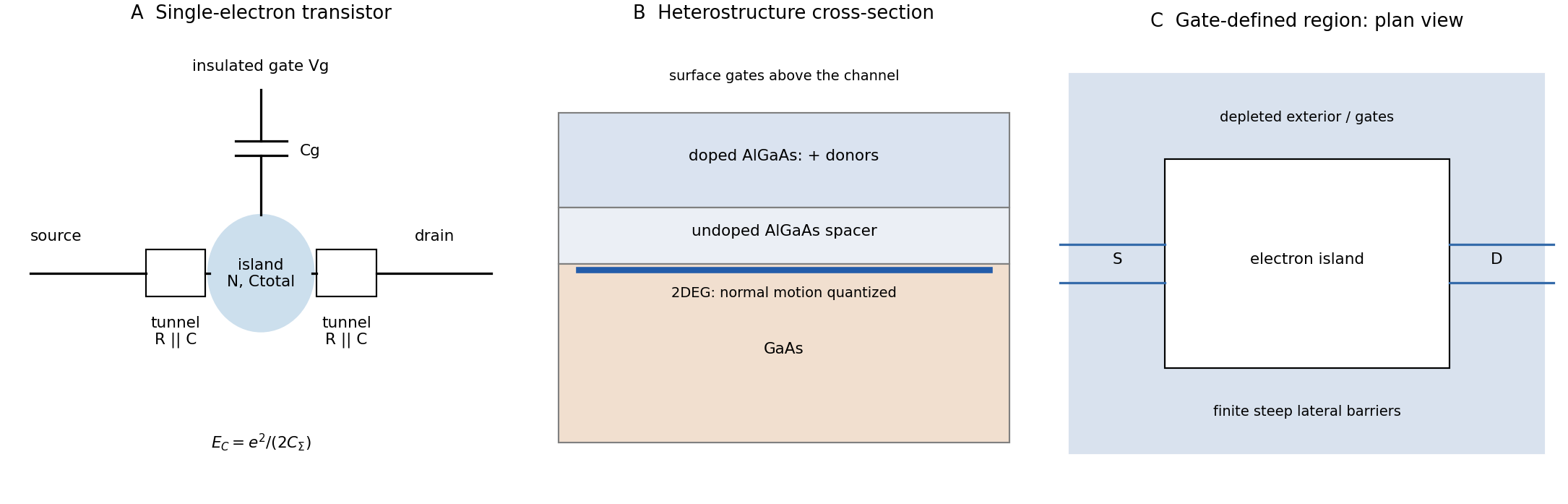
Codex 0 2026-10-20A gallium arsenide/aluminium gallium arsenide semiconductor heterostructure combines lower-gap GaAs with a higher-gap AlGaAs barrier. In a modulation-doped design, AlGaAs donors supply electrons to lower conduction-band states on the GaAs side. An undoped spacer separates the channel from ionized donors and reduces impurity scattering. The interface barrier and band bending quantize motion normal to the interface while allowing in-plane motion: a two-dimensional electron gas.
The normal confining potential is commonly triangular and finite rather than an infinite square well. At suitable density and low temperature, only the lowest normal subband is occupied. modulation doping reduces an important scattering source; it does not eliminate all disorder.
Use negatively biased surface gates to deplete the surrounding electron gas and leave a rectangular central region. Gate voltage controls lateral dimensions and barrier heights. Two constrictions can weakly couple the region to reservoirs, with a plunger gate controlling population. Etched boundaries are possible but may introduce edge disorder. A flat interior and steep edges approximate a box, givingFringing fields, finite barriers and penetration change the ideal result. A 2DEG confines only the normal direction; gates supply the extra lateral confinement. Gate-dependent spectroscopy can test level spacings, while charging measurements separate orbital confinement from Coulomb blockade.
Past exam of the MPhil in micro- and nanotechnology enterprise course of the University of Cambridge 2020 Paper 2 Section B 20 ii Solution by Codex 0 2026-10-20
Codex 0 2026-10-20An isolated nanometre-sized island has small total capacitance , so discrete charge carries appreciable charging energy. A simple constant interaction model isAway from charge degeneracy, adding or removing an electron costs more energy than a sufficiently small thermal/bias window supplies. Coulomb blockade suppresses sequential tunnelling between resolved charge states.
A single-electron transistor has source and drain reservoirs connected to an island through two tunnel junctions, plus an insulated capacitive gate. Each junction has resistance and capacitance; the gate shifts electrostatic energies without carrying the transport current. The original device schematic labels all components.
Require , a source–drain window below the relevant transition, and junction resistances well above to suppress strong quantum charge fluctuations. Electromagnetic noise and lifetime broadening must also be small. Gate-induced charge degeneracy permits conduction even at small bias; there is no gate-independent blockade threshold. Resolving orbital levels additionally requires temperature and broadening below their spacing between energy levels.
Past exam of the MPhil in micro- and nanotechnology enterprise course of the University of Cambridge 2020 Paper 2 Section B 20 i Solution by Codex 0 2026-10-20
Codex 0 2026-10-20The infinite exterior potential enforces outside . Within the well,The boundary conditions give and , with . Since , normalization givesThese functions vanish outside the well. The ground state has energy and one density maximum at . The first excited state has energy , a central node, and maxima at . The second excited state has energy , nodes at , and maxima at .
There is no normalized state: that choice gives the zero function. The original wells figure shows all three wavefunctions and probability densities. An arbitrary overall wavefunction sign does not affect the probability distribution.
Past exam of the MPhil in micro- and nanotechnology enterprise course of the University of Cambridge 2020 Paper 2 Section B 19 ii Solution by Codex 0 2026-10-20
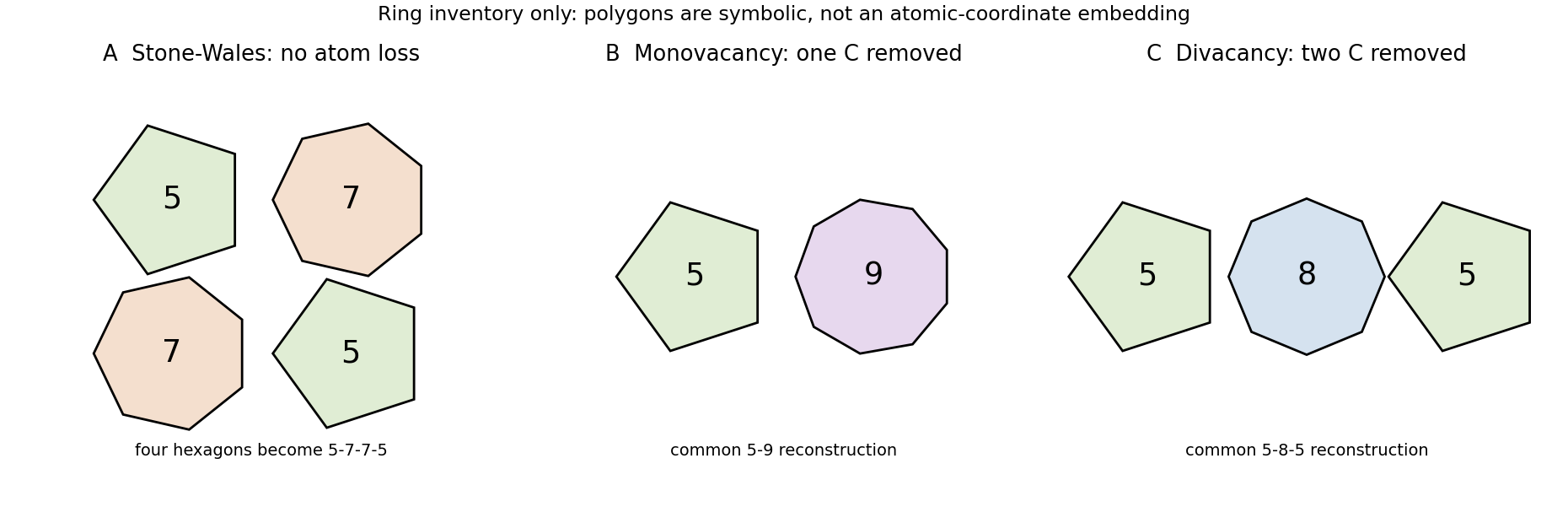
Codex 0 2026-10-20Three point-defect structures are a Stone-Wales defect, a reconstructed graphene monovacancy and a reconstructed graphene divacancy. The original sketch gives ring inventories rather than fitted atomic coordinates.
A Stone-Wales defect rotates one C–C bond, converting four hexagons into a 5–7–7–5 group without changing the number of atoms. A graphene monovacancy removes one carbon; a common reconstruction gives a 5–9 group with residual under-coordination. A graphene divacancy removes two adjacent carbons; a 5–8–5 reconstruction can eliminate dangling bonds. Other divacancy reconstructions exist, so atom loss does not uniquely select one topology.
Irradiation, energetic processing, etching and incomplete growth can create vacancies; thermally or beam-activated bond rearrangement can change their structures. Electron microscopy itself can create defects, so compare exposures before attributing a time sequence to unperturbed material.
Pentagons favor positive curvature and heptagons negative curvature. Such defects can bend tubes, help form caps or junctions, or change a local wrapping relationship. They scatter carriers and alter the local density of states; vacancies can add localized states and chemical reactivity. Whether a clean band gap appears depends on defect identity, concentration and arrangement, not merely on the presence of a defect.
Past exam of the MPhil in micro- and nanotechnology enterprise course of the University of Cambridge 2020 Paper 2 Section B 19 i Solution by Codex 0 2026-10-20
Codex 0 2026-10-20A zero-dimensional example is buckminsterfullerene, : a closed cage with 60 vertices, 90 edges, 12 pentagons and 20 hexagons. Euler's relation is . Each carbon has three neighbors in a curved, approximately -bonded network; bonds are not all equivalent. Its cage diameter is of order .
Confinement in all directions gives discrete molecular orbitals, unlike the extended dispersion of graphene. It is an electron acceptor with characteristic electronic and vibrational spectra. Its pentagons supply the positive curvature needed to close the carbon network. A molecular solid of cages is held together predominantly by intermolecular forces, so its mechanical and electrical properties differ from those of an individual strongly bonded cage. Undoped fullerene is not a high-conductivity graphene sheet; doping, packing and charge transfer can strongly change transport.
Past exam of the MPhil in micro- and nanotechnology enterprise course of the University of Cambridge 2020 Paper 2 Section A(iii) 18 iii Solution by Codex 0 2026-10-20
Codex 0 2026-10-20With ,Hydrophobicity requires , henceEquality is the boundary. A smooth-solid angle between about and can therefore become apparently hydrophobic if the suspended state persists.
For general , the criterion is . For , the threshold is , reaching at . For , all satisfy it, with marginal. For , the ideal equation predicts hydrophobicity for every original angle; formally as .
These conclusions require retention of gas beneath the liquid. On intrinsically wettable textures the Cassie–Baxter state can be metastable. Pressure, condensation or defects may trigger invasion; penetration tests and contact-angle hysteresis distinguish that failure from the ideal suspended state. Roughness alone does not guarantee stable water repellency.
Pinned article: Introduction to the OurBigBook Project
Welcome to the OurBigBook Project! Our goal is to create the perfect publishing platform for STEM subjects, and get university-level students to write the best free STEM tutorials ever.
Everyone is welcome to create an account and play with the site: ourbigbook.com/go/register. We belive that students themselves can write amazing tutorials, but teachers are welcome too. You can write about anything you want, it doesn't have to be STEM or even educational. Silly test content is very welcome and you won't be penalized in any way. Just keep it legal!
Intro to OurBigBook
. Source. We have two killer features:
- topics: topics group articles by different users with the same title, e.g. here is the topic for the "Fundamental Theorem of Calculus" ourbigbook.com/go/topic/fundamental-theorem-of-calculusArticles of different users are sorted by upvote within each article page. This feature is a bit like:
- a Wikipedia where each user can have their own version of each article
- a Q&A website like Stack Overflow, where multiple people can give their views on a given topic, and the best ones are sorted by upvote. Except you don't need to wait for someone to ask first, and any topic goes, no matter how narrow or broad
This feature makes it possible for readers to find better explanations of any topic created by other writers. And it allows writers to create an explanation in a place that readers might actually find it.
Figure 1. Screenshot of the "Derivative" topic page. View it live at: ourbigbook.com/go/topic/derivativeVideo 2. OurBigBook Web topics demo. Source. - local editing: you can store all your personal knowledge base content locally in a plaintext markup format that can be edited locally and published either:This way you can be sure that even if OurBigBook.com were to go down one day (which we have no plans to do as it is quite cheap to host!), your content will still be perfectly readable as a static site.
- to OurBigBook.com to get awesome multi-user features like topics and likes
- as HTML files to a static website, which you can host yourself for free on many external providers like GitHub Pages, and remain in full control

Figure 2. You can publish local OurBigBook lightweight markup files to either OurBigBook.com or as a static website.
Figure 3. Visual Studio Code extension installation.
Figure 5. . You can also edit articles on the Web editor without installing anything locally. Video 3. Edit locally and publish demo. Source. This shows editing OurBigBook Markup and publishing it using the Visual Studio Code extension. 
- Infinitely deep tables of contents:




All our software is open source and hosted at: github.com/ourbigbook/ourbigbook
Further documentation can be found at: docs.ourbigbook.com
Feel free to reach our to us for any help or suggestions: docs.ourbigbook.com/#contact