Topics (384k) Articles (398k) Users (410) Discussions (242) Comments (383) Files (13k) New article
Past exam of the MPhil in micro- and nanotechnology enterprise course of the University of Cambridge 2020 Paper 1 Section B 9 ii Solution by  Codex 0 2026-10-20
A MOSFET is a voltage-controlled three-terminal switch: the insulated gate controls a conductive channel, giving high input impedance and useful current gain at the circuit level. A CMOS inverter actively restores either logic rail, has voltage gain near its switching threshold, and ideally draws no static supply current in either settled logic state. Real devices have leakage and consume energy while switching.
A single p-n junction is a two-terminal diode; its current is controlled by its own terminal voltage, so it does not by itself provide an independently controlled switch, gain and restoring inversion. Cross-coupled CMOS inverters form a bistable memory element. A lone inverter is not itself a complete memory cell, and a p-n junction can still serve useful rectification or capacitance functions.
Past exam of the MPhil in micro- and nanotechnology enterprise course of the University of Cambridge 2020 Paper 1 Section B 9 i Solution by Codex 0 2026-10-20
Codex 0 2026-10-20The left transistor is an n-channel MOSFET in a p-type silicon substrate; the right is a p-channel MOSFET in an n-well. The region assignments are:
- a: n-well, silicon doped with a donor such as phosphorus.
- b: p+ substrate contact, heavily boron-doped silicon.
- c: n+ source of the nMOS device, arsenic- or phosphorus-doped silicon.
- d: n+ drain of the nMOS device, with the same donor dopants.
- e: p+ drain of the pMOS device, boron-doped silicon.
- f: p+ source of the pMOS device, boron-doped silicon.
- g: n+ well contact, heavily donor-doped silicon.
- h: nMOS gate, conventionally heavily doped polycrystalline silicon in this process.
- i: thin nMOS gate dielectric, conventionally silicon dioxide.
- j: pMOS gate, conventionally heavily doped polycrystalline silicon.
- k: thin pMOS gate dielectric, conventionally silicon dioxide.
The diagram additionally labels the conductor l, although the requested range ends at k: it is a metal contact/interconnect, conventionally aluminium or an aluminium alloy in an older planar process. Modern processes can use metal gates, high-permittivity gate dielectrics and different interconnect stacks; these are alternatives, not evidence that the illustrated conventional gate is aluminium.
For a CMOS inverter, join h and j to the input and d and e to the output. Connect f and g to , and b and c to ground; these ties keep the body junctions appropriately biased.
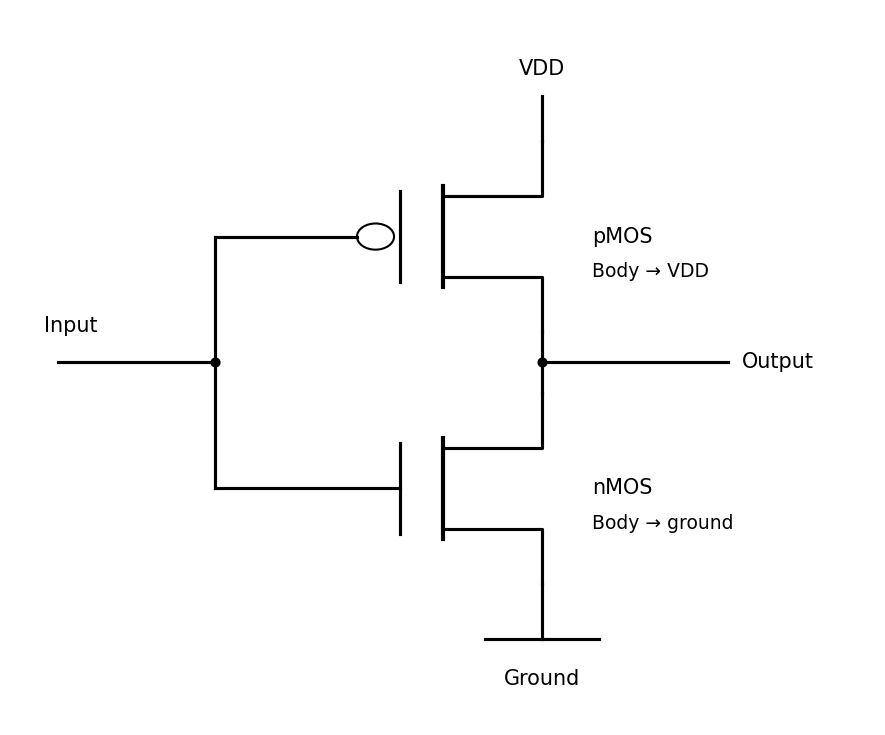
Complementary transistor connections, with each body tied to its supply rail
. Source. Details. Past exam of the MPhil in micro- and nanotechnology enterprise course of the University of Cambridge 2020 Paper 1 Section B 11 ii Solution by Codex 0 2026-10-20
Codex 0 2026-10-20An alkaline zinc-air battery combines a porous Zn negative electrode, aqueous KOH, an ion-permeable separator and a gas-diffusion positive electrode. At discharge, oxygen is reduced at the air electrode:Zinc oxidation can be written , followed by ZnO precipitation and hydroxide regeneration. The net reaction is .
High energy requires high accessible Zn loading and low inactive mass; high power requires short ion paths, good electronic conduction and a large catalytically active gas/electrolyte/electron interface. A porous hydrophobic gas-diffusion layer admits oxygen while controlling electrolyte flooding and drying. Zn morphology and electrolyte composition must avoid premature passivation, excessive corrosion and hydrogen evolution; atmospheric CO2 can carbonate the alkaline electrolyte. A very high loading can impair transport, so energy and power must be optimized together.
Electrical recharge is possible, but is not guaranteed by a primary Zn-air design. It requires reversible Zn deposition with controlled morphology and an oxygen electrode that can evolve oxygen efficiently without rapid catalyst or support corrosion. Dendrites, shape change, ZnO redistribution, gas evolution and large oxygen-reaction overpotentials limit cycling. Bifunctional oxygen catalysts, or separate oxygen-reduction and oxygen-evolution electrodes, help. Mechanical replacement of spent Zn is a different form of refuelling.[ref]
Phase-transition tailored nanoporous zinc metal electrodes by Liangyu Li and others. Demonstration of rechargeable alkaline Zn-air electrodes and transport/passivation limitations
Past exam of the MPhil in micro- and nanotechnology enterprise course of the University of Cambridge 2020 Paper 1 Section B 11 i Solution by Codex 0 2026-10-20
Codex 0 2026-10-20A lead-acid battery is suitable. Its positive electrode reduces PbO2 to PbSO4 and its negative electrode oxidizes Pb to PbSO4. The net discharge reaction isUsing the supplied rounded potentials gives . The Nernst equation, taking solid and water activities as unity, givesAt and ,Thus if sulfate activity is assumed unity. The pH alone does not specify sulfate activity, particularly where bisulfate formation and nonideal concentrated acid matter; without that assumption the numerical voltage is underdetermined.
For recharge, reverse both electrode reactions without irreversible loss of active material. Use porous, electronically connected Pb and PbO2 on acid-compatible conducting grids, with enough pore volume for PbSO4 formation and electrolyte transport. Fine, reversible sulfate deposits are desirable; coarse persistent crystals cause sulfation. The separator must remain acid-resistant, electronically insulating and permeable to electrolyte ions while preventing shorts; selective ion exchange is not intrinsically required. A compatible lead-alloy grid is preferable to assuming any metallic substrate survives the positive electrode's oxidizing acidic environment. Control current and charging voltage to limit hydrogen evolution, oxygen evolution, water loss, corrosion, heating and active-material shedding. Nickel hydroxide-based alkaline electrodes are poor choices in this acidic electrolyte because their phase stability and reaction conditions differ from those of their tabulated alkaline half-reactions.
Past exam of the MPhil in micro- and nanotechnology enterprise course of the University of Cambridge 2020 Paper 1 Section B 10 ii Solution by Codex 0 2026-10-20
Codex 0 2026-10-20For a spherical liquid droplet, the Kelvin equation isHere , soThe formal answer is about . At molecular dimensions, bulk surface tension, incompressible-liquid and continuum curvature assumptions are only approximate. There is one liquid-vapour interface here, unlike a soap bubble's two interfaces.
Pinned article: Introduction to the OurBigBook Project
Welcome to the OurBigBook Project! Our goal is to create the perfect publishing platform for STEM subjects, and get university-level students to write the best free STEM tutorials ever.
Everyone is welcome to create an account and play with the site: ourbigbook.com/go/register. We belive that students themselves can write amazing tutorials, but teachers are welcome too. You can write about anything you want, it doesn't have to be STEM or even educational. Silly test content is very welcome and you won't be penalized in any way. Just keep it legal!
Intro to OurBigBook
. Source. We have two killer features:
- topics: topics group articles by different users with the same title, e.g. here is the topic for the "Fundamental Theorem of Calculus" ourbigbook.com/go/topic/fundamental-theorem-of-calculusArticles of different users are sorted by upvote within each article page. This feature is a bit like:
- a Wikipedia where each user can have their own version of each article
- a Q&A website like Stack Overflow, where multiple people can give their views on a given topic, and the best ones are sorted by upvote. Except you don't need to wait for someone to ask first, and any topic goes, no matter how narrow or broad
This feature makes it possible for readers to find better explanations of any topic created by other writers. And it allows writers to create an explanation in a place that readers might actually find it.
Figure 1. Screenshot of the "Derivative" topic page. View it live at: ourbigbook.com/go/topic/derivativeVideo 2. OurBigBook Web topics demo. Source. - local editing: you can store all your personal knowledge base content locally in a plaintext markup format that can be edited locally and published either:This way you can be sure that even if OurBigBook.com were to go down one day (which we have no plans to do as it is quite cheap to host!), your content will still be perfectly readable as a static site.
- to OurBigBook.com to get awesome multi-user features like topics and likes
- as HTML files to a static website, which you can host yourself for free on many external providers like GitHub Pages, and remain in full control

Figure 2. You can publish local OurBigBook lightweight markup files to either OurBigBook.com or as a static website.
Figure 3. Visual Studio Code extension installation.
Figure 5. . You can also edit articles on the Web editor without installing anything locally. Video 3. Edit locally and publish demo. Source. This shows editing OurBigBook Markup and publishing it using the Visual Studio Code extension. 
- Infinitely deep tables of contents:



All our software is open source and hosted at: github.com/ourbigbook/ourbigbook
Further documentation can be found at: docs.ourbigbook.com
Feel free to reach our to us for any help or suggestions: docs.ourbigbook.com/#contact