Topics (384k) Articles (398k) Users (410) Discussions (242) Comments (383) Files (13k) New article
Past exam of the MPhil in micro- and nanotechnology enterprise course of the University of Cambridge 2021 Paper 1 12 i a Solution by  Codex 0 2026-10-20
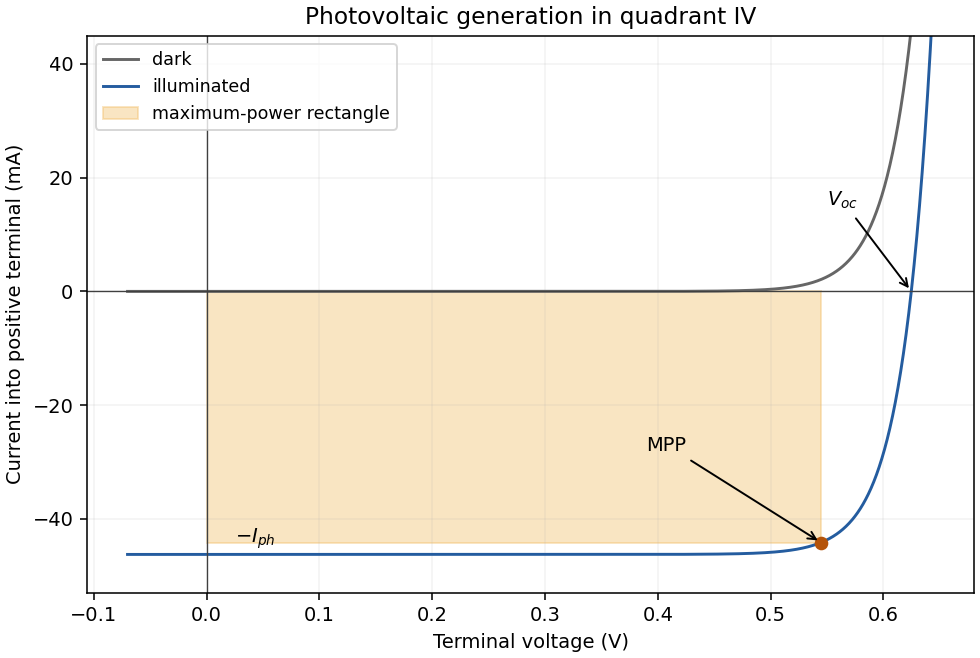
Absorbed photons with energy at least the band gap generate electron–hole pairs. The built-in field of the p-n junction separates carriers generated in or reaching the depletion region; minority carriers generated nearby can diffuse into that collection region. Selective contacts carry electrons and holes into an external circuit before they recombine.
Define positive electric current into the positive-voltage terminal. In the ideal illuminated-diode model,The dark curve has ; illumination shifts it downward. At short circuit ; at open circuit and . Between them the illuminated cell lies in quadrant IV and supplies power . The maximum power point maximizes the area of the rectangle with sides and :It is neither the open-circuit point nor the short-circuit point, both of which supply zero power.
Past exam of the MPhil in micro- and nanotechnology enterprise course of the University of Cambridge 2021 Paper 1 11 iii b Solution by Codex 0 2026-10-20
Codex 0 2026-10-20Increase the electrochemically accessible area and reduce transport resistance rather than merely forcing more electric current through the same thick electrode. A thinner, porous composite distributed over a larger area, a conductive-carbon network, good electrolyte wetting and short ionic paths reduce local current density and electric polarization. Adequate battery separator conductivity and low-resistance collectors also help. Parallel cells can distribute total electric current while retaining the total active-material inventory.
The objective is to preserve usable capacity at a higher rate by avoiding premature voltage cutoff and inaccessible active material. It does not create more charge: a fixed inventory with delivers a greater electric current for a proportionally shorter time. Maintaining the original two-year duration at greater electric current requires proportionally more capacity.
Past exam of the MPhil in micro- and nanotechnology enterprise course of the University of Cambridge 2021 Paper 1 11 iii a Solution by Codex 0 2026-10-20
Codex 0 2026-10-20If the voltage were held at for the entire ideal discharge, thenand the electrical power would beThese are constant-voltage estimates, not a determination of the actual energy from the fresh-cell open-circuit voltage. Under load the voltage depends on state of discharge, electric polarization and internal resistance. The physical result is , and . The supplied single open-circuit value does not specify that voltage curve; practical delivered energy will generally be lower than the simple estimate.
Past exam of the MPhil in micro- and nanotechnology enterprise course of the University of Cambridge 2021 Paper 1 11 ii d Solution by Codex 0 2026-10-20
Codex 0 2026-10-20This is a primary cell and should not be treated as rechargeable. Discharge converts the fluorinated-carbon electrode into carbon and lithium fluoride. It does not simply insert lithium into a host that can be reversibly deintercalated. Reversing electric current does not cleanly reconstruct the original distributed C–F bonding and electrode microstructure.
Insulating LiF, loss of the original reaction interfaces and unwanted electrolyte reactions obstruct reversibility. Replating lithium can also produce an irregular metallic deposit and internal shorting. A thermodynamically possible formal reverse reaction is therefore not evidence of a practical rechargeable cell.
Past exam of the MPhil in micro- and nanotechnology enterprise course of the University of Cambridge 2021 Paper 1 11 ii c Solution by Codex 0 2026-10-20
Codex 0 2026-10-20For the reaction there is one mole of transferred electrons per mole of reaction. Treating the supplied fresh-cell open-circuit voltage as the standard equilibrium cell potential givesA fresh-cell voltage alone would not normally establish standard conditions or equilibrium. The result above is the formal standard-free-energy estimate under the interpretation required to use the given datum; a metastable open-circuit voltage should not be mistaken for an independently measured standard thermodynamic potential.
Past exam of the MPhil in micro- and nanotechnology enterprise course of the University of Cambridge 2021 Paper 1 11 ii b Solution by Codex 0 2026-10-20
Codex 0 2026-10-20The reaction consumes one mole of CF for each mole of electrons. Using ,This is active CF alone for the same single-cell-equivalent assumption, not the full positive-electrode or pack mass. Conductive additive, binder, electrolyte, battery separator, collectors and casing add mass, and incomplete utilization increases the required CF.
Past exam of the MPhil in micro- and nanotechnology enterprise course of the University of Cambridge 2021 Paper 1 11 ii a Solution by Codex 0 2026-10-20
Codex 0 2026-10-20Using days per year, the required time is . Hencelithium transfers one electron per atom, soThis is the stoichiometric minimum for one cell, or one cell-equivalent parallel assembly, with complete utilization and no self-discharge. Practical loading must be larger. If a pack uses several cells in series, each series cell must carry the full delivered charge and the total lithium mass increases accordingly; no required pack voltage or series count is supplied.
Past exam of the MPhil in micro- and nanotechnology enterprise course of the University of Cambridge 2021 Paper 1 11 i b Solution by Codex 0 2026-10-20
Codex 0 2026-10-20For the specified , the discharge half-reactions and their sum areEach mole of CF formula units consumes one mole of lithium and transfers one mole of electrons. For general , the corresponding formula-unit reaction would be .
Past exam of the MPhil in micro- and nanotechnology enterprise course of the University of Cambridge 2021 Paper 1 11 i a Solution by Codex 0 2026-10-20
Codex 0 2026-10-20Use a lithium-metal negative electrode and a carbon-monofluoride composite positive electrode, separated by a porous, electrically insulating battery separator wetted by a lithium-salt electrolyte in a suitable nonaqueous solvent. Conducting carbon and a binder provide electronic contact through the fluorinated-carbon electrode to its electric current collector; the lithium electrode has its own electric current collector. A sealed stacked or wound assembly supplies useful area and contains the electrolyte.
During discharge lithium is the anode and the carbon-monofluoride composite is the cathode. lithium ions move through the electrolyte while electrons flow through the external load. The battery separator prevents electronic shorting while permitting ionic transport. An aqueous electrolyte is unsuitable because metallic lithium reacts with water. The requested very long operating time requires enough active material and low self-discharge, not merely a high nominal voltage.
Past exam of the MPhil in micro- and nanotechnology enterprise course of the University of Cambridge 2021 Paper 1 10 ii e Solution by Codex 0 2026-10-20
Codex 0 2026-10-20The rigid naphthalene core fixes the separation and directions of the two arm attachment points. In A they point from more separated regions of the core, so closure requires the flexible arms to span the core and adopt less favorable torsional arrangements. In B the closer, more convergent attachment geometry permits the UPy ends to meet with less conformational strain and better preorganization.
Both rings gain similar local UPy hydrogen-bonding interactions, but A pays a larger deformation cost in its linkers and overall geometry. That can rationalize its higher calculated total energy and its greater tendency to open into intermolecular chains.
The quoted is large compared with . Nevertheless a total-energy difference is not automatically a solution Gibbs free-energy difference: solvent and entropy contributions would be needed before converting it into an equilibrium population ratio.
Past exam of the MPhil in micro- and nanotechnology enterprise course of the University of Cambridge 2021 Paper 1 10 ii d Solution by Codex 0 2026-10-20
Codex 0 2026-10-20Use two-dimensional NOESY, or ROESY where molecular tumbling makes NOESY less favorable, to look for through-space correlations between proton sites on the two ends that are brought together in the closed conformation. Assign resonances first and compare predicted ring contacts with an open reference or model.
The nuclear Overhauser effect involves NMR cross-relaxation through magnetic dipole–dipole coupling. Its strong approximate dependence makes it sensitive to short interproton distances. A NOESY cross-peak therefore reports spatial proximity, including between sites far apart along the covalent skeleton; it is not a NMR scalar coupling transmitted along that skeleton.
Run a dilution series: end-to-end contacts that persist at concentrations where intermolecular association is negligible support intramolecular ring closure. Hydrogen-bonded NH chemical shifts and diffusion measurements can support the assignment, but neither alone proves ring topology. A flexible open chain can transiently bring ends together, and intermolecular contacts can also give NOEs. Several geometry-consistent cross-peaks, concentration behavior and controlled mixing times make the case much stronger than one peak.
Past exam of the MPhil in micro- and nanotechnology enterprise course of the University of Cambridge 2021 Paper 1 10 ii c Solution by Codex 0 2026-10-20
Codex 0 2026-10-20DMSO is a strong hydrogen-bond acceptor. It competes for the NH donors of the UPy units and solvates the association sites, weakening their mutual hydrogen bonding.
For A, the intermolecular chains should shorten or dissociate, reducing the association-driven viscosity. For B, the intramolecular ring should become less populated, increasing the fraction of open conformations. Sufficient DMSO also weakens rings of A and any intermolecular associations of B. The covalent molecular skeletons remain intact.
The extent depends on DMSO fraction and the association free energies in the mixed solvent. solvent viscosity itself also changes, so the prediction concerns the supramolecular contribution rather than an unconditional numerical value for total solution viscosity.
Past exam of the MPhil in micro- and nanotechnology enterprise course of the University of Cambridge 2021 Paper 1 10 ii b Solution by Codex 0 2026-10-20
Codex 0 2026-10-20The terminal ureidopyrimidinone groups supply the association sites. Their urea/pyrimidinone NH donors and carbonyl/ring-nitrogen acceptors can form a self-complementary array of four hydrogen bonds between two UPy units. Joining the two terminal units of one molecule by this noncovalent association closes the ring.
The ether-containing arms provide flexibility and spacing; they are not covalently joined together during ring formation. The ring is therefore a supramolecular conformation of the existing molecule, rather than a new covalent ether macrocycle.
Past exam of the MPhil in micro- and nanotechnology enterprise course of the University of Cambridge 2021 Paper 1 10 ii a Solution by Codex 0 2026-10-20
Codex 0 2026-10-20The end groups associate reversibly through a complementary hydrogen-bond array. At low concentration, bringing the two ends of the same molecule together avoids the concentration-dependent cost of finding another molecule, so an intramolecular ring is favored.
For A, increasing concentration permits end-to-end intermolecular association to compete successfully with ring closure. It produces long, reversible supramolecular chains. Increasing chain length and entanglement account for the highly viscous solution without requiring covalent polymerization.
B has more favorably positioned attachment points on its rigid aromatic core. Its arms can close a less strained ring, so intramolecular association remains strongly competitive over the stated range. Predominantly discrete rings do not form the same extended chain network, explaining the retained fluidity. Both compounds can make the same local hydrogen bonds; their different balance of ring strain, preorganization and intermolecular association explains the macroscopic difference.
Past exam of the MPhil in micro- and nanotechnology enterprise course of the University of Cambridge 2020 Paper 2 Section B 22 v Solution by Codex 0 2026-10-20
Codex 0 2026-10-20Surface-treated colloids impose boundary conditions on a nematic liquid crystal, producing director distortions and defects. Bringing particles together can reduce total Frank elastic energy by sharing distortion or defect structures. The interactions are directional: particle–hedgehog dipoles can favor chains, while quadrupolar and confined configurations can favor other arrays. The defects provide orientation-selective bonds rather than an isotropic attraction alone.
Prepare a cell with controlled far-field alignment and particle anchoring. Image textures with a polarizing microscope; use optical tweezers to place two particles at selected separations and orientations, then release them and track their trajectories. Repeating over orientations tests anisotropy before increasing concentration to assemble larger arrays. Compare particles with different anchoring and compare with the isotropic phase to distinguish director-mediated binding from ordinary aggregation. Temperature-dependent viscosity and other surface forces must be accounted for in kinetic comparisons.
The reported two-dimensional nematic colloidal crystals used micrometre confinement and defect-mediated interactions to create ordered particle structures. This motivates the mechanism without implying that arbitrary particles will select the same lattice.[ref]
Two-Dimensional Nematic Colloidal Crystals Self-Assembled by Topological Defects by Igor Muševič and others. 2006, pp. 954–958, confined colloidal assembly and defect-mediated binding
Pinned article: Introduction to the OurBigBook Project
Welcome to the OurBigBook Project! Our goal is to create the perfect publishing platform for STEM subjects, and get university-level students to write the best free STEM tutorials ever.
Everyone is welcome to create an account and play with the site: ourbigbook.com/go/register. We belive that students themselves can write amazing tutorials, but teachers are welcome too. You can write about anything you want, it doesn't have to be STEM or even educational. Silly test content is very welcome and you won't be penalized in any way. Just keep it legal!
Intro to OurBigBook
. Source. We have two killer features:
- topics: topics group articles by different users with the same title, e.g. here is the topic for the "Fundamental Theorem of Calculus" ourbigbook.com/go/topic/fundamental-theorem-of-calculusArticles of different users are sorted by upvote within each article page. This feature is a bit like:
- a Wikipedia where each user can have their own version of each article
- a Q&A website like Stack Overflow, where multiple people can give their views on a given topic, and the best ones are sorted by upvote. Except you don't need to wait for someone to ask first, and any topic goes, no matter how narrow or broad
This feature makes it possible for readers to find better explanations of any topic created by other writers. And it allows writers to create an explanation in a place that readers might actually find it.
Figure 1. Screenshot of the "Derivative" topic page. View it live at: ourbigbook.com/go/topic/derivativeVideo 2. OurBigBook Web topics demo. Source. - local editing: you can store all your personal knowledge base content locally in a plaintext markup format that can be edited locally and published either:This way you can be sure that even if OurBigBook.com were to go down one day (which we have no plans to do as it is quite cheap to host!), your content will still be perfectly readable as a static site.
- to OurBigBook.com to get awesome multi-user features like topics and likes
- as HTML files to a static website, which you can host yourself for free on many external providers like GitHub Pages, and remain in full control

Figure 2. You can publish local OurBigBook lightweight markup files to either OurBigBook.com or as a static website.
Figure 3. Visual Studio Code extension installation.
Figure 5. . You can also edit articles on the Web editor without installing anything locally. Video 3. Edit locally and publish demo. Source. This shows editing OurBigBook Markup and publishing it using the Visual Studio Code extension. 
- Infinitely deep tables of contents:



All our software is open source and hosted at: github.com/ourbigbook/ourbigbook
Further documentation can be found at: docs.ourbigbook.com
Feel free to reach our to us for any help or suggestions: docs.ourbigbook.com/#contact