Topics (384k) Articles (398k) Users (410) Discussions (242) Comments (383) Files (13k) New article
Past exam of the MPhil in nuclear energy course of the University of Cambridge 2021 Module NE1 2 e Solution by  Codex 0 2026-10-20
After the short prompt adjustment, the prompt jump approximation takes the neutron amplitude to remain nearly in balance with the slowly changing delayed neutron precursor reservoir. For the source-free model,Substitute this quasi-steady relation into the precursor equation:For constant coefficients,The approximation is meaningful in the stated delayed-neutron regime with and a separated fast transient. The delayed neutron precursor reservoir remains continuous across an idealized instantaneous reactivity step; the approximation does not resolve the short prompt adjustment itself.
Past exam of the MPhil in nuclear energy course of the University of Cambridge 2021 Module NE1 2 d Solution by Codex 0 2026-10-20
Codex 0 2026-10-20Multiply the supplied inhour equation by and collect powers of the inverse period:With the stipulated constants this becomeswith roots and . The negative root describes a rapidly decaying component. The positive root governs the late-time growth, givingThe growing-mode e-folding time is not the precursor mean lifetime, and the negative root is a legitimate transient mode rather than an unphysical negative time.
Past exam of the MPhil in nuclear energy course of the University of Cambridge 2021 Module NE1 2 c Solution by Codex 0 2026-10-20
Codex 0 2026-10-20At equilibrium, precursor production balances precursor decay:ThereforeThe delayed neutron precursor population can exceed the instantaneous neutron population even when the delayed neutron fraction is small: the delayed neutron precursor reservoir persists much longer than an individual prompt-neutron generation.
Past exam of the MPhil in nuclear energy course of the University of Cambridge 2021 Module NE1 2 b Solution by Codex 0 2026-10-20
Codex 0 2026-10-20The point kinetics model replaces the spatially and spectrally distributed neutron field by a single amplitude , effectively assuming a fixed or sufficiently slowly varying flux shape. The source amplitude is . A single effective delayed neutron precursor population , delayed neutron fraction and decay rate stand in for many precursor species with different lifetimes. is the prompt neutron generation time and the specified reactor reactivity.
The displayed equations omit explicit thermal-hydraulic, fuel-temperature and isotope-composition feedback. For the stated constant-coefficient transients, are prescribed rather than being solved as evolving fields. The model is useful for an elementary timescale calculation; it does not establish the spatial stability or operating limits of an actual core.
Past exam of the MPhil in nuclear energy course of the University of Cambridge 2021 Module NE1 2 a Solution by Codex 0 2026-10-20
Codex 0 2026-10-20Delayed neutrons are emitted after precursor radioactive transformations, rather than promptly at fission. Some neutron-rich fission products undergo beta decay into excited daughter states that can emit a neutron. The waiting time is governed chiefly by the precursor's radioactive lifetime, not by a neutron moving unusually slowly after it has already been emitted.
Although their fraction is small, delayed neutrons introduce a much slower population timescale into the nuclear chain reaction. In the delayed-neutron-controlled regime, changes can therefore develop over times comparable with precursor lifetimes rather than only the prompt neutron generation time. That timescale separation is central to qualitative reactor controllability. It does not imply that every positive-reactivity transient is slow.
Past exam of the MPhil in nuclear energy course of the University of Cambridge 2021 Module NE1 1 e Solution by Codex 0 2026-10-20
Codex 0 2026-10-20Alpha decay releases energy in charged particles with short stopping ranges in matter, so much of their kinetic energy becomes local heat. An appropriate radioisotope thermoelectric generator can use a predictable radioactive decay heat source without requiring sunlight or a sustained nuclear chain reaction. Low penetrating photon and neutron output is desirable, but being an alpha emitter does not by itself establish the complete radiation spectrum.
The isotope's half-life must suit the mission. A short half-life gives high initial specific activity but a rapid decline in useful thermal power; a much longer one gives a steadier output but less activity per atom. Selection also depends on recoverable decay energy, specific power, daughter emissions, chemical and thermal stability, compatibility with the power-conversion system, availability and cost. Practical containment and radiological acceptability remain separate system-level requirements.
A thermoelectric generator converts a temperature difference into electrical output through the Seebeck effect; not all decay heat becomes electricity. NASA's operational account describes this heat-to-electricity distinction and the need to match source lifetime to long space missions.[ref]
Radioisotope Power Systems FAQ by National Aeronautics and Space Administration. What is an RTG, and the discussion of isotope-selection and mission-duration criteria
Past exam of the MPhil in nuclear energy course of the University of Cambridge 2021 Module NE1 1 c Solution by Codex 0 2026-10-20
Codex 0 2026-10-20Over half-lives, the duration is . The time-averaged thermal power isSince and ,This is a time average, not the arithmetic mean of the initial and final powers. It follows directly from the assumed constant nuclear decay constant and constant recovered energy per decay.
Past exam of the MPhil in nuclear energy course of the University of Cambridge 2021 Module NE1 1 b Solution by Codex 0 2026-10-20
Codex 0 2026-10-20The stipulated decay branch gives . Using the supplied atomic masses, the mass defect isso the total Q value is . The photon carries away the stated , leavingApplying the recoil partition,The daughter recoil takes approximately . Atomic electron counts balance in the neutral-atom mass difference; small electronic binding corrections and photon recoil are neglected consistently with the problem. These values follow the branch specified in the examination, rather than an assumed average over every physical decay branch.
Past exam of the MPhil in nuclear energy course of the University of Cambridge 2021 Module NE1 1 a Solution by Codex 0 2026-10-20
Codex 0 2026-10-20The lighter product receives the fraction of the two massive products' kinetic energy. Neglecting photon momentum, conservation of momentum gives equal and opposite daughter momenta, . In the nonrelativistic approximation,Hence andThis partitions kinetic energy after any stipulated photon energy has been removed from the available Q value. It does not assign the complete mass-defect energy to the light particle.
Past exam of the MPhil in nuclear energy course of the University of Cambridge 2020 Module NE4 2 c Solution by Codex 0 2026-10-20
Codex 0 2026-10-20The assumption is a leading approximation for concentrated ballistic radiation damage, not an exact statement that the alpha particle displaces no atoms. The daughter has only about times the alpha particle's kinetic energy, but it is much slower and loses a much larger fraction of that energy in collisions with target nuclei. Those collisions initiate closely packed recoil cascades. The alpha particle deposits most of its much larger energy into the electronic system over a path hundreds of times longer, with a less concentrated displacement contribution.
Thus the dense region susceptible to one-event loss of crystalline order can reasonably be associated chiefly with the daughter recoil. This explains why the effective damaged volume in the direct-impact amorphization model can be estimated or fitted from recoil-dominated cascades. It is the spatial density and stopping channel of the damage, not simply which particle carries more energy, that matters.
The approximation has a measurable limit. Turcotte's comparison of actinide-dioxide self-damage and external alpha irradiation found a nonzero alpha contribution, reporting about of total damage in the studied case. Comparison of diffraction-derived lattice changes with internal-reference measurements helps separate real radiation-induced swelling from instrument shifts, while the distinction between self-decay and external-alpha irradiation probes the omitted recoil channel.[ref]
Alpha radiation damage in the actinide dioxides by R. P. Turcotte. BNWL-SA-5333, summary and experimental/results discussion; nonzero alpha damage and diffraction measurements
Consequently “all ballistic radiation damage” is useful as the stated model assumption but should not be promoted to an exact material-independent law. electronic excitation can also couple to structural change, and recovery alters what survives. The derivation in part (b) remains valid for an effective one-event volume fitted consistently to the relevant regime; it does not establish that all ceramics or spent fuels share the same or the same eventual amorphous fraction.
Past exam of the MPhil in nuclear energy course of the University of Cambridge 2020 Module NE4 2 b Solution by Codex 0 2026-10-20
Codex 0 2026-10-20Consider a representative bulk volume and let be its amorphous fraction. With alpha-decay event rate density , during the expected number of independent alpha decay events is . Each produces effective amorphization volume per decay , but only the fraction of a randomly placed damage region was previously crystalline. The expected new amorphous volume is thereforeDividing by givesSeparate variables and integrate:Hence, with cumulative alpha-decay event density ,The product is dimensionless: events per cubic metre accumulated over time multiply cubic metres damaged per event. Here “dose” is an event density, not an absorbed energy per kilogram.
An independent probability interpretation reaches the same result. A particular point is covered by a number of random damage events with a Poisson distribution of mean . Its probability of remaining crystalline is the zero-hit probability ; the complementary fraction has been hit at least once. Overlapping events do not create a second copy of already amorphous material.
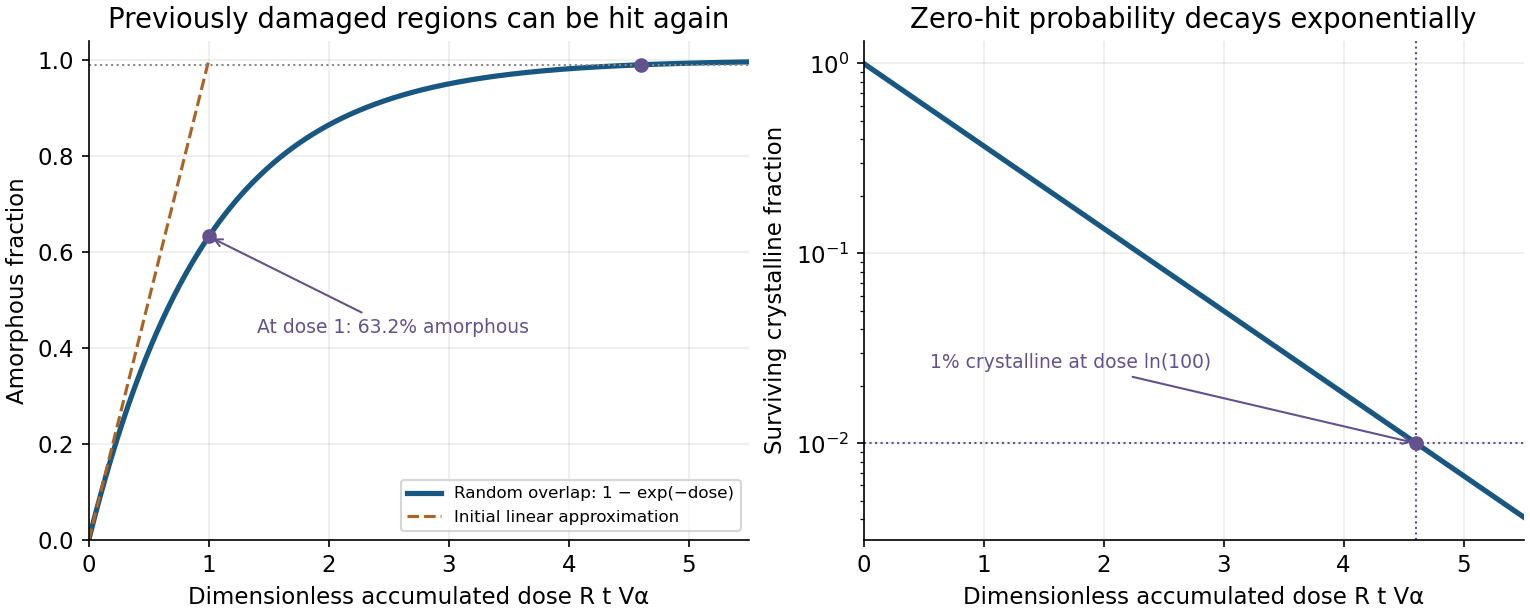
At small dose, ; at larger dose, overlap bends the curve towards one. For example, gives , not full radiation-induced amorphization, and requires .
The derivation assumes a homogeneous, initially crystalline material; independent random event locations; one-event radiation-induced amorphization of a fixed effective volume; and no recovery of that volume. It is the direct-impact model, not a model requiring several prior hits to cross a damage threshold. If varies while stays fixed, replace by . If annealing, material evolution or spatially correlated actinide distributions matter, this simple law need not hold. The subscript on indexes an alpha decay event: it does not require the emitted alpha particle itself to produce the damaged volume.
Past exam of the MPhil in nuclear energy course of the University of Cambridge 2020 Module NE4 2 a Solution by Codex 0 2026-10-20
Codex 0 2026-10-20A parent initially at rest emits an alpha particle and a recoiling heavy daughter. momentum conservation gives equal and opposite momenta, so their nonrelativistic kinetic energies satisfyHere is the kinetic energy available to this branch; excitation of the daughter reduces it and may be followed by photon emission. For an illustrative MeV, and , the energies are MeV in the alpha particle and keV in the daughter. The heavy daughter receives much less energy, but that does not imply much less atomic damage.
The fast alpha particle loses most of its energy through electronic stopping: ionization and electronic excitation along a relatively long path. It also undergoes nuclear collisions, particularly towards the end of its range, and can produce displacement damage. The slower, heavy, highly charged recoil couples strongly to surrounding nuclei and generates a compact displacement cascade. Successive knock-on atoms create vacancies, interstitial defects and clusters. Some Frenkel pairs recombine as the cascade relaxes; the initial collision count is therefore not the number of defects that remain.
A quantitative illustration comes from brannerite rather than an assumed universal ceramic. Simulations in the primary natural-mineral study used a MeV alpha particle and an keV daughter recoil. The corresponding ranges were about micrometres and nanometres. At the study's assumed eV threshold displacement energy, its tabulated results give roughly – recoil atomic displacements and – alpha particle atomic displacements per radioactive decay. The numbers depend strongly on the displacement threshold and material, but the shorter recoil path contains the dominant and much denser ballistic radiation damage.[ref]
Chemistry, microstructure, and alpha decay damage of natural brannerite by G. R. Lumpkin and others. Chemical Geology 291, section 2.3 and Table 5; simulated ranges and threshold-dependent displacement counts
In a susceptible ceramic, cascade cores can accumulate into an amorphous fraction; defects and associated relaxation can also change volume, thermal conductivity and mechanical response. molecular dynamics simulations of zirconolite found a strongly disordered core surrounded by more isolated point defects, supporting this distinction between local cascade damage and an entirely transformed specimen.[ref]
Molecular dynamics simulation of the α-recoil nucleus displacement cascade in zirconolite by L. Veiller and others. Journal of Nuclear Materials 306, 61–72, abstract and cascade-core/point-defect results
The alpha particle eventually becomes a helium atom after slowing and charge exchange. helium accumulation can have later microstructural effects distinct from the initial knock-on cascade. Material-dependent recombination and annealing limit surviving disorder; a change in diffraction or radiation-induced swelling is not automatically radiation-induced amorphization, and radiation-induced amorphization is not automatically dissolution or release of the contained radionuclide.
Past exam of the MPhil in nuclear energy course of the University of Cambridge 2020 Module NE4 1 d Solution by Codex 0 2026-10-20
Codex 0 2026-10-20Resource savings do not by themselves establish a financial saving. The one-recycle case avoids purchasing kg U in natural feed and kg-SWU per year. Those are the benefits to compare with the incremental costs, not the whole value of the recovered uranium or the gross avoided fresh-product separative work.
Let be the concentrate price per kilogram of uranium, the price per kg-SWU, and the annual net extra cost of recovery, recycle-specific conversion and fabrication, waste management and financing, relative to the once-through alternative. Recycling is cheaper under this simplified boundary only ifEquivalently, if and were supplied, the break-even uranium price would beAn avoided spent-fuel-disposal charge belongs as a credit in ; a new radioactive waste conditioning or disposal liability belongs as a cost. They must not both be assigned the same sign simply because each concerns waste.
The natural-uranium saving is appreciable, but the fractional separative-work saving is small. Recovery losses and the uranium-236 compensation limit the value of recycling. Additional radiological handling, separate fabrication campaigns, secondary waste streams, capital tied up during storage and recovery, and uncertain future disposal costs can matter. Conversely, a higher natural-uranium price, a lower incremental recovery cost or an independently justified disposal credit can favour reuse. The calculation gives a conditional comparison, not a uniquely determined economic verdict or market-price threshold, because no costs are supplied. plutonium utilisation is a different option and has not been silently credited to this uranium-only recycle.
Past exam of the MPhil in nuclear energy course of the University of Cambridge 2020 Module NE4 1 c Solution by Codex 0 2026-10-20
Codex 0 2026-10-20The recycle feed is the recovered uranium, not the whole initial nuclear fuel charge. After the stated loss it isUsing the same enrichment tails assay and the stipulated higher recycle-product assay, the isotopic mass balance givesTreat the recycled product as replacing the same uranium mass of ordinary nuclear fuel: the additional uranium-235 compensates for the supplied uranium-236 penalty. It displaces fresh natural-uranium feed in the ratio calculated in part (b), henceThe remaining natural feed is , a 9.885% resource saving relative to the full-power once-through requirement. This credits one uranium recycle only; it adds no second-pass recycling or plutonium credit.
Separative work must be charged for producing the recycled nuclear fuel as well as credited for displaced fresh nuclear fuel. With uranium-235 mass fraction , use the separative value functionMasses in kilograms give work in kg-SWU. For ordinary fresh product the work per product kilogram isThus the fresh work avoided isThe recycled product still requiresThe net separative-work saving is consequentlyAs a whole-cycle check, the fresh route requires kg-SWU per year, while the mixed fresh-plus-recycled supply requires kg-SWU. The net saving is only 0.7385% of the original work. The recovered stream has a higher uranium-235 assay than natural feed, but the higher required product assay uses most of the work credit. These equations are resource accounting and do not specify an uranium enrichment plant or its operation.
Past exam of the MPhil in nuclear energy course of the University of Cambridge 2020 Module NE4 1 b Solution by Codex 0 2026-10-20
Codex 0 2026-10-20Use the thermal power when applying nuclear fuel burnup. No capacity factor is supplied, so take a full-power year of days; if the operating fraction were , the annual quantities in this part would be multiplied by .The corresponding initial heavy-metal nuclear fuel requirement isAll nuclear fuel and concentrate masses below are uranium masses, excluding oxygen. Let denote uranium feed, product and enrichment tails, and the uranium-235 mass fractions. Conservation of total uranium and uranium-235 givessoWith , the uranium oxide concentrate requirement is thereforeThis is not the gross mass of oxide concentrate. Both and provide independent balance checks.
Pinned article: Introduction to the OurBigBook Project
Welcome to the OurBigBook Project! Our goal is to create the perfect publishing platform for STEM subjects, and get university-level students to write the best free STEM tutorials ever.
Everyone is welcome to create an account and play with the site: ourbigbook.com/go/register. We belive that students themselves can write amazing tutorials, but teachers are welcome too. You can write about anything you want, it doesn't have to be STEM or even educational. Silly test content is very welcome and you won't be penalized in any way. Just keep it legal!
Intro to OurBigBook
. Source. We have two killer features:
- topics: topics group articles by different users with the same title, e.g. here is the topic for the "Fundamental Theorem of Calculus" ourbigbook.com/go/topic/fundamental-theorem-of-calculusArticles of different users are sorted by upvote within each article page. This feature is a bit like:
- a Wikipedia where each user can have their own version of each article
- a Q&A website like Stack Overflow, where multiple people can give their views on a given topic, and the best ones are sorted by upvote. Except you don't need to wait for someone to ask first, and any topic goes, no matter how narrow or broad
This feature makes it possible for readers to find better explanations of any topic created by other writers. And it allows writers to create an explanation in a place that readers might actually find it.
Figure 1. Screenshot of the "Derivative" topic page. View it live at: ourbigbook.com/go/topic/derivativeVideo 2. OurBigBook Web topics demo. Source. - local editing: you can store all your personal knowledge base content locally in a plaintext markup format that can be edited locally and published either:This way you can be sure that even if OurBigBook.com were to go down one day (which we have no plans to do as it is quite cheap to host!), your content will still be perfectly readable as a static site.
- to OurBigBook.com to get awesome multi-user features like topics and likes
- as HTML files to a static website, which you can host yourself for free on many external providers like GitHub Pages, and remain in full control

Figure 2. You can publish local OurBigBook lightweight markup files to either OurBigBook.com or as a static website.
Figure 3. Visual Studio Code extension installation.
Figure 5. . You can also edit articles on the Web editor without installing anything locally. Video 3. Edit locally and publish demo. Source. This shows editing OurBigBook Markup and publishing it using the Visual Studio Code extension. 
- Infinitely deep tables of contents:



All our software is open source and hosted at: github.com/ourbigbook/ourbigbook
Further documentation can be found at: docs.ourbigbook.com
Feel free to reach our to us for any help or suggestions: docs.ourbigbook.com/#contact