Topics (384k) Articles (398k) Users (410) Discussions (242) Comments (383) Files (13k) New article
Past exam of the MPhil in nuclear energy course of the University of Cambridge 2021 Module NE3 4 b Solution by  Codex 0 2026-10-20
Mitigation should reduce the driving gradients and keep the resulting material response within a demonstrated range. A uniform starting mixture and controlled pore and grain structure reduce pre-existing local compositional and thermal variations. Control of the oxygen-to-metal ratio matters because oxygen chemistry changes both transport and fuel–cladding compatibility.
Reducing peak temperature and unnecessary thermal gradients limits thermally activated redistribution and evaporation–condensation. Possible design responses include improving heat transfer, choosing suitable fuel geometry and thermal properties, and limiting local power peaking. Their benefit has to be checked against neutronic performance, mechanical constraints and changing properties during burnup.
Materials selection and interface design can reduce harmful fuel–cladding chemical interaction. Retaining a suitable gap, limiting cladding attack and accommodating gas and swelling are coupled requirements; simply suppressing one transport pathway can leave other degradation mechanisms.
Finally, use post-irradiation composition profiles and microstructural examinations to test the fuel-performance model. Measurements at different radii and axial positions can reveal whether an assumed homogeneous composition remains adequate. An observed redistribution in one fuel history does not establish a universal correction for all mixed oxide fuel. Mitigation aims at acceptable temperature, integrity and lifetime, rather than promising that every atom remains at its original radial position.
Past exam of the MPhil in nuclear energy course of the University of Cambridge 2021 Module NE3 4 a Solution by Codex 0 2026-10-20
Codex 0 2026-10-20Mixed oxide fuel begins as a specified mixture of uranium and plutonium oxides. A fuel pin develops strong radial temperature gradients during operation. The components and oxygen need not remain spatially uniform: their chemical potentials depend on temperature, local composition and oxygen-to-metal ratio.
Actinide redistribution in oxide fuel can involve thermally driven solid-state diffusion and evaporation–condensation transport across pores or a central cavity. Oxygen redistributes as well, changing local oxidation states and the relative thermodynamic tendencies of uranium- and plutonium-bearing species. Pore migration, grain growth and central-void formation couple compositional redistribution to fuel restructuring. Differential local burnup also changes composition over time.
The direction and magnitude of plutonium migration cannot be inferred from a temperature gradient alone. In particular irradiated fast-reactor pins, enrichment around a central cavity has been observed, but the result depends on stoichiometry and operating history. M. Bober and colleagues investigated thermal-diffusion and evaporation–condensation effects using autoradiographs of sections of fuel irradiated in RAPSODIE.[ref]
Plutonium redistribution in fast reactor mixed oxide fuel pins by M. Bober and others. Abstract: irradiated-pin autoradiographs, oxygen redistribution, and dependence on stoichiometric state
Redistribution changes the radial heat generation rate and material properties. Concentrating more fissile material near an already hot region can raise local heat generation; changes in thermal conductivity and local melting behavior modify the temperature response. Gas release, pore formation and fuel–cladding contact can also change thermal resistance and mechanical loading. A spatially averaged composition can therefore underestimate a local temperature or chemical interaction.
Segregated fission products add another concern: mobile species can accumulate at colder interfaces or react with the cladding, while insoluble products form separate phases. Fuel performance must therefore track composition, temperature and microstructure together, rather than treating segregation as merely a cosmetic change in an otherwise fixed fuel.
Past exam of the MPhil in nuclear energy course of the University of Cambridge 2021 Module NE3 3 b Solution by Codex 0 2026-10-20
Codex 0 2026-10-20The resulting dislocation density reflects competing production, growth and recovery rates. The irradiation spectrum and displacement dose rate set the supply of recoil cascades and surviving point defects. Cascade structure controls the fraction born as isolated defects or clusters; equal nominal displacements per atom can therefore give different defect populations.
Temperature sets vacancy and interstitial mobilities and the rates of thermal emission and recovery. A simple radiation damage rate theory model illustrates the competition using number densities :Here is the surviving mobile-pair production rate per volume, is the recombination coefficient, are diffusion coefficients, and are sink strengths. The model omits explicit cluster-size populations and thermal-equilibrium emission; those must be added for a quantitative description of a particular exposure.
The initial dislocation density, grain size, free surfaces, precipitates and existing cavities all change sink strengths. Dislocations can have an interstitial bias, so their capture rates for the two defect types differ. Solutes and transmutation gases alter defect binding and mobility. Crystal structure, elastic anisotropy and applied stress affect which loop orientations survive and grow.
For a number density of circular loops of radius , their contribution to line length per volume isThus loop nucleation and loop growth both increase dislocation density, while shrinkage, annihilation and absorption at other sinks can decrease it. A change in loop count alone does not determine the change in total line density.
Schematically, is a production-and-growth contribution minus recovery and annihilation. An initial rise followed by approximate saturation is possible when these balance, but the saturation value and approach rate depend on the evolving microstructure. There is no universal dislocation density fixed by dose alone.
Past exam of the MPhil in nuclear energy course of the University of Cambridge 2021 Module NE3 3 a Solution by Codex 0 2026-10-20
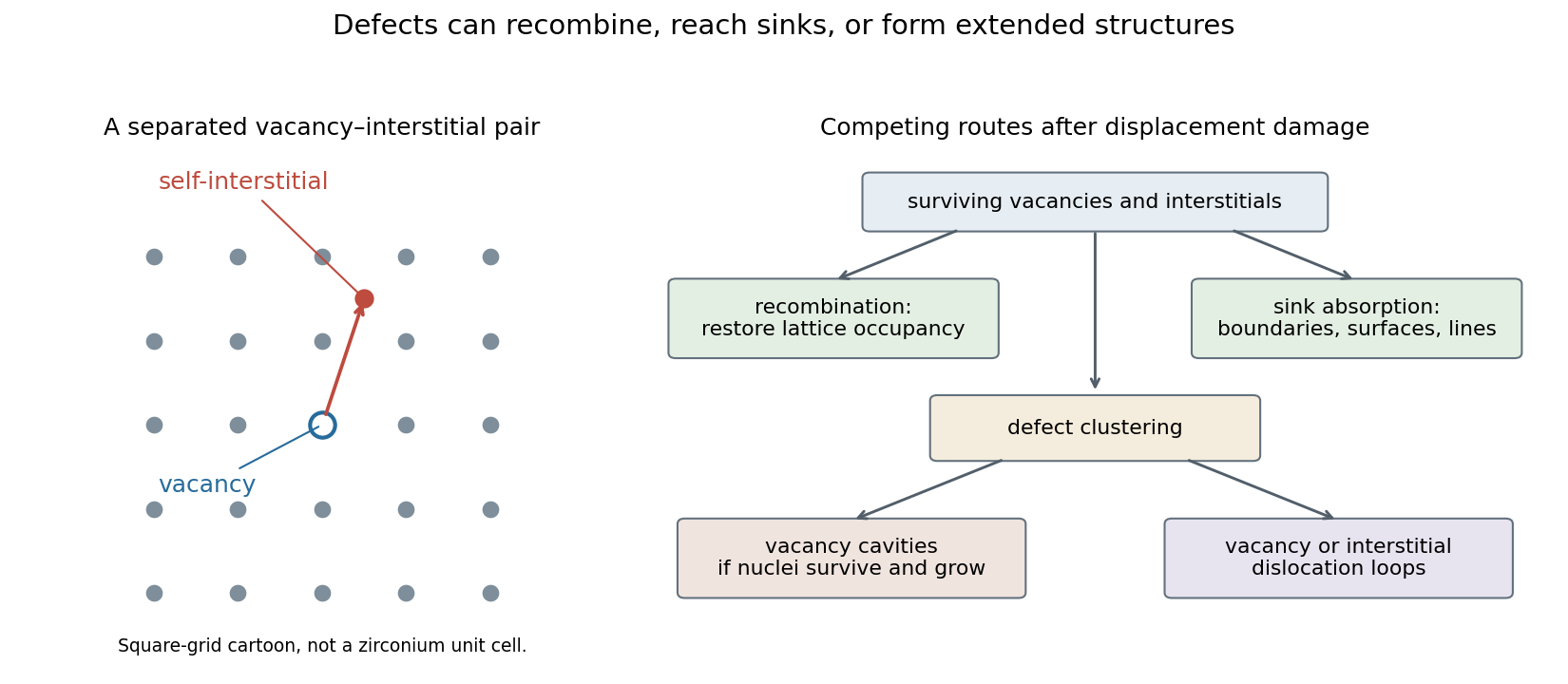
Codex 0 2026-10-20An energetic neutron can collide with a lattice atom and create a primary knock-on atom. That recoil transfers energy to other atoms in a displacement cascade. Some atoms leave their normal lattice sites, creating Frenkel pairs: a vacancy and an extra atom at an interstitial position.
Many nearby defects recombine during the cascade and its thermal relaxation. The surviving point defects are therefore fewer than a simple count of all displacement events. Some defects are already clustered within the cascade; others migrate and aggregate later.
A collection of vacancies can collapse into a platelet bounded by a vacancy-type dislocation loop. An aggregation of self-interstitial atoms can create an extra atomic platelet bounded by an interstitial-type dislocation loop. The boundary is a line defect because a circuit around it has a nonzero Burgers vector. The allowed Burgers vectors and habit planes depend on the material's crystal structure and fault energies.
Loops can grow by absorbing mobile point defects, shrink by emitting or absorbing the opposite defect type, and interact with existing dislocations. Some remain faulted, while suitable loops can unfault or become part of a larger dislocation network. Repeated cascades and subsequent defect transport therefore create a population of extended defects even in material with a low initial dislocation density.
This describes the main displacement-damage mechanism. Ionizing energy deposited in a material does not automatically create the same defect population as a neutron recoil cascade; recoil spectrum, displacement thresholds and material response matter.
Past exam of the MPhil in nuclear energy course of the University of Cambridge 2021 Module NE3 2 c Solution by Codex 0 2026-10-20
Codex 0 2026-10-20Reducing void swelling means delaying stable cavity growth and reducing its rate after incubation. Several approaches act on different parts of that mechanism.
Choose an alloy and initial microstructure with favorable defect sink populations. Grain boundaries, stable interfaces, precipitates and a controlled dislocation structure can remove mobile defects and promote recombination before they feed voids. The relevant quantity is sink efficiency and bias, rather than the number of visible microstructural features alone.
Cold working can increase the starting dislocation density and prolong incubation in suitable austenitic steels. Irradiation and thermal recovery can later change that structure, so an initial benefit need not persist indefinitely. Solute additions and controlled precipitation can also change vacancy mobility, defect trapping and cavity nucleation. Their effectiveness must be assessed together with corrosion, ductility and irradiation-assisted changes in composition.
Where other constraints permit, choose a more swelling-resistant material family, such as an appropriate ferritic-martensitic steel, rather than assuming every stainless steel has the response of an austenitic grade. This introduces its own tradeoffs in toughness, temperature window and compatibility.
Manage the operating temperature and accumulated dose to avoid the most unfavorable swelling regime, and account for transmutation-gas production. Neither simply minimizing temperature nor adding gas traps guarantees an improved component: the former can increase hardening and embrittlement, and gas-stabilized cavities can become nuclei for later swelling.
Useful comparisons require specimens with controlled composition and heat treatment, measured dose and temperature histories, and both dimensional measurements and transmission electron microscopy. Matching final dose alone does not establish that two irradiation conditions produce the same swelling.
Past exam of the MPhil in nuclear energy course of the University of Cambridge 2021 Module NE3 2 b Solution by Codex 0 2026-10-20
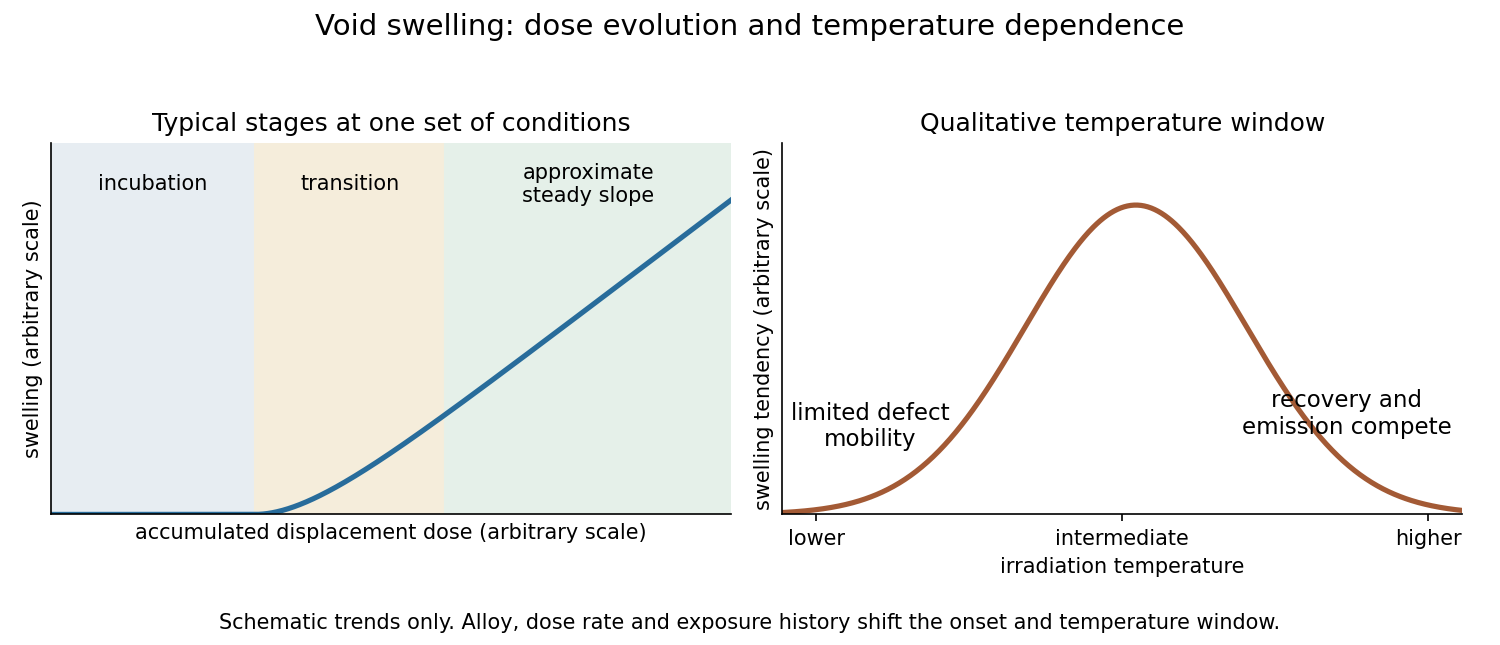
Codex 0 2026-10-20Temperature controls the competition between defect creation, diffusion, recombination, sink absorption and thermal vacancy emission. Consequently void swelling is normally largest in an intermediate temperature window, whose location depends on alloy, dose rate and exposure history.
At low temperature, many generated defects lack sufficient mobility to feed a growing cavity. Considerable irradiation hardening can still occur through small defect clusters, while large-scale void growth remains limited.
At intermediate temperature, vacancies and interstitials migrate sufficiently to establish the biased defect fluxes described above. Cavity nuclei can survive and receive a net vacancy flux, producing strong swelling.
At sufficiently high temperature, thermal vacancy emission, recombination, recovery and changes in sink populations compete more strongly with vacancy absorption. Stable nucleation and net cavity growth can become less favorable. This does not imply that every radiation effect disappears: material creep, precipitation, segregation and gas-bubble evolution can remain important.
For austenitic stainless steels, the relevant range is typically several hundred degrees Celsius; an alloy-independent peak temperature is not justified. Raising the displacement dose rate changes the balance between production and thermally activated processes and can shift both the temperature window and the incubation dose. Temperatures from accelerated ion or electron experiments should therefore be interpreted together with dose rate, implantation, specimen thickness and surface-sink effects.
Past exam of the MPhil in nuclear energy course of the University of Cambridge 2021 Module NE3 2 a Solution by Codex 0 2026-10-20
Codex 0 2026-10-20At low accumulated displacements per atom, a stainless steel can undergo substantial microscopic damage while its macroscopic volume changes little. Irradiation-generated vacancies and self-interstitials recombine, reach defect sinks, or form small clusters and dislocation loops. These processes can harden the steel before a large population of growing cavities appears. Thus dimensional stability during this interval does not imply an undamaged microstructure.
Void swelling commonly has an incubation interval, a transition into appreciable swelling, and a later interval with an approximately steady swelling rate per unit dose. The transition reflects the evolution of both stable cavity nuclei and the competing sink population. Gas atoms can help stabilize small cavities, but a vacancy void need not be filled with high-pressure gas.
The driving imbalance is a vacancy supersaturation. Dislocations generally capture interstitial defects more efficiently than vacancies, giving an interstitial bias. Once stable voids exist, the resulting excess vacancy supply can enlarge them. Growing and evolving dislocation structures compete with the cavities for defects. A roughly steady balance can give an approximately linear volume increase with dose over part of the exposure range, rather than proving indefinite linear growth.
If cavities occupy a fraction of the current volume and the matrix volume is otherwise unchanged, the void swelling volume fraction relation isSince cavity volume scales as radius cubed, numerous tiny clusters and a smaller population of larger voids can have very different dimensional consequences.
The original Cawthorne-Fulton observation of voids in irradiated steel used thin-foil electron microscopy on type316 stainless steel exposed in the Dounreay Fast Reactor. It connected microscopic cavities with the dimensional-instability problem that had emerged during fast-reactor fuel development.[ref]
Voids in irradiated stainless steel by C. Cawthorne and E. J. Fulton. Opening description: irradiated fuel cladding and mechanical-test specimens examined by the thin-foil electron-microscope technique
Past exam of the MPhil in nuclear energy course of the University of Cambridge 2021 Module NE3 1 c Solution by Codex 0 2026-10-20
Codex 0 2026-10-20The low-temperature zirconium matrix has a hexagonal close packing structure. Its crystallographic and directions therefore have different elasticity, thermal expansion and available slip systems. Producing tubing also develops a crystallographic texture, so averaging over grains does not necessarily remove these directional effects.
Different expansion along the crystal axes produces intergranular thermal stresses during temperature changes. Under load, easy dislocation glide modes may accommodate some strains much more readily than others; additional slip or crystal twinning is needed for general compatibility. Consequently strength and ductility can depend on the axial, circumferential and radial orientation of the tube.
Irradiation creates vacancies and self-interstitials that cluster into dislocation loops with different crystallographic orientations. Their anisotropic accumulation can produce irradiation growth even without external stress. Different directions can elongate or contract while the net volume change remains small. Texture turns these grain-scale strains into macroscopic length and diameter changes, bowing and stresses between constrained components. This mechanism is distinct from the added cavity volume of void swelling.
The crystallographic character of irradiation loops matters: atomistic calculations by Rory Hulse and Christopher P. Race examine several possible loop types and show that loop energy and shape depend on orientation and size. A single generic spherical-defect description therefore misses important aspects of zirconium's dimensional response.[ref]
An atomistic modelling study of the properties of dislocation loops in zirconium by Rory Hulse and Christopher P. Race. Abstract and loop-orientation results; the study is atomistic modelling, not a direct measurement of every loop population
Hydrogen also produces direction-sensitive damage. Zirconium hydrides are brittle precipitates whose preferred orientation depends on crystal texture and stress history. Radially oriented hydrides can offer crack paths across a thin tube wall under circumferential tension. Controlling texture, hydrogen pickup and hydride orientation helps manage that risk; changing the hexagonal structure's orientation cannot by itself eliminate corrosion or irradiation damage.
Past exam of the MPhil in nuclear energy course of the University of Cambridge 2021 Module NE3 1 b Solution by Codex 0 2026-10-20
Codex 0 2026-10-20For zirconium alloys, the practical upper temperature is governed by time-dependent corrosion, material creep and loss of ductility, well before bulk melting. In ordinary water-reactor service, cladding surfaces are commonly in the several-hundred-degree range, with normal operation around the low-to-mid range in a pressurized water reactor. A quoted service limit must specify alloy, coolant chemistry, exposure time, stress and accumulated hydrogen; there is no universal temperature at which every zirconium tube abruptly fails.
Increasing temperature accelerates zirconium-steam oxidation and creep. Oxide growth increases thermal resistance, and hydrogen uptake can leave a hydride-containing cladding with reduced resistance to cracking. A transient can also cause ballooning or rupture as hot material loses strength under internal pressure. Oxygen absorbed beneath the oxide stabilizes a brittle oxygen-rich region; a tube that survives the hot part of a transient can still have poor ductility during cooling and quenching.
For scale, the established US emergency-core-cooling criterion discussed by the United States Nuclear Regulatory Commission fuel-damage criteria limits peak cladding temperature to , about , together with an oxidation criterion. This is an accident-analysis criterion, rather than a proposed continuous service temperature.[ref]
United States Nuclear Regulatory Commission fuel-damage criteria. Issue170, description of the10CFR50.46 peak-temperature and17% oxidation criteria
These material constraints limit allowable fuel heat flux and temperature excursions and require adequate heat removal and thermal margin. A small increase in coolant temperature or oxide thermal resistance can raise the underlying metal temperature and accelerate degradation. Alloy changes, protective coatings and alternative claddings aim to improve that margin, while still satisfying the neutronic and mechanical requirements.
Past exam of the MPhil in nuclear energy course of the University of Cambridge 2021 Module NE3 1 a Solution by Codex 0 2026-10-20
Codex 0 2026-10-20Nuclear fuel cladding has to retain the nuclear fuel and its fission products, transfer heat to the coolant, and preserve a usable mechanical geometry throughout irradiation. Those functions impose several coupled requirements.
Its neutron absorption cross section should be small: absorption in a structural tube removes neutrons without producing useful fuel fission. This is a major attraction of zirconium alloys in a thermal-spectrum nuclear reactor. Low absorption alone is insufficient, because the material must also tolerate its coolant and irradiation environment.
The tube needs adequate yield strength, fracture toughness and ductility to withstand pressure differences, handling, thermal cycling and fuel expansion. Resistance to material creep and mechanical fatigue limits progressive deformation and cracking. The design must accommodate changes in pressure and contact with the expanding fuel, including pellet-cladding mechanical interaction.
The coolant-facing surface should resist corrosion and loss of protective oxide integrity. Hydrogen uptake and hydrogen embrittlement matter for zirconium alloys; chemical compatibility with the fuel and released fission products matters on the inner surface. Resistance to stress corrosion cracking is particularly important when chemical attack and tensile loading act together.
The material should transfer heat without an excessive temperature drop, retain mechanical integrity at the relevant temperatures, and remain dimensionally acceptable under radiation damage in materials. Irradiation growth, irradiation creep, void swelling and irradiation hardening can alter clearance, stresses and coolant passages even when the unirradiated tube meets its specification.
Finally, the alloy should be manufacturable as thin, reproducible, leak-tight tubing with reliable end joints and inspectable defects. Material selection balances these requirements: increasing strength by alloying, for example, can change corrosion, neutron absorption and irradiation behavior. A high melting point by itself does not establish suitability.
Past exam of the MPhil in nuclear energy course of the University of Cambridge 2021 Module NE1 4 e Solution by Codex 0 2026-10-20
Codex 0 2026-10-20At this point , so and . The solution from part (c) givesThereforeThe fissile population has declined by about from its initial value, while the conversion ratio has decreased slightly from . The replacement shortfall persists over this interval. Maintaining a specified long-term fuel inventory would require replenishment or a different balance of reactions; the prescribed-flux equations alone do not establish a constant-power operating state. Intermediate decay delays and the changing neutron spectrum were excluded by the original lumped model.
Past exam of the MPhil in nuclear energy course of the University of Cambridge 2021 Module NE1 4 d Solution by Codex 0 2026-10-20
Codex 0 2026-10-20The production rate is , while depletion includes both capture and fission of the fissile population, . Thus the conversion ratio in this stipulated model isAt zero instantaneous flux this expression describes the limiting ratio of the two reaction rates. The total absorption coefficients are and , soIt is below one: fissile nuclei are initially removed slightly faster than this simplified chain replaces them. Consequently this model is not initially self-replacing in fissile inventory. Inventory replacement is distinct from the instantaneous neutron balance that determines criticality.
Past exam of the MPhil in nuclear energy course of the University of Cambridge 2021 Module NE1 4 c Solution by Codex 0 2026-10-20
Codex 0 2026-10-20Use neutron fluence as the independent variable and abbreviate , and . Substituting the parent solution into the second linear differential equation givesThe integrating factor is . Integrating from the initial state yieldsThe first term is survival of the initial population; the second accumulates production at earlier exposures, weighted by subsequent survival. For , the continuous limit is . The same formula applies to a time-varying prescribed flux through ; intervals of zero flux leave both populations unchanged.
Past exam of the MPhil in nuclear energy course of the University of Cambridge 2021 Module NE1 4 b Solution by Codex 0 2026-10-20
Codex 0 2026-10-20The first equation is a prescribed first-order removal law. For a constant absorption coefficient,Integrating from the initial condition givesand henceThe neutron fluence is the time integral of scalar neutron flux; it has inverse-area units, making dimensionless. Constant flux is not needed for this integration, but a constant effective coefficient is.
Past exam of the MPhil in nuclear energy course of the University of Cambridge 2021 Module NE1 4 a Solution by Codex 0 2026-10-20
Codex 0 2026-10-20The first balance treats the fertile parent as being removed by neutron absorption. The second has a production contribution associated with capture in the parent and a removal contribution from absorption in the fissile population. Capture and total absorption are not interchangeable: in general absorption includes capture and fission, and a capture channel is the one that feeds the specified transmutation chain.
The lumped description assumes spatially averaged populations and flux, fixed effective reaction coefficients, no transport of material into or out of the system, and a shortened chain in which intermediate decay delays are neglected. It omits explicit precursor accumulation, competing reaction chains and the changing neutron spectrum. It also prescribes flux rather than solving a coupled power-and-composition feedback problem. Neglecting intermediate lifetimes requires them to be short relative to the variation being modelled; that assumption can fail during a rapid change in irradiation.
Past exam of the MPhil in nuclear energy course of the University of Cambridge 2021 Module NE1 3 b Solution by Codex 0 2026-10-20
Codex 0 2026-10-20For the prescribed homogeneous one-group model, number balance isUse steady state, , and the diffusion approximation . A spatially constant givesFor a spherically symmetric scalar field,Dividing by reproduces the requested radial equation. The assumptions are a steady source, spherical symmetry, homogeneous effective coefficients, a single energy-group description and a diffusion closure. In particular, replacing the general production term by the supplied is a model assumption, not a general identity for heterogeneous reactor materials.
Past exam of the MPhil in nuclear energy course of the University of Cambridge 2021 Module NE1 3 a Solution by Codex 0 2026-10-20
Codex 0 2026-10-20Cadmium acts as an energy-selective neutron absorber in the stated comparison. Its large thermal capture collision cross-section preferentially reduces the thermal neutron field reaching the source material, while its much lower fast-neutron capture probability allows more of the emitted fast neutrons to escape. This limits thermal neutron-induced changes in the source while retaining its qualitative role as a neutron emitter.
The point is selectivity between incoming thermal and outgoing fast components, rather than a claim that cadmium is transparent to every neutron or that capture produces no secondary radiation. This explains the stated material choice at a conceptual level; no source construction, cladding dimensions or irradiation specification follows from it.
Pinned article: Introduction to the OurBigBook Project
Welcome to the OurBigBook Project! Our goal is to create the perfect publishing platform for STEM subjects, and get university-level students to write the best free STEM tutorials ever.
Everyone is welcome to create an account and play with the site: ourbigbook.com/go/register. We belive that students themselves can write amazing tutorials, but teachers are welcome too. You can write about anything you want, it doesn't have to be STEM or even educational. Silly test content is very welcome and you won't be penalized in any way. Just keep it legal!
Intro to OurBigBook
. Source. We have two killer features:
- topics: topics group articles by different users with the same title, e.g. here is the topic for the "Fundamental Theorem of Calculus" ourbigbook.com/go/topic/fundamental-theorem-of-calculusArticles of different users are sorted by upvote within each article page. This feature is a bit like:
- a Wikipedia where each user can have their own version of each article
- a Q&A website like Stack Overflow, where multiple people can give their views on a given topic, and the best ones are sorted by upvote. Except you don't need to wait for someone to ask first, and any topic goes, no matter how narrow or broad
This feature makes it possible for readers to find better explanations of any topic created by other writers. And it allows writers to create an explanation in a place that readers might actually find it.
Figure 1. Screenshot of the "Derivative" topic page. View it live at: ourbigbook.com/go/topic/derivativeVideo 2. OurBigBook Web topics demo. Source. - local editing: you can store all your personal knowledge base content locally in a plaintext markup format that can be edited locally and published either:This way you can be sure that even if OurBigBook.com were to go down one day (which we have no plans to do as it is quite cheap to host!), your content will still be perfectly readable as a static site.
- to OurBigBook.com to get awesome multi-user features like topics and likes
- as HTML files to a static website, which you can host yourself for free on many external providers like GitHub Pages, and remain in full control

Figure 2. You can publish local OurBigBook lightweight markup files to either OurBigBook.com or as a static website.
Figure 3. Visual Studio Code extension installation.
Figure 5. . You can also edit articles on the Web editor without installing anything locally. Video 3. Edit locally and publish demo. Source. This shows editing OurBigBook Markup and publishing it using the Visual Studio Code extension. 
- Infinitely deep tables of contents:




All our software is open source and hosted at: github.com/ourbigbook/ourbigbook
Further documentation can be found at: docs.ourbigbook.com
Feel free to reach our to us for any help or suggestions: docs.ourbigbook.com/#contact