Topics (384k) Articles (398k) Users (410) Discussions (242) Comments (383) Files (13k) New article

Unicode normalization maps text to a specified standard representation while respecting a chosen equivalence relation between Unicode sequences. Canonical normalization uses canonical equivalence; compatibility normalization additionally uses compatibility equivalence. NFD decomposes canonical combinations, NFC then composes where permitted, and NFKD/NFKC additionally apply compatibility decompositions.[ref]
Unicode Normalization Forms by the Unicode Consortium. §1.1, canonical and compatibility equivalence; §1.2, normalization forms
For example,
U+00E9 and U+0065 U+0301 represent canonically equivalent accented text. NFD produces the second sequence from either input, while NFC produces the first. NFKC also changes the circled digit U+2460 to the ordinary digit U+0031; NFC preserves that compatibility distinction. The choice consequently depends on which distinctions an application intends to retain. Unicode normalization is different from choosing a character encoding or a font, and it does not make every visually similar pair of strings equal.UTF-16 is a Unicode encoding form using sixteen-bit code units. A Unicode scalar value below
U+10000 uses one code unit; a larger one uses a surrogate pair. The surrogate range D800–DFFF is reserved for these pairs and does not itself contain Unicode scalar values.[ref]The Unicode Standard Version 17 Core Specification. §3.9.2, UTF-16 definition and surrogate-pair construction
To encode
U+1F600, subtract hexadecimal 10000, obtaining F600. Split the result into two ten-bit pieces, 003D and 0200; adding D800 and DC00 respectively gives D83D DE00. One represented code point therefore occupies two code units. Counting or cutting sixteen-bit positions can split that pair, while a grapheme cluster can span several code points. The encoding form specifies these numerical units; serialization as bytes additionally requires a byte-order convention.The Unicode Bidirectional Algorithm computes visual text order from logical text order. Unicode bidirectional classes and context determine bidirectional embedding levels: levels with an even integer value run left-to-right, and those with an odd integer value run right-to-left. Stored code points retain their order; text shaping is separate.[ref]
After levels and line boundaries are resolved, level-based reordering of bidirectional text descends from the largest level to the smallest level that is an odd integer. Each pass reverses maximal consecutive runs at or above its level.[ref]
Unicode Bidirectional Algorithm (Revision 51) by the Unicode Consortium. §3.4, rules L1–L3, especially L2
Here is a small example with the resolved levels supplied. The labels each represent a distinct right-to-left text character, while represent left-to-right text characters. All rows below are written in physical left-to-right order. Start withThe level 2 pass changes the middle digits to . The level 1 pass then reverses the whole five-item middle run, producingThe digits have been reversed twice, preserving their original internal order. Reversing the entire stored sequence once would instead exchange and and leave the digits in the wrong order. This example demonstrates the reordering step, not how all Unicode bidirectional classes are resolved.
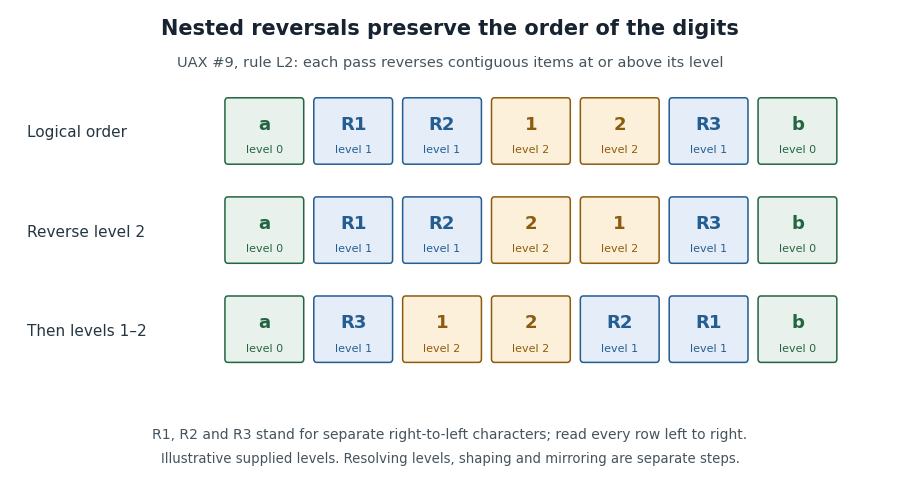
Two level-based reversals preserve the internal order of the digits
. Original illustration with supplied bidirectional embedding levels. The boxes denote individual abstract text characters, not literal multi-character labels. Details.A bidirectional isolate limits directional interaction between inserted text and its surroundings. Markup can express isolation without storing explicit formatting code points.[ref]
CLDR, currently expanded as Common Locale Data & Rules, is the Unicode project supplying structured data and rules for locale-sensitive software. It supports conventions such as date, number and unit formatting. The older name Common Locale Data Repository identifies the same project.[ref]
Unicode CLDR project overview by the Unicode Consortium. What is CLDR: project name, scope and components
A locale identifies the language-related and regional conventions relevant to a software operation. Representing a character and choosing how to format a date are different tasks: Unicode character properties alone do not specify every cultural convention. CLDR combines curated data with a specification of structures and algorithms, plus code for collecting and processing those data.[ref]
Unicode CLDR project overview by the Unicode Consortium. What is CLDR: curated data, UTS35 specification and collection/processing code
An original ambiguity example uses the string
03/04/2026. Under a day/month/year pattern it represents3April; under a month/day/year pattern it represents4March. The identical stored code points permit both readings until a format convention is specified. The example illustrates missing contextual information; it is not a quotation of the default format for a particular named locale.Now imagine a program that stores a date as separate year, month and day values and formats it only for presentation. Keeping the represented value distinct from its localized string allows two users to see different forms of the same date. Parsing a user-facing string in turn requires the intended conventions, rather than assuming that visible punctuation supplies them unambiguously.
Applications often consume CLDR through libraries such as International Components for Unicode. Recording the relevant data version and formatting options makes an output example reproducible: a library name alone does not specify every rule or data revision used.[ref]
Unicode CLDR project overview by the Unicode Consortium. How to Use and Who uses CLDR: data supplied through internationalization libraries
A typesetting glue order assigns a priority to stretch or shrink in TeX. The orders are normal finite flexibility,
fil, fill and filll, in increasing priority. With nonnegative coefficients, the highest present order absorbs the adjustment; lower-order flexibility is left unused.[ref]TeX source code by Donald E. Knuth. glue_spec fields and hpack/vpack: highest nonzero order for glue setting
For example, suppose a line has natural width 22 and must reach width 34. Two zero-width glue items have stretch coefficients
1fil and 2fil. Their added widths areA finite-order glue item in the same line keeps its nominal width during this adjustment. The symbols define priorities for distributing a finite width difference. Within the selected order, the coefficients still determine proportional sharing.The simple finite model in typesetting glue uses only the normal order. Higher orders make it possible to place flexible space at selected locations, such as before or after a line's content, without requiring the ordinary word spacing to absorb that particular adjustment.
A current transformer is a transformer used to reproduce a scaled version of an alternating primary electric current in a secondary measurement circuit. Many secondary turns around a primary with few turns make large primary electric currents measurable by an instrument. The DOE handbook describes this instrument arrangement and its magnetic operating conditions.[ref]
DOE Fundamentals Handbook Electrical Science. Volume 4, Module 13, Transformer Types, printed p.19, Instrument Current Transformer
For ideal magnitudes, primary and secondary turns giveThe polarity depends on the chosen terminal directions. The current-transformer burden is the connected secondary load, including the instrument and connection impedance. With a resistive secondary load , and its dissipated power is .
For an original example, take , , primary current RMS, and total secondary electrical resistance . The ideal secondary delivers , develops and supplies to this resistive burden. The reflected primary electrical resistance isThe primary is measured through magnetic coupling, while the secondary still needs a suitable connected circuit.
Real behavior includes current-transformer ratio error and current-transformer phase displacement. To see why the second matters, let the inferred current magnitude have fractional error and an extra lag relative to the true current. For a sinusoidal load with lag , the estimated-to-true active power ratio isWith , and radians, the first-order error is about . Correct amplitude scaling alone does not establish correct power measurement.
Opening an energized conventional current-transformer secondary removes its normal balancing current and can produce a large induced electric potential difference. The DOE handbook specifically explains this open-secondary behavior and its requirement for a closed secondary circuit when the instrument is absent.[ref]
DOE Fundamentals Handbook Electrical Science. Volume 4, Module 13, printed p.19, open-secondary explanation
A proposed measurement check therefore uses the intended connected burden and compares ratio and phase at relevant frequencies and current levels. Core response and saturation limit the ideal scaling model; a conventional inductive current transformer does not measure a steady DC component by the same transformer action.Cytotoxicity is the capacity of an exposure or agent to damage or kill biological cells. Its measurement depends on the cell type, exposure conditions, observation time and endpoint. A test of cell viability, membrane damage or metabolic activity records a particular response; it does not by itself identify every mechanism of injury or establish overall biocompatibility.
A motivating experiment is T. Mosmann's 1983 tetrazolium salt colorimetric assay. Living mammalian cells produced a measurable signal read with a multiwell scanning spectrophotometer. The primary paper explicitly notes that the signal depends on cellular activation, permitting studies of survival, proliferation and activation.[ref]
Rapid colorimetric assay for cellular growth and survival: application to proliferation and cytotoxicity assays by T. Mosmann. Abstract, living-cell signal, activation dependence and multiwell readout
For an original blank-corrected comparison, suppose the treated culture gives absorbance , the matched control and the reagent blank . The relative assay signal isCalling this a relative signal states exactly what was calculated. It does not establish that half the cells died. In a linear response model , either halving viable-cell number at fixed per-cell response , or halving with no change in , produces the same result.
A useful experiment therefore compares complementary endpoints and controls for the exposure vehicle, reagent background and direct optical interference. A material-only blank can reveal color or light scattering from the tested substance itself. Independent cell counts or a membrane-integrity measurement address different ambiguities from repeated readings of the same optical signal. Reduced proliferation and cell death should be distinguished when interpreting an apparent cytotoxic response.
A model of computation specifies how inputs are represented, which states and operations are available, how execution proceeds and what counts as its output and resource cost. Examples include Turing machines, random-access machines, Boolean circuits and the lambda calculus. A mathematical algorithmic claim is interpreted within such a model, even when the model is left implicit.
For example, adding two integers is one instruction in a unit-cost machine model. In a bit-cost model, operating on arbitrarily long integers requires time depending on their encoded lengths. A bound counting arithmetic operations therefore need not be a bound on bit complexity. Likewise, a circuit family can supply separate hardware for each input length, while a uniformity requirement asks one algorithm to generate those circuits. Stating the model makes efficiency comparisons meaningful and separates questions of computability from the cost of a chosen representation.
Automata theory studies abstract machines, the formal languages they recognize and transformations between machine descriptions. The machine's permitted memory and transition rules determine its power. A finite-state automaton stores only one of finitely many states; a pushdown automaton additionally has a stack, while a Turing machine has unbounded working storage.
For example, a two-state finite-state automaton recognizes binary strings containing an even number of ones: reading1 switches state, reading0 preserves it, and the initial state is accepting. In contrast, recognizing all strings requires remembering an unbounded count, which a finite-state automaton cannot do. A pushdown automaton can push once per and pop once per . These comparisons separate language recognition from implementation details and motivate closure properties, minimization and decidability questions.
Glyph positioning assigns locations to the glyphs selected during text shaping. It specifies how each glyph is placed and how the logical pen position progresses through the text. A text baseline supplies a common reference for placing the shapes. An OpenType GPOS table can adjust horizontal and vertical placement, glyph advances and attachment between selected glyphs.[ref]
Glyph Positioning Table by Microsoft. Overview, ValueRecords and positioning/attachment lookup types
A simple coordinate model separates the two effects. Let be the pen position, a placement offset and the glyph advance. Draw glyph with its origin atthen update the logical position byChanging moves the current shape; changing moves the starting position of subsequent shapes.
For example, a combining character can select an accent glyph that must be positioned above an earlier base glyph. The accent's placement and its glyph advance answer different questions. Kerning similarly changes spacing according to context, while glyph substitution changes which forms are selected. These choices precede the rasterization of the placed outlines into pixels.
A grapheme cluster is a sequence of Unicode code points treated as a unit by a text-segmentation rule. Default extended grapheme clusters approximate user-perceived characters, supporting operations such as moving a text cursor or deleting a visible unit. They are not a universal linguistic definition of a text character; boundaries can require language-specific tailoring.[ref]
Unicode Text Segmentation by the Unicode Consortium. Sections1,3 and3.1.1: purpose, extended clusters and default boundary rules
For example,
e followed by the combining character U+0301 COMBINING ACUTE ACCENT contains two code points, but forms one default extended grapheme cluster. Its UTF-8 representation has three bytes: 65 CC 81 in hexadecimal notation. The precomposed U+00E9 also forms one grapheme cluster, with two UTF-8 bytes, C3 A9. The two representations correspond under the canonical rules of Unicode normalization.[ref]Unicode Normalization Forms by the Unicode Consortium. Sections1.1–1.3: canonical equivalence, decomposition and composition
A glyph count answers another question: text shaping can represent the two text characters
f and i by one typographic ligature even though their default grapheme cluster boundary remains. Byte offsets, code point offsets, grapheme cluster boundaries and glyph indices therefore serve different purposes.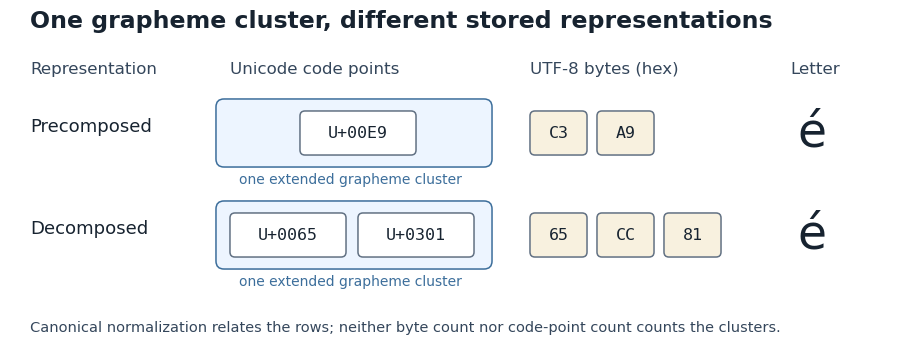
A combining character is an encoded text character intended to combine with another character in its written presentation. A familiar case is
U+0301 COMBINING ACUTE ACCENT: the sequence e followed by that code point represents an accented letter without requiring a separate precomposed code point for the whole letter.[ref]Characters and Combining Marks by the Unicode Consortium. Which character should I use for a given diacritical mark?
The same acute-accent code point can mark a distinct letter, stress or tone in different languages. Those functions do not require a different encoding of the accent in every language. Text shaping determines how the selected glyph is attached to the base shape, and glyph positioning can place additional marks relative to earlier marks.
A combining sequence and a grapheme cluster are related but distinct notions. The default segmentation rules determine which code points an editor treats as one unit. Unicode normalization addresses equivalence between encodings, such as a precomposed accented letter and a base-plus-accent sequence; it does not perform the geometric placement of their glyphs.
A TeX macro associates a TeX control sequence with a replacement list of TeX tokens, possibly containing parameters. During TeX expansion, arguments are substituted into that list. Character tokens retain their TeX category codes, so this mechanism has more structure than unrestricted replacement of raw text strings.[ref]
TeX by Topic by Victor Eijkhout. §§11.2,11.5 and12.1: definitions, parameters and token-stream expansion
For a simple example,
\def\dup#1{#1+#1} defines a macro with one parameter. In mathematics, $\dup{x}$ yields the token sequence for . With $\dup{u+v}$, the expansion gives . The replacement duplicates the supplied tokens; it does not evaluate or simplify the mathematical expression.This makes TeX macros useful for reusable notation. A document can express an intention through one command and change the associated presentation centrally. The actual printed result still depends on subsequent execution, computer fonts and mathematical typesetting.
A TeX format is a prepared collection of definitions and initialization state used with TeX. A TeX format file, conventionally ending in
.fmt, stores internal structures so they can be loaded efficiently instead of reconstructed from the original initialization input.[ref]Plain TeX supplies one such foundation; LaTeX supplies another, with document-level conventions and facilities. The same mathematical input
$x^2$ can be embedded in either system, but an authoring command defined by one format need not be available in the other.Keeping the layers separate helps diagnose a failed document. The TeX implementation provides TeX primitives; the format makes further TeX macros and defaults available; a document invokes those definitions. Loading a different format can change the meaning or availability of commands without changing their spelling in the input file.
A TeX primitive is an operation supplied by TeX itself, such as defining a TeX macro, changing a register or constructing a typesetting box. A TeX control sequence can name a primitive or a macro. The distinction concerns the current meaning of the command, rather than the appearance of its name.[ref]
For example,
\hbox constructs a horizontal typesetting box. The assignment \let\mkbox=\hbox gives another name to its current meaning. Defining a macro with \def\label{sample} creates a replacement list instead. Some primitives participate in TeX expansion, while others perform operations during later processing; primitive does not mean unexpandable. This distinction helps explain why a command can appear in an expansion trace without immediately drawing a glyph.A TeX token is an internal syntactic unit used by TeX. Ordinary character tokens pair a TeX character code with a TeX category code; TeX control sequence tokens identify commands. Macro processing also uses TeX parameter tokens.[ref]
For example, an
a read with category 11 and an a read with category 12 are different character tokens, even though both can select the same printed glyph in ordinary text. Changing a category assignment later does not retokenize a previously stored TeX macro replacement list. A stored control-sequence token can, however, acquire a different current meaning through redefinition.The TeX input processor performs the relevant lexical analysis. The later TeX expansion stage operates on the resulting tokens. This separation explains why changing the spelling of input and changing the meaning of an existing command are different operations.
TeX expansion replaces expandable TeX tokens with other tokens according to their current meanings and the scanning context. TeX macros provide replacement lists; some TeX primitives also expand. Subsequent processing can execute commands or build typesetting boxes.[ref]
For example,
\def\firstdemo{AB}\def\seconddemo{\firstdemo} establishes two macros. Expanding \seconddemo first produces the token for \firstdemo; expanding that yields the character tokens A and B. The intermediate result is a token stream. The printed shapes are determined later by computer fonts and layout.Meaning can change between definition and use. With
\def\value{A}\def\callvalue{\value}, redefining \value to expand to B changes the later expansion of \callvalue to B. The stored TeX control sequence still identifies the same name, while its current definition supplies the replacement. This makes the distinction between token identity and current meaning practically useful. Pinned article: Introduction to the OurBigBook Project
Welcome to the OurBigBook Project! Our goal is to create the perfect publishing platform for STEM subjects, and get university-level students to write the best free STEM tutorials ever.
Everyone is welcome to create an account and play with the site: ourbigbook.com/go/register. We belive that students themselves can write amazing tutorials, but teachers are welcome too. You can write about anything you want, it doesn't have to be STEM or even educational. Silly test content is very welcome and you won't be penalized in any way. Just keep it legal!
Intro to OurBigBook
. Source. We have two killer features:
- topics: topics group articles by different users with the same title, e.g. here is the topic for the "Fundamental Theorem of Calculus" ourbigbook.com/go/topic/fundamental-theorem-of-calculusArticles of different users are sorted by upvote within each article page. This feature is a bit like:
- a Wikipedia where each user can have their own version of each article
- a Q&A website like Stack Overflow, where multiple people can give their views on a given topic, and the best ones are sorted by upvote. Except you don't need to wait for someone to ask first, and any topic goes, no matter how narrow or broad
This feature makes it possible for readers to find better explanations of any topic created by other writers. And it allows writers to create an explanation in a place that readers might actually find it.
Figure 1. Screenshot of the "Derivative" topic page. View it live at: ourbigbook.com/go/topic/derivativeVideo 2. OurBigBook Web topics demo. Source. - local editing: you can store all your personal knowledge base content locally in a plaintext markup format that can be edited locally and published either:This way you can be sure that even if OurBigBook.com were to go down one day (which we have no plans to do as it is quite cheap to host!), your content will still be perfectly readable as a static site.
- to OurBigBook.com to get awesome multi-user features like topics and likes
- as HTML files to a static website, which you can host yourself for free on many external providers like GitHub Pages, and remain in full control

Figure 2. You can publish local OurBigBook lightweight markup files to either OurBigBook.com or as a static website.
Figure 3. Visual Studio Code extension installation.
Figure 5. . You can also edit articles on the Web editor without installing anything locally. Video 3. Edit locally and publish demo. Source. This shows editing OurBigBook Markup and publishing it using the Visual Studio Code extension. 
- Infinitely deep tables of contents:




All our software is open source and hosted at: github.com/ourbigbook/ourbigbook
Further documentation can be found at: docs.ourbigbook.com
Feel free to reach our to us for any help or suggestions: docs.ourbigbook.com/#contact