Topics (384k) Articles (398k) Users (410) Discussions (242) Comments (383) Files (13k) New article

Deserialization reconstructs values from a representation produced according to a format such as JSON. The decoder's mapping determines the resulting runtime data types. In Python,
json.loads maps a JSON object to a dictionary, an array to a list, false to False and null to None by default.[ref]For an original example,
json.loads('{"enabled":false,"items":[null,0,"0"]}') produces {'enabled': False, 'items': [None, 0, '0']}. The last two items differ: the integer zero and a string containing a digit are not interchangeable. The decoder reconstructs nested values rather than returning the displayed source text.Syntax and application meaning require separate checks. The malformed JSON
{"items":[1,2,]} raises JSONDecodeError. By contrast, {"items":"many"} parses successfully but fails a program's requirement that items be a list. That second check is data validation, beyond recognizing the format's syntax.[ref]Nor does successful deserialization guarantee recovery of every original property. A Python tuple encoded as a JSON array normally returns as a list. A round-trip claim must specify whether it preserves values, runtime types or object identity. Character encoding and parsing contribute to the reconstruction, while the selected mapping determines which distinctions survive.
Data format interoperability means that independent producers and consumers can exchange data with an agreed interpretation. Sharing a syntax is one part of that agreement; character encoding, supported values and handling of ambiguous inputs also matter. Serialization and deserialization must preserve the distinctions the application needs.[ref]
The JavaScript Object Notation (JSON) Data Interchange Format. RFC8259, §1.3 interoperability motivation; §§4,6 and8.1
Consider the original JSON input
{"mode":"fast","mode":"safe"}. RFC8259 says object member names should be unique and warns that duplicate-name handling differs. In Python, the default json.loads result is {'mode': 'safe'}. The same decoder with object_pairs_hook=list instead returns [('mode', 'fast'), ('mode', 'safe')], preserving both pairs.[ref]The JavaScript Object Notation (JSON) Data Interchange Format. §4: object names and duplicate-name interoperability
[ref]The text has not changed, yet one consumer retains one value and another retains both occurrences. Re-encoding the default dictionary cannot recover the discarded occurrence. A consumer can instead use a hook that rejects a repeated name, making the ambiguity explicit before the application acts on it.
An exchange contract can therefore require unique names and a shared duplicate-rejection policy, as well as a character encoding such as UTF-8. That is a stronger agreement than merely saying that both programs support JSON. Data validation then checks application-level requirements on the agreed decoded representation.
An accelerometer measures proper acceleration, the acceleration associated with nongravitational support and applied forces on its sensing mass. A common design suspends a proof mass on springs inside a housing. Housing motion displaces the mass relative to the support; a capacitive accelerometer reads the resulting change in capacitance. At frequencies well below mechanical resonance, Hooke's law and Newton's second law give displacement magnitude , with spring constant .[ref]
Low-g Accelerometers by Murata Manufacturing. Low-g Accelerometer, spring/proof-mass structure and capacitive readout
A simple calibration rotates a stationary sensor so one axis points up, sideways and down. Near Earth's surface, the axis reading changes approximately from through zero to , where . A supported stationary device therefore has a nonzero reading even though its position is constant; in ideal free fall, the mass and housing fall together and the reading approaches zero. This experimentally separates the measured support acceleration from coordinate acceleration.[ref]
Motion sensors in the Android Developers documentation. Use the accelerometer, stationary-table and free-fall readings
For a horizontal ideal sensor with and , an acceleration of gives a displacement magnitude of . The readout converts a tiny mechanical displacement into an electrical signal; its scale, bias and frequency response must be calibrated.
A tachometer measures rotational speed, commonly displayed in revolutions per minute. A non-contact optical tachometer illuminates a reflective mark on a shaft or rotor and detects its passage as a pulse. HIOKI's fan-speed experiment uses reflective tape and counts reflected-light pulses.[ref]
If the readout detects pulses per revolution and counts pulses during a gate of duration , its average speed estimate isHere is the angular velocity magnitude in radians per second. For an original example, , and give revolutions per minute. Mistakenly configuring one pulse per revolution would double the displayed value without changing the rotor.
The counting step corresponds to revolutions per minute per pulse: in this example. Increasing gate time improves that counting resolution but averages over a longer interval, potentially hiding speed changes. At low speeds, measuring the time between successive marks can be more useful than waiting for many counts. A rotary encoder provides a related pulse-based measurement and can also encode angular position or direction.
Missed marks, extra reflections and an incorrect pulses-per-revolution setting are distinct from uncertainty in the timing clock. A single repeated mark normally measures speed magnitude; it does not establish the direction of rotation. A convincing check specifies the mark pattern, counts per revolution and timing convention rather than treating every electrical pulse as a complete turn.
A temperature sensor is a sensor whose physical response is used to estimate temperature. A resistance thermometer and a thermistor use changes in electrical resistance; a thermocouple uses the Seebeck effect. The sensor element, its thermal contact and its electrical readout together determine what a temperature measurement means.[ref]
DOE Fundamentals Handbook Instrumentation and Control Volume 1 of 2. Module 1, printed pp. 1–7, resistance detectors and thermocouples
A contact sensor first responds to its own temperature, which need not immediately equal that of the object or fluid. A useful original lumped thermal model writes the first law of thermodynamics for a sensor with heat capacity , thermal conductance to an environment at , and internal heating power :For constant inputs, its thermal time constant and equilibrium are and . The temperature sensor response time and the bias from heating are different properties. Better thermal coupling both shortens and reduces in this model.
Take stipulated values and . Then . With and an environment step from to ,At the sensor reads about , despite a perfect electrical readout. Reaching of the step takes . A steady heating input would instead add at equilibrium. These are model calculations, not universal sensor specifications.
A proposed two-bath step test of a temperature sensor transfers a small probe between two well-stirred baths with independently established temperatures and records its readout against time. Repeating with a protective sleeve tests the thermal part of the measurement chain. The DOE handbook illustrates insulated sensor elements inside metal sheaths and protective wells; electrical accuracy alone does not describe that complete assembly.[ref]
Thermal loading by a contact temperature sensor is another limit: a probe exchanges heat with the object and can perturb the quantity it is meant to measure. A small object may require a coupled thermal model rather than a fixed . For a resistance thermometer, the excitation also causes Joule heating; checking several currents can distinguish that effect from a fixed readout offset.[ref]
Guide on Secondary Thermometry: Industrial Platinum Resistance Thermometers by Jonathan Pearce and others. §4.1, self-heating and excitation-current dependence
Lead telluride is the compound semiconductor , important in thermoelectric materials and infrared devices. Its electronic band structure and transport properties can be modified through composition and doping, while heat is carried by both charge carriers and lattice vibrations.
Thermoelectric performance is summarized by , combining the Seebeck coefficient , electrical conductivity and thermal conductivity . These quantities cannot generally be tuned independently. Experiments on doped lead telluride-selenide alloys demonstrated improved performance by bringing multiple electronic valleys into closer energetic alignment, connecting band structure with measured transport.[ref]
Convergence of electronic bands for high performance bulk thermoelectrics by Yanzhong Pei and others. Abstract, band convergence and thermoelectric transport in PbTe-Se alloys
SIL International is a language-focused organization whose name appears as the publisher of linguistic reference materials and software documentation. Its glossary distinguishes concepts such as grammatical tense, which locates a situation relative to a reference time, and grammatical aspect, which describes its temporal presentation.[ref][ref]
Aspect in the SIL Glossary of Linguistic Terms. Definition and progressive example
Its language-technology work includes FieldWorks Language Explorer, software for organizing lexical entries, analyzing texts and describing grammar. An investigator can connect an observed word form with an analysis into morphemes, then compare that analysis across further recorded examples. Such tools make a proposed linguistic morphology inspectable; the stored analysis still needs evidence from language use.[ref]
FieldWorks Language Explorer documentation. Analyze Texts and Describe Grammar; official project description
A robot arm is an articulated mechanism whose joints move an end effector, such as a gripper or tool, relative to a base. Forward kinematics maps joint coordinates to the tool's position and orientation; inverse kinematics asks which joint coordinates realize a desired tool configuration. The mechanism's degrees of freedom and joint limits constrain which configurations are reachable.[ref]
Modern Robotics: Mechanics, Planning, and Control by Kevin M. Lynch and Frank C. Park. Chapter 4; author video supplement §4.1.1, open-chain forward kinematics
For a planar arm with two rotating joints and link lengths , let measure the first link's angle from the horizontal and the second link's angle relative to the first. Its tip satisfiesWith both lengths , angles put the tip at . Angles reach the same position with a different arm shape and tool orientation. The example explains why inverse kinematics can have multiple solutions and why specifying position alone differs from specifying a full configuration.
In a physical experiment, joint encoders report angles while an external camera measures the tip. Comparing measured and predicted positions tests the geometric model; load-dependent deviations reveal flexibility or calibration errors that ideal kinematics omits. Feedback control then uses measured deviations to adjust the actuators.
Forward kinematics computes an end effector's configuration from a mechanism's joint coordinates and geometric model. For a serial robot arm, each joint contributes a relative displacement or rotation, and composing these transformations gives the tool's position and orientation relative to the base. This is a geometric calculation; the forces needed to realize the motion belong to dynamics.[ref]
Modern Robotics: Mechanics, Planning, and Control by Kevin M. Lynch and Frank C. Park. Chapter 4, author supplement §4.1.1, base and end-effector frames
For a two-link planar arm, with relative joint angles and lengths ,For , and , the tool is at and points at angle . Using alone for the second link's absolute angle would give the wrong result. Comparing this predicted position with an external measurement tests the link lengths, zero-angle calibration and rigid-link approximation.
Inverse kinematics finds joint coordinates that place an end effector at a requested position or configuration. It reverses the mapping specified by forward kinematics, but need not have a unique solution: a target can be unreachable, attainable through several configurations, or attainable through a continuous family when the mechanism has redundant degrees of freedom.[ref]
Modern Robotics: Mechanics, Planning, and Control by Kevin M. Lynch and Frank C. Park. Chapter 6, inverse kinematics; author supplement, analytical versus numerical solutions
For a two-link planar robot arm, the law of cosines givesWith unit link lengths and target , . Two position solutions are and . They have different arm shapes and tool orientations. A target at is unreachable because it lies beyond the total link length of two. Joint limits, obstacles and a specified tool orientation can exclude solutions even when the position is geometrically reachable.
A robot is a programmed, actuated mechanism that performs physical tasks such as locomotion, manipulation or positioning with some degree of autonomy. Its control system belongs to the robot, alongside the mechanism. The IFR’s primary classification document reproduces this broad ISO definition and distinguishes it from the narrower definition of an industrial manipulator.[ref]
World Robotics 2025 Industrial Robots: Sources and methods by the International Federation of Robotics. Section 1.7.1, printed p. 28, ISO 8373:2021 definitions
A practical robot combines a physical mechanism, actuators, task instructions and, where required by the task, sensing and feedback control. An arm’s joint arrangement constrains the positions it can reach; a mobile mechanism must also sustain contact and balance. The degree of autonomy is a task-specific property rather than a guarantee of unrestricted reasoning or competence.
An original two-link planar arm illustrates the relationship between structure and task. For unit link lengths and joint angles , measured with the second angle relative to the first link, forward kinematics givesAt and , the endpoint is ; with both angles zero it is . Inverse kinematics asks which joint values achieve a requested endpoint, while control must make the actual mechanism follow the intended motion.[ref]
Reaching a geometric target is only one part of an experiment. Position error, repeatability, applied force, execution time and behavior after a disturbance measure different aspects of performance. An arm can have an accurate kinematic model yet deviate under load; a controller can compensate only within its sensing, actuation and timing limits.
The MIT Cheetah robot provides a contrasting locomotion example: perception, contact planning and force generation are coordinated while the mechanism is moving. Such examples connect the physical meaning of a robot with mechanics, geometry, computation and experimental verification of a defined task.
A gait is a pattern of coordinated limb motion and contact used in locomotion. In a periodic gait, the order of foot contacts, their relative timing and the duration of each contact characterize a cycle. A quadrupedal robot can change gait without changing the number of legs or their basic mechanical arrangement.
For a repeated foot motion with period , the stance phase is the interval during which that foot contacts the ground; the swing phase moves it between contacts. If stance lasts , its contact duty cycle is . Relative phase specifies how one leg's cycle is shifted from another's. Equal duty cycles do not determine a unique gait because those phase shifts can differ.
For an original four-leg schedule, take front-left, front-right, hind-left and hind-right phases with . Apart from transition instants, three feet contact the floor. A second constructed schedule takes phases and : diagonal pairs contact together and alternate every half-cycle, illustrating a trot. The first schedule has total contact-time sum per cycle; the second has . Summing leg contact times does not mean a stride itself lasts three or two periods.
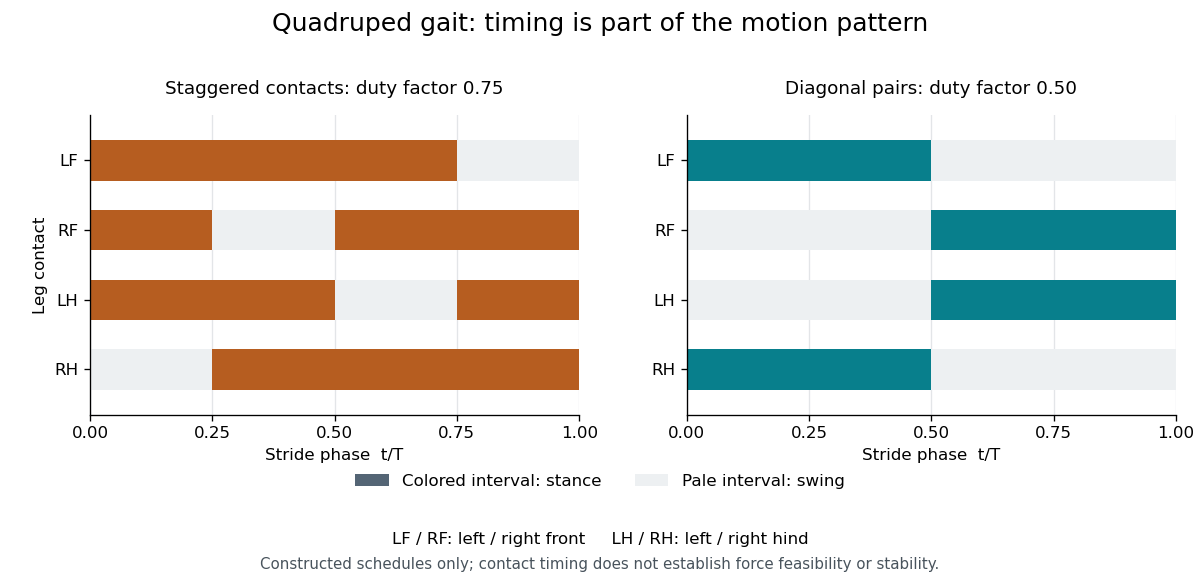
A real dynamic apparatus illustrates why timing must connect to forces. The 2015 MIT Cheetah demonstration adjusted approach strides and motor forces to execute a running jump; its account describes bounding as successive small jumps.[ref]
MIT cheetah robot lands the running jump by Jennifer Chu. See, run, jump: stride adjustment, force planning and bounding description
The numerical schedules above are not measurements from that experiment.A support polygon is useful for a stipulated static contact model, but a contact schedule alone does not establish static or dynamic feasibility. Friction, joint motion, actuator capability and angular momentum can matter. Measuring foot-contact times alongside body motion and ground reactions tests whether a planned gait is actually realized. Nonperiodic transitions, starts and obstacle maneuvers additionally require more than one fixed repeating cycle.
A roboticist develops or studies robots by combining their mechanical design, sensing, computation and control. The work connects a desired physical task to a machine that can actually perform it. Kinematics describes permitted motion; robot motion planning selects motions subject to constraints; feedback control uses measurements to correct execution. An algorithm and the apparatus it controls must therefore be evaluated together.
For an original planar robot arm example, let two links have lengths and relative joint angles . Its end effector position isWith both lengths and angles , the endpoint is . A small first-joint offset radians changes the position to first order by , an error magnitude about . Accurate commanded numbers do not imply equally accurate physical geometry.
A proposed investigation compares measured endpoint positions with the kinematics model over several configurations, then checks whether the discrepancies follow a joint offset, a link-length error or changing mechanical deflection. Those alternatives suggest different corrections. It also tests execution on the real robot, rather than treating successful numerical planning as sufficient evidence of task completion.
Kris Hauser's author-hosted Robotic Systems by Kris Hauser connects geometric configurations, inverse kinematics, motion selection and contact constraints in one technical account.[ref]
Robotic Systems by Kris Hauser. Chapters 5–6, robot kinematics and inverse kinematics; Chapter 12, contact modeling and equilibrium conditions
Its contact discussion makes another key distinction: deciding when to touch the environment changes the applicable physical constraints. A roboticist may consequently work with mechanisms, algorithms or experiments while still needing a common model of what is sensed, commanded and physically achieved.Robot motion planning computes a robot's proposed motion from its modeled state, environment and task constraints. A geometric planning problem asks for a path through configuration space; a timed motion can additionally constrain velocity, acceleration, forces and actuator effort. Hauser's primary text explicitly distinguishes geometric path planning from the broader problem involving dynamics and execution.[ref]
Robotic Systems by Kris Hauser. Chapter 8, introductory definition, Stating the motion planning problem and Point-to-point path planning
Let be the configurations allowed by joint limits and collision detection. A geometric solution is a continuous curveEach point represents a complete robot configuration. A configuration-space obstacle is a forbidden set of configurations, not necessarily the same shape as the physical obstacle in the workspace.
An original planar example uses a point robot starting at and aiming for , in metres. A circular obstacle centered at with radius blocks the straight path. A two-segment detour through has lengthThe perpendicular distance from the obstacle center to either segment isso the detour clears the circular obstacle. Checking only the start and goal would instead miss the collision on the straight segment.
Now give the robot a circular footprint of radius , with translation as its only degree of freedom. The forbidden center positions form a disk of radius : the obstacle is expanded by the footprint through Minkowski addition. The same detour still passes, but its center-path margin above the expanded obstacle is only about . The geometric reduction depends on the stated footprint and permitted motion.
A path's corner does not supply a dynamically smooth trajectory. Traversing this sharp detour at nonzero constant speed would instantaneously change velocity at its midpoint. A physical controller must stop, smooth the corner or choose a different feasible trajectory, while continuing to respect the obstacle and actuator constraints. A larger path length can be an acceptable cost if it permits the required motion.
A proposed validation compares the continuous planned geometry, sampled collision tests and measured execution on a controlled obstacle course. Report the robot geometry, constraints, computational budget and observed clearance. Failure to find a path in a limited run does not alone prove none exists; success on a numerical path does not alone establish accurate execution. Hauser treats completeness and the distinction between paths and feedback policies separately.[ref]
The menstrual cycle coordinates recurring ovarian and uterine changes through hormonal feedback. Cycle day one is conventionally the first day of menstrual bleeding. The ovarian sequence includes follicular development, ovulation and a luteal phase; the uterine lining undergoes shedding, proliferation and secretory changes in response to the changing signals.[ref]
Biology 2e by Mary Ann Clark and others. Section 43.4, ovarian and uterine cycles and their hormonal coordination
These are linked sequences, not identical names for one anatomical event. Follicular development concerns the ovary, while endometrial proliferation concerns the uterus. Luteinising hormone, ovarian estrogens and progesterone couple the two. A twenty-eight-day schematic is a teaching example rather than a rule that every cycle has that duration or ovulates on day fourteen. Comparing observations requires specifying the event or phase used to align the records.
Viviparity is reproduction in which offspring develop within the maternal body and are delivered alive. It contrasts with oviposition, in which an egg is laid before development is completed. Viviparity describes retention and birth; it does not by itself specify how much nourishment is supplied during development.
Some live-bearing animals rely largely on reserves packaged in the ovum, while others receive substantial additional maternal nutrients. A study of the lizard Mabuya heathi compared egg size, fetal growth and placenta structure and found extensive maternal contribution to the developing offspring.[ref]
Eutherian-like reproductive specializations in a viviparous reptile by Daniel G. Blackburn and others. PNAS 81, pp. 4860–4863; embryonic dry mass and placental nutrient transfer
The comparison illustrates why live birth and the mode of nourishment are separate biological characters, and why a placenta is not exclusive to mammals.Ejaculation moves semen through and out of the urethra. In male reproductive physiology, emission brings sperm and glandular fluids into the urethra, while expulsion uses coordinated muscular contractions to discharge them. Contributions from the autonomic nervous system and somatic nervous system couple secretion and transport with the activity of skeletal muscles.
The coordination involves the spinal cord, rather than being an isolated contraction of one reproductive organ. A rat experiment identified a population of spinal neurons whose loss disrupted ejaculation while leaving other components of mating behavior relatively preserved.[ref]
Identification of a potential ejaculation generator in the spinal cord by William A. Truitt and Lique M. Coolen. Science 297, pp. 1566–1569; selective disruption of ejaculation in rats
The result supports a spinal cord coordinating mechanism in that animal model; it does not by itself establish that every aspect of human ejaculation or sexual experience has the same organization of the nervous system.In psychology, behavior is what an organism does, described through actions or responses in a specified setting. A keypress, a spoken answer and a shift of gaze can all be measured, but they provide different evidence about the processes producing them. An operational definition states what will count as the response in a particular investigation.
For an original example, a learning task might measure how often a participant chooses a rewarded symbol and how long each choice takes. Choice frequency and reaction time are distinct outcomes: two participants can make equally accurate choices while taking different amounts of time. Neither measure alone establishes whether a difference arises from attention, comprehension, motivation or motor demands. The interpretation requires a model and suitable comparison conditions.
This distinction is central to construct validity: recording a response reliably does not by itself show that it measures the intended psychological construct. A report of an emotion is also a response to a question, rather than an unmediated measurement of every component of the emotion.
The mind is the collection of mental processes and capacities involved in perception, attention, human memory, thought, emotion and consciousness. In scientific psychology, these processes are investigated through specified tasks, reports, behavior and measurements of the brain. The mind is not one directly observed score: remembering a location and noticing a flash require different explanations and measurements.
A useful experiment separates available information from the ability to report it. In 1960, George Sperling used briefly displayed arrays of symbols and partial report paradigms. Asking for only part of a display helped test whether a limited whole report reflected unavailable visual information or a limit on retaining and reporting it. Tones could specify which portion to report after the display had ended.[ref]
For an invented sampling example, suppose a display has three rows and a randomly selected row can be reported with an average of three correct symbols. Under equal sampling and accessibility assumptions, multiplying by three estimates nine available symbols across the display. That is an inference from a task, not a direct inspection of a mental store. Its assumptions must be checked, and a cue delivered much later can test how availability changes with time.
The example links perception, sensory memory and reporting while keeping them distinguishable. An operational definition identifies the actual response to be measured; construct validity asks whether the proposed interpretation of that response is justified. The scientific study of the mind becomes more precise when these connections are explicit.
Pinned article: Introduction to the OurBigBook Project
Welcome to the OurBigBook Project! Our goal is to create the perfect publishing platform for STEM subjects, and get university-level students to write the best free STEM tutorials ever.
Everyone is welcome to create an account and play with the site: ourbigbook.com/go/register. We belive that students themselves can write amazing tutorials, but teachers are welcome too. You can write about anything you want, it doesn't have to be STEM or even educational. Silly test content is very welcome and you won't be penalized in any way. Just keep it legal!
Intro to OurBigBook
. Source. We have two killer features:
- topics: topics group articles by different users with the same title, e.g. here is the topic for the "Fundamental Theorem of Calculus" ourbigbook.com/go/topic/fundamental-theorem-of-calculusArticles of different users are sorted by upvote within each article page. This feature is a bit like:
- a Wikipedia where each user can have their own version of each article
- a Q&A website like Stack Overflow, where multiple people can give their views on a given topic, and the best ones are sorted by upvote. Except you don't need to wait for someone to ask first, and any topic goes, no matter how narrow or broad
This feature makes it possible for readers to find better explanations of any topic created by other writers. And it allows writers to create an explanation in a place that readers might actually find it.
Figure 1. Screenshot of the "Derivative" topic page. View it live at: ourbigbook.com/go/topic/derivativeVideo 2. OurBigBook Web topics demo. Source. - local editing: you can store all your personal knowledge base content locally in a plaintext markup format that can be edited locally and published either:This way you can be sure that even if OurBigBook.com were to go down one day (which we have no plans to do as it is quite cheap to host!), your content will still be perfectly readable as a static site.
- to OurBigBook.com to get awesome multi-user features like topics and likes
- as HTML files to a static website, which you can host yourself for free on many external providers like GitHub Pages, and remain in full control

Figure 2. You can publish local OurBigBook lightweight markup files to either OurBigBook.com or as a static website.
Figure 3. Visual Studio Code extension installation.
Figure 5. . You can also edit articles on the Web editor without installing anything locally. Video 3. Edit locally and publish demo. Source. This shows editing OurBigBook Markup and publishing it using the Visual Studio Code extension. 
- Infinitely deep tables of contents:



All our software is open source and hosted at: github.com/ourbigbook/ourbigbook
Further documentation can be found at: docs.ourbigbook.com
Feel free to reach our to us for any help or suggestions: docs.ourbigbook.com/#contact