Topics (384k) Articles (398k) Users (410) Discussions (242) Comments (383) Files (13k) New article

Published in BIT, volume 20, pp. 176–184. Sections 3–4 develop the cycle-finding and factorization algorithms.
Consulted locators: Chapter I, definition and basic properties; sections on the dual abelian variety, rigidity and the theorem of the cube.
Ring theory studies rings, their ideals, modules, and structure-preserving ring homomorphisms. It includes both commutative algebra and noncommutative algebra. Here rings are associative and have an identity unless another convention is specified.
The integers are a commutative example. Matrix rings are generally noncommutative: in , while . Thus techniques that reorder scalar factors do not automatically work for matrices.
Quotient rings organize the information lost by a ring homomorphism. If , the first isomorphism theorem for rings identifies with the image of . Studying ideals describes such quotients, while studying modules describes how a ring acts by additive transformations. The two viewpoints connect arithmetic examples with matrix and operator examples.
Universal algebra studies algebraic structures by specifying their operations and identities in a common language. A signature assigns an arity to each operation symbol. A structure interprets each symbol as a function on its underlying set; an identity requires two terms to agree for every assignment of their variables.
For example, a group can be presented with a binary operation, a unary operation for inversion, and a nullary operation for its identity element. A ring adds multiplication and its distributive identities. These signatures differ, but the same definitions of a structure-preserving homomorphism, a compatible equivalence relation, and a quotient structure apply to both.
This shared framework explains why many proofs recur across algebra: a homomorphism identifies elements in a way compatible with every specified operation. The resulting quotient must preserve all those operations, not only a selected multiplication table. Universal algebra isolates that compatibility before considering special properties of groups, rings or other examples.
4-Methylpentanal is a branched six-carbon aldehyde with molecular formula . Its condensed structure is . The aldehyde carbon is numbered 1, so the branch is a methyl group at carbon 4 of the five-carbon parent chain.[ref]
The name makes a useful atom-counting example. A pentanal parent chain supplies five carbons, and the methyl substituent supplies a sixth. The hydrogen count is , including the hydrogen attached to the aldehyde carbon. Five in the parent-chain name does not mean that the entire molecule contains only five carbons.
4-Methylpentanal also provides a chemically identifiable coproduct of cholesterol side-chain cleavage. The cholesterol side-chain cleavage enzyme makes pregnenolone and 4-Methylpentanal, separating the original 27-carbon skeleton into 21- and six-carbon products.[ref] In an ideal fully coupled reaction, one mole of pregnenolone corresponds to one mole of this aldehyde. Detecting both products can therefore test the proposed material balance more specifically than measuring total steroid-related signal alone.
A wing planform is the two-dimensional outline of an aircraft wing viewed from above. It is bounded by the projected leading edge, trailing edge and wing tips. A rectangular, tapered or swept wing planform can be combined with many different airfoil profiles; the outline alone does not specify the wing's thickness or airfoil camber.[ref]
Let point aft and run along the wingspan. Describe the two edges by and . Their separation is the projected local airfoil chord,The second equation computes wing area. The first retains information lost by that single area value: where the chord lies along the fore-and-aft direction.
For an original comparison, a rectangular wing with and has . A symmetric trapezoidal wing of the same wingspan, root chord and tip chord also has . Now shift both edges of each spanwise strip aft by : the local airfoil chord and wing area stay unchanged, while the wing sweep changes. This explains geometrically why even specifying wingspan, wing area and wing taper ratio does not uniquely determine a wing planform.
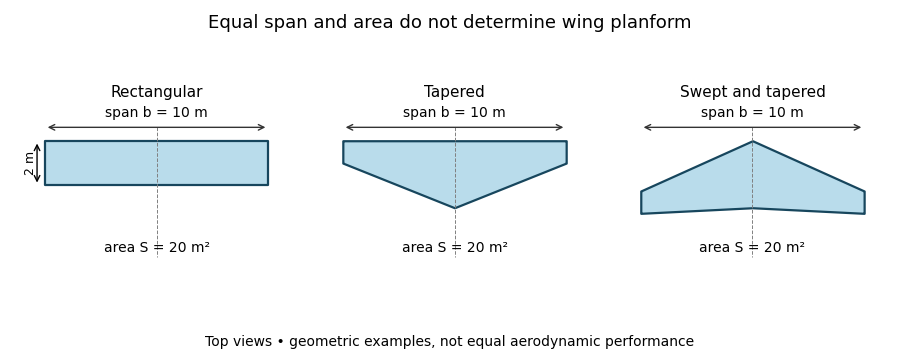
Three wing planforms with equal span and projected area
. Details. The construction compares geometry, not aerodynamic equivalence. The airfoil, angle of attack and three-dimensional fluid flow still matter when predicting lift and drag.
The wingspan of an aircraft wing is its lateral tip-to-tip extent. For a symmetric wing planform, a spanwise coordinate runs from at one tip to at the other; the semispan is . This geometrical distance differs from the local fore-and-aft airfoil chord.[ref]
Wing Geometry by NASA Glenn Research Center. Top View: tip-to-tip span and chord directions
Together with wing area , the wingspan defines the dimensionless wing aspect ratio,For a rectangular wing planform of constant airfoil chord , , giving . For example, a wing with and has . A second wing with the same wing area but has . Equal wing area therefore does not imply equal lateral slenderness.
There is also a simple structural reason why the span matters. Suppose a symmetric wing supplies total upward lift , distributed uniformly along its span. On one half-wing the resultant load is and acts from the center. The corresponding bending moment at the center isFor and this gives . This is an idealized aerodynamic loading calculation: the actual load distribution, structural supports and component masses modify the wing's bending moment. It nevertheless shows why increasing wingspan affects the structure as well as the wing aspect ratio.
The wing aspect ratio is the dimensionless measurewhere is wingspan and is projected wing area. For a rectangular wing planform, and therefore , where is airfoil chord. For other wing planforms, dividing the span by a chosen root chord need not give the wing aspect ratio.[ref]
Its aerodynamic importance comes from lift-induced drag. The wingtip vortices of a finite aircraft wing change the local flow direction; maintaining lift then entails an additional rearward force. A standard model writesHere is a span efficiency factor, is dynamic pressure and is lift coefficient. The model compares a specified spanwise loading in a regime where this finite-wing approximation is appropriate; need not stay unchanged when the design changes.[ref]
Induced Drag Coefficient by NASA Glenn Research Center. Induced Drag Coefficient, aspect ratio and efficiency
For an original example, take , , and . Both wings then supply . Spans of 8 and 12 metres give and , respectively, and lift-induced drag approximately and . Under those stipulated conditions, increasing span by 50% reduces that drag component by , about 55.6%.
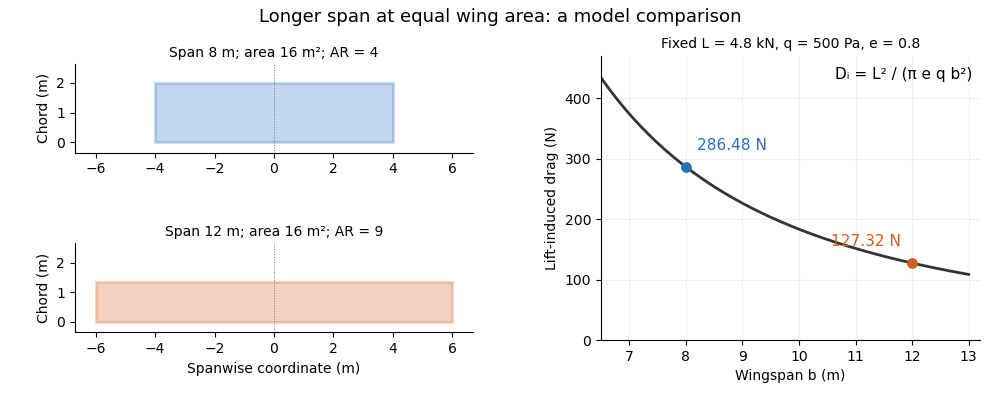
Equal-area wings with different span, and the inverse-square induced-drag comparison at fixed lift, dynamic pressure and span efficiency. Original model calculation.
Details. The boxed expression also exposes a common comparison error. At fixed , , and , changing only the reference wing area changes both wing aspect ratio and lift coefficient; their effects cancel in this model's dimensional lift-induced drag. A larger numerical is therefore not, by itself, a promise of smaller total drag. Structural loads, wing loading, surface losses and aerodynamic stall impose further design constraints.
Wing loading is the gravitational weight of an aircraft divided by its reference wing area:It is a whole-aircraft loading measure. In SI its units are , not . The latter units describe mass per wing area, , and require multiplication by gravitational acceleration to obtain .
For an original unit check, , and give but . Although this has the units of pressure, it is not the local pressure distribution on the wing surface.
In straight level flight with negligible vertical thrust, lift balances gravitational weight.[ref] Combining this with the definition of the whole-wing lift coefficient givesAt fixed air mass density and required coefficient, airspeed therefore scales as the square root of wing loading. For stipulated , and , the result is . Doubling only the loading gives , a factor of .
If a model assumes a maximum attainable , the same equation gives a corresponding minimum speed for that straight-level condition. It is not a universal speed for every attitude or configuration: a turning condition can require , and a changed airfoil, surface condition or Reynolds number can change the attainable coefficient.
A geometric and weighing check determines , the relevant loading state and projected wing area. Those measurements establish ; a separate aerodynamic experiment is needed to establish the applicable lift coefficient. Equal wing loading does not establish equal lift-to-drag ratio or identical aerodynamic stall behavior.
A swept wing has a specified spanwise reference line inclined relative to the direction perpendicular to the aircraft's longitudinal axis. Aft sweep places the outboard part farther rearward; forward sweep places it farther forward. The leading-edge sweep angle and quarter-chord sweep angle can differ, so a sweep value needs a named reference line.[ref]
Applied Computational Aerodynamics by W. H. Mason. Appendix A, pp. A-27–A-29, planform coordinates and sweep relations
A useful geometric construction shifts each spanwise strip of a wing planform fore or aft while retaining its local airfoil chord. If both edges receive the same shift, their separation and hence the integrated wing area remain unchanged. For an original constant-chord example with wingspan and , define . The tip leading edge is aft of the root, while and are unchanged by the strip shift.
Preserving these geometric scalars does not preserve the three-dimensional flow. At high Mach number, the normal Mach number for a swept leading edge helps organize a simplified comparison of the component perpendicular to that edge. Finite-span flow, thickness and interference with the fuselage remain relevant.
The primary 1947 experiment by Richard T. Whitcomb used a different geometric change: it rotated the two wing semispans to obtain zero, forward and backward sweep, then obtained loading and drag information from pressure measurements and wake surveys. The shock-associated changes did not shift by exactly a universal cosine factor.[ref]
Thus an experimental sweep comparison should identify what changed besides the angle: rotation of an existing wing, a stripwise shear of a planform, and a newly designed swept wing need not retain the same projected area or section arrangement.
A winglet is a small wing-tip lifting surface, often inclined upward out of the main wing planform. By changing the three-dimensional loading and flow near the tip, it can reduce lift-induced drag. Its winglet cant angle, shape and attachment must be considered with the entire aircraft wing; it is not a universal bolt-on reduction in total drag.[ref]
A Design Approach and Selected Wind-Tunnel Results at High Subsonic Speeds for Wing-Tip Mounted Winglets by Richard T. Whitcomb. NTRS author abstract, geometry and measured aerodynamic effects
Richard T. Whitcomb's 1976 report compared measured forces, moments and loads on a representative transport wing with and without wing-tip devices. A particularly useful comparison was a tip extension giving approximately the same increase of bending moment at the wing–fuselage junction as the winglets. That comparison asks how much aerodynamic benefit is obtained for a similar structural penalty, rather than comparing only nominal span.[ref]
A Design Approach and Selected Wind-Tunnel Results at High Subsonic Speeds for Wing-Tip Mounted Winglets by Richard T. Whitcomb. Abstract, matched bending-moment increment for tip-extension comparison
An original coefficient budget illustrates why component and total benefits differ. Keep the same reference wing area, dynamic pressure and lift coefficient. Suppose initiallywhere the second term is the lift-induced drag contribution. If a proposed modification reduces that term by but adds to other drag coefficient contributions, thenThe total reduction is about , not . This is an invented budget, not a prediction or a measured winglet efficiency. Increased loading, additional wetted area and an off-design operating point can change the result.
A convincing wind tunnel comparison measures total drag at matched lift, records moments and loading, and documents how the mounting correction and reference area are handled. A photograph of a weaker-looking wingtip vortex is not a measurement of total drag. Conversely, reducing lift-induced drag does not require all three-dimensional trailing vorticity to disappear.
Pinned article: Introduction to the OurBigBook Project
Welcome to the OurBigBook Project! Our goal is to create the perfect publishing platform for STEM subjects, and get university-level students to write the best free STEM tutorials ever.
Everyone is welcome to create an account and play with the site: ourbigbook.com/go/register. We belive that students themselves can write amazing tutorials, but teachers are welcome too. You can write about anything you want, it doesn't have to be STEM or even educational. Silly test content is very welcome and you won't be penalized in any way. Just keep it legal!
Intro to OurBigBook
. Source. We have two killer features:
- topics: topics group articles by different users with the same title, e.g. here is the topic for the "Fundamental Theorem of Calculus" ourbigbook.com/go/topic/fundamental-theorem-of-calculusArticles of different users are sorted by upvote within each article page. This feature is a bit like:
- a Wikipedia where each user can have their own version of each article
- a Q&A website like Stack Overflow, where multiple people can give their views on a given topic, and the best ones are sorted by upvote. Except you don't need to wait for someone to ask first, and any topic goes, no matter how narrow or broad
This feature makes it possible for readers to find better explanations of any topic created by other writers. And it allows writers to create an explanation in a place that readers might actually find it.
Figure 1. Screenshot of the "Derivative" topic page. View it live at: ourbigbook.com/go/topic/derivativeVideo 2. OurBigBook Web topics demo. Source. - local editing: you can store all your personal knowledge base content locally in a plaintext markup format that can be edited locally and published either:This way you can be sure that even if OurBigBook.com were to go down one day (which we have no plans to do as it is quite cheap to host!), your content will still be perfectly readable as a static site.
- to OurBigBook.com to get awesome multi-user features like topics and likes
- as HTML files to a static website, which you can host yourself for free on many external providers like GitHub Pages, and remain in full control

Figure 2. You can publish local OurBigBook lightweight markup files to either OurBigBook.com or as a static website.
Figure 3. Visual Studio Code extension installation.
Figure 5. . You can also edit articles on the Web editor without installing anything locally. Video 3. Edit locally and publish demo. Source. This shows editing OurBigBook Markup and publishing it using the Visual Studio Code extension. 
- Infinitely deep tables of contents:




All our software is open source and hosted at: github.com/ourbigbook/ourbigbook
Further documentation can be found at: docs.ourbigbook.com
Feel free to reach our to us for any help or suggestions: docs.ourbigbook.com/#contact