Topics (384k) Articles (398k) Users (410) Discussions (242) Comments (383) Files (13k) New article

A spectroscopic response factor relates a specified measured signal in spectroscopy to an amount of material under fixed measurement conditions. In the convention is the signal after blank correction, is the amount of substance, and has units of signal per amount. Specify whether the signal is a peak height or an integrated feature, and retain the same acquisition conditions during measurement calibration and unknown-sample measurement. Some literature instead defines a response factor as amount per signal: it is the reciprocal of in this simple model.[ref]
Rigorous evaluation of chemical measurement uncertainty: Liquid chromatographic analysis methods using detector response factor calibration by Blaza Toman and others. Introduction, equations 1–3: calibrated factor RF multiplies the peak-area response to obtain mass fraction
For an original calibration, two standards with amounts and give raw integrated signals 25 and 45 in fixed instrument units. Fitting givesAn unknown with raw signal 35 therefore hasRatios of uncorrected signal to amount would give 2.5 and 2.25 for the standards, falsely suggesting a changing response. Here the cause is an additive background, not a changing .
Two standards fit this illustrative straight line exactly. Additional standards and repeats are needed to test the useful linear range. The inferred amount inherits measurement uncertainty in the signal, background and response factor. Samples calibrated using the same uncertain factor can have correlated inferred amounts; repeating the unknown measurement does not independently average away that shared calibration contribution.[ref]
Rigorous evaluation of chemical measurement uncertainty: Liquid chromatographic analysis methods using detector response factor calibration by Blaza Toman and others. Introduction, discussion after equation 3 and equation 4, positive correlation from a shared response factor
Time-resolved spectroscopy measures how a spectroscopic response changes after a defined excitation or other reference event. Instead of only a time-integrated spectrum, it records a response such as as a function of frequency and delay. A changing spectral feature can distinguish population loss, changing molecular environment and motion of a resonance; a single integrated intensity need not separate them.
In pump-probe spectroscopy, a pump pulse prepares the sample and a delayed probe interrogates it. A movable mirror in a double-pass optical path provides a precise delay change:For an original displacement of 15 micrometres, the delay changes by about 100 femtoseconds. A spectrally resolved detector records the response while delay is scanned. The time resolution is set by pulse overlap, jitter and the detection scheme, rather than by mirror step size alone. Ahmed H. Zewail's lecture explains how such optical timing enabled femtochemistry.[ref]
Femtochemistry: Atomic-Scale Dynamics of the Chemical Bond Using Ultrafast Lasers by Ahmed H. Zewail. Pump–Probe Femtoscopy; discussion of temporal resolution
An original decay example assumes an isolated feature with background already removed and responseIf its intensity at 3 picoseconds is of its intensity at 1 picosecond, then and . This inference assumes the same feature is measured at both delays and that the instrument response is sufficiently short. A shifting line observed through a narrow spectral window can change intensity without following that simple population law.
Finite resolution instead produces a convolution. For a time-invariant instrument response function at a selected spectral channel,For ideal Gaussian pump and probe intensity envelopes, their cross-correlation width is the square root of the sum of their squared widths. Chosen full widths of 80 and 100 femtoseconds therefore give about 128 femtoseconds before other contributions. This original calculation describes pulse-overlap resolution, not an arbitrary material lifetime.
A motivating historical example is Zewail's discussion of the NaI/NaBr experiments reported in 1988. Delay-dependent signals probe evolving molecular motion and final fragments, supplying information absent from a static spectrum. His lecture presents the NaI dynamics in Figure 15.[ref]
Femtochemistry: Atomic-Scale Dynamics of the Chemical Bond Using Ultrafast Lasers by Ahmed H. Zewail. The NaI Discovery, Figure 15
A practical experiment compares pumped and unpumped records, checks delay zero and wavelength calibration, and varies excitation strength to test whether the response remains in the intended regime. Negative-delay data, backgrounds and the measured instrument response function help distinguish sample dynamics from timing and detection artifacts.
An isosbestic point is a wavelength, wavenumber or frequency at which a sample's total absorbance remains unchanged during a specified chemical or physical transformation. It is a property of the observed spectra and transformation, rather than proof of a particular reaction mechanism.[ref]
IUPAC Compendium of Chemical Terminology, fifth edition (Gold Book) by International Union of Pure and Applied Chemistry. isosbestic point, I03310, definition and stoichiometric qualifications
For a simple conversion between two species and , assume additive Beer-Lambert law response, fixed optical path length and constant total concentration . ThenAt a wavelength where ,independent of the conversion fraction. For example, stipulated values , and give constant absorbance .
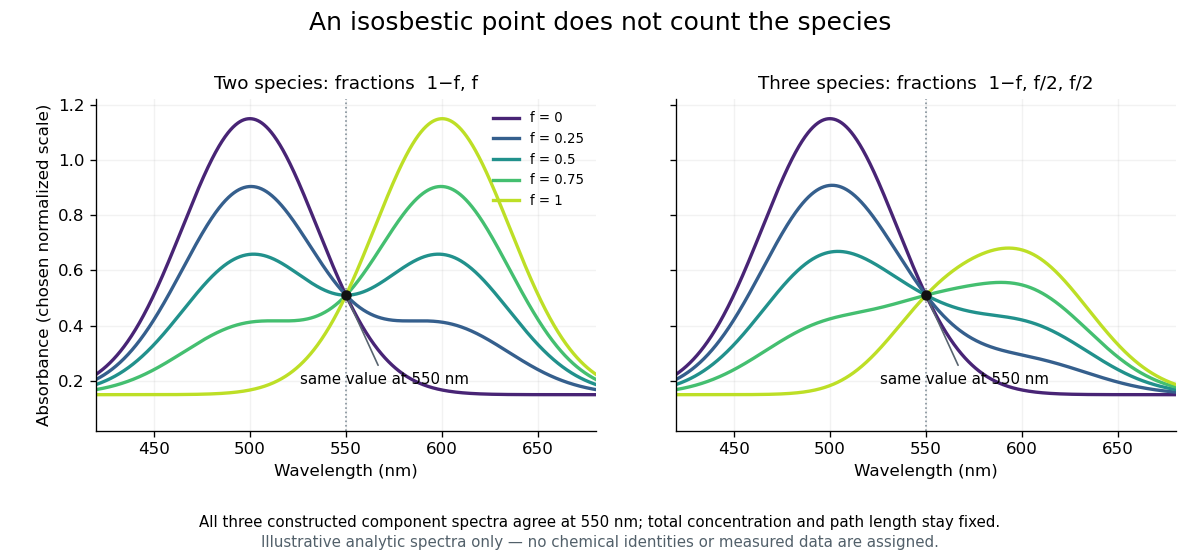
An isosbestic point does not establish that exactly two species exist. Three species could all have the same absorption coefficient at ; every mixture with the same total concentration would then give the same absorbance there. More generally, constant stoichiometric combinations of coefficients can produce an invariant signal. Conversely, dilution, changing path length, background absorption or changing spectra can remove a crossing without demonstrating a new reaction intermediate.
In an experimental test, record multiple full spectra while controlling total concentration, path length and background. Inspect the stability of the common intersection relative to measurement uncertainty, rather than selecting one pair of curves that happens to cross. The invariant wavelength alone cannot determine composition in the two-species model: its response has deliberately lost sensitivity to the conversion fraction. Measurements away from that wavelength carry the separating information, a distinction also useful in co-oximetry.
A software dependency is another component, tool, library or service required for some aspect of a program's construction or operation. Dependencies form a dependency graph; direct requirements can introduce additional transitive requirements. Dependency resolution selects versions satisfying the combined constraints.
For example, if one component requires library versions at least 2 but below 3, while another requires at least 3, no single library version satisfies both in one shared installation. A resolver must report the conflict or use an isolation mechanism that genuinely permits separate versions. Pip documents backtracking through candidate package versions to solve such constraints.[ref]
Dependency Resolution in the pip documentation. How it works and Dealing with dependency conflicts
Recording selected versions improves reproducibility, but the operating system, input data and execution settings can still affect the result.A graphical user interface lets a user inspect and manipulate a program through visual controls such as windows, buttons, menus and text fields. A GUI widget combines a displayed representation with interaction behavior. Input events select a control or action, while application state determines what is drawn next.
For example, pressing a button can initiate a calculation and later display its result. The Event handler should not have to embed every computational detail; separating the underlying model from its view makes other interfaces and tests possible. Qt Widgets provides visual elements, layout management and event handling as separate cooperating mechanisms.[ref]
Qt Widgets documentation. Widgets, Layouts and Model/View Classes
A visible control is therefore an interaction interface, not an authorization boundary or proof that the requested action succeeded.A software event represents an occurrence that a program can observe and handle, such as a key press, timer expiry or completed operation. It may carry data identifying what happened, where and to which object. An event handler performs the relevant response; an event loop commonly dispatches pending events to their destinations.
In Qt, an event object is delivered to a target object whose event method dispatches to a type-specific handler. Mouse, keyboard, resize and timer events carry different information.[ref] A queued event can be handled after the original occurrence, so event time and handling time differ. Reentrant or asynchronous handlers must also account for changes in application state between those moments.
Software internationalization is designing software so it can be adapted to different languages, regions and conventions without redesigning its core logic. Software localization performs a particular adaptation. Preparing the machinery and supplying a translated or region-specific result are related but distinct tasks.[ref]
Localization vs. Internationalization by the World Wide Web Consortium. Internationalization and Localization working definitions
For example, a program displaying a file count can keep the numerical count separate from the message that presents it. The selected software locale and message resources can then determine the full phrase, word order and grammatical form. Building every message by appending a fixed word to a decimal number assumes more about language than the underlying count requires. Similarly, a date represented as separate year, month and day values can be formatted for a chosen audience, whereas the bare string
03/04/2026 leaves the month/day convention ambiguous.[ref]Localization vs. Internationalization by the World Wide Web Consortium. Internationalization items1,3–4: string construction, locale preferences and separated resources
The engineering work includes selecting suitable character encodings, supporting Unicode, accounting for text direction, and separating localizable resources from source code. International Components for Unicode supplies reusable implementations of many text and formatting services. Internationalization still needs application-level decisions: a display format cannot supply a missing unit, infer an unspecified date convention or replace a meaningful data model.[ref]
Localization vs. Internationalization by the World Wide Web Consortium. Internationalization items1–4
International Components for Unicode, commonly abbreviated ICU, is a set of libraries providing Unicode text processing and software internationalization services. Its C/C++ and Java implementations support tasks such as character encoding conversion, Unicode normalization, text-boundary analysis, language-sensitive sorting and formatting. A software locale selects conventions for a language or region; it does not change the abstract numerical value being formatted.[ref]
ICU User Guide by the Unicode Consortium. Introduction to ICU; ICU Services
For a text example, a visually accented letter can be represented by the single code point
U+00E9 or by U+0065 U+0301, a base letter followed by a combining accent. Those sequences differ as raw code-point arrays. A Unicode normalization service can bring these canonically equivalent sequences into the same normalization form before a comparison. This is distinct from translating a word or deciding a language-specific sort order.[ref]Unicode Normalization Forms by the Unicode Consortium. §§1.1–1.3: canonical equivalence and normalization
Such services make a useful division of labor: the application supplies meaning and policy, while a library implements detailed text and formatting rules. Storing text as UTF-8 alone does not implement software internationalization; the program must still handle boundaries, comparisons, numbers, dates and displayed messages appropriately.[ref]
ICU User Guide by the Unicode Consortium. ICU Services; Locales and Resources; Formatting
nauty is software for computing graph automorphisms and canonical graph labeling, originally developed by Brendan McKay. It is distributed with Traces graph isomorphism software and auxiliary graph-generation and manipulation tools.[ref]
nauty and Traces by Brendan McKay and Adolfo Piperno. Summary; Documentation; original and current algorithm references
An automorphism result describes relabelings that preserve adjacency. For an original example, the graph with6vertices and no edges permits every vertex permutation, so its automorphism group is the symmetric group of orderA compact generator description can use a transposition and a cycle . Conjugating the transposition by powers of the cycle produces adjacent transpositions, which generate the whole symmetric group. These are illustrative generators, not a claim about the exact generator list returned by a particular run.
A canonical result serves another purpose. If denotes the chosen canonical graph encoding, correctness requiresRenaming vertices changes the input representation but must not change that chosen result. This permits duplicate elimination when generating graphs and comparison of structures supplied with unrelated labels.
nauty combines structural refinement with a search over unresolved choices, exploiting discovered graph automorphisms to reduce equivalent work. Its theoretical framework and relationship to Traces are described in the authors' joint paper.[ref]
Practical graph isomorphism, II by Brendan D. McKay and Adolfo Piperno. Introduction and individualization/refinement framework
A generating set for symmetries and a canonical encoding are different outputs. The first describes equivalences within a graph; the second makes equivalence between independently labeled graphs directly testable.
Traces is software for computing graph automorphisms and canonical graph labeling, developed by Adolfo Piperno and distributed with nauty. A canonical result permits two graphs to be compared without depending on their input vertex names. Traces uses individualization-refinement graph search, with strategies designed to reduce the explored search space.[ref]
Search Space Contraction in Canonical Labeling of Graphs by Adolfo Piperno. Abstract and introduction, Traces and the search-space design
Refinement groups vertices according to structural information, including their numbers of neighbors in existing vertex classes. When this does not distinguish all vertices, individualization temporarily gives a selected vertex its own class and refinement continues. Discovering equivalent choices and distinguishing branches can avoid repeated work; the validity of the framework and implementation strategies are developed with Brendan McKay.[ref]
Practical graph isomorphism, II by Brendan D. McKay and Adolfo Piperno. Framework and Traces implementation
An original example shows why a coarse invariant is insufficient. A cycle on6vertices and two separate triangles both have6vertices and every vertex has2neighbors. Starting with one vertex class, neighbor-count refinement leaves one class in both cases. Yet the graphs are not isomorphic: one is connected and the other is not. Their correct canonical graph encodings must therefore differ.
Conversely, two differently numbered copies of the same6-cycle should give the same canonical result when processed with the same canonicalization convention. The example illustrates the required behavior, not a benchmark of a particular Traces version.
Performance depends on the graph family and search strategy. The practical success of the program does not by itself establish a polynomial worst-case bound for graph isomorphism. A reproducible comparison should keep the canonicalization settings consistent rather than assume all programs must choose an identical representative.
A biological growth factor is a signaling ligand that modulates cell growth, cell proliferation, cell differentiation or cell survival. Many are proteins recognized by cell-surface receptors. The resulting response depends on which receptors and intracellular pathways the target cell contains.
For example, epidermal growth factor engages the epidermal growth factor receptor, while FGF8 acts through FGF receptors. These interactions can alter gene expression through signal transduction. The ligand and its receptor are separate molecular components, so their distribution jointly determines where a signal can act.[ref]
Molecular Biology of the Cell, 4th edition by Bruce Alberts and others. Chapter 15, Signaling through Enzyme-Linked Cell-Surface Receptors
Signal sampling records a continuous signal at discrete times. Uniform sampling creates shifted frequency spectra separated by the sample rate; avoiding overlap requires suitable bandwidth limits and an anti-aliasing filter. The Nyquist–Shannon sampling theorem describes exact reconstruction for an ideal band-limited signal.
Digital signal processing transforms or analyzes signals represented by numerical sequences. A physical input commonly passes through signal sampling and quantization before an algorithm filters or transforms it. Sampling chooses times; quantization chooses a finite set of representable values. A discrete-time signal is a sequence indexed by integers, whereas a digital implementation also has finite precision.[ref]
What the Nyquist Criterion Means to Your Sampled Data System Design by Walt Kester. MT-002, introductory sampling chain and sampled spectra
An elementary digital filter averages adjacent samples:For a constant sequence it preserves the value. For an alternating sequence it gives zero. If the input noise samples are independent with variance , the output noise variance is , but neighboring output samples are now correlated because they share an input sample. Smoothing changes both the signal and its noise statistics.
Sampling can also erase distinctions before any algorithm runs. At sampling frequency ,These distinct analog frequencies produce the same samples. An anti-aliasing filter limits unwanted input frequencies before conversion; later computation cannot uniquely recover which of these unrestricted inputs produced the sequence.[ref]
What the Nyquist Criterion Means to Your Sampled Data System Design by Walt Kester. MT-002, Nyquist-zone folding and anti-aliasing discussion
Fourier analysis and the discrete Fourier transform help reveal frequency content, while finite-word arithmetic introduces an additional error budget. The sampling rate, numerical representation and intended physical bandwidth are therefore part of the processing design.
Quadrature detection measures a signal against two reference oscillations separated by a quarter cycle. The resulting in-phase and quadrature components retain both amplitude and relative phase; a single component can vanish merely because the signal and reference are out of phase. A two-channel lock-in amplifier is a concrete implementation.[ref]
About Lock-In Amplifiers by Stanford Research Systems. pp.1–2: multiplication, low-pass filtering and two reference phases
For a signal with constant and , choose the normalized references and . Multiplication followed by a low-pass filter that removes terms at givesThus , while the pair specifies phase including its quadrant. For , the in-phase reading is zero but the quadrature reading is : the signal has not disappeared. The sign of depends on the chosen reference convention.
In an actual detector, finite filter bandwidth admits nearby frequencies and noise. Synchronization does not reject an unwanted signal at exactly the same reference frequency. If the reference is detuned, the output components rotate at the difference frequency rather than remaining constant.[ref]
About Lock-In Amplifiers by Stanford Research Systems. pp.1–2: sum/difference frequencies and narrow-band detection
Order tracking follows vibration or other signal components according to their ratio to a reference shaft's rotational frequency. That ratio is the rotational order:where is speed in revolutions per minute and are measured in hertz. A component at three cycles per reference revolution has order 3 even while its ordinary frequency changes. The reference shaft must be specified; changing the reference changes the order value.[ref]
Order Analysis of a Vibration Signal in MATLAB documentation. Introduction, order definition and reference-speed ratios
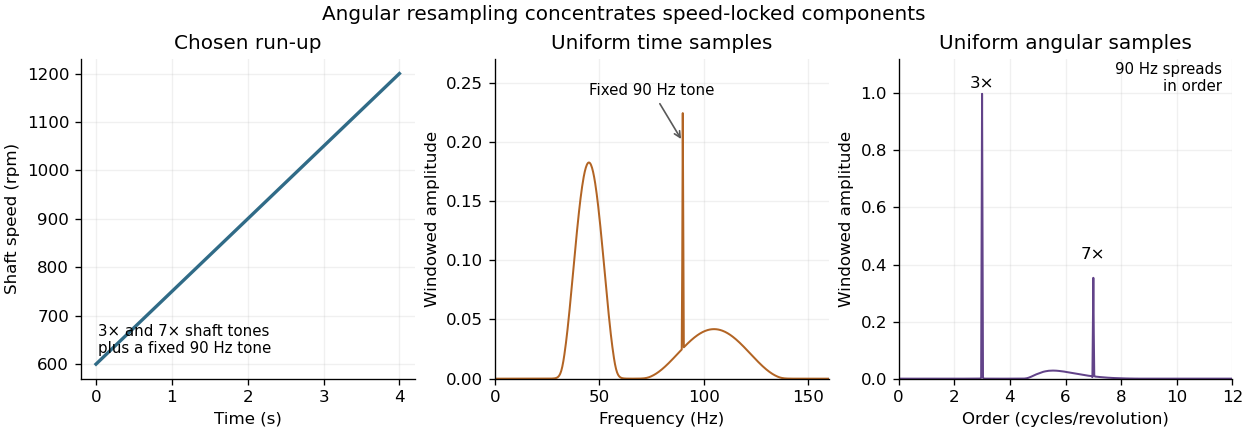
For an original example, a shaft accelerates from 600 to 1200 revolutions per minute. Its third-order component sweeps from 30 to 60 hertz, while its seventh-order component sweeps from 70 to 140 hertz. A Fourier transform over the entire time record spreads those components over frequency. An unrelated fixed 90-hertz tone instead retains its frequency but changes from order 9 to order 4.5.
Angular resampling expresses the record on a uniform shaft-angle grid. A speed-locked component then becomes , with fixed angular periodicity. An order spectrum or order-versus-speed map can separate that structure from a frequency-domain smear. MathWorks demonstrates this distinction with explicitly simulated helicopter-vibration data.[ref]
Order Analysis of a Vibration Signal in MATLAB documentation. Visualize Data Using an RPM-Order Map; example-data introduction
In an apparatus, an accelerometer can record housing motion while a tachometer or rotary encoder records the reference. Tracking an order's amplitude and phase over a run-up can reveal where the machine's response grows, but a large amplitude need not identify the forcing mechanism by itself. Mechanical resonance, load changes and sensor placement can also change the response.
Time-synchronous averaging is related but answers a different question: it estimates a waveform repeatable over the chosen reference period. Order tracking can retain amplitude variation over speed and inspect selected components. Record speed-estimation assumptions, angular resolution and amplitude normalization with either analysis.
Time-synchronous averaging aligns repeated signal segments to a common reference phase and averages corresponding positions. In rotating machinery, a tachometer or rotary encoder provides a shaft reference. Components repeating at that reference phase remain coherent, while unrelated variations can cancel. MathWorks implements the operation using supplied pulse times and allows the averaging interval to span one or several rotations.[ref]
For angle-aligned records , the average over revolutions isIf the noise terms are centered, independent between revolutions and each have variance at that phase, the average's noise variance is . In an original example, noise standard deviation 4 signal units falls to 0.5 after 64 independent aligned records. Shared drift or other inter-record correlations invalidate that reduction rule.
Alignment is essential when speed changes. Equal time intervals after a trigger can represent different shaft angles in different revolutions. Angular resampling supplies a common angle grid before averaging. Errors in the reference phase also matter: a rotational order acquires phase error from a shaft-angle error , making high orders especially sensitive.
Cancellation is not proof that a component was unwanted noise. Consider a half-order component on a continuously increasing shaft angle, . Consecutive one-revolution records satisfyAn even number of such records averages to zero, although the component is perfectly deterministic and repeats every two revolutions. Averaging over a two-revolution reference interval can retain it. The reference period therefore selects what the procedure regards as repeatable.
A useful bench acquisition records vibration and the reference pulses together, checks missing pulses and sensor timing, and compares individual aligned records with their average. Time-synchronous averaging estimates a repeatable waveform; it does not preserve every transient or every component merely because it is mechanically important.
Stochastic resonance is an enhancement of a defined response to a weak signal by adding an appropriate amount of noise to a nonlinear system. The response measure and system matter: increasing noise is not a general method for improving every signal. Thresholds or switching between states can allow noise to reveal a modulation that would otherwise produce little observable output.
A primary optical experiment used a bidirectional ring laser. Bruce McNamara, Kurt Wiesenfeld and Rajarshi Roy periodically modulated the asymmetry between counter-rotating lasing modes and injected noise. They observed an improved signal-to-noise ratio relative to the case without externally injected noise.[ref]
Observation of Stochastic Resonance in a Ring Laser by Bruce McNamara and others. Abstract, modulation apparatus and observed signal-to-noise improvement
An original threshold model illustrates the competing effects without claiming to reproduce that laser. Let a detector report one when , with and independent Gaussian noise samples . If is the standard normal distribution's cumulative distribution function, its crossing probability at signal phase isThe contrast between the most and least favorable phases isIt tends to zero both as and as : without noise the subthreshold signal never crosses; overwhelming noise makes the two phases nearly indistinguishable.
For chosen and , , and give contrasts about , and . Moderate noise improves this particular phase-contrast statistic. These numbers are not laser data and are not themselves an output spectral signal-to-noise ratio.
A discriminating experiment holds the weak drive and response definition fixed while sweeping noise intensity, and includes a no-drive comparison. A larger output fluctuation is not enough: one must test whether the output better tracks the imposed signal. Switching rates, noise correlation and observation bandwidth can determine the useful regime in a dynamical system.
JSON, short for JavaScript Object Notation, is a textual data interchange format used for serialization. Its values are objects, arrays, strings, numbers, Boolean values and
null. Object member names are strings; array elements are ordered. A complete JSON text may represent a single value, including a number or string.[ref]The format's syntax and an implementation's numerical precision are separate. For an original example, consider
{"n":9007199254740993}. A JavaScript call to JSON.parse produces a Number whose decimal value is 9007199254740992; the requested integer has rounded to in the double-precision floating-point format. The same input decoded by Python's default json.loads retains the integer 9007199254740993 exactly.Encoding the digits as
{"n":"9007199254740993"} preserves them as a string in both examples, but changes the represented type. Any later numerical interpretation needs an agreed rule. RFC8259 identifies the integer interval for exact agreement with commonly used numerical implementations; it does not restrict valid JSON numerals to that interval.[ref]The JavaScript Object Notation (JSON) Data Interchange Format. §6: number magnitude, precision and interoperability
Pinned article: Introduction to the OurBigBook Project
Welcome to the OurBigBook Project! Our goal is to create the perfect publishing platform for STEM subjects, and get university-level students to write the best free STEM tutorials ever.
Everyone is welcome to create an account and play with the site: ourbigbook.com/go/register. We belive that students themselves can write amazing tutorials, but teachers are welcome too. You can write about anything you want, it doesn't have to be STEM or even educational. Silly test content is very welcome and you won't be penalized in any way. Just keep it legal!
Intro to OurBigBook
. Source. We have two killer features:
- topics: topics group articles by different users with the same title, e.g. here is the topic for the "Fundamental Theorem of Calculus" ourbigbook.com/go/topic/fundamental-theorem-of-calculusArticles of different users are sorted by upvote within each article page. This feature is a bit like:
- a Wikipedia where each user can have their own version of each article
- a Q&A website like Stack Overflow, where multiple people can give their views on a given topic, and the best ones are sorted by upvote. Except you don't need to wait for someone to ask first, and any topic goes, no matter how narrow or broad
This feature makes it possible for readers to find better explanations of any topic created by other writers. And it allows writers to create an explanation in a place that readers might actually find it.
Figure 1. Screenshot of the "Derivative" topic page. View it live at: ourbigbook.com/go/topic/derivativeVideo 2. OurBigBook Web topics demo. Source. - local editing: you can store all your personal knowledge base content locally in a plaintext markup format that can be edited locally and published either:This way you can be sure that even if OurBigBook.com were to go down one day (which we have no plans to do as it is quite cheap to host!), your content will still be perfectly readable as a static site.
- to OurBigBook.com to get awesome multi-user features like topics and likes
- as HTML files to a static website, which you can host yourself for free on many external providers like GitHub Pages, and remain in full control

Figure 2. You can publish local OurBigBook lightweight markup files to either OurBigBook.com or as a static website.
Figure 3. Visual Studio Code extension installation.
Figure 5. . You can also edit articles on the Web editor without installing anything locally. Video 3. Edit locally and publish demo. Source. This shows editing OurBigBook Markup and publishing it using the Visual Studio Code extension. 
- Infinitely deep tables of contents:




All our software is open source and hosted at: github.com/ourbigbook/ourbigbook
Further documentation can be found at: docs.ourbigbook.com
Feel free to reach our to us for any help or suggestions: docs.ourbigbook.com/#contact