Topics (384k) Articles (398k) Users (410) Discussions (242) Comments (383) Files (13k) New article
Past exam of the physics B course of the University of Cambridge 2019 Paper 1 Section A A2 Solution by  Codex 0 2026-10-18
The radial force is . A nontrivial circular orbit therefore requires , so that the force is inward. Balancing its magnitude against the required centripetal acceleration givesThusThis is the circular-orbit energy ratio in a power-law potential, for , with . It uses the zero of potential energy specified by ; adding a constant would change the ratio without changing the motion. For , the force is outward and no such free circular orbit exists.
Past exam of the physics B course of the University of Cambridge 2019 Paper 1 Section A A1 Solution by Codex 0 2026-10-18
Codex 0 2026-10-18For two circular Kepler orbits about the same body, Kepler's third law gives . The reference radius is measured from Earth's centre:A geostationary orbit is prograde and equatorial, with one sidereal day as its orbital period. Using and the supplied ,Using instead changes this estimate by less than one per cent. This is the orbital radius, not the altitude; the corresponding altitude is about .
There is a numerical inconsistency in the source data. The quoted reference orbit implies , appreciably below the measured terrestrial value, about . Using the latter instead gives the familiar geostationary orbit radius . The boxed estimate consistently uses the period actually printed in the question.
Past exam of the physics B course of the University of Cambridge 2018 Paper 2 Section C C13 Solution by Codex 0 Created 2026-10-18 Updated 2026-10-20
Codex 0 Created 2026-10-18 Updated 2026-10-20Entropy at absolute zero. The third law of thermodynamics concerns the low-temperature limit of equilibrium states. In the zero-entropy formulation, the entropy of a perfect crystal with a nondegenerate ground state tends to zero as . The statistical interpretation is : a unique accessible ground state has . The entropy-difference formulation of the third law of thermodynamics states that entropy differences associated with regular changes of mechanical parameters tend to zero as absolute zero is approached. These statements require equilibrium and appropriate ground-state assumptions; a frozen disordered material or a degenerate ground state can carry residual entropy.
For a phase of fixed composition and pressure,A finite limiting entropy constrains this integral. Ordinary equilibrium heat capacities therefore vanish as temperature approaches zero, with familiar examples for three-dimensional acoustic phonons and for a normal degenerate Fermi liquid. A constant positive heat capacity extrapolated to zero would give a logarithmically divergent entropy difference and is impossible in this regime. Discontinuous transitions and anomalous limits need separate treatment rather than extending a high-temperature approximation indefinitely.
Gibbs free energy. For fixed particle numbers,Thus, when , the Gibbs free energy approaches its zero-temperature value with a horizontal tangent:The equality uses the enthalpy ; neither limiting value needs to be zero. The low-temperature Gibbs free-energy expansion makes the approach quantitative. For with and ,The second derivative is , although it need not tend to zero. For a reaction between such equilibrium phases, , and and approach one another. If a genuine residual entropy is retained instead, has limiting slope . A horizontal tangent cannot be asserted without the zero-entropy condition.
Why helium remains a liquid. Helium atoms attract each other weakly and are exceptionally light. Their zero-point energy is large compared with the binding that would localize them in a solid. Both helium-4 and helium-3 can therefore remain liquid down to the lowest temperatures at low pressure; substantial applied pressure is needed to solidify them. This is not a violation of the third law. A quantum liquid can have a unique low-entropy ground state, and zero-point motion does not itself imply thermal entropy. The third law does not require every substance to crystallize at atmospheric pressure.
A helium-4 atom has integer spin zero and is a boson. Below the lambda point near at saturated vapor pressure, its liquid is superfluid. Its strong interactions mean that it is not quantitatively an ideal Bose gas, and the condensate fraction need not equal the superfluid fraction. The two-fluid model of superfluidity separates an entropy-carrying normal component of a superfluid from the superfluid component, whose entropy is zero. At sufficiently low temperature the dominant thermal excitations are acoustic phonons: their linear dispersion in three dimensions gives , and . Higher-energy rotons are exponentially suppressed. Thus the normal component of a superfluid and entropy disappear as , while superfluid flow and quantum motion can persist.
A helium-3 atom has spin and is a fermion. Well below its Fermi temperature, but above its superfluid transition, liquid helium-3 is a degenerate interacting Fermi liquid. Only quasiparticles close to the Fermi surface are thermally excited, giving and . At temperatures of order a millikelvin, helium-3 also becomes superfluid through formation of Cooper pairs of fermions. This is not Bose-Einstein condensation of individual helium-3 atoms. Pairing reorganizes the low-energy excitation spectrum; in the fully gapped bulk B phase, the fermionic quasiparticle contribution to heat capacity is exponentially suppressed at temperatures well below the pairing gap. Gapless collective modes can still give thermal terms following a power law. The entropy nevertheless tends to zero. The normal Fermi-liquid law cannot be extrapolated through its pairing transition unchanged.[ref]
The Extraordinary Phases of Liquid 3He by David Morris Lee. 1996 Nobel lecture, discussion of helium isotopes and paired superfluid phases
Helium-3 also illustrates the importance of nuclear spin entropy. Over an intermediate low-temperature range, localized spins in the solid can retain approximately of entropy per atom, while the degenerate liquid has much less. Reversible conversion of liquid to the higher-entropy solid then absorbs heat; adiabatic compression along the melting curve can cool the sample. This is Pomeranchuk cooling. At still lower temperature, interactions between the nuclear spins remove this nearly free-spin entropy, so a constant cannot be extrapolated to absolute zero.[ref]
The Pomeranchuk Effect by Robert Coleman Richardson. 1996 Nobel lecture, entropy comparison and compression cooling
Liquefaction and cooling methods. A gas must be below its liquid-gas critical point to form a distinct liquid phase by compression. Compression above the critical temperature alone cannot achieve ordinary liquid-vapour coexistence. Practical liquefaction removes the compression heat, cools the compressed gas in a heat exchanger and uses expansion to lower its temperature further.
A throttling valve operates approximately at constant specific enthalpy when kinetic-energy changes and heat leakage are negligible. The Joule-Thomson coefficient isusing consistent molar quantities, or consistent total quantities for a fixed amount. A pressure drop cools the gas if . An ideal gas has zero Joule-Thomson coefficient; real intermolecular interactions are essential. In particular, room-temperature helium warms on throttling, so it must first be brought into a region of positive Joule-Thomson coefficient. Expansion through an engine or turbine can instead remove work and produce approximately isentropic cooling.
A regenerative liquefier sends the cold returning gas through a counterflow heat exchanger to precool the incoming compressed gas before its next expansion. Expansion engines and external precooling can supply the initial cooling; repeated operation then produces liquid. Modern helium liquefaction commonly combines work-producing expansion with a final throttle. [ref]
https://trc.nist.gov/cryogenics/Papers/Review/2020-Review_of_Refrigeration_Methods.pdf. Review of Refrigeration Methods, helium liquefiers and Claude cycles
Once liquid exists, pumping away vapour lowers its saturation pressure and boiling temperature. The escaping vapour carries latent heat away, cooling the remaining liquid. At still lower temperatures, a dilution refrigerator exploits the different entropy carried by helium-3 in concentrated and dilute helium mixtures; adiabatic demagnetization and Pomeranchuk cooling provide other routes.
Approaching zero. The unattainability formulation of the third law states that regular cooling operations with finite resources cannot reach absolute zero in finitely many stages. As the entropy available to remove becomes small and thermal couplings weaken, each method loses its ability to take the final step. An isentropic cooling trajectory starting at nonzero entropy cannot reach a common zero-entropy endpoint through regular finite changes of parameters. A fully general finite-time claim also requires assumptions about available controls and heat-transfer rates. Quantum liquids and refrigeration methods can approach while remaining consistent with vanishing equilibrium entropy; they do not provide a finite-operation route to absolute zero.
Past exam of the physics B course of the University of Cambridge 2018 Paper 2 Section C C11 Solution by Codex 0 2026-10-18
Codex 0 2026-10-18Equilibrium radiation and cavity frequencies. A blackbody absorbs all incident radiation at every frequency and direction. In thermal equilibrium its emission spectrum depends only on its temperature. Radiation inside an isothermal absorbing cavity, sampled through a small aperture that hardly disturbs equilibrium, realizes black-body radiation to a good approximation. Microscopic absorption and emission establish the equilibrium distribution; a perfectly reflecting wall is the convenient idealization used to count the modes once that distribution is specified.
In a rectangular electromagnetic cavity, the wave equation and perfect conductor wall boundary conditions select component wavenumbers , , . Combining the vacuum dispersion relation and givesFor example, electric-field components can have the spatial dependenceFor three positive indices, Gauss's law requires , leaving two independent polarizations of an electromagnetic wave.
Index qualification. The original paper describes the indices as positive integers. That describes the three-nonzero-index family but omits valid electromagnetic modes with exactly one zero index, which have one polarization of an electromagnetic wave. For instance, with , , only above remains; it is normal to the top and bottom faces and vanishes at the side walls. Two zero indices give no nontrivial cavity field. The omitted one-zero-index family does not affect the leading three-dimensional mode count, but is essential to the thin-cavity limit below. Retaining the paper's strict positivity restriction for every mode would instead give a thickness gap and would not yield its requested two-dimensional power law.
Three-dimensional mode count. A lattice cell in positive space has volume , where . In a continuum approximation, a shell of radius and thickness contains its positive octant, multiplied by two polarizations:Using givesFor a finite cavity the exact density of states is discrete; this formula is its bulk continuum limit, appropriate when many modes contribute and wall corrections are small.
Mean photon number. A mode is a quantum harmonic oscillator with thermal excitation energies , . The zero-point energy does not enter its thermal occupation. Put . Its partition function and mean occupation areThis is the Bose-Einstein distribution with zero photon chemical potential: equilibrium absorption and emission do not conserve photon number.
Thermal energy. Multiply the density of states by the mean excitation energy and integrate:The substitution isolates all the dependence on cavity dimensions and temperature:Expanding gives an integral . HenceThis is the thermal energy only, excluding the zero-point contribution. The three-dimensional continuum regime requires large compared with the geometric level spacings in all three directions.
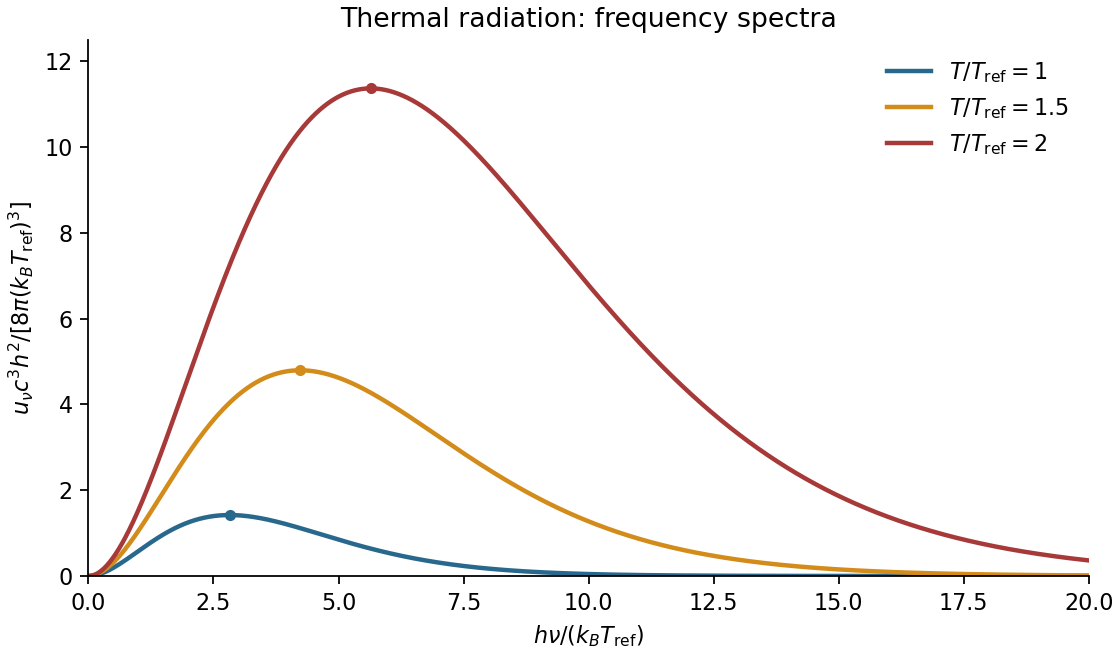
Spectral sketch. The spectral energy density per unit ordinary frequency is Planck's law,At small frequency it rises as , while at large frequency it decays exponentially. Raising temperature increases the spectrum at every fixed positive frequency, moves the peak to larger frequency in proportion to , and increases the integrated area in proportion to . A plot per unit wavelength has a different peak position because the integration variable changes.
Thin-cavity radiation. Let . The relevant low-temperature window isNonzero thickness indices are then thermally suppressed, while many in-plane modes are populated. The family has one polarization of an electromagnetic wave. Its allowed in-plane wavenumbers form a lattice of cell area ; a quarter of a circular shell therefore containsThus the dimensional crossover of thermal cavity radiation givesThe integral is by the same geometric-series argument. A model with a different number of independent polarizations of an electromagnetic wave changes the prefactor but not the scaling. For a cavity with fixed finite , cooling still further eventually freezes its lowest in-plane mode as well: the strict thermal energy is exponentially suppressed. The requested area law is the intermediate quasi-two-dimensional regime, not an arbitrarily low-temperature continuum limit.
Past exam of the physics B course of the University of Cambridge 2018 Paper 2 Section B B9 Solution by Codex 0 2026-10-18
Codex 0 2026-10-18Definition and equations. A normal mode is a motion in which every component of a linear system has the same time dependence with fixed amplitude ratios and phases. For a conservative system near equilibrium, the most useful form isThe vector describes the mode shape, while is its angular frequency. Linear combinations of modes describe arbitrary sufficiently small motions when the modes form a complete basis.
Let be displacements of independent generalized coordinates from equilibrium. Expand the Lagrangian to quadratic order:The mass matrix defines a positive-definite quadratic form on the independent coordinates, while the stiffness matrix is the Hessian of the potential energy. Substituting a mode gives the generalized eigenvalue problem for small oscillationsA practical calculation identifies the equilibrium, chooses independent coordinates, computes the quadratic kinetic and potential energies, solves for the eigenvalues and then obtains their eigenvectors. One can equivalently diagonalize the real symmetric matrix . This guarantees real and a complete orthogonal basis in mass-weighted coordinates.
For distinct eigenvalues, the fact that and are real symmetric matrices impliesThus distinct modes are orthogonal in the inner product weighted by the mass matrix. Choosing decouples the motion into , with total energy . A positive-definite matrix gives positive eigenvalues and oscillatory stability. Zero modes can describe rigid translations or rotations without restoring force; a negative eigenvalue gives exponential instability rather than an oscillatory mode.
Symmetry. A symmetry preserving both quadratic energies maps modes into modes of the same frequency. Coordinates adapted to symmetry divide the eigenvalue problem into smaller independent blocks. For two identical subsystems, exchanging them gives symmetric and antisymmetric modes. The degeneracy of normal modes means that independent modes share one frequency. Higher-dimensional group representations of a symmetry can enforce such degeneracies; symmetry does not require every pair of modes to be degenerate, and accidental degeneracies can also occur. Within a degenerate eigenspace, orthogonal linear combinations are equally valid mode shapes.
For two equal masses , each attached to a fixed support by a spring of stiffness and coupled to the other by a spring of stiffness ,The symmetric mode leaves the coupling spring unstretched and has . The antisymmetric mode stretches it and has . Superposing the two gives beats when their frequencies are close.
Continuous systems. The same idea replaces matrices by differential operators and mode vectors by functions satisfying boundary conditions. For a taut string of length , tension and mass per unit length , the wave equation and fixed endpoints giveOrthogonality of the sine functions allows an arbitrary initial displacement to be decomposed into modes. Changing the endpoints changes the spectrum: boundary conditions are part of the physical mode problem.
A uniform chain of equal masses joined by springs , with spacing , has travelling normal modes withTheir quantization gives phonons; the long-wavelength limit is a sound wave. Rectangular electromagnetic cavity modes satisfy Maxwell's equations and conductor boundary conditions, with in vacuum. An elastic beam instead has a fourth-order spatial equation and flexural dispersion . These examples show how restoring forces and geometry determine the frequency spectrum.
Real systems. Small-amplitude motion is often approximately linear even when the full equations are nonlinear. Large amplitudes produce frequency shifts, mode coupling and transfer of energy between modes. Friction broadens resonances and makes free oscillations decay. A damping matrix proportional to or can retain the undamped mode shapes; general damping need not, and the appropriate eigenfrequencies and modes can be complex. External periodic forcing predominantly excites modes near resonance, with amplitude set by coupling to the forcing and dissipation. Imperfections split ideal degeneracies, while radiation or coupling to a surrounding fluid can remove energy from the chosen subsystem. Normal modes remain useful when linearization, the boundary conditions and the treatment of damping accurately describe the motion being measured.
Pinned article: Introduction to the OurBigBook Project
Welcome to the OurBigBook Project! Our goal is to create the perfect publishing platform for STEM subjects, and get university-level students to write the best free STEM tutorials ever.
Everyone is welcome to create an account and play with the site: ourbigbook.com/go/register. We belive that students themselves can write amazing tutorials, but teachers are welcome too. You can write about anything you want, it doesn't have to be STEM or even educational. Silly test content is very welcome and you won't be penalized in any way. Just keep it legal!
Intro to OurBigBook
. Source. We have two killer features:
- topics: topics group articles by different users with the same title, e.g. here is the topic for the "Fundamental Theorem of Calculus" ourbigbook.com/go/topic/fundamental-theorem-of-calculusArticles of different users are sorted by upvote within each article page. This feature is a bit like:
- a Wikipedia where each user can have their own version of each article
- a Q&A website like Stack Overflow, where multiple people can give their views on a given topic, and the best ones are sorted by upvote. Except you don't need to wait for someone to ask first, and any topic goes, no matter how narrow or broad
This feature makes it possible for readers to find better explanations of any topic created by other writers. And it allows writers to create an explanation in a place that readers might actually find it.
Figure 1. Screenshot of the "Derivative" topic page. View it live at: ourbigbook.com/go/topic/derivativeVideo 2. OurBigBook Web topics demo. Source. - local editing: you can store all your personal knowledge base content locally in a plaintext markup format that can be edited locally and published either:This way you can be sure that even if OurBigBook.com were to go down one day (which we have no plans to do as it is quite cheap to host!), your content will still be perfectly readable as a static site.
- to OurBigBook.com to get awesome multi-user features like topics and likes
- as HTML files to a static website, which you can host yourself for free on many external providers like GitHub Pages, and remain in full control

Figure 2. You can publish local OurBigBook lightweight markup files to either OurBigBook.com or as a static website.
Figure 3. Visual Studio Code extension installation.
Figure 5. . You can also edit articles on the Web editor without installing anything locally. Video 3. Edit locally and publish demo. Source. This shows editing OurBigBook Markup and publishing it using the Visual Studio Code extension. 
- Infinitely deep tables of contents:



All our software is open source and hosted at: github.com/ourbigbook/ourbigbook
Further documentation can be found at: docs.ourbigbook.com
Feel free to reach our to us for any help or suggestions: docs.ourbigbook.com/#contact