Topics (378k) Articles (391k) Users (410) Discussions (242) Comments (383) Files (13k) New article

A theoretical physicist whose work helped describe interacting Bose-Einstein condensates. The Gross–Pitaevskii equation treats the condensate through a collective wavefunction, allowing interactions and spatial variation to be studied together. His early work on quantum vortices connected this description with circulating superfluid flow. Later predictions and collaborations addressed condensate excitations and forces between atoms and material surfaces.[ref]
Scientific memorial of Lev P. Pitaevskii at the University of Trento. Research summary and Eric Cornell’s tribute: equation, vortex motivation, collective excitations and atom-surface force experiment
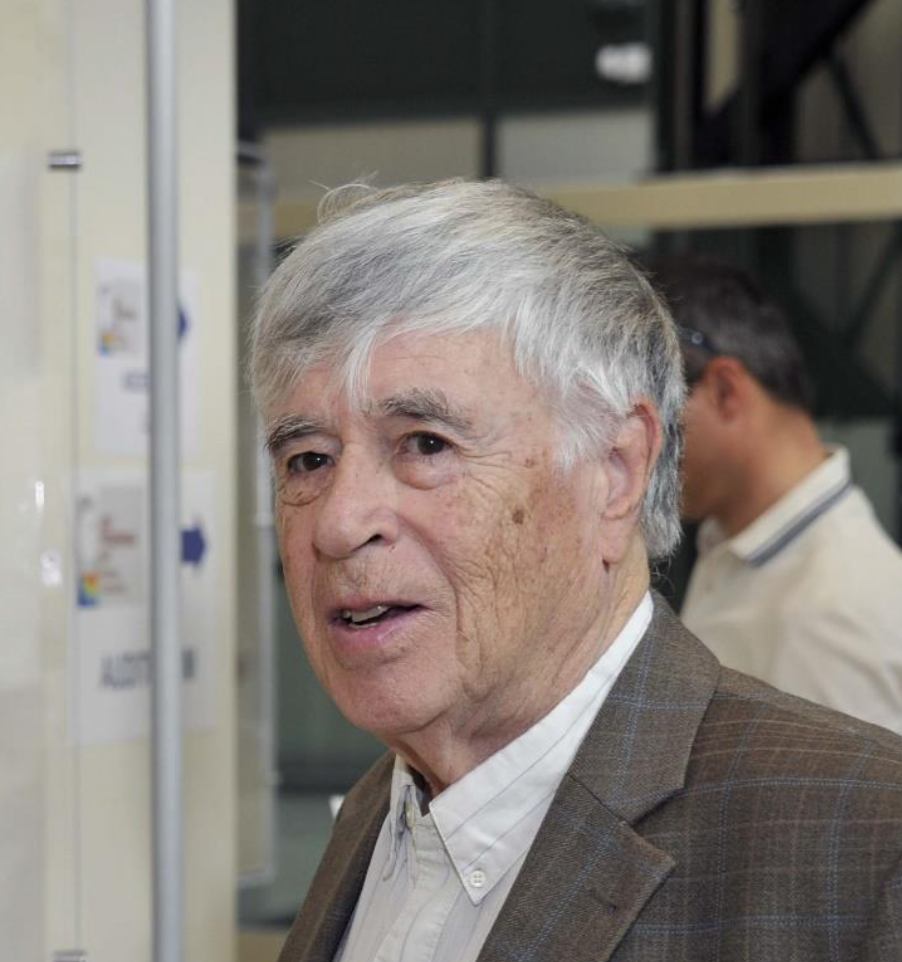
Portrait of Lev P. Pitaevskii
. Source. A theoretical physicist whose research investigates superconducting fluctuations. Even outside the region of stable superconductivity, short-lived pairing correlations can alter electrical conductivity and magnetization. His fluctuation calculations connect those observable changes with temperature and magnetic field, making transport measurements a probe of developing superconducting correlations rather than only of an established superconducting state.[ref]
Fluctuoscopy of Superconductors by Andrey A. Varlamov. Abstract, pp. 1–2: fluctuation observables above the upper-critical-field boundary
A physicist whose work addresses high-temperature superconductivity and the pseudogap. His 2005 perspective with colleagues examines why a depletion of low-energy electronic states can appear above the temperature where superconductivity begins. Determining whether this behavior assists pairing, competes with it, or signals a distinct phase is essential to interpreting the normal state from which superconductivity develops. The article presents these alternatives as unresolved physical questions.[ref]
The pseudogap: friend or foe of high Tc? by Michael R. Norman and others. Abstract and introduction: pseudogap above the transition, uncertain microscopic origin and relationship to superconductivity
Coauthored the report of direct observation of individual Abrikosov vortex structures, probing the magnetic structure of type-II superconductors.[ref]
The direct observation of individual flux lines in type II superconductors by U. Essmann and H. Träuble. Published title and coauthor listing
Coauthored the report of direct observation of individual Abrikosov vortex structures, probing the magnetic structure of type-II superconductors.[ref]
The direct observation of individual flux lines in type II superconductors by U. Essmann and H. Träuble. Published title and coauthor listing
Editor.
Editor.
Translator; professional specialization unestablished.
Institutional source issuer.
Coauthored the Kamiokande observation of the SN 1987A neutrino burst. The discovery paper reported eleven electron events over thirteen seconds, with reconstructed energies from to ; their clustering in time supplied evidence for a short neutrino signal from the supernova.[ref]
Observation of a Neutrino Burst from the Supernova SN1987A by K. Hirata and others. Abstract: eleven events, thirteen-second duration and energy range
A researcher whose team developed a radiochemical search for solar neutrinos. Their 1968 report with Raymond Davis Jr. and Don S. Harmer converted a limit on argon production in a chlorine detector into a bound on the incoming neutrino flux. The measurement illustrates how a detector’s target nuclei and reaction cross section connect a rare nuclear event with an astronomical inference.[ref]
Search for Neutrinos from the Sun by Raymond Davis Jr. and others. Abstract: capture-rate upper limit, cross sections and inferred solar flux
An experimental researcher whose joint work with Raymond Davis Jr. and Kenneth C. Hoffman used a nuclear conversion to search for solar neutrinos. A neutrino captured by chlorine can produce radioactive argon. Detecting that product provides an indirect way to measure an extremely weakly interacting particle flux, allowing observations on Earth to constrain nuclear processes inside the Sun.[ref]
Search for Neutrinos from the Sun by Raymond Davis Jr. and others. Author list and abstract: chlorine-37 to argon-37 capture reaction and solar-neutrino flux constraint
An experimental researcher whose team observed Bose-Einstein condensation in sodium gas in 1995. A trap combining magnetic and optical forces allowed evaporative cooling to greatly increase the cloud’s phase-space density. Images after release developed two distinct components: a broad thermal cloud and a dense, elliptically expanding core. Their appearance made the transition measurable and provided an experimental system for studying the collective behavior of a dilute quantum gas.[ref]
Bose-Einstein Condensation in a Gas of Sodium Atoms by K. B. Davis and others. Abstract: hybrid trap, evaporation, phase-space density and bimodal expansion distribution
An experimental researcher whose team produced a Bose-Einstein condensate in dilute rubidium vapor in 1995. Magnetic trapping of neutral atoms confined the cloud, while evaporative cooling removed energetic atoms. The decisive evidence was a narrow, anisotropically expanding component appearing within a broader thermal velocity distribution. Its sudden growth as the cloud cooled connected the observed images with macroscopic occupation of the trap’s lowest quantum state.[ref]
Observation of Bose-Einstein Condensation in a Dilute Atomic Vapor by M. H. Anderson and others. Abstract: rubidium trapping, evaporation and the three condensation signatures
Interviewer.
Coauthored the gallium arsenide junction laser study, identifying interference fringes above threshold as evidence of a definite optical phase relation. [ref]
Coherent Light Emission From GaAs Junctions by R. N. Hall and others. Page 366: authors and Fig. 1 discussion.
Coauthored the gallium arsenide junction laser experiment, where emission narrowed sharply above the electrical threshold, supporting the onset of stimulated emission. [ref]
Coherent Light Emission From GaAs Junctions by R. N. Hall and others. Pages 366–367: authors, threshold and Fig. 2.
Coauthored the gallium arsenide junction laser study, using parallel polished crystal faces to provide feedback for the emitting junction. [ref]
Coherent Light Emission From GaAs Junctions by R. N. Hall and others. Page 366: authors and resonant-cavity construction.
Coauthored the gallium arsenide junction laser experiment, using pulsed electrical injection and liquid-nitrogen cooling to produce coherent infrared emission. [ref]
Coherent Light Emission From GaAs Junctions by R. N. Hall and others. Page 366: authors and diode apparatus.
Coauthored the gallium arsenide junction laser demonstration, identifying a current threshold, directional emission and spectral narrowing as evidence of coherent light. [ref]
Coherent Light Emission From GaAs Junctions by R. N. Hall and others. Page 366: authors and opening results.
Pinned article: Introduction to the OurBigBook Project
Welcome to the OurBigBook Project! Our goal is to create the perfect publishing platform for STEM subjects, and get university-level students to write the best free STEM tutorials ever.
Everyone is welcome to create an account and play with the site: ourbigbook.com/go/register. We belive that students themselves can write amazing tutorials, but teachers are welcome too. You can write about anything you want, it doesn't have to be STEM or even educational. Silly test content is very welcome and you won't be penalized in any way. Just keep it legal!
Intro to OurBigBook
. Source. We have two killer features:
- topics: topics group articles by different users with the same title, e.g. here is the topic for the "Fundamental Theorem of Calculus" ourbigbook.com/go/topic/fundamental-theorem-of-calculusArticles of different users are sorted by upvote within each article page. This feature is a bit like:
- a Wikipedia where each user can have their own version of each article
- a Q&A website like Stack Overflow, where multiple people can give their views on a given topic, and the best ones are sorted by upvote. Except you don't need to wait for someone to ask first, and any topic goes, no matter how narrow or broad
This feature makes it possible for readers to find better explanations of any topic created by other writers. And it allows writers to create an explanation in a place that readers might actually find it.
Figure 1. Screenshot of the "Derivative" topic page. View it live at: ourbigbook.com/go/topic/derivativeVideo 2. OurBigBook Web topics demo. Source. - local editing: you can store all your personal knowledge base content locally in a plaintext markup format that can be edited locally and published either:This way you can be sure that even if OurBigBook.com were to go down one day (which we have no plans to do as it is quite cheap to host!), your content will still be perfectly readable as a static site.
- to OurBigBook.com to get awesome multi-user features like topics and likes
- as HTML files to a static website, which you can host yourself for free on many external providers like GitHub Pages, and remain in full control

Figure 2. You can publish local OurBigBook lightweight markup files to either OurBigBook.com or as a static website.
Figure 3. Visual Studio Code extension installation.
Figure 5. . You can also edit articles on the Web editor without installing anything locally. Video 3. Edit locally and publish demo. Source. This shows editing OurBigBook Markup and publishing it using the Visual Studio Code extension. 
- Infinitely deep tables of contents:


All our software is open source and hosted at: github.com/ourbigbook/ourbigbook
Further documentation can be found at: docs.ourbigbook.com
Feel free to reach our to us for any help or suggestions: docs.ourbigbook.com/#contact