Topics (384k) Articles (398k) Users (410) Discussions (242) Comments (383) Files (13k) New article
Daniel Tsui, Horst Störmer and Arthur Gossard reported the effect in 1982. They grew gallium arsenide–aluminium gallium arsenide layers by molecular beam epitaxy, separating the two-dimensional electron gas from its semiconductor doping. They cut Hall bars and made indium contacts. Low-field measurements established number density and charge carrier mobility. A perpendicular magnetic field sweep measured transverse and longitudinal sheet resistivities at several temperatures. Cooling sharpened the plateau near and the longitudinal minimum at filling factor ; integer plateaus provided an internal comparison. The longitudinal minimum remained finite at the lowest temperature: zero-temperature vanishing was unresolved. This established anomalous transport, without directly measuring excitation electric charge.[ref]
Two-Dimensional Magnetotransport in the Extreme Quantum Limit by Daniel Chee Tsui and others. pp. 1559–1561, sample preparation, Figs. 1–2 and finite longitudinal minimum
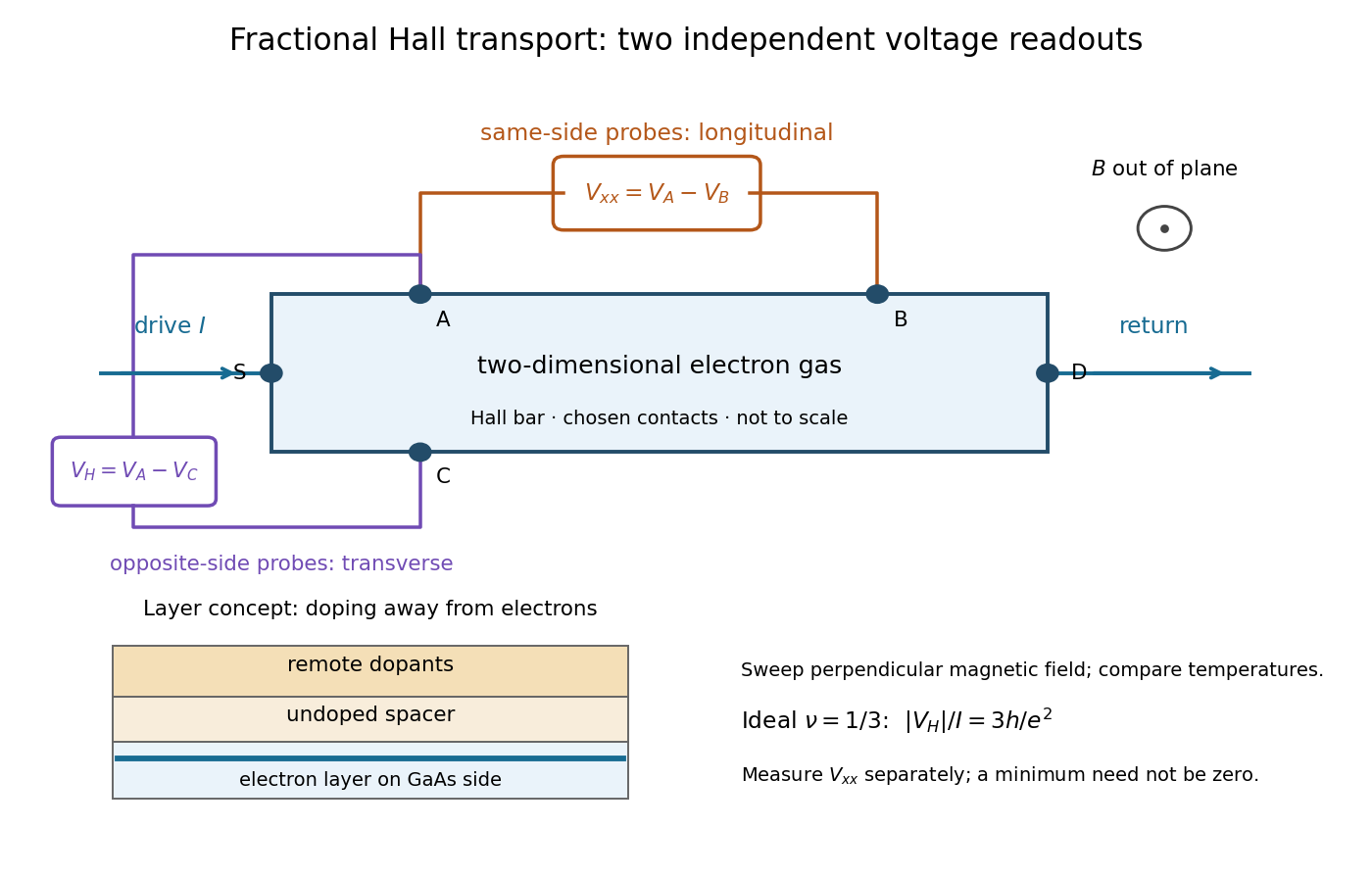
The two readouts test different statements. A single intersection with would also occur on the smooth classical relation at . A quantum Hall plateau instead persists over a magnetic field interval. Comparing transverse and longitudinal signals helps distinguish that plateau from a contact-placement artefact; the quantum Hall conductivity tensor inversion quantifies the contamination when longitudinal sheet resistivity is nonzero.
Later, 1997 shot noise measurements associated with quantum tunnelling at filling factor tested the excitation electric charge separately, finding . That is a different observable from a Hall plateau.[ref]
Observation of the e⁄3 Fractionally Charged Laughlin Quasiparticle by L. Saminadayar and others. Publisher abstract: tunnelling noise and inferred quasiparticle charge
The magnitude of one magnetic flux unit for an electron-pair order parameter, whose electric charge has magnitude . The enclosing contour must satisfy the flux condition in fluxoid and flux quantization in a superconductor; it is not a statement that every finite area inside the material contains an integer number of these units.
A quasienergy is defined by an eigenvalue of the Floquet operator. It is determined modulo , because adding an integer multiple of that quantity leaves the complex exponential unchanged. A time-independent effective Hamiltonian can be defined by a branch of the matrix logarithm; its eigenvalues are the corresponding chosen quasienergies.
Multiplying the two matrix exponentials with the Pauli matrix multiplication law givesOne has . If , put and . The exponential of a Pauli vector gives . Its action on a Bloch vector is a rotation through about , and its quasienergies are modulo . When , its axis is arbitrary and the Bloch vector is unchanged.
The fermion self-energy of an electron in quantum electrodynamics. After renormalization, its contribution in a bound chemical atom is one source of the Lamb shift; other radiative corrections and nuclear structure also affect the observed energy levels.
Choose the Pauli matrices with , and let be an angular frequency. The computational basis is an orthonormal basis of energy eigenstates for the qubit Hamiltonian operatorIn this convention is the lower energy eigenstate; the labels describe a basis choice, not a universal ground state/excited state ordering. Start in the Hadamard basis pure state . ThenThe first factor in the second expression is a global phase. The ratio of the two probability amplitudes has relative quantum phase , so its sign follows directly from .
Multiplying this density matrix by each Pauli matrix and taking its trace gives the Bloch vector:The Bloch vector travels counterclockwise around the equator of the Bloch sphere, from toward when viewed from . A computational-basis measurement always has , while the Hadamard basis and eigenbasis measurements giveAt , the quantum state is up to a global phase, giving . At , it is up to a global phase, giving . Both retain equal energy measurement probabilities.
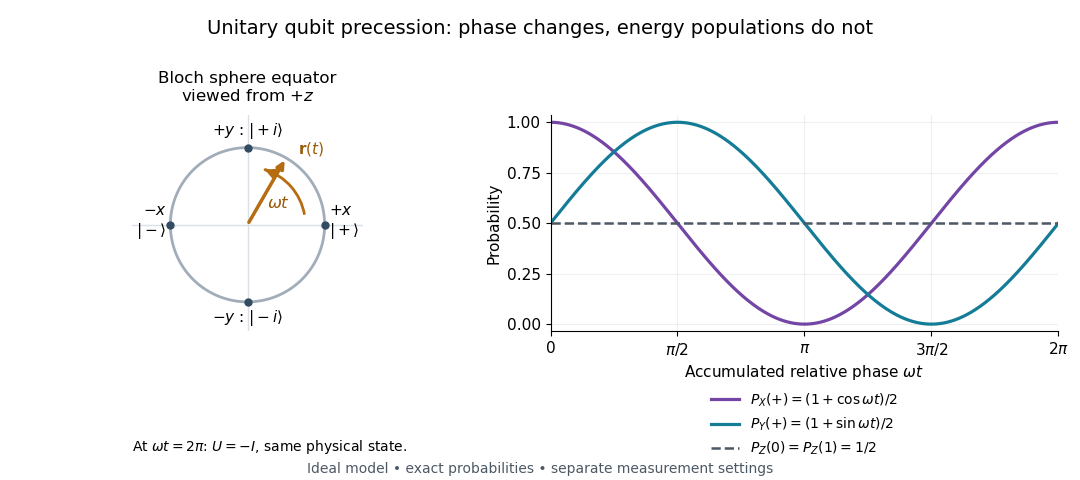
At , the time-evolution operator is , so . The physical quantum state ray, its density operator, and every measurement's probabilities have returned. The representative vector returns exactly only at , when . The minus sign is a global phase for this isolated evolution; comparing an evolved branch with an unevolved branch through a controlled unitary gate can make it a relative quantum phase, as explained in global phase of an uncontrolled quantum gate is unobservable.
The sheet resistivity tensor relates tangential electric field to surface current density: . It is the matrix inverse of the sheet conductivity tensor, when that inverse exists. Its SI unit is the ohm, rather than the ohm times metre used for bulk electrical resistivity. With a transverse response, individual tensor components are not generally reciprocals of the corresponding sheet conductivity components.
Matthiessen's rule approximates the total electrical resistivity of a metal by the sum of separate scattering contributions. For a common parabolic energy band, approximately independent scattering mechanisms give for the respective momentum relaxation times, and hence . Correlated scattering, strongly angle-dependent processes or a complicated changing energy band structure can invalidate the simple addition.
The residual resistivity is the low-temperature electrical resistivity remaining in a normal metal when thermally excited scattering becomes negligible. Static disorder, impurities and boundaries can relax carrier momentum without requiring a thermal population of phonons. Its value depends on sample purity and structure; a superconducting transition is a different phenomenon.
The resistivity tensor is the matrix relating electric field to current density in linear local transport. It is the matrix inverse of the conductivity tensor, not the componentwise reciprocal. A Hall response produces antisymmetric off-diagonal components. In a multicarrier system, the conductivities add because each species sees the same electric field; invert only after summing the species' conductivity tensors.
For a constant-amplitude square pulse on resonance, a Rabi pi pulse lasts and gives in the rotating frame. A half-duration pulse prepares . The quantum pulse area determines these rotations only under the stated resonant, constant-axis assumptions; a detuned drive rotates about a different axis.
As an original numerical illustration, choose and hence . These are chosen model parameters, not historical apparatus settings. Holding that duration fixed givesThus , , and . The last zero comes from completing a full rotation about the tilted axis, rather than switching the drive off. At zero Rabi detuning, doubling the pulse duration restores the ground-state population; continuous driving does not keep transferring population irreversibly.
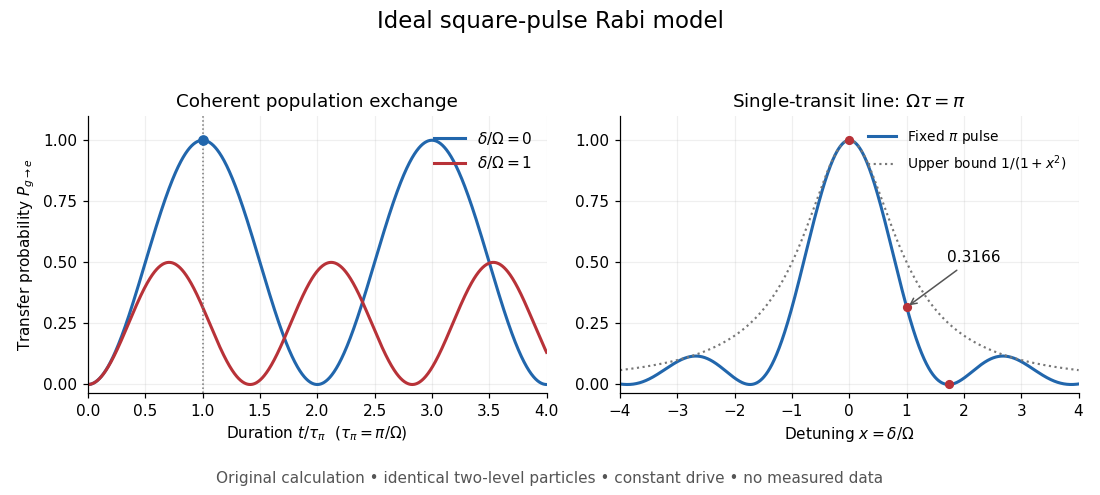
The Rabi detuning is the unperturbed transition angular frequency minus the drive angular frequency in this convention. Its sign controls the longitudinal rotation of the Bloch vector; the single-pulse population formula is even in . Reversing the definition of Rabi detuning requires reversing its sign in the rotating-frame Hamiltonian operator as well.
The Rabi angular frequency is the on-resonance population oscillation rate in the specified Driven two-level Rabi model. The rotating-frame off-diagonal Hamiltonian operator entry has magnitude . Stating this convention avoids a factor-of-two ambiguity between drive coefficients and oscillation rates. The generalized rate off resonance is .
Consider two identical magnetic layers separated by a nonmagnetic layer, between reservoirs that impose the same terminal electric potential difference on both spin channels. Neglect spin-flip scattering and assume each layer obeys Ohm's law. In a magnetic layer, define positive channel electrical resistances . Let the spacer contribute to each channel. These are circuit parameters, not measured iron or chromium resistivities.
For parallel layer magnetizations, one channel meets and the other . For opposite layer magnetizations, each meets one , one , and the spacer. The two channels share the same terminal electric potential difference and run in parallel. Writing givesThe inequality is algebra, given the specified network. It shows how a difference between spin-channel responses can yield a difference between magnetic configurations even though all the constituent resistors are ohmic.
For chosen , , , the parallel channels have total electrical resistances and , while the opposite-alignment channels each have . Thus and . At a common terminal electric potential difference , the total electric currents are and , respectively.
A spectral doublet comprises two neighbouring spectral lines. Resolving it requires information about the line response, relative strengths and noise, not only precision in reading an angle. Choose two equal angular responses shaped as Gaussian functions with common standard deviation and separation . If is angular displacement from their midpoint, their summed signal isThese are assumed response shapes, not a measured Siegbahn frequency spectrum. By symmetry , andThe midpoint changes from a maximum to a minimum at . For this particular equal-width, equal-height model, two distinct maxima occur when . Each isolated Gaussian function has full width at half maximum ; the two-maxima threshold is therefore about times that width.
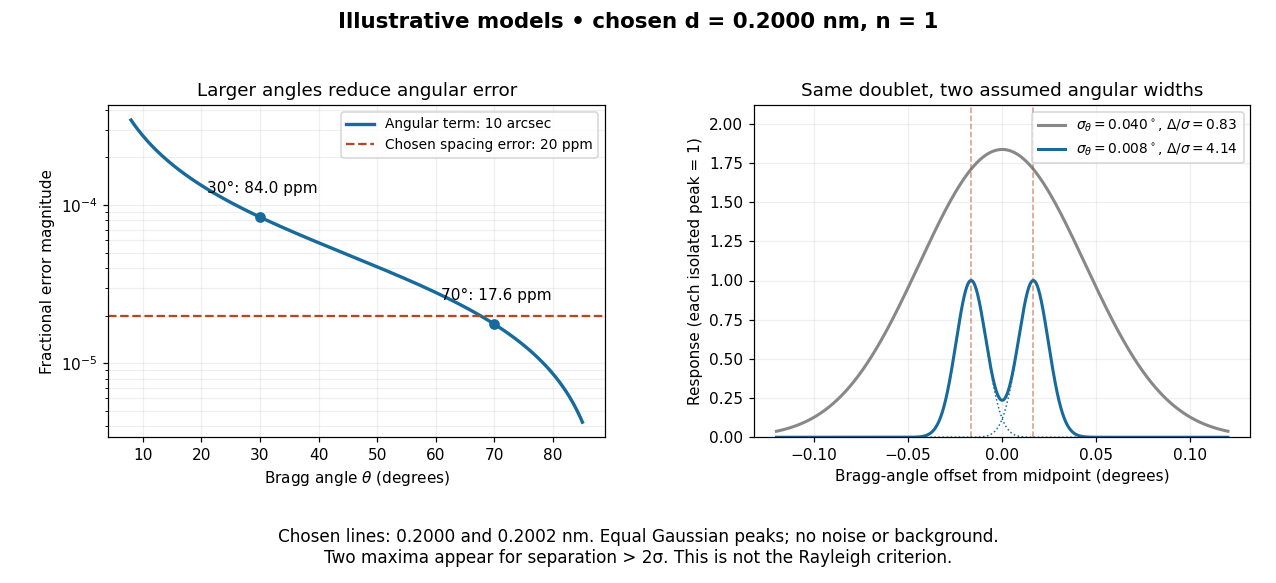
In this chosen model, the two Bragg angles are and . Their separation is times for , giving one maximum, and times for , giving two. Sharpening the response can reveal the doublet without changing either emitted wavelength.
The Rayleigh criterion uses a first-zero convention for specified diffraction patterns. A Gaussian function has no finite zero, so its two-maxima threshold is not the Rayleigh criterion. Neither convention is a universal inference limit: known response shapes and adequate signal-to-noise ratio can support estimating a separation before two visible maxima appear. Unequal strengths, background, finite sampling and uncertainty in the response can make that inference much harder. Measurement resolution, the precision of an isolated line's centre and absolute wavelength accuracy should therefore be reported separately.
For two lines measured with the same interplanar spacing at the same temperature, division of Bragg's law givesThe common cancels. Consequently a precise wavelength ratio can coexist with an uncertain conversion to SI length. In contrast, angular calibration errors generally survive: a shared small zero offset changes the inferred ratio fractionally by approximately . Nearby lines partially cancel this effect, but widely separated angles need not. Different crystals, temperatures or refraction corrections also prevent unqualified cancellation.
Differentiate Bragg's law at fixed correctly assigned diffraction order:Divide the second equality by the first. For small signed changes,The Bragg angle error must be in radians. An error quoted for detector deflection must first be halved. The expression is a first-order Taylor expansion; an unknown diffraction order is a discrete assignment error, not an infinitesimal perturbation.
For error bounds, add magnitudes. For independent zero-mean random errors with standard deviations , variance addition instead givesCorrelated errors require a covariance term. A shared calibration bias does not become independent merely because many line positions are measured.
With a chosen angular error arcseconds, , the angular contribution is at and at . Larger Bragg angles reduce this contribution because decreases. For a nearby spectral doublet, the inverse relation is : a fixed fractional separation spreads farther apart angularly at large Bragg angle.
This does not permit unlimited improvement. The geometry requires ; a desired wavelength might not have an accessible large-angle reflection with the chosen crystal. Higher diffraction orders can reach larger Bragg angles but their strengths depend on the crystal lattice structure factor. Finite crystal response, slit widths and source size remain relevant. An error in , including uncorrected thermal expansion, remains even when the angular term is small. Very near , the leading angular derivative vanishes and the second-order Taylor expansion matters.
For a lossless nonmagnetic uniaxial optical medium, the electric displacement field of a plane electromagnetic wave is perpendicular to its wavevector. The magnetic field is perpendicular to the plane containing the electric field and wavevector, while the Poynting vector is perpendicular to the electric field in that same plane. Thus the angle between and equals the walk-off angle between energy flow and phase propagation. At normal incidence on a parallel slab of thickness , a lateral separation of the ordinary and extraordinary exiting rays gives , while . The output rays can be parallel even though their internal energy paths differ.
Complex analytic representation of biharmonic functions by  Codex 0 Created 2026-10-18 Updated 2026-10-20
If are holomorphic functions, both real and imaginary parts of solve the biharmonic equation. In Wirtinger derivatives, , so is harmonic and its next Laplacian is zero. This construction gives local representations of planar solutions of the biharmonic equation; it is useful for the biharmonic stream function for planar Stokes flow.
The Lorenz number is the ratio . The Sommerfeld value applies under the assumptions of the Wiedemann-Franz law. The ratio must use electronic thermal conductivity if lattice heat flow is appreciable.
Pinned article: Introduction to the OurBigBook Project
Welcome to the OurBigBook Project! Our goal is to create the perfect publishing platform for STEM subjects, and get university-level students to write the best free STEM tutorials ever.
Everyone is welcome to create an account and play with the site: ourbigbook.com/go/register. We belive that students themselves can write amazing tutorials, but teachers are welcome too. You can write about anything you want, it doesn't have to be STEM or even educational. Silly test content is very welcome and you won't be penalized in any way. Just keep it legal!
Intro to OurBigBook
. Source. We have two killer features:
- topics: topics group articles by different users with the same title, e.g. here is the topic for the "Fundamental Theorem of Calculus" ourbigbook.com/go/topic/fundamental-theorem-of-calculusArticles of different users are sorted by upvote within each article page. This feature is a bit like:
- a Wikipedia where each user can have their own version of each article
- a Q&A website like Stack Overflow, where multiple people can give their views on a given topic, and the best ones are sorted by upvote. Except you don't need to wait for someone to ask first, and any topic goes, no matter how narrow or broad
This feature makes it possible for readers to find better explanations of any topic created by other writers. And it allows writers to create an explanation in a place that readers might actually find it.
Figure 1. Screenshot of the "Derivative" topic page. View it live at: ourbigbook.com/go/topic/derivativeVideo 2. OurBigBook Web topics demo. Source. - local editing: you can store all your personal knowledge base content locally in a plaintext markup format that can be edited locally and published either:This way you can be sure that even if OurBigBook.com were to go down one day (which we have no plans to do as it is quite cheap to host!), your content will still be perfectly readable as a static site.
- to OurBigBook.com to get awesome multi-user features like topics and likes
- as HTML files to a static website, which you can host yourself for free on many external providers like GitHub Pages, and remain in full control

Figure 2. You can publish local OurBigBook lightweight markup files to either OurBigBook.com or as a static website.
Figure 3. Visual Studio Code extension installation.
Figure 5. . You can also edit articles on the Web editor without installing anything locally. Video 3. Edit locally and publish demo. Source. This shows editing OurBigBook Markup and publishing it using the Visual Studio Code extension. 
- Infinitely deep tables of contents:




All our software is open source and hosted at: github.com/ourbigbook/ourbigbook
Further documentation can be found at: docs.ourbigbook.com
Feel free to reach our to us for any help or suggestions: docs.ourbigbook.com/#contact