Topics (384k) Articles (398k) Users (410) Discussions (242) Comments (383) Files (13k) New article

For bending stiffness and mass per area , a plane wave of surface displacement satisfies . An inviscid deep-water velocity potential has vertical dependence ; the kinematic boundary condition and linear Bernoulli equation give . Eliminating gives the displayed dispersion relation. With water depth , replace it by .
Write and in the dispersion relation of a floating elastic plate. A stationary point of squared phase velocity satisfies . If plate inertia is neglected, its solution is . A steadily translating load can resonate only when its speed matches a phase velocity; this threshold differs from the group-velocity minimum of a flexural-gravity wave.
The average of the two flat translation connections on a Lie group is a torsion-free connection. For left-invariant vector fields, the Jacobi identity gives with . Contracting gives for the Killing form . It is flat exactly when all double Lie brackets vanish, including the case of a two-step nilpotent group. For a semisimple Lie algebra, is nondegenerate and supplies a bi-invariant pseudo-Riemannian metric whose Levi-Civita connection is .
Declare a global frame of left-invariant vector fields parallel on a semisimple Lie group. This affine connection is flat and preserves a left-invariant metric tensor because its frame components are constant. If , its torsion tensor is . For fixed , the matrix with entries is . Its trace vanishes because a semisimple Lie algebra is perfect and adjoints of brackets are commutators. The trace of the product for is the Killing form , proving both contractions. This flat metric connection differs from the curved torsion-free Levi-Civita connection of the Killing metric.
Let a bounded probability density function have Fourier transform supported in the plateau of a flat-top kernel for density estimation. At fixed smoothing bandwidth one, the convolution theorem gives , so the kernel density estimator is pointwise unbiased. Its variance is at most , and the Cauchy-Schwarz inequality proves the displayed rate. An explicit example is , with value at zero and transform . Direct inverse Fourier integration gives the formula. The function is nonnegative, integrable and has integral one because its transform at zero is one. Compact frequency support also gives bounded derivatives of every order.
Every map from a flat sublocale of to a compact locale that is also a regular locale extends uniquely to . On frames the extension iswhere the terms are first regarded as fixed elements in the ambient frame. Regularity proves agreement after applying ; compactness reduces arbitrary covers to finite subcovers on a well-inside open, and flatness identifies those finite joins with ambient joins. These facts prove that preserves arbitrary joins and finite meets.
For a Noetherian ring , an injective module gives a flasque sheaf on . If , clearing denominators on finitely many principal opens identifies with . Each map extends to by injectivity. Thus every section on extends globally, and all restriction maps are surjective. This concerns sheafification of an injective module, rather than the different assertion that an injective sheaf of modules is flasque.
With known size , the mean-dependent log mass of a negative binomial distribution is . Its derivative is , so the saturated mean is , including its boundary value zero. Subtracting the fitted log mass from that maximum gives the displayed deviance. This formula needs no fitted-intercept cancellation. As , its second term tends to and it becomes the full Poisson deviance.
With , the combinator satisfies . Every finite reduct of is, up to alpha equivalence, : the remaining copy of is its only beta-redex.
Put and . Then . Unlike the Curry fixed-point combinator, every finite reduct retains a closed subterm . Contracting this subterm recreates one; every other generated redex substitutes a variable and preserves it. The Church-Rosser theorem therefore proves .
Take the original sphere on the tube axis, with diagonal positive hydrodynamic resistance matrix and axial force . Add a freely moving neutral sphere and extend its rigid velocity through its interior. The resulting field is admissible in the original domain, so its dissipation obeys for any finite nonoverlapping placement of the extra sphere. Since only the first sphere does external work, , giving the displayed bound without assuming zero transverse velocity or rotation. Strictness follows because equality would require the original nontrivial analytic flow to have zero strain throughout the added ball.
For , moving the Mellin contour past the pole at one, the Nontrivial zeros of the Riemann zeta function, and the remaining poles givesZeros are included with multiplicity. The Riemann–von Mangoldt formula makes the zero sum absolutely convergent. If every nontrivial zero has real part below one, division by and dominated convergence give . Monotonicity of then recovers by upper and lower difference quotients.
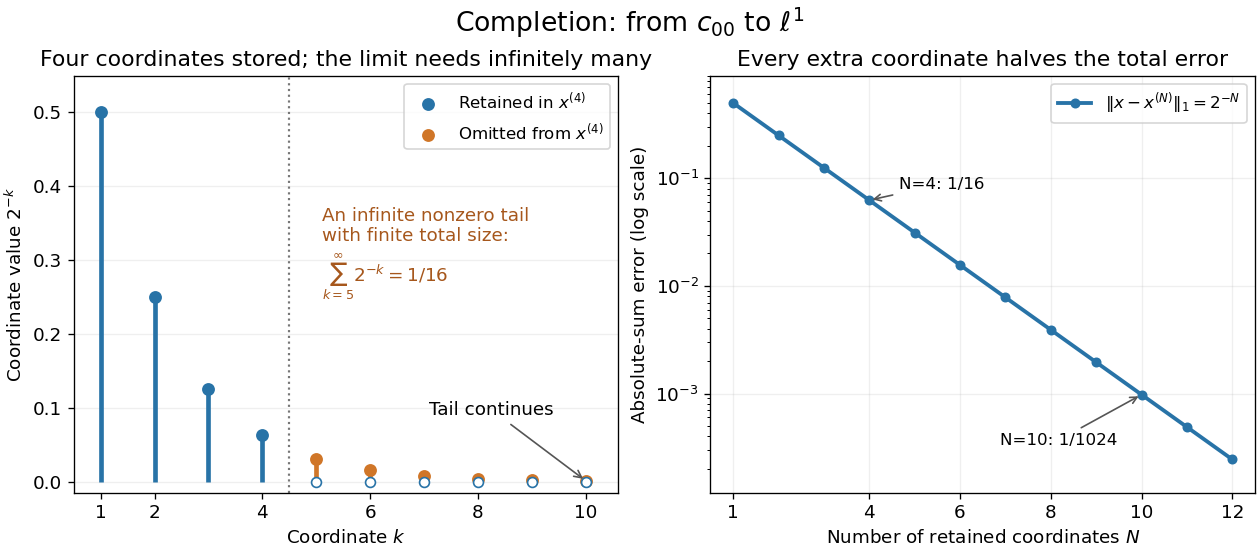
Equip the vector space of finitely supported sequences with the norm inherited from the absolutely summable sequence space. Consider the truncationsFor , the geometric series givesTherefore is a Cauchy sequence. Any possible norm limit must have coordinate equal to , since . That forces infinitely many nonzero coordinates, so no limit lies in . There is nothing wrong with the approximations: the space is missing their limit.
Inside the absolutely summable sequence space, the limit is and its exact truncation error is . Four retained coordinates leave error ; ten leave . More generally, truncating any element of the absolutely summable sequence space leaves a tail whose norm tends to zero. Together with completeness, this identifies that Banach space as the completion of a normed space with this norm. Finite storage and an infinite mathematical object fit together through a controlled error.
Normalization of the reverse law gives an exact finite identity:The sum notation describes discrete paths; the corresponding path integral has the same change-of-variable argument. Jensen's inequality for the exponential function then gives , hence . Equivalently this mean is the Kullback-Leibler divergence between the forward path law and the reverse path law pulled back by . Equality requires those two laws to agree. [ref]
Entropy production along a stochastic trajectory and an integral fluctuation theorem by Udo Seifert. Seifert, 2005, Eqs. (17)–(18): integral relation and its mean inequality
Rare negative entropy production contributes disproportionately to this expectation through . Missing such events in a finite sample can spoil an estimate of the identity. Matching probability support is also essential: reverse paths absent from the forward law cannot be recovered by cancelling forward weights. This Second law of thermodynamics statement concerns an ensemble average; an individual negative value is compatible with it.
In a Fokas method boundary integral over , where inside, the contribution of replacing by is an integral of times an holomorphic coefficient. For it vanishes by the Cauchy integral theorem and the exponential decay in the upper domain. The transformed amplitude is then independent of the observation time, which simplifies differentiation of the partial differential equation. Temporal inversion at recovers the full boundary value rather than the half-value of a truncated transform at its endpoint.
The Spanier-Whitehead dual of a finite spectrum is . It is finite, and evaluation and coevaluation give the natural Spanier-Whitehead duality adjunction.
A product of reflections has , by the rank inequality applied successively to . Conversely an orthogonal transformation fixes the orthogonal complement of its moved space; successive Householder reflections fix one new basis direction at each step in that moved space. At most its dimension are required. Thus central inversion in three dimensions needs exactly three reflections.
Here . The missing-trace matrix has determinant . Its nonzero zeros are the eigenvalues in the parametrization of with . Integration by parts gives . No nonzero zero lies in : on its boundary the determinant equation reduces, after rotation, to an equality between a unit-modulus exponential and , whose modulus exceeds one unless . The zero at the origin is removable in the original boundary problem. There are nevertheless infinitely many genuine negative eigenvalues of , obtained from , , with . Absence of contour poles in the Fokas method does not imply absence of discrete spectrum of the operator.
Deligne-Lusztig theory constructs virtual characters of finite groups of Lie type from compactly supported étale cohomology of varieties associated with Frobenius and flags. Rational maximal tori and their finite-group characters provide induction data, while the geometry explains character orthogonality and cuspidality.
For a rational parabolic subgroup , use inflation of a group representation for a complex -module across and induce it to . This is Harish-Chandra induction. Its adjoint, Harish-Chandra restriction, takes -invariants. These are ordinary finite-group group representation functors and should not be confused with general Deligne-Lusztig induction from a nonrational Borel.
Pinned article: Introduction to the OurBigBook Project
Welcome to the OurBigBook Project! Our goal is to create the perfect publishing platform for STEM subjects, and get university-level students to write the best free STEM tutorials ever.
Everyone is welcome to create an account and play with the site: ourbigbook.com/go/register. We belive that students themselves can write amazing tutorials, but teachers are welcome too. You can write about anything you want, it doesn't have to be STEM or even educational. Silly test content is very welcome and you won't be penalized in any way. Just keep it legal!
Intro to OurBigBook
. Source. We have two killer features:
- topics: topics group articles by different users with the same title, e.g. here is the topic for the "Fundamental Theorem of Calculus" ourbigbook.com/go/topic/fundamental-theorem-of-calculusArticles of different users are sorted by upvote within each article page. This feature is a bit like:
- a Wikipedia where each user can have their own version of each article
- a Q&A website like Stack Overflow, where multiple people can give their views on a given topic, and the best ones are sorted by upvote. Except you don't need to wait for someone to ask first, and any topic goes, no matter how narrow or broad
This feature makes it possible for readers to find better explanations of any topic created by other writers. And it allows writers to create an explanation in a place that readers might actually find it.
Figure 1. Screenshot of the "Derivative" topic page. View it live at: ourbigbook.com/go/topic/derivativeVideo 2. OurBigBook Web topics demo. Source. - local editing: you can store all your personal knowledge base content locally in a plaintext markup format that can be edited locally and published either:This way you can be sure that even if OurBigBook.com were to go down one day (which we have no plans to do as it is quite cheap to host!), your content will still be perfectly readable as a static site.
- to OurBigBook.com to get awesome multi-user features like topics and likes
- as HTML files to a static website, which you can host yourself for free on many external providers like GitHub Pages, and remain in full control

Figure 2. You can publish local OurBigBook lightweight markup files to either OurBigBook.com or as a static website.
Figure 3. Visual Studio Code extension installation.
Figure 5. . You can also edit articles on the Web editor without installing anything locally. Video 3. Edit locally and publish demo. Source. This shows editing OurBigBook Markup and publishing it using the Visual Studio Code extension. 
- Infinitely deep tables of contents:



All our software is open source and hosted at: github.com/ourbigbook/ourbigbook
Further documentation can be found at: docs.ourbigbook.com
Feel free to reach our to us for any help or suggestions: docs.ourbigbook.com/#contact