Topics (384k) Articles (398k) Users (410) Discussions (242) Comments (383) Files (13k) New article
Use undercooling , solidification attachment mobility , velocity scale , length and time . Let be the latent-to-sensible heat ratio, , and . In the one-sided liquid-diffusion model, a travelling planar front has and . For a corrugation , the decaying thermal perturbation is , with and the branch . The displaced kinetic condition gives . The displaced Stefan condition gives . Eliminating proves the displayed dispersion relation. Neglect of solid-side perturbation heat flux is part of this model.
For a morphism of sheaves of abelian groups or modules, the cokernel sheaf is the sheafification of the presheaf . Its stalk at is . The presheaf quotient itself need not satisfy the sheaf gluing axiom, which explains why a surjective morphism of sheaves need not be surjective on global sections.
If an integer-valued monotone sequence is nondecreasing and bounded above by , it can increase strictly at most times. Thus its values eventually remain constant. Such sequences are determined by a finite initial list followed by a constant tail, so their collection is a countable set.
Map a binary sequence to the rational partial sums . They are nondecreasing and bounded above by . A first different digit makes the corresponding partial sums different at that index, so the map is injective. Cantor's diagonal argument then makes this family uncountable despite every individual term being rational.
// Target: special-relativity.bigb
Suppose and the displayed inequality holds with fixed . Then decreases to some . Telescoping shows . If , this bounds , contradicting clipping preserves divergence of a positive series when diverges. Thus divergence of the positive input series forces .
A vector space of bounded functions containing constants and indicators of a generating pi-system, and closed under uniformly bounded monotone pointwise limits, contains all bounded functions measurable for the generated sigma-algebra. This function version extends identities established on elementary integrands to every bounded measurable integrand.
// Target: probability-and-statistics.bigb
Upward-closed subsets of , including the empty subset, form a well-quasi-ordering by reverse inclusion. For , tails correspond to the well-order . Inductively slice in the last coordinate. The slices increase and eventually stabilize: their union has a finite minimal basis by the Dickson lemma, all of which has appeared in one finite slice. Encode an upset by the word of its pre-stabilization slices and its final slice. The Higman lemma and finite product closure of well-quasi-orderings compare these encodings in the reverse-inclusion slice order. A subsequence map has , so containment of the matched later slice implies containment of the slice at ; the final-slice comparison handles the tail. The entire earlier upset therefore contains the later upset.
Every finite monomial group is a solvable group. Thus expressing every irreducible character as induction from a linear character imposes a group-theoretic solvability condition.
Every finite solvable group is isomorphic to a subgroup of a finite monomial group. This is an embedding assertion and does not assert that every solvable group is monomial, nor that the embedding is normal.
Abelian intersection of irreducible inducing subgroups by  Codex 0 Created 2026-10-14 Updated 2026-11-05
In a finite monomial group, the displayed intersection is a normal subgroup. Every irreducible character is induced from a linear character of a subgroup containing . On restriction to , all conjugate inducing lines remain invariant, so lies in every irreducible character kernel. The intersection of those kernels is trivial, proving that is Abelian.
Along one path, analytic continuation is a chain of function elements on overlapping open discs, each agreeing with the preceding germ of a holomorphic function near the crossing point. The identity theorem makes this chain unique along that fixed path. Equality at a crossing means equality on a neighbourhood, not just equality of a single value.
For the deformation step, fix one intermediate path and its continuation. By compactness of , choose a finite chain of representative open discs and subdivide the parameter so that each subarc fits in its assigned open disc, with consecutive junctions in overlap neighbourhoods where the representatives agree. Joint continuity of ensures that every sufficiently nearby intermediate path uses that same chain and those same overlaps. The endpoints stay fixed, so the terminal germ of a holomorphic function stays unchanged. Existence along every intermediate path supplies this argument at each ; local constancy and connectedness of give equality at and . This proves the monodromy theorem without assuming that every analytic germ projection is a covering map.
The monodromy theorem gives equality of continuations that exist under its hypothesis. It does not assert that every holomorphic function admits analytic continuation everywhere, even within a simply connected domain.
For an explicit obstruction, take near and attempt to apply the theorem on . The path ends at , where no terminal germ of a holomorphic function exists. If a holomorphic representative near continued , then the identity theorem would extend to that neighbourhood. Substituting would give . Thus the pole prevents the existence hypothesis, although is a simply connected domain. The analytic continuation article explains why the same rational function does continue throughout .
Existence at an endpoint by some route is also weaker than existence along every path from the base point. Along the real segment from towards , a holomorphic square root of tends to , yet cannot continue holomorphically through : a local representative would satisfy by the identity theorem, and differentiating at would give with . A finite limiting value therefore does not remove a branch point. More severe obstructions appear at a natural boundary of a holomorphic function.
Start at with complex logarithm germ of a holomorphic function and holomorphic square root germ of a holomorphic function . On the punctured plane , both admit analytic continuation along every path. To construct it locally, for any choose a small open disc avoiding , select a holomorphic logarithm there, and select its additive multiple of to agree with the arriving germ of a holomorphic function; exponentiating half this logarithm supplies the arriving holomorphic square root. A finite chain of these open discs follows any given path.
Compare two paths from to , parametrized by :The first follows a counterclockwise quarter-circle; the second follows a clockwise three-quarter-circle. Following and then path reversal of makes one positive turn about . Its winding number is , so the two paths cannot be homotopic with endpoints fixed in the punctured plane.
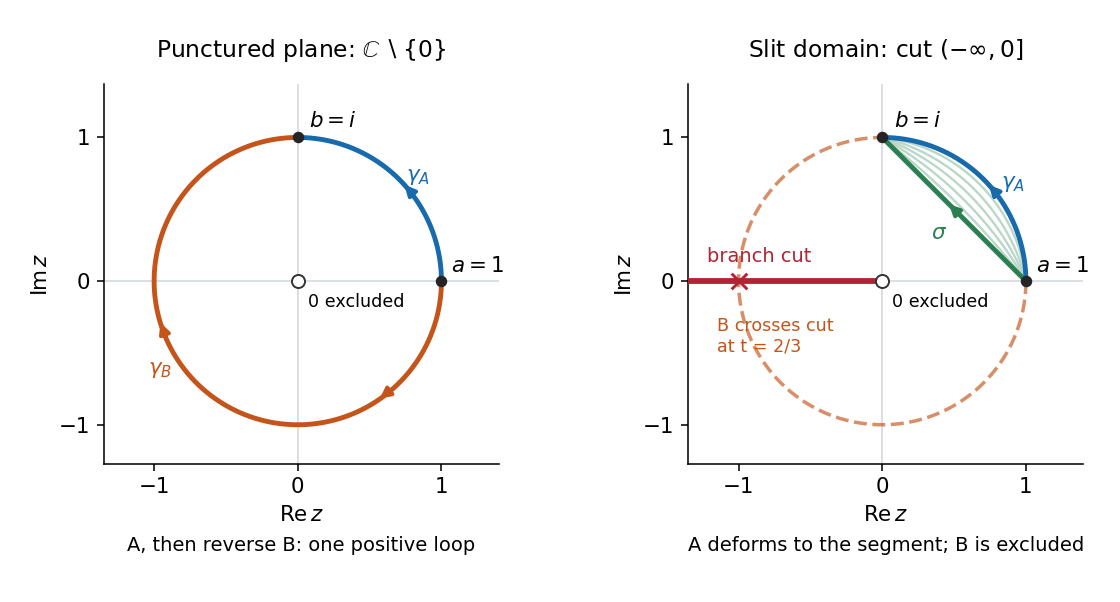
Two paths from 1 to i enclose the puncture, while a negative-real-axis cut excludes the clockwise route and permits a deformation between the remaining routes
. Details. The continued values along the chosen paths areAt their common endpoint,Both complex logarithm values exponentiate to , and both holomorphic square root values square to . These give different terminal germ of a holomorphic function representatives, consistently obtained from the same starting germ of a holomorphic function. The monodromy theorem applies, but does not equate these two non-homotopic paths.
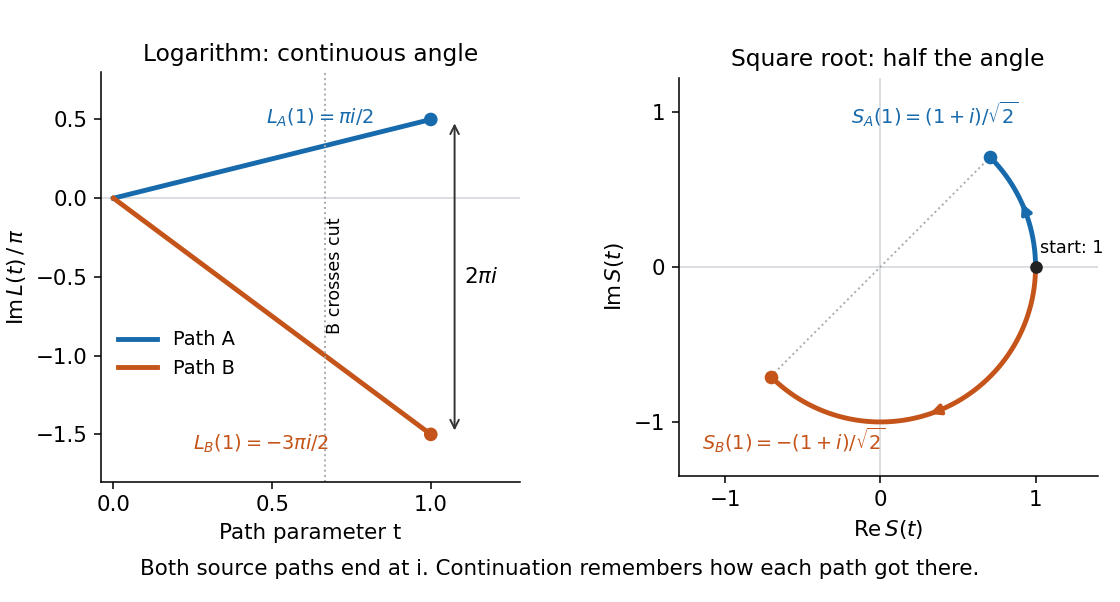
Tracking continuation from 1 to i along a quarter-circle and a clockwise three-quarter-circle gives logarithms separated by 2 pi i and opposite square roots
. Details. The closed path instead returns to , with continued values and . One counterclockwise turn changes the complex logarithm by and flips the holomorphic square root from to . Hence neither initial germ of a holomorphic function can come from a global holomorphic logarithm or a global holomorphic square root of on the punctured plane. Repeating a loop of winding number gives the changes and . [ref]
Branch Points and Branch Cuts by Rodolfo R. Rosales. Rosales, Branch Points and Branch Cuts, section 1, printed pp. 3–8, and Example 2.4, printed p. 15
Now restrict to the slit domain . The principal logarithm and realize the same initial germ of a holomorphic function for each expression globally. To see that this is a simply connected domain, polar form identifies this domain with , a convex set; every loop contracts there. The simply connected corollary of the monodromy theorem now forces equality along every pair of paths with matching endpoints. In particular, and the segment both give and . The explicit homotopy stays in the closed first quadrant away from , hence in .
The other route crosses the removed ray at and is no longer admissible. In the punctured plane, that crossing is locally regular: analytic continuation passes through smoothly, although evaluating the principal logarithm would reset its argument. The branch cut changes the allowed domain; it does not create additional branch points or poles. That distinction is the beauty of the obstruction: perfectly compatible local holomorphic functions can fail to make a global choice solely because of the allowed based loops. The branches of a multivalued function article develops how moving the branch cut changes the selected values.
On a simply connected domain , a germ of a holomorphic function admitting analytic continuation along every path from its base point determines a unique holomorphic function with that initial germ of a holomorphic function. [ref]
A Guide to Complex Variables by Steven G. Krantz. Section 9.3.6, printed p. 159: globally defined holomorphic function
Indeed, any two paths with the same endpoints are homotopic with endpoints fixed. Define using the terminal germ of a holomorphic function. The monodromy theorem makes this independent of the path. In a small open disc about , extend the chosen route by a short segment; the same local representative supplies throughout the open disc, proving holomorphy. The identity theorem proves uniqueness. The existence hypothesis of the monodromy theorem must still be checked.
Monic irreducible integer-polynomial quotient is a domain by Codex 0 Created 2026-10-14 Updated 2026-11-05
Codex 0 Created 2026-10-14 Updated 2026-11-05For monic irreducible in , monic division gives an injection : an integer polynomial in the rational ideal has zero integer remainder. The target is a field, so the source is an integral domain. For positive degree , unique remainders make the source a free abelian group on . The nonzero integer is not a unit, since multiplying an integer remainder by two cannot give remainder one. Thus this integral domain is not a field.
The precise monadicity theorem says that a right adjoint is monadic exactly when it reflects isomorphisms and creates coequalizers of the pairs whose images have split coequalizers.
For scalar metric potentials and positive extrinsic curvature, . The scalar shear terms cancel between its divergence and trace gradient. With , the momentum constraint becomes . Reversing the convention for reverses the geometric left side.
For a weakly Hamiltonian left Lie group action on a connected symplectic manifold, choose . Fundamental vector fields and Hamiltonian vector fields are both antihomomorphisms, so the displayed difference is constant. The Jacobi identity for the Poisson bracket makes it a two-cocycle. Changing by changes the difference by . Thus its class in Lie algebra cohomology obstructs choosing an equivariant moment map. For a connected group, vanishing of this class gives infinitesimal and group equivariance.
On the canonical cotangent bundle , and . The unitary group acts by , preserving both. For a Hermitian , the generator has Hamiltonian . The Poisson bracket satisfies , with no central term. The central generator has moment map ; imaginary antisymmetric matrices give ordinary angular momentum, while real symmetric matrices give quadratic observables mixing position and momentum.
For a centered complex Gaussian variable whose real and imaginary parts are jointly Gaussian, the displayed formula follows by analytic continuation of the real joint moment-generating function. It uses the nonconjugated Second moment , not the positive variance . This distinction matters for the coherent mean in the Rytov approximation.
Pinned article: Introduction to the OurBigBook Project
Welcome to the OurBigBook Project! Our goal is to create the perfect publishing platform for STEM subjects, and get university-level students to write the best free STEM tutorials ever.
Everyone is welcome to create an account and play with the site: ourbigbook.com/go/register. We belive that students themselves can write amazing tutorials, but teachers are welcome too. You can write about anything you want, it doesn't have to be STEM or even educational. Silly test content is very welcome and you won't be penalized in any way. Just keep it legal!
Intro to OurBigBook
. Source. We have two killer features:
- topics: topics group articles by different users with the same title, e.g. here is the topic for the "Fundamental Theorem of Calculus" ourbigbook.com/go/topic/fundamental-theorem-of-calculusArticles of different users are sorted by upvote within each article page. This feature is a bit like:
- a Wikipedia where each user can have their own version of each article
- a Q&A website like Stack Overflow, where multiple people can give their views on a given topic, and the best ones are sorted by upvote. Except you don't need to wait for someone to ask first, and any topic goes, no matter how narrow or broad
This feature makes it possible for readers to find better explanations of any topic created by other writers. And it allows writers to create an explanation in a place that readers might actually find it.
Figure 1. Screenshot of the "Derivative" topic page. View it live at: ourbigbook.com/go/topic/derivativeVideo 2. OurBigBook Web topics demo. Source. - local editing: you can store all your personal knowledge base content locally in a plaintext markup format that can be edited locally and published either:This way you can be sure that even if OurBigBook.com were to go down one day (which we have no plans to do as it is quite cheap to host!), your content will still be perfectly readable as a static site.
- to OurBigBook.com to get awesome multi-user features like topics and likes
- as HTML files to a static website, which you can host yourself for free on many external providers like GitHub Pages, and remain in full control

Figure 2. You can publish local OurBigBook lightweight markup files to either OurBigBook.com or as a static website.
Figure 3. Visual Studio Code extension installation.
Figure 5. . You can also edit articles on the Web editor without installing anything locally. Video 3. Edit locally and publish demo. Source. This shows editing OurBigBook Markup and publishing it using the Visual Studio Code extension. 
- Infinitely deep tables of contents:




All our software is open source and hosted at: github.com/ourbigbook/ourbigbook
Further documentation can be found at: docs.ourbigbook.com
Feel free to reach our to us for any help or suggestions: docs.ourbigbook.com/#contact