Topics (384k) Articles (398k) Users (410) Discussions (242) Comments (383) Files (13k) New article
Neumann boundary data are prescribed values of the outward normal derivative of a function on the boundary of a boundary value problem. They enter a Neumann boundary condition as . Directional derivatives defined using a fixed coordinate direction must be converted to the outward-normal convention: for example, on the bottom of an upper domain, .
In a directed network with no negative-cost directed cycle, add a source having zero-cost arcs to all vertices and compute shortest-path distances . The inequalities make dual feasible for uncapacitated minimum-cost flow. Shortest-path tree arcs are tight. An arbitrary spanning tree also fixes tight candidate potentials up to a constant, but it does not guarantee the non-tree inequalities; these must be checked.
The view factor is the fraction of uniformly distributed, diffuse outgoing radiant flux from surface that directly reaches surface . It depends on geometry, including obstruction, rather than on temperature or emissivity. All destinations in a closed enclosure have fractions summing to one. For a convex body fully enclosed by walls, ; the reverse view factor is generally smaller. Reciprocity gives . Two unobstructed spheres with outer radius ten times the inner radius have and . Do not multiply both directions by an assumed identical view factor.[ref]
Thermodynamics and Propulsion. §19.4, equations 19.4 and following reciprocity relation; §19.4.1, concentric spheres
Homogeneous tensile bifurcation of a neo-Hookean cube by  Codex 0 Created 2026-10-14 Updated 2026-10-31
For the volume-preserving family , equal dead nominal tension gives potentialIts derivative factors as . The nontrivial branch has a fold at , , and meets the trivial branch at . Stability in this one-parameter family is determined by , not by branch count alone. At there is only one nontrivial positive solution, ; the other branch value is .
The dielectric response differs along and perpendicular to the nematic director. In Gaussian units the orientational electric contribution at prescribed field is ; positive anisotropy favors alignment with the electric field. The electric term does not receive the additional one-half convention used in writing the Frank elastic terms.
The Fréedericksz transition is a field-driven orientational instability of a confined nematic liquid crystal. Elasticity and surface anchoring resist the electric field or magnetic torque; a lowest allowed distortion mode becomes unstable at a finite threshold. Positive dielectric anisotropy of a nematic permits a normal electric field to tilt a planar anchored director.
The twisted nematic field effect switches a nematic liquid crystal between a twisted optically rotating state and a largely field-aligned state. With adiabatic optical following in a twisted nematic and crossed polarizers aligned to the two planar surface directors, a quarter-turn cell passes light at low voltage and suppresses it at high voltage. A rear reflector permits reflective operation with little power expended on light generation.
Finite Erlang-mixture tail for a negative-binomial exponential aggregate by Codex 0 Created 2026-10-14 Updated 2026-11-05
Codex 0 Created 2026-10-14 Updated 2026-11-05Let be a positive integer, , and . For independent rate- exponential distribution claims and a zero-based negative binomial distribution count of shape and parameter , the random-sum transform identity gives . This equals the transform of a compound binomial distribution with count and rate- claim sizes. Conditional on its positive count , the total has Erlang distribution, whose survival function is the inner exponential-polynomial sum. Conditioning yields the displayed finite mixture distribution formula for . It replaces an infinite mixture and includes the zero-total atom through the omitted term.
For , the formula reduces to for : there is an atom at zero and a rate- exponential distribution positive component. This checks both the omitted zero-count term and the parameter scaling.
A uniform algebra is natural exactly when functions with no common zero generate the unit ideal. If a generated ideal is proper, it is contained in a maximal ideal. That maximal ideal is closed: the closure of a proper ideal stays proper, since an element within distance less than one of the identity is invertible by the Neumann series. The Gelfand-Mazur theorem identifies the maximal-ideal quotient with the complex numbers, yielding a character of an algebra. Naturality would make that character a common-zero evaluation, a contradiction. Conversely, the asserted unit-ideal property makes the zero sets of every finite collection in a character's kernel intersect. Compactness gives a point common to all these zero sets; applying this to proves . For , one can directly take .
For , a dinatural transformation has components satisfying, for ,Both composites have domain and codomain . It is the compatibility used for categorical ends and categorical coends, rather than ordinary naturality on just one variance.
The interval dependency problem is the loss of relationships between repeated occurrences of the same input. For , interval subtraction gives : it permits with independent choices . But the function has actual image of a function . Giving both operands the name does not tell an interval arithmetic calculation to enforce .
For the polynomial on , the natural interval extension isThis allows the impossible combination in the first factor and in the second, producing the spurious upper bound . In the actual function, both occurrences use the same . Completing the square gives , which lies between and on ; every value between these bounds occurs, by continuity and the intermediate value theorem. The maximum occurs at , while either endpoint gives the minimum .
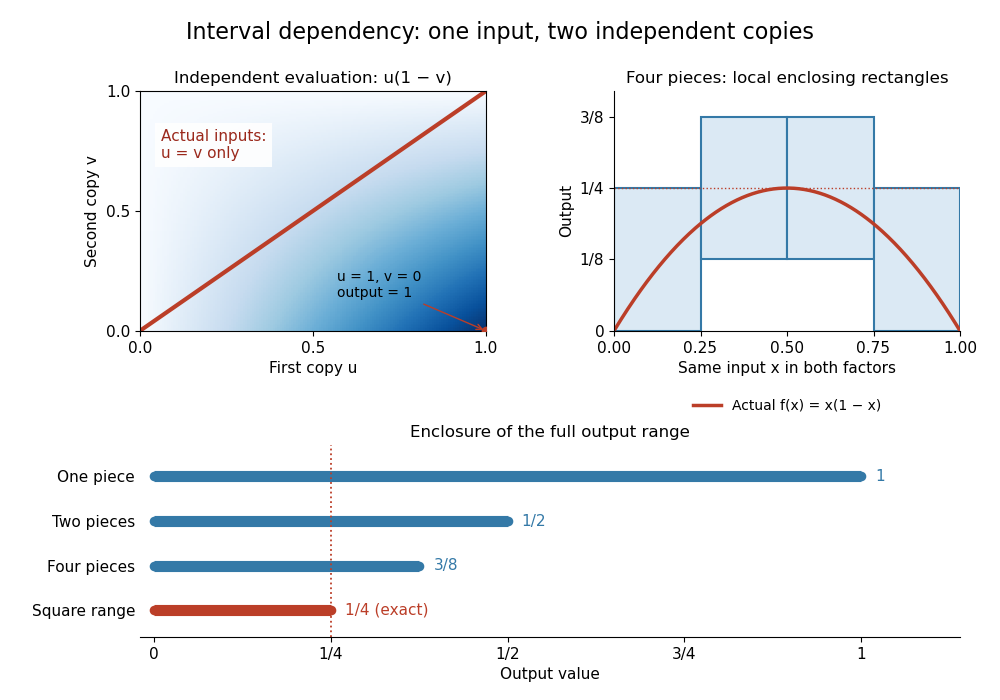
Independent interval inputs lose the diagonal constraint; subdivision tightens the enclosure of x times one minus x
. Left: the Cartesian product permits separate choices , while the actual function uses only . Right: rectangles from four pieces contain the polynomial curve. Below: one, two and four pieces give interval enclosures with upper bounds , and ; the interval square range gives the exact . Details.A natural exponential family is full when its parameter set is the entire natural parameter space, with no restrictions on the allowable canonical parameters beyond finiteness of its normalizing integral. Fullness must not be confused with minimality or regularity.
A natural exponential family is regular when its parameter space is open. In a full regular family, differentiation under the normalizing integral is justified locally by exponential moments in a neighbourhood. Regularity does not guarantee that every possible data set has a finite maximum-likelihood estimator.
The convex support is the closed convex hull of the canonical sufficient-statistic support. For a minimal exponential family it has nonempty interior. Means at finite interior natural parameters lie in that interior, because a supporting hyperplane at a boundary mean would force the sufficient statistic itself onto that hyperplane.
For each player in a finite bimatrix game, add the positive pure-strategy gains to its current mixed strategy and normalize. This gives a continuous self-map of the product of probability simplices. At a Brouwer fixed-point theorem fixed point, the gain coordinates equal the current strategy times their total gain. If that total were positive, every supported action would beat the current average payoff, contradicting that average. Thus every pure deviation has nonpositive gain for both players, proving a Nash equilibrium.
Define and for . By the Mycielskian chromatic increase and Mycielskian triangle preservation, each is a finite triangle-free graph with chromatic number . The first steps are , the Grötzsch graph, and then a 23-vertex graph needing five colours. The vertex recurrence gives . These explicit examples show how arbitrarily strong graph coloring constraints can accumulate without any three-vertex clique.
A finite simple graph is a triangle-free graph if and only if its Mycielskian is a triangle-free graph. No triangle in a graph can contain the Mycielski apex, whose neighbours are an independent set, or two Mycielski shadow vertices. A triangle in a graph containing one shadow and two originals requires all three original edges , hence an original triangle in a graph. Conversely every original triangle in a graph remains. In fact each original triangle in a graph gives four in : itself and the three choices of replacing one of its vertices by its shadow. Thus triangle-freeness is preserved, but a positive triangle count is multiplied by four.
For a nonempty finite simple graph, the upper bound copies an optimal proper vertex colouring to its Mycielski shadow vertices and gives the Mycielski apex a fresh colour. For the lower bound, suppose uses colours, with coloured . Shadows avoid . Replace colour at each original by 's colour. Changed originals form an independent set; unchanged neighbours differ because is an edge. This proper vertex colouring of uses colours, contradicting its chromatic number.[ref]
Mycielski graphs and PR proofs by Emre Yolcu and others. §4.1, Proposition 1 and proof, manuscript pp. 6–7
The nonempty condition means , not . An edgeless -vertex graph with has chromatic number one; its Mycielskian is a star graph on together with isolated vertices, and needs two colours. If has no vertices, is a single vertex, so the same formula also holds with the convention .
The Mycielski apex is the added vertex adjacent to every Mycielski shadow vertex and to no original vertex. Its graph neighbourhood is precisely .
A Mycielski shadow vertex has graph neighbourhood in . Its neighbours other than the Mycielski apex are original vertices. All Mycielski shadow vertices form an independent set.
Pinned article: Introduction to the OurBigBook Project
Welcome to the OurBigBook Project! Our goal is to create the perfect publishing platform for STEM subjects, and get university-level students to write the best free STEM tutorials ever.
Everyone is welcome to create an account and play with the site: ourbigbook.com/go/register. We belive that students themselves can write amazing tutorials, but teachers are welcome too. You can write about anything you want, it doesn't have to be STEM or even educational. Silly test content is very welcome and you won't be penalized in any way. Just keep it legal!
Intro to OurBigBook
. Source. We have two killer features:
- topics: topics group articles by different users with the same title, e.g. here is the topic for the "Fundamental Theorem of Calculus" ourbigbook.com/go/topic/fundamental-theorem-of-calculusArticles of different users are sorted by upvote within each article page. This feature is a bit like:
- a Wikipedia where each user can have their own version of each article
- a Q&A website like Stack Overflow, where multiple people can give their views on a given topic, and the best ones are sorted by upvote. Except you don't need to wait for someone to ask first, and any topic goes, no matter how narrow or broad
This feature makes it possible for readers to find better explanations of any topic created by other writers. And it allows writers to create an explanation in a place that readers might actually find it.
Figure 1. Screenshot of the "Derivative" topic page. View it live at: ourbigbook.com/go/topic/derivativeVideo 2. OurBigBook Web topics demo. Source. - local editing: you can store all your personal knowledge base content locally in a plaintext markup format that can be edited locally and published either:This way you can be sure that even if OurBigBook.com were to go down one day (which we have no plans to do as it is quite cheap to host!), your content will still be perfectly readable as a static site.
- to OurBigBook.com to get awesome multi-user features like topics and likes
- as HTML files to a static website, which you can host yourself for free on many external providers like GitHub Pages, and remain in full control

Figure 2. You can publish local OurBigBook lightweight markup files to either OurBigBook.com or as a static website.
Figure 3. Visual Studio Code extension installation.
Figure 5. . You can also edit articles on the Web editor without installing anything locally. Video 3. Edit locally and publish demo. Source. This shows editing OurBigBook Markup and publishing it using the Visual Studio Code extension. 
- Infinitely deep tables of contents:



All our software is open source and hosted at: github.com/ourbigbook/ourbigbook
Further documentation can be found at: docs.ourbigbook.com
Feel free to reach our to us for any help or suggestions: docs.ourbigbook.com/#contact