Topics (384k) Articles (398k) Users (410) Discussions (242) Comments (383) Files (13k) New article
The supervielbein is the local frame of a superspace geometry. Pulling its bosonic-frame components back along a brane embedding gives , and hence the induced worldvolume metric . Fermionic coordinates remain present through their dependence on .
// Target: string-theory.bigb
The displayed one-forms give an invertible triangular change from the coordinate coframe on flat Majorana superspace. A rigid supertranslation has , and the variation of cancels that of . Their Maurer-Cartan equation is . The bosonic frame transforms as a Lorentz vector and the odd frame as a Majorana spinor.
Collapse of a massive stellar core can launch an explosion that ejects material processed by hydrostatic and explosive burning. Whether an explosion succeeds, and how much material escapes instead of falling back, depend on the core and envelope structure. A failed supernova can retain much of the nucleosynthetic core; initial stellar mass alone is not a complete prediction.
A hypothetical explosion in which a degenerate carbon-oxygen core within a single evolved star grows toward the Chandrasekhar mass and ignites explosive carbon burning while retaining an envelope. This differs from accretion onto an already exposed white dwarf in standard Type Ia supernova scenarios. Evolutionary calculations by Doherty et al. explain the strong dependence of this proposed channel on envelope mass loss; their adopted winds remove the carbon-oxygen envelope before this outcome. It is a proposed possibility under different assumptions, rather than an established endpoint for normal stars.
A four-dimensional N=1 chiral multiplet consists off shell of a complex scalar , a Weyl fermion , and a complex auxiliary scalar . A chiral superfield packages their supersymmetry transformations. Eliminating the auxiliary scalar leaves two bosonic and two fermionic physical polarizations; an allowed supersymmetric mass gives equal scalar and fermion masses.
The gravitino mass parameter in four-dimensional supergravity is the displayed expression. In a zero-energy supersymmetry breaking vacuum with only F-term breaking, . Writing this norm as gives . It is small relative to when the breaking scale is below the Planck mass. The super-Higgs mechanism supplies the longitudinal gravitino states.
Let generate a holomorphic gauge transformation, with and moment map . Substitution of the Kähler covariant derivative of a superpotential gives the displayed identity. Consequently, a finite point with and all also has . Pure D-term breaking with vanishing chiral auxiliary fields can therefore evade this argument only where or outside its hypotheses. In conventional two-derivative matter-coupled supergravity, a constant Fayet–Iliopoulos term gauges an R-symmetry and constrains the transformation of ; a neutral superpotential and an independently assigned nonzero constant shift are not generally consistent. The gauge-covariance restriction is derived in Van Proeyen's discussion of Fayet–Iliopoulos terms and R-symmetry.
The normal component of a superfluid describes the momentum and entropy carried by excitations rather than the phase-gradient condensate current. Its velocity need not equal the superfluid velocity. In phenomenological condensate equations, prescribing its motion supplies a reference flow for dissipation; a full two-component fluid theory would also evolve its momentum and energy.
These are two responses of one liquid, not separable kinds of atoms. Their fractions need not equal the Bose-Einstein condensation fraction.[ref]
The Theory of Superfluidity of Helium II by Lev Davidovich Landau. Landau (1941), reprint §5, p.506
Superspace differential realization of N=1 supercharges by  Codex 0 Created 2026-10-14 Updated 2026-11-05
With left Grassmann derivatives, define , and . The anticommutators of the derivative parts and of the coordinate parts vanish. Each mixed derivative/coordinate pair contributes by the graded product rule, giving the displayed mixed anticommutator. Equal-chirality anticommutators vanish, and all these operators commute with translations. Under Lorentz transformations their spinor indices transform in conjugate Weyl spinor representations, completing the minimal Super-Poincaré algebra. A convention for left derivatives is essential to the signs.
A supertranslation is generated by translations and supercharges, excluding the Lorentz transformations. For flat Majorana superspace with , the rigid odd transformation , leaves invariant. Its commutator gives an ordinary translation.
A supersymmetric domain wall contributes a boundary or tensorial charge to the extended anticommutator of supercharges. It is not the Lorentz-scalar central charge of an extended particle algebra. The wall's energy per unit area can cancel this charge in half the real charge combinations, giving the BPS tension bound and half-supersymmetry preservation. This does not contradict the rank classification for the ordinary algebra without wall charges.
For a Planck photon distribution, the hot-electron Kompaneets equation gives , where . The equivalent thermodynamic temperature perturbation has the displayed form, while the Rayleigh-Jeans law gives . The distortion changes sign at . This first-order expression assumes a small Compton y parameter and nonrelativistic thermal electrons.
Bulk motion of a scattering electron cloud relative to the cosmic microwave background gives a first-order Doppler temperature shift. With positive directed away from the observer, the displayed sign applies, and is the Thomson scattering optical depth. In the nonrelativistic, single-scattering limit it has the spectrum of a small blackbody temperature change, unlike the thermal Sunyaev-Zeldovich effect.
For a uniform spherical cluster of depth , thermal bremsstrahlung gives received bolometric flux , while the Rayleigh-Jeans law limit of the thermal Sunyaev-Zeldovich effect gives . Eliminating and using yields the displayed angular diameter distance. A model for the density profile fixes its numerical coefficient. Clumping, nonsphericity and temperature structure can bias this distance because the two observables weight the gas differently.
Represent each element of by the lexicographically least tuple with that sum. Every coordinate projection of the resulting tuple set is itself lexicographically least for its partial sum: replacing it by a smaller representative would improve the original tuple without changing its sum. Consequently projected cardinalities are at most the corresponding partial sumset cardinalities. Projection inequalities, including the box theorem, therefore give sumset inequalities.
For a subset of density in a finite cyclic group, put using normalized convolution on a finite group. Its average is , so choose with . Retain the large spectrum where . The Parseval identity on a finite group gives at most frequencies. Their phases change by at most on the associated Bohr set, contributing at most to the change of . The discarded frequencies contribute at most another , since . Therefore on the Bohr set, proving the containment.
For finite sets in an abelian group , the sumset representation function isIt counts ordered pairs in the Cartesian product, so and are different when , even though commutativity makes their sums equal. It is zero outside the sumset, andFor , its values at are . For , its values at the increasing elements of are . Both lists total sixteen, but the first concentrates more ordered pairs on fewer sums. This distinction is what additive energy quantifies.
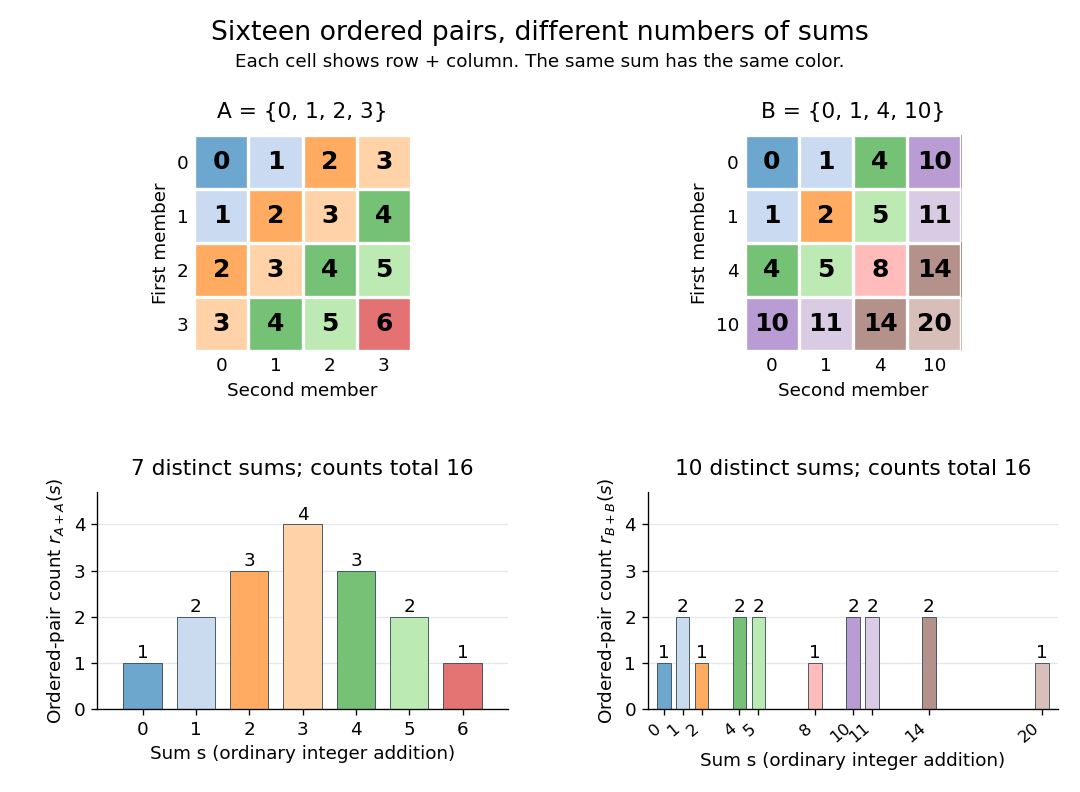
Ordered-pair sums and representation counts for an arithmetic progression and a spread-out integer set
. Details. A telescoping sum cancels intermediate sequence terms, leaving boundary terms. For a finite sequence of real numbers , the displayed identity follows because every occurs once with each sign. Applying it to an infinite series also requires checking the limit of the boundary terms; finite cancellation alone does not prove that the series is a convergent series.[ref]
5.2 Infinite Series. Calculus Volume 2, §5.2 Infinite Series: Telescoping Series definition and successive partial-sum identities
For , expanding the finite sum givesNo monotone sequence assumption is required. Consider the original sequence . Its successive finite differences are , soThe large intermediate rise and fall disappear from the net change. This is useful whenever one knows successive changes rather than every absolute value: adding the changes reconstructs the final value from the initial one. It also checks a cumulative-update calculation without requiring all increments to be positive.
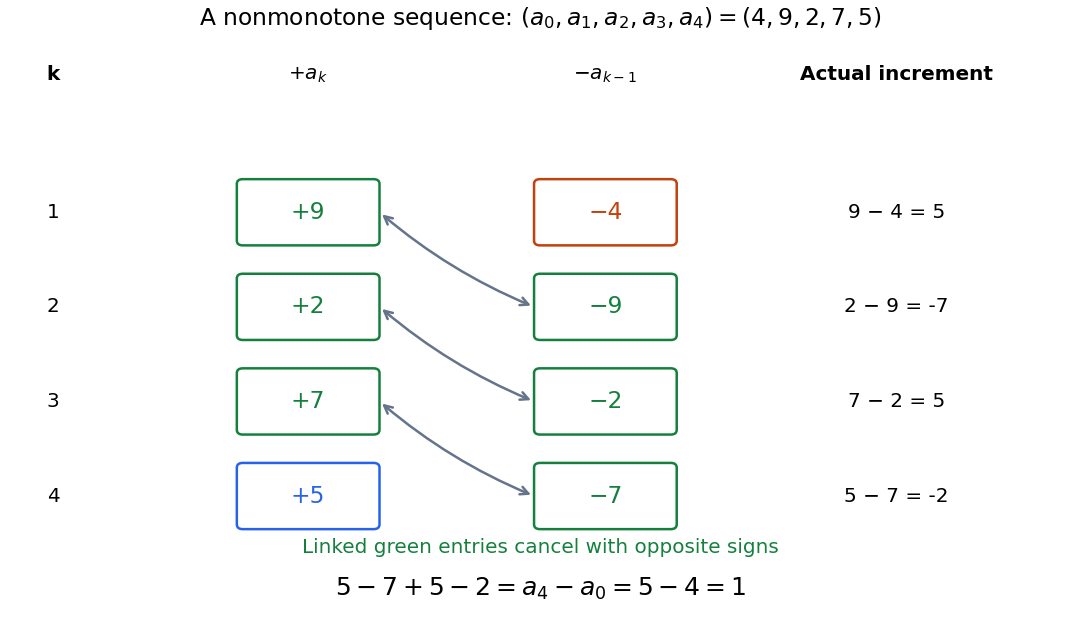
Opposite signs cancel the intermediate sequence terms, leaving the final value minus the initial value
. Original nonmonotone sequence . Linked green entries have the same magnitude and opposite signs; the unmatched entries are and . The increments are , whose sum is one. Details.A finite difference measures one discrete change. The identity is the discrete counterpart of the fundamental theorem of calculus: accumulation of changes returns the endpoint difference. The related summation by parts transfers a finite difference from one factor of a product to another, with explicit boundary terms.
Pinned article: Introduction to the OurBigBook Project
Welcome to the OurBigBook Project! Our goal is to create the perfect publishing platform for STEM subjects, and get university-level students to write the best free STEM tutorials ever.
Everyone is welcome to create an account and play with the site: ourbigbook.com/go/register. We belive that students themselves can write amazing tutorials, but teachers are welcome too. You can write about anything you want, it doesn't have to be STEM or even educational. Silly test content is very welcome and you won't be penalized in any way. Just keep it legal!
Intro to OurBigBook
. Source. We have two killer features:
- topics: topics group articles by different users with the same title, e.g. here is the topic for the "Fundamental Theorem of Calculus" ourbigbook.com/go/topic/fundamental-theorem-of-calculusArticles of different users are sorted by upvote within each article page. This feature is a bit like:
- a Wikipedia where each user can have their own version of each article
- a Q&A website like Stack Overflow, where multiple people can give their views on a given topic, and the best ones are sorted by upvote. Except you don't need to wait for someone to ask first, and any topic goes, no matter how narrow or broad
This feature makes it possible for readers to find better explanations of any topic created by other writers. And it allows writers to create an explanation in a place that readers might actually find it.
Figure 1. Screenshot of the "Derivative" topic page. View it live at: ourbigbook.com/go/topic/derivativeVideo 2. OurBigBook Web topics demo. Source. - local editing: you can store all your personal knowledge base content locally in a plaintext markup format that can be edited locally and published either:This way you can be sure that even if OurBigBook.com were to go down one day (which we have no plans to do as it is quite cheap to host!), your content will still be perfectly readable as a static site.
- to OurBigBook.com to get awesome multi-user features like topics and likes
- as HTML files to a static website, which you can host yourself for free on many external providers like GitHub Pages, and remain in full control

Figure 2. You can publish local OurBigBook lightweight markup files to either OurBigBook.com or as a static website.
Figure 3. Visual Studio Code extension installation.
Figure 5. . You can also edit articles on the Web editor without installing anything locally. Video 3. Edit locally and publish demo. Source. This shows editing OurBigBook Markup and publishing it using the Visual Studio Code extension. 
- Infinitely deep tables of contents:




All our software is open source and hosted at: github.com/ourbigbook/ourbigbook
Further documentation can be found at: docs.ourbigbook.com
Feel free to reach our to us for any help or suggestions: docs.ourbigbook.com/#contact