Topics (384k) Articles (398k) Users (410) Discussions (242) Comments (383) Files (13k) New article
For a two-dimensional hyperbolic toral automorphism, the stable and unstable eigenvalues obey . In a sufficiently small Bowen ball, lifting to the stable and unstable coordinates gives widths proportional to and . Its normalized Haar measure is therefore proportional to , uniformly in the centre. Maximal separated sets cover by radius- Bowen balls and pack disjoint radius- Bowen balls, so their exponential growth rate is . Smallness of must exclude nonzero lattice jumps between successive lifted iterates; this is essential to the ball-volume argument.
Use half-width , upward speed , constant inertial reference density , and positive buoyant reduced gravity . Half-section fluxes are , and . With two-sided entrainment , the Boussinesq balances areFull-width fluxes are twice these definitions. The shape coefficients differ from triangular transverse profiles, so their unsteady balances cannot be used unchanged here.
For plume area and reduced gravity , the principal matrix in variables is . At it has a triple real speed but only two independent eigenvectors. Thus the model is weakly hyperbolic, not strongly or strictly hyperbolic. Real speeds alone do not provide a complete set of characteristic fields or a uniform high-frequency estimate. Shape factors representing nonuniform radial profiles can alter this degeneracy.
With zero source volume flux and zero buoyancy flux but positive source momentum flux, the axisymmetric top-hat plume model reduces to a turbulent round jet. For full-cross-section kinematic fluxes, put . Entrainment gives , while momentum conservation gives . Hence , speed and radius . A finite source flux replaces by . The ideal zero-flux source has singular speed and is a far-field model, not a finite nozzle.
Source volume flux is negligible only when entrained volume greatly exceeds it. In the jet limit of the top-hat plume model, this requires . In a pure plume with , it requires , where for full-cross-section fluxes and . These scales differ from the jet length which measures imposed momentum relative to buoyancy. Neglecting source volume does not automatically permit neglecting source momentum.
In an impermeable cylinder, an axisymmetric turbulent plume with negligible source volume flux requires a downward return flow. With uniform upward plume velocity and ambient velocity , volume conservation gives . An entrainment coefficient based on the relative speed gives . A specified pressure closure is essential for momentum conservation. If the departure from ambient hydrostatic pressure and wall force are neglected in the whole-section integral, the total specific momentum flux obeys . Homogeneous unmodified ambient and no buoyancy loss give . These are leading integral-model closures; restoring the ambient dynamic pressure can change the singularity criterion.
A form of tomography that reconstructs an internal radioactive source from directional counts of individually emitted photons. Known spatial photon absorption gives the exponential path weight in an attenuated Radon transform. Full directed data and a suitable reconstruction formula recover the source intensity rather than a transmitted exterior-beam attenuation map.
Transmission measurements determine line integrals of an absorption coefficient after taking the logarithm of incident intensity divided by transmitted intensity. Under the ideal straight-ray model, these measurements are a Radon transform; filtered backprojection reconstructs a planar slice. Angular coverage, calibration and noise control matter because differentiating measured projections amplifies high frequencies. In contrast, single-photon emission computed tomography reconstructs an emitting source through a possibly attenuating medium.
A light clock measures time by counting round trips of a light pulse between mirrors. In its rest frame, mirrors separated by give a tick duration , where is the speed of light. Comparing this round trip in another inertial frame provides the geometric time dilation argument above.
Amortized analysis bounds the total cost of every permitted sequence of operations from a specified initial state. An amortized bound means that some constants satisfy for every such sequence of length . The cost model and allowed operations are part of the claim; Big O notation alone does not specify them.
- A worst-case bound for one operation limits its cost in any reachable state. Summing these separate maxima can overestimate the cost of a whole sequence because expensive states may take many cheap operations to rebuild.
- An amortized analysis limits the total over every allowed sequence, including an unfavourably chosen one. Dividing that bound by the number of operations is a deterministic guarantee about the sequence.
- A probabilistic average-case analysis bounds an expected value under a stated probability distribution on inputs. For a randomized algorithm, an expected value can instead average over its random choices. Neither interpretation is required by a deterministic amortized analysis.
This distinction, and the credit and potential method viewpoints, are developed in R. Endre Tarjan's 1985 paper Amortized Computational Complexity, sections 1–2, pp. 306–308. The dynamic array doubling example below shows how an expensive operation can pay for itself through the cheap operations that precede it.
An algorithm has pseudo-polynomial time when its running time is bounded by a polynomial in the numerical magnitudes of input quantities, rather than necessarily in their encoded lengths. The dynamic programming table for the 0-1 knapsack problem uses arithmetic operations for items and capacity .
A binary numeral system representation needs only bits for that capacity, so the table bound can be exponential in the number of capacity bits. For example, capacities below fit in bits, while a table with one entry for every capacity can have nearly columns. The numerical-value bound does not claim that every instance requires exponential work.
This circular lensing potential has reduced deflection , mean lensing convergence and local convergence . Its central convergence is finite for . As the core shrinks to zero, the deflection tends to that of a singular isothermal sphere lens. This softening of the projected lensing potential must not be confused with replacing a three-dimensional density by a different cored profile.
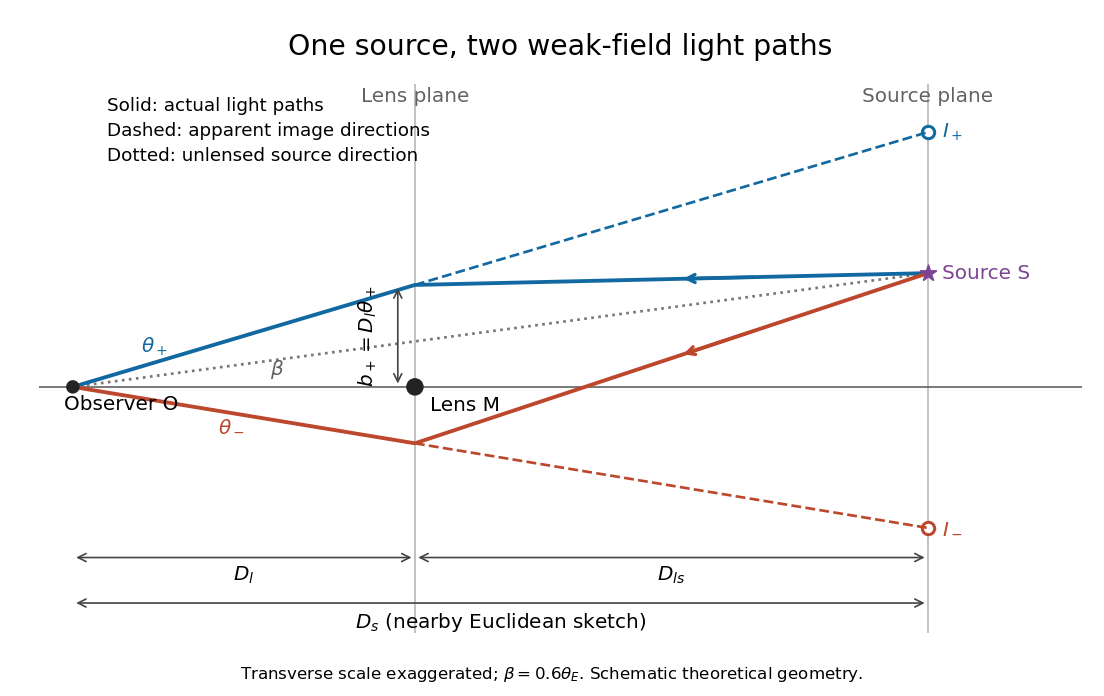
A point-mass gravitational lens is the ideal gravitational lens obtained by concentrating a positive mass at one location. Use geometrical optics, the weak-field approximation, small angles in radians, and a stationary lens whose deflecting region is short compared with the observer-lens and lens-source distances. At impact parameter , require , the Schwarzschild radius, and a ray passing outside any opaque body. The physical bend has magnitude from Schwarzschild light deflection; is the gravitational constant and the speed of light. Multiple images can occur within this weak-field approximation: strong gravitational lensing does not require a ray to approach a black hole closely.[ref]
Gravitational Lensing by Matthias Bartelmann. Section 1.2, printed p. 2: geometrical optics, weak fields and slowly moving lenses; compact-object near-field propagation excluded
Let , and be angular diameter distances from observer to lens, observer to source, and lens to source, respectively. They refer to the background geometry used in the thin gravitational lens equation. In nearby Euclidean geometry, ; in cosmology, do not make that subtraction. The angular source coordinate is the direction the source would have without this lens; the observed image coordinate is . Both are measured relative to the observer-lens optical axis.[ref]
Lectures on Gravitational Lensing by Ramesh Narayan and Matthias Bartelmann. Section 2.1.3, pp. 8-9, equations (13)-(15), including the warning that lens-source angular diameter distance is not the difference of the observer distances
For the flat sketch below, extend the observer-side light ray backwards to the source plane. Its transverse position would be , whereas the actual source is at . Their separation is . Here is defined outward along the lens-plane impact vector, as in the thin gravitational lens equation; the physical ray bends toward the mass. Substituting givesThe same thin gravitational lens equation uses angular diameter distances in the cosmological setting. The factor converts the physical bend into the reduced angular deflection; these are different angles.
A passive astrophysical disk receives most of its heat from external irradiation rather than internal viscous dissipation. For a stellar disk, a rough criterion is . The actual local requirement compares absorbed stellar flux with viscous flux; incidence angle, shadowing and absorption can invalidate a luminosity comparison alone.
Thermoelasticity with a temperature-dependent constraint by  Codex 0 Created 2026-10-14 Updated 2026-11-05
The admissible rates obey . A reaction multiplier in the reversible nominal stress tensor therefore has an accompanying specific entropy contribution:Their reaction contributions cancel in the Clausius-Duhem inequality on admissible rates. Omitting the entropy term would generally violate the constraint's power balance.
An isolated system exchanges neither matter nor energy with its surroundings. Its total energy is fixed, while the Second law of thermodynamics requires its total entropy to be nondecreasing. Its internal energy alone is fixed when bulk kinetic energy and external potential energy also remain unchanged. For example, an initially spinning stirrer inside an insulated rigid vessel can lose kinetic energy while the contents gain internal energy, with no external input.
An isolated system need not yet be in thermodynamic equilibrium. Two enclosed bodies at different temperatures can exchange heat internally until they reach thermal equilibrium; their combined energy stays constant. Their internal transfer is absent from the outer boundary ledger. A vacuum-insulated container is only an approximation to isolation: residual thermal conduction and thermal radiation can still carry energy across its boundary.
A closed system exchanges no matter with its surroundings, but can exchange energy through heat or work. A sealed cylinder with a moving piston is a typical idealized example. “Closed” fixes the material inventory, rather than the volume or the internal energy. An insulated cylinder can receive compression work; a rigid sealed vessel can receive heat. Neither is necessarily an isolated system.
A thermodynamic system is in thermodynamic equilibrium when its macroscopic state has no spontaneous tendency to change through any exchange allowed by its constraints. For an isolated system, stable thermodynamic equilibrium maximizes entropy over the accessible states at fixed total energy and conserved material inventories. A wall can forbid an exchange, so always specify what can cross or move. Thermal, mechanical and chemical conditions answer different questions about that same constrained state. [ref]
For example, two compartments separated by a rigid, impermeable wall that transmits heat can reach thermal equilibrium while retaining different pressures and compositions. Allowing an unloaded piston to move adds a mechanical equilibrium condition. Allowing one chemical species to cross adds chemical potential equality for particle exchange; allowing a chemical reaction adds its chemical equilibrium condition. A fixed barrier can therefore support a constrained thermodynamic equilibrium that ceases to be an equilibrium when the barrier is removed.
Uniformity is not the definition of thermodynamic equilibrium. An isothermal atmosphere in hydrostatic equilibrium can have a common temperature while its pressure and mass density vary with height: the pressure gradient balances gravity. In an external field, the exchange condition must include the relevant potential energy; for charged matter this leads to the electrochemical potential. Relativistic gravitational corrections to thermal equilibrium are described separately by the Tolman temperature law.
A steady state only says that the macroscopic description is constant in time. A bar maintained between hot and cold thermal reservoirs has steady heat flux and produces entropy, so it is not in thermodynamic equilibrium. Even matching temperatures at one perfect-contact interface can coexist with heat transfer through the surrounding material; matching those two local values does not establish equilibrium of the whole apparatus. See thermal conduction for that spatial transport problem.
The useful simplification is that equilibrium conditions predict an endpoint without computing every collision or flow during relaxation. The first law of thermodynamics supplies the conserved quantities, and the Second law of thermodynamics supplies the direction of change. For a system held at fixed temperature and volume, the corresponding criterion is minimization of Helmholtz free energy; at fixed temperature and pressure, it is minimization of Gibbs free energy, with the material and exchange constraints still imposed.
A thermodynamic system for which the reversible mechanical work is entirely pressure-volume work. At fixed composition its internal energy is specified by entropy and volume; additional work modes require additional state variables.
A free energy is a thermodynamic potential that compares possible states under specified environmental constraints. For a closed system of fixed composition, treated as a simple compressible system with only pressure-volume work, stable thermodynamic equilibrium minimizes Helmholtz free energy at fixed temperature and volume, or Gibbs free energy at fixed temperature and pressure. The choice follows the experiment: a rigid sealed vessel and a sealed cylinder with a freely moving loaded piston impose different constraints. Both may exchange heat with a thermal reservoir. See W. C. Carter, MIT thermodynamics notes, sections 2-1.14 and 2-1.19.
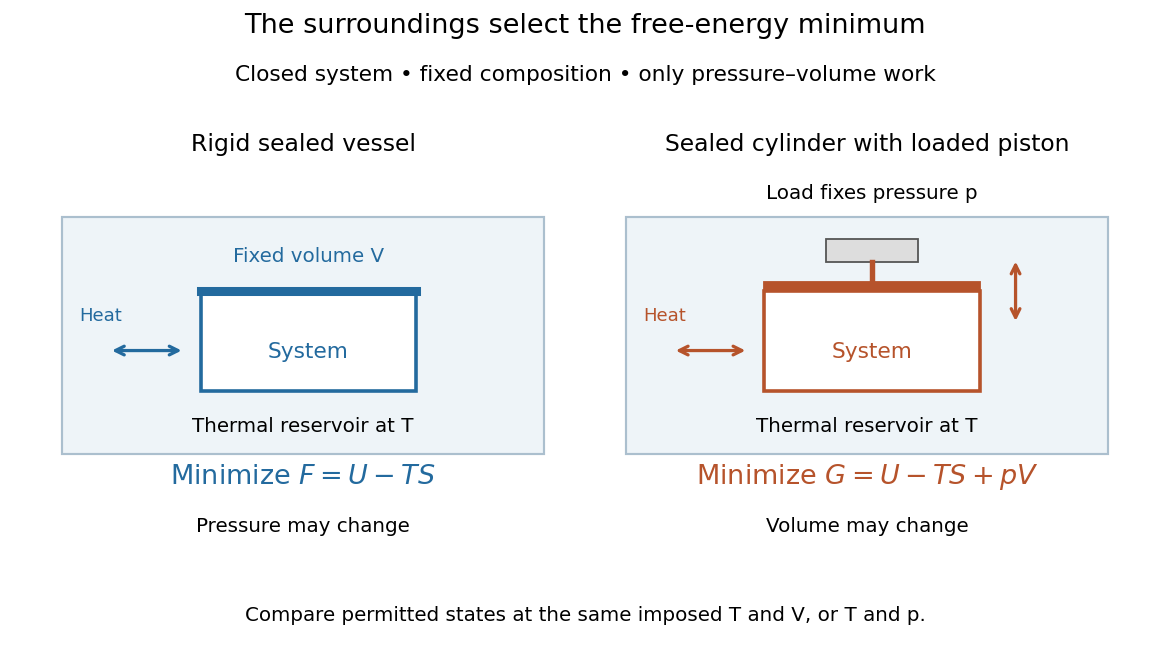
Choose Helmholtz free energy for fixed temperature and volume, or Gibbs free energy for fixed temperature and pressure
. Original schematic of two closed vessels in contact with a thermal reservoir. Composition is fixed, and only pressure-volume work is allowed. The right piston permits the volume to change. Details.The useful insight is that internal energy alone cannot rank these alternatives: exchanging heat also changes the surroundings' entropy. Subtracting packages that accounting into a property of the chosen system. Adding additionally accounts for displacing the surroundings at fixed pressure. A free energy is a state function; supplied heat describes a transfer during a process. Under the stated constraints, supplied heat is at fixed volume or at fixed pressure, whereas neither nor generally equals .
A lower free energy identifies a thermodynamic preference, without specifying a timescale. A barrier can trap a system in a local minimum, producing metastability although a lower global minimum exists. The enzyme example illustrates the corresponding distinction for chemical reactions: changing the route can change the reaction rate while preserving the endpoint Gibbs free energy difference and chemical equilibrium.
Pinned article: Introduction to the OurBigBook Project
Welcome to the OurBigBook Project! Our goal is to create the perfect publishing platform for STEM subjects, and get university-level students to write the best free STEM tutorials ever.
Everyone is welcome to create an account and play with the site: ourbigbook.com/go/register. We belive that students themselves can write amazing tutorials, but teachers are welcome too. You can write about anything you want, it doesn't have to be STEM or even educational. Silly test content is very welcome and you won't be penalized in any way. Just keep it legal!
Intro to OurBigBook
. Source. We have two killer features:
- topics: topics group articles by different users with the same title, e.g. here is the topic for the "Fundamental Theorem of Calculus" ourbigbook.com/go/topic/fundamental-theorem-of-calculusArticles of different users are sorted by upvote within each article page. This feature is a bit like:
- a Wikipedia where each user can have their own version of each article
- a Q&A website like Stack Overflow, where multiple people can give their views on a given topic, and the best ones are sorted by upvote. Except you don't need to wait for someone to ask first, and any topic goes, no matter how narrow or broad
This feature makes it possible for readers to find better explanations of any topic created by other writers. And it allows writers to create an explanation in a place that readers might actually find it.
Figure 1. Screenshot of the "Derivative" topic page. View it live at: ourbigbook.com/go/topic/derivativeVideo 2. OurBigBook Web topics demo. Source. - local editing: you can store all your personal knowledge base content locally in a plaintext markup format that can be edited locally and published either:This way you can be sure that even if OurBigBook.com were to go down one day (which we have no plans to do as it is quite cheap to host!), your content will still be perfectly readable as a static site.
- to OurBigBook.com to get awesome multi-user features like topics and likes
- as HTML files to a static website, which you can host yourself for free on many external providers like GitHub Pages, and remain in full control

Figure 2. You can publish local OurBigBook lightweight markup files to either OurBigBook.com or as a static website.
Figure 3. Visual Studio Code extension installation.
Figure 5. . You can also edit articles on the Web editor without installing anything locally. Video 3. Edit locally and publish demo. Source. This shows editing OurBigBook Markup and publishing it using the Visual Studio Code extension. 
- Infinitely deep tables of contents:




All our software is open source and hosted at: github.com/ourbigbook/ourbigbook
Further documentation can be found at: docs.ourbigbook.com
Feel free to reach our to us for any help or suggestions: docs.ourbigbook.com/#contact