Topics (384k) Articles (398k) Users (410) Discussions (242) Comments (383) Files (13k) New article

Give the topology whose nonempty open sets are and the finite initial segments. Every nonempty open set contains , so any two nonempty open sets intersect. A continuous map from this topological space into a Hausdorff space is constant: distinct image points would have disjoint open neighbourhoods, whose inverse images would be disjoint nonempty open sets. This includes continuous real-valued maps.
An open map sends each open set to an open set; a closed map sends each closed set to a closed set. These properties concern images, whereas continuity concerns inverse images of open sets. Neither openness nor closedness alone implies continuity.
Kahn's algorithm maintains each remaining vertex's indegree, the number of its unfinished incoming directed edges, and a FIFO queue of ready vertices. Initialize the counts by scanning all directed edges and enqueue every vertex of indegree zero. Repeatedly dequeue a vertex , append it to the output, and decrement the count of each destination in 's adjacency list. Enqueue exactly when its count becomes zero. When the FIFO queue empties, accept the output if it contains all vertices; otherwise report a directed cycle. [ref]
https://raw.githubusercontent.com/kevin-wayne/algs4/master/src/main/java/edu/princeton/cs/algs4/TopologicalX.java. Sedgewick and Wayne, TopologicalX: queue-based topological sorting
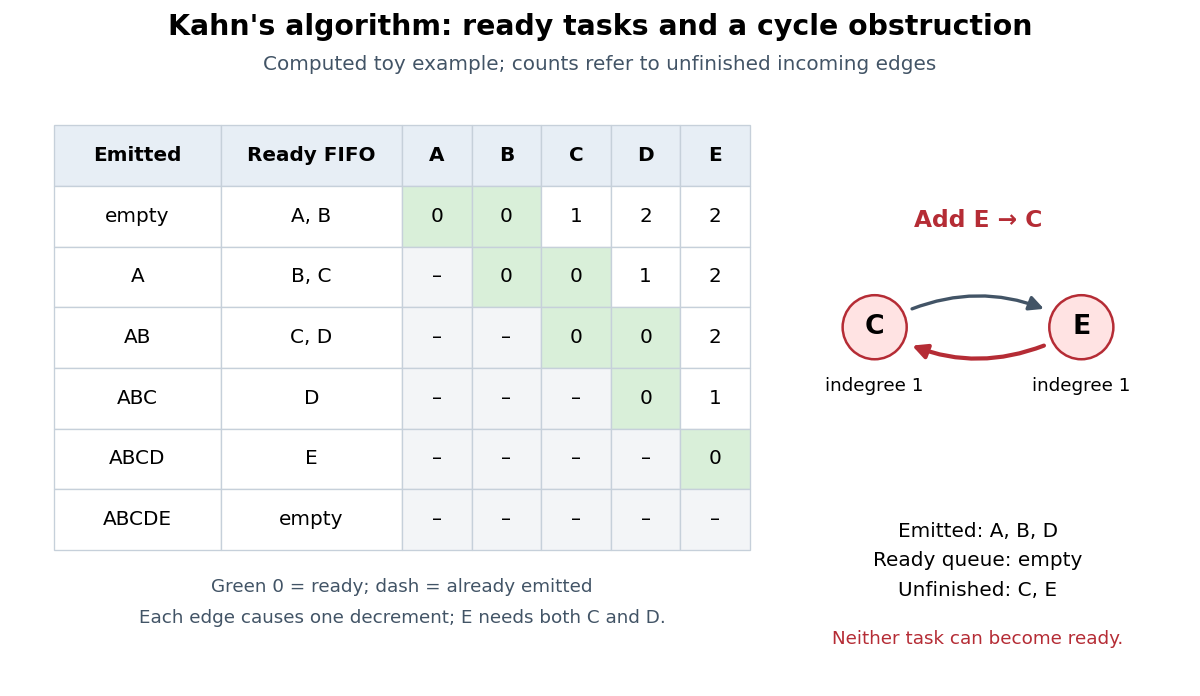
Computed ready-queue trace and the obstruction caused by a reverse dependency
. Details. In the displayed run, initialize the FIFO queue as and visit 's destinations in the order . Removing makes ready but leaves waiting for . Removing then makes ready. Publication becomes ready only after both and are removed. The output is ; choosing ready vertices differently can produce the other topological orders. For the modified directed graph with , the same procedure emits and then stops with still waiting on each other.
The invariant is that each stored indegree counts incoming directed edges from unprocessed vertices. A ready vertex therefore has every prerequisite already in the output. If the FIFO queue empties with vertices left, every remaining vertex has a predecessor in the remaining directed graph; the predecessor argument gives a directed cycle. The unprocessed vertices can also include tasks blocked downstream of a directed cycle, so the leftover list alone is not a list of exactly the cyclic vertices.
With adjacency lists, constant-time array access and counter updates, and constant-time FIFO queue operations, the time complexity is in Big O notation. Initialization scans all vertices and directed edges; each vertex is then enqueued at most once and each outgoing directed edge processed at most once. Counts, ready FIFO queue, and output need storage beyond the adjacency lists. Shifting an array on every dequeue invalidates this bound. [ref]
https://raw.githubusercontent.com/kevin-wayne/algs4/master/src/main/java/edu/princeton/cs/algs4/TopologicalX.java. Sedgewick and Wayne, TopologicalX: time and extra-space bounds
[ref]https://raw.githubusercontent.com/kevin-wayne/algs4/master/src/main/java/edu/princeton/cs/algs4/Digraph.java. Sedgewick and Wayne, Digraph: adjacency lists and outgoing-edge iteration
The name refers to A. B. Kahn's 1962 paper "Topological sorting of large networks", published in Communications of the ACM, volume 5, issue 11, pages 558–562. Its abstract motivates topological sorting through network analysis and project planning. [ref]
https://doi.org/10.1145/368996.369025. Kahn, Topological sorting of large networks (1962): publisher's record and abstract
// Target: foundations-of-mathematics.bigb
A topological order of a finite directed graph is a sequence containing every vertex exactly once, withThus every directed edge points forward in the list. Equivalently, a bijection assigning positions satisfies for every directed edge . A topological ordering names the same kind of list. [ref]
The toy directed acyclic graph has exactly five topological orders: , , , , and . These lists were checked by enumerating all permutations and retaining precisely those satisfying all five directed edge inequalities. Every list ends with , since all other tasks have a directed path to publication. A topological order need not put adjacent entries next to one another in the directed graph: and are consecutive in without a directed edge between them.
A directed cycle would force the impossible chain of position inequalities . In the toy example, adding requires review before publication and publication before review, so there are no topological orders. Together with the construction in topological sorting, this proves that a finite directed graph admits a topological order if and only if it is a directed acyclic graph. The empty directed graph has the empty sequence as its topological order.
There is also a useful connection to partial orders: define when or there is a directed path from to . For a directed acyclic graph, this reachability relation is a partial order, and its linear extensions are exactly the topological orders. The directed acyclic graph specifies which pairs must be ordered; a topological order chooses positions for all the remaining pairs.
A 4-manifold is a topological manifold locally modeled on , with a half-space model if a boundary is allowed. Examples include the four-sphere, the Complex projective plane and the product of two spheres . Its middle-dimensional intersection form pairs degree-two homology classes. Dimension four is special because an embedded two-dimensional surface has the same dimension as its complementary normal directions; intersections and their removal become particularly subtle. A smooth four-manifold carries additional differentiable structure, which is not determined merely by its local topological model.
A piecewise linear ball is a simplicial complex admitting a homeomorphism to an -simplex that is linear on the simplexes of suitable finite simplicial subdivisions. Its boundary is a piecewise linear sphere.
For compact metric , odd topological K-theory is the homotopy set of norm-continuous maps into unitaries equal to the identity modulo compact operators on a fixed separable infinite-dimensional Hilbert space. Uniform finite-rank approximation over and over homotopies gives the equivalent stable model . Block sum gives an abelian group: a finite-dimensional unitary path swaps blocks, and a two-block rotation contracts to the identity. On the circle the determinant winding identifies with ; Bott periodicity gives in odd dimensions and zero in even dimensions.
A subgroup of a topological group is discrete when the identity has a neighbourhood containing no other element of . Translation then isolates every group element. In a Hausdorff topological group, such a subgroup is closed: any accumulation at a point would make differences of distinct nearby group elements approach the identity. Consequently its intersection with a compact set is finite. For isometries of hyperbolic space, this converts compactness of the set of isometries moving one point a bounded distance into a properly discontinuous group action.
For example, isolates the identity element of the additive discrete subgroup . Its induced subspace topology is the discrete topology, while the surrounding real numbers retain their usual topology; see closed subgroup for why this subgroup is closed but not open.
A topology on a group makes it a topological group precisely when its neighbourhood bases satisfy two local tests: every neighbourhood of contains for some neighbourhoods of and of , and every neighbourhood of contains for some neighbourhood of . These are exactly continuity of multiplication in the product topology and continuity of inversion. Equivalently, bases can be chosen as left translates of a basis at the identity, with arbitrarily small squares, inverses and conjugates inside each prescribed identity neighbourhood.
A locally compact group is a topological group whose underlying space is a locally compact space. In Haar measure and Fourier transform theory one normally also assumes it is a Hausdorff space. Local compactness supplies compact neighbourhoods, not just compact sets which algebraically generate the group.
A topological group is compactly generated in the algebraic sense when a compact subset generates its underlying group. Adjoining its inverse and the identity gives a compact symmetric generating set , and is a sigma-compact space. Some conventions restrict the term to locally compact groups or require a compact generating neighbourhood; those stronger conventions supply local compactness. Compact generation by an arbitrary compact subset alone does not.
An open subgroup is also closed, since its complement is the union of its other open cosets. Conversely a closed subgroup need not be open, as shows.
A closed subgroup is a subgroup which is a closed set in the ambient topology. It is a topological group in its subspace topology, but need not be an open subgroup.
The additive subgroup of integers is a closed subgroup: every noninteger lies in an open interval avoiding . It is also a discrete subgroup, since . Nevertheless it is not an open subgroup of : every open interval containing an integer contains nonintegers too. Thus having a discrete topology internally says nothing about being an open set in the ambient topology.
This is a distance function satisfying the displayed identity, rather than a Riemannian metric tensor. When it induces the group's given topology, it is a compatible left-invariant group metric. Left translations are isometries.
Right translations are isometries for a right-invariant group metric. Given a compatible left-invariant group metric , the formula defines a compatible right-invariant group metric, since inversion is a homeomorphism and . Compatible invariant metrics need not be Lipschitz equivalent; on the additive group , both and are compatible invariant distances.
A continuous unitary character is a continuous group homomorphism from a topological group to the unit circle with multiplication. For abelian groups, multiplication of continuous unitary characters is pointwise. Such continuous unitary characters must be distinguished from the traces of higher-dimensional group representations, called characters of a representation, and from characters of an algebra.
For every integer , the map is a continuous unitary character of the circle group: and . By contrast, the two-dimensional group representation has character of a representation . Its value at the identity element is , so this trace is not a continuous unitary character.
A locally profinite group is a Hausdorff, locally compact, totally disconnected topological group. It has a neighbourhood basis at the identity consisting of compact-open subgroups. In smooth representation theory this is also called an -group; that terminology is unrelated to a lattice-ordered group.
For a continuous map on a compact metric space, the Bowen metric compares the first points of two forward orbits. Its radius- ball is . If is the largest cardinality of an -separated set in this metric, then topological entropy is . The uniform continuity of the identity between two compatible metrics gives the comparison of separated-set counts needed for independence of the original metric.
Pinned article: Introduction to the OurBigBook Project
Welcome to the OurBigBook Project! Our goal is to create the perfect publishing platform for STEM subjects, and get university-level students to write the best free STEM tutorials ever.
Everyone is welcome to create an account and play with the site: ourbigbook.com/go/register. We belive that students themselves can write amazing tutorials, but teachers are welcome too. You can write about anything you want, it doesn't have to be STEM or even educational. Silly test content is very welcome and you won't be penalized in any way. Just keep it legal!
Intro to OurBigBook
. Source. We have two killer features:
- topics: topics group articles by different users with the same title, e.g. here is the topic for the "Fundamental Theorem of Calculus" ourbigbook.com/go/topic/fundamental-theorem-of-calculusArticles of different users are sorted by upvote within each article page. This feature is a bit like:
- a Wikipedia where each user can have their own version of each article
- a Q&A website like Stack Overflow, where multiple people can give their views on a given topic, and the best ones are sorted by upvote. Except you don't need to wait for someone to ask first, and any topic goes, no matter how narrow or broad
This feature makes it possible for readers to find better explanations of any topic created by other writers. And it allows writers to create an explanation in a place that readers might actually find it.
Figure 1. Screenshot of the "Derivative" topic page. View it live at: ourbigbook.com/go/topic/derivativeVideo 2. OurBigBook Web topics demo. Source. - local editing: you can store all your personal knowledge base content locally in a plaintext markup format that can be edited locally and published either:This way you can be sure that even if OurBigBook.com were to go down one day (which we have no plans to do as it is quite cheap to host!), your content will still be perfectly readable as a static site.
- to OurBigBook.com to get awesome multi-user features like topics and likes
- as HTML files to a static website, which you can host yourself for free on many external providers like GitHub Pages, and remain in full control

Figure 2. You can publish local OurBigBook lightweight markup files to either OurBigBook.com or as a static website.
Figure 3. Visual Studio Code extension installation.
Figure 5. . You can also edit articles on the Web editor without installing anything locally. Video 3. Edit locally and publish demo. Source. This shows editing OurBigBook Markup and publishing it using the Visual Studio Code extension. 
- Infinitely deep tables of contents:



All our software is open source and hosted at: github.com/ourbigbook/ourbigbook
Further documentation can be found at: docs.ourbigbook.com
Feel free to reach our to us for any help or suggestions: docs.ourbigbook.com/#contact