Topics (384k) Articles (398k) Users (410) Discussions (242) Comments (383) Files (13k) New article
In this positive integer context, a power of two is for a nonnegative integer , giving . Allowing negative or real exponents gives a broader meaning of exponentiation, which is not intended in the integer divisibility criteria here.
This antisymmetric spinor bilinear converts the positive energy theorem into a boundary-charge identity. Its divergence is in the mostly-plus conventions specified here. On a spacelike hypersurface the first term is twice the difference between the squared spatial covariant derivative and the squared spatial Dirac operator. The Witten spinor equation removes the negative square, while the dominant energy condition controls the curvature term through the Einstein constraints.
The vacuum Witten-Nester identity makes a zero-energy Witten spinor parallel under the Sen spinor connection on a complete asymptotically flat slice. In an orthogonal static slicing, extrinsic curvature vanishes, so this spinor is intrinsically parallel. Contracting its spin-curvature integrability condition gives zero spatial Ricci tensor; in three dimensions this implies flatness. The static vacuum equation then gives a parallel lapse gradient, which asymptotic normalization forces to vanish. The time-independent spinor consequently extends to a spacetime parallel spinor, with Minkowski spacetime the complete regular asymptotically flat example.
A nonzero spacetime parallel spinor makes the Nester two-form vanish, so its ADM boundary charge vanishes. For complete regular spin initial data in an asymptotically flat spacetime under the dominant energy condition, the ADM momentum is future causal. Its contraction with the spinor's nonzero future causal Dirac current cannot vanish if the momentum is timelike. Thus the invariant ADM mass is zero; in a rest frame this gives zero energy. Local parallel-spinor existence without asymptotic/global hypotheses does not establish this mass conclusion.
For a locally compact Hausdorff Abelian group, a continuous positive-definite function is uniquely representable as for a finite positive Radon measure on the Pontryagin dual group. Its total mass is . Conversely every such finite positive measure defines a continuous positive-definite function.
For an Abelian group, on finite formal sums of group points, define , with the first variable linear. Quotient by the null space of this positive semidefinite form and complete to a Hilbert space. Left translation is unitary, and generates a dense span of translated vectors. For continuous , the equality gives strong continuity. This realizes as a matrix coefficient without assuming its integral representation.
A decimal expansion writes a nonnegative real number using decimal digits at successive powers of ten:Nonnegative indices describe the integer part, and negative indices describe the fractional part. For a negative real number, add a minus sign to the expansion of its positive magnitude. A terminating decimal has a zero tail; a general decimal expansion can require infinitely many fractional digits.
An infinite tail of nines can duplicate a terminating expansion. For example, the geometric series gives . The usual uniqueness convention excludes a final infinite tail of nines, and redundant leading zeros are ignored.
For a nonnegative integer , only finitely many nonnegative powers are needed: . This makes divisibility tests into polynomial calculations modulo the proposed divisor. Since ,Thus is divisible by exactly when its alternating digit sum is divisible by . That sum need not be literally zero: for , it is , and .
A localized release of actual fluid volume per unit width on a reflecting half-line has the Barenblatt solution , where and . The mass conservation normalization is . Zero slope at the reflecting boundary gives zero Darcy flux. For symmetric spreading on the full line, the same formula has when denotes the total released volume. A finite initial patch is not determined by volume alone; this exact source profile has a concentrated initial release.
For a thin buoyant layer beneath an inclined impermeable roof, the hydrostatic approximation and Darcy's law give and the volume flux per unit width . The first term transports fluid upslope; the second spreads the layer through its hydrostatic pressure gradient. The porosity multiplies the stored fluid volume, so the advection speed is , not the Darcy velocity .
For energy remaining , , , running cost and terminal cost , the normal maximizing Hamiltonian is , where the constant costate defines . Hence full power is chosen below the threshold and zero power above it. Free completion time on an active terminal arc gives . Global optimality still requires a comparison of feasible completion times; the maximum principle is only a necessary condition.
For a closed planar path with , and , the signed area satisfies times the usual oriented area. Periodic Wirtinger and Cauchy-Schwarz inequalities give . Thus terminal requires cost at least . A clockwise circular path traversed once at constant speed attains equality, proving the global minimum rather than merely a stationary Pontryagin extremal.
For an automorphism of a unital ring , this ring consists of finite sums , with multiplication determined by . Both left and right coefficient normal forms are available because is invertible. The noncommutative Hilbert basis theorem implies that it is a right Noetherian ring when is, and a left Noetherian ring when is. Invertibility of matters in this two-sided formulation.
For a compact set , its polynomial hull is . In one complex variable this is together with all bounded components of its complement. The maximum modulus principle proves inclusion of each filled hole. Conversely, polynomial approximation of an exterior pole by the Runge approximation theorem separates an exterior point from the filled compact set. The filled set has connected complement, which makes it the natural set for polynomial approximation of functions whose poles lie in the unbounded complementary component.
Start with a provisional polynomial quotient and remainder . If has polynomial degree at least the divisor's polynomial degree , with leading coefficients and , subtract , whereThe identity survives each step, while the leading term cancels and the polynomial degree of nonzero strictly decreases. Stop when or .
For uniqueness over a field, subtract two proposed decompositions:If , the left side has polynomial degree at least , while the right side is zero or has smaller polynomial degree. Hence and then .[ref]
Chapter 3 Ring theory. Abstract Algebra, Chapter 3 Ring theory, §3.9, Theorem 3.9.1 and proof: cancellation, termination and degree comparison for uniqueness
The polynomial remainder is the polynomial in polynomial division . Division by has a constant polynomial remainder , as expressed by the factor theorem.
For any identity , polynomial evaluation at a root of a polynomial of givesThis substitution requires no division by . In the worked example, polynomial factorization gives , so its two roots of a polynomial are and . The cubic polynomial and its linear polynomial remainder agree there:A cubic expression has been compressed into a straight line carrying exactly these two values.
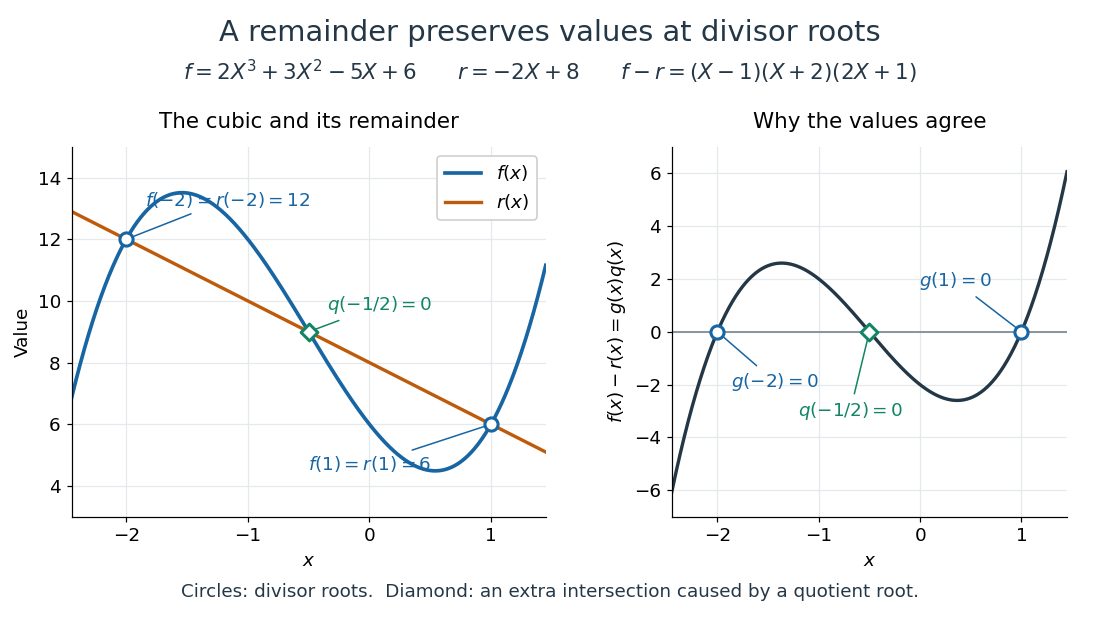
The original polynomial and its polynomial remainder agree at both polynomial roots of because vanishes there
. Details. Conversely, those two values determine the linear polynomial remainder by polynomial interpolation. Write ; then and , giving and . The polynomial degree bound is essential: adding any multiple of preserves the two values, but generally raises the polynomial degree. The plot also shows agreement at , where rather than . Agreement of and at a point therefore does not imply that the point is a root of a polynomial of the divisor.
In polynomial division over a field, the polynomial quotient is the polynomial . The polynomial remainder has smaller polynomial degree than the nonzero divisor unless it is zero.
In the notation , the polynomial quotient is instead named . It is a polynomial determined by the divisor and the polynomial degree bound. The pointwise ratio of the associated polynomial functions satisfiesFor the worked example, , while ; the correction is . Thus a polynomial quotient need not equal the rational function . At and , the pointwise ratio is undefined, but the polynomial quotient still has perfectly well-defined values. When , the divisor is a polynomial factor of and the ratio agrees with wherever .
Squarefree polynomial discriminant does not imply irreducibility by  Codex 0 Created 2026-10-14 Updated 2026-10-25
A squarefree polynomial discriminant does not ensure that the polynomial defines a field of its stated degree. For example, has discriminant five. Its roots have degrees one or two, so no root generates a cubic number field. In particular cannot be a field basis for any of its roots. The squarefree discriminant certifies an integral basis argument assumes that the polynomial is the minimal polynomial: then the discriminant of its power basis is the field discriminant times the square of the order index. For a reducible squarefree polynomial the analogous rank belongs instead to its quotient algebra, which is a product of fields, not to one root field.
Let be a boundary point of a compact convex set and choose exterior points . Approximate uniformly on the compact set by a polynomial with error at most . At each fixed , the reciprocal converges and so does the approximating polynomial. On a boundary accumulating at , uniform convergence to the singular reciprocal is impossible because each polynomial is bounded there. This distinguishes pointwise convergence from uniform convergence without confusing the two norms.
Strict polynomial error decrease from nonvanishing derivatives by Codex 0 Created 2026-10-14 Updated 2026-10-31
Codex 0 Created 2026-10-14 Updated 2026-10-31If , is real and on an interval, and is nowhere zero there, the displayed inequality holds. If the errors were equal, a best degree-at-most- polynomial would also be best at degree . The Chebyshev alternation theorem and intermediate value theorem would give zeros of the error. Applying Rolle's theorem times would force a zero of , a contradiction. The zero-error case already contradicts . In particular this proves strict improvement for the exponential function at every positive degree step.
In the instantaneous-addition, negligible-removal ratchet, the gap reflects at zero and a first passage to triggers addition and resets the gap to zero. With load diffusion coefficient and opposing drift , the mean passage time solves , , . It is , giving the displayed speed and zero-load limit . The finite-load slowdown is not simply in this diffusion-limited regime.
Pinned article: Introduction to the OurBigBook Project
Welcome to the OurBigBook Project! Our goal is to create the perfect publishing platform for STEM subjects, and get university-level students to write the best free STEM tutorials ever.
Everyone is welcome to create an account and play with the site: ourbigbook.com/go/register. We belive that students themselves can write amazing tutorials, but teachers are welcome too. You can write about anything you want, it doesn't have to be STEM or even educational. Silly test content is very welcome and you won't be penalized in any way. Just keep it legal!
Intro to OurBigBook
. Source. We have two killer features:
- topics: topics group articles by different users with the same title, e.g. here is the topic for the "Fundamental Theorem of Calculus" ourbigbook.com/go/topic/fundamental-theorem-of-calculusArticles of different users are sorted by upvote within each article page. This feature is a bit like:
- a Wikipedia where each user can have their own version of each article
- a Q&A website like Stack Overflow, where multiple people can give their views on a given topic, and the best ones are sorted by upvote. Except you don't need to wait for someone to ask first, and any topic goes, no matter how narrow or broad
This feature makes it possible for readers to find better explanations of any topic created by other writers. And it allows writers to create an explanation in a place that readers might actually find it.
Figure 1. Screenshot of the "Derivative" topic page. View it live at: ourbigbook.com/go/topic/derivativeVideo 2. OurBigBook Web topics demo. Source. - local editing: you can store all your personal knowledge base content locally in a plaintext markup format that can be edited locally and published either:This way you can be sure that even if OurBigBook.com were to go down one day (which we have no plans to do as it is quite cheap to host!), your content will still be perfectly readable as a static site.
- to OurBigBook.com to get awesome multi-user features like topics and likes
- as HTML files to a static website, which you can host yourself for free on many external providers like GitHub Pages, and remain in full control

Figure 2. You can publish local OurBigBook lightweight markup files to either OurBigBook.com or as a static website.
Figure 3. Visual Studio Code extension installation.
Figure 5. . You can also edit articles on the Web editor without installing anything locally. Video 3. Edit locally and publish demo. Source. This shows editing OurBigBook Markup and publishing it using the Visual Studio Code extension. 
- Infinitely deep tables of contents:



All our software is open source and hosted at: github.com/ourbigbook/ourbigbook
Further documentation can be found at: docs.ourbigbook.com
Feel free to reach our to us for any help or suggestions: docs.ourbigbook.com/#contact