Topics (384k) Articles (398k) Users (410) Discussions (242) Comments (383) Files (13k) New article
After cosmological weak freeze-out, the surviving neutron fraction is , where is the initial neutron-to-proton ratio and is the mean lifetime. Baryon number is conserved because a decaying neutron becomes a proton. If almost all surviving neutrons enter helium-4, neutron-limited helium synthesis gives the displayed primordial helium mass fraction. Increasing the half-life increases survival. If the longer lifetime also represents uniformly weaker weak interactions, it raises the temperature of cosmological weak freeze-out and the initial neutron fraction, reinforcing the helium increase. That last conclusion requires specifying how the weak rates change, rather than treating lifetime alone as a complete microscopic model.
Primordial helium response to the neutron-proton mass difference by  Codex 0 Created 2026-10-14 Updated 2026-11-05
At fixed cosmological weak freeze-out temperature and fixed neutron survival factor, neutron-proton chemical equilibrium gives and neutron-limited helium synthesis gives . Differentiating yields the displayed sensitivity. A finite change gives . Increasing the positive mass difference reduces helium production. Changes to the weak conversion rates, neutron lifetime or nuclear history must be supplied separately for a full abundance prediction.
In polynomial modular arithmetic, prime-row binomial coefficient divisibility gives . Multiply by and compare coefficients of for ; the term cannot contribute.
// Target: foundations-of-mathematics.bigb
A prime ring is a nonzero ring whose zero ideal is a prime ideal of a noncommutative ring. Equivalently, the product of any two nonzero two-sided ideals is nonzero. This condition is weaker than absence of zero divisors: a full matrix ring over a division ring is prime even when its size is greater than one. For a commutative ring, primeness is exactly being an integral domain.
For , the first order bound already gives . The second supplementary law for quadratic reciprocity says that two is then a quadratic residue modulo . Euler's criterion gives , so its multiplicative order divides . Thus , further reducing the candidate factors. At , meets this bound. The restriction matters: has factor five, which is not one modulo eight.
For an atomless measure of consumers with measurable, complete, transitive and continuous preference relations, every exactly feasible Pareto efficient consumption allocation admits nonzero quasi-equilibrium supporting prices. Countably many rational strict-improvement directions remove all exceptional null sets simultaneously. If their convex hull contained zero, sufficiently small disjoint cohorts could make those improvements in exactly balancing proportions, violating Pareto efficiency. A supporting hyperplane theorem then supplies the prices. Individual convexity of preferences is unnecessary.
A Fourier mode advected with a homologous spherical flow has phase . Its material derivative in the background vanishes because . Thus contraction shortens its physical wavelength while preserving its phase on each fluid element. Linearizing the continuity equation and pressureless momentum equation gives and . Combining these with the Poisson equation for Newtonian gravity yields for nonzero compressive wavenumber. It is a local bulk calculation, without the moving cloud-boundary conditions.
In a symmetric wedge , a constant Poisson forcing admits the particular solution , except at resonant angles. Zero-wall harmonic corrections have exponents . If the smallest exponent is below two, the global boundary data make that homogeneous mode dominate the local quadratic forcing. If it is below one, the velocity gradient can be singular although the velocity vanishes. When an exponent equals two, the appropriate radial solution contains , since .
A small flush opening communicating the local surface static pressure through tubing to a manometer or pressure transducer. An upstream-facing Pitot tube instead brings incident flow to rest to measure stagnation pressure.
Dividing a pressure disturbance by the constant reference mass density gives a quantity whose gradient enters the Boussinesq equations directly as an acceleration. Its units are squared velocity. Distinguish this convention from physical pressure when calculating energy flux or comparing wave polarization formulae.
Atmospheric pressure often provides the reference for a gauge pressure measurement: . The absolute pressure is measured relative to an ideal vacuum, whereas zero gauge pressure means equality to the chosen reference. The actual atmospheric pressure can vary; it must be specified when converting between these descriptions. [ref]
University Physics Volume 1 by William Moebs and others. OpenStax: atmospheric, gauge and absolute pressure
.A sheaf of sets is a presheaf in which compatible sections on any open cover glue to one unique section on the union.
A sheaf may additionally carry abelian group or module structure on its sections, with restriction and gluing preserving that structure. The underlying sheaf of sets retains the same local-to-global axiom.
For independent normal random variables with unknown common mean and variance, let and . The standardized future difference is normal with variance and is independent of the residual sum of squares. Thus the ratio using the displayed standard error has Student's t-distribution with degrees of freedom. This is unconditional repeated-sampling prediction coverage, not a confidence interval for the mean.
Use natural units, the unreduced Planck mass , and . In a flat universe dominated by a canonical inflaton, and solve the inflaton equation of motion and Friedmann equation exactly when and . The positive-potential scaling solution requires , while cosmic inflation requires . Its constant equation-of-state parameter is . In terms of the reduced Planck mass , the exponential slope is and the same exponent is .
Potential energy of mixed-layer deepening with an initial buoyancy jump by Codex 0 Created 2026-10-14 Updated 2026-11-05
Codex 0 Created 2026-10-14 Updated 2026-11-05Let an initial upper mixed layer have finite depth , buoyancy , and fixed upper boundary; beneath it let with the initial interface at . Homogenization down to conserves buoyancy and gives mixed buoyancy . Integrating gravitational potential energy over the initial and final profiles gives the displayed increase per unit area. Its derivative is . Specifying absorbed mixing power is not enough to determine deepening unless the initial depth or an alternative upper-reservoir model is supplied.
Gravitational energy is the potential energy associated with gravity. In Newtonian gravity, separated point masses haveFor a continuous isolated distribution, the corresponding self-energy is , where is its own Newtonian gravitational potential with zero at infinity. The half avoids counting every pair twice.
For a spherical body with a fixed dimensionless mass density profile, , with determined by that profile; a uniform sphere has . The inverse-radius scaling follows by rescaling every separation at fixed total mass.
This competes with the internal energy of an ultrarelativistic degenerate electron gas, which scales as at fixed electron number . Its electron degeneracy pressure instead scales as ; it is the internal energy, rather than the pressure itself, that shares the gravitational scaling. With , comparing the two energy coefficients gives the Chandrasekhar mass scalewhere is one unified atomic mass unit and the mean number of atomic mass units per electron. The numerical coefficient requires a stellar structure model.
This potential energy generates a repulsive central force . It is an inverse-square potential but an inverse-cube force; the powers must not be confused with the Coulomb or gravitational potential proportional to .
A positive integer whose proper-divisor sum exceeds itself; equivalently, its sum-of-divisors function satisfies . For example, .
A positive integer whose proper-divisor sum is smaller than itself; equivalently, its sum-of-divisors function satisfies . For example, ; also .
A perfect number is a positive integer equal to the sum of all its positive proper divisors. The divisor itself is excluded: including it gives the equivalent condition for the sum-of-divisors function. The smallest examples are and .
For comparison, has proper divisors , whose sum is : it is a deficient number. The proper divisors of are , whose sum is : it is an abundant number. The proper-divisor sum classifies these examples with the same rule, and gives , so one is not a perfect number.
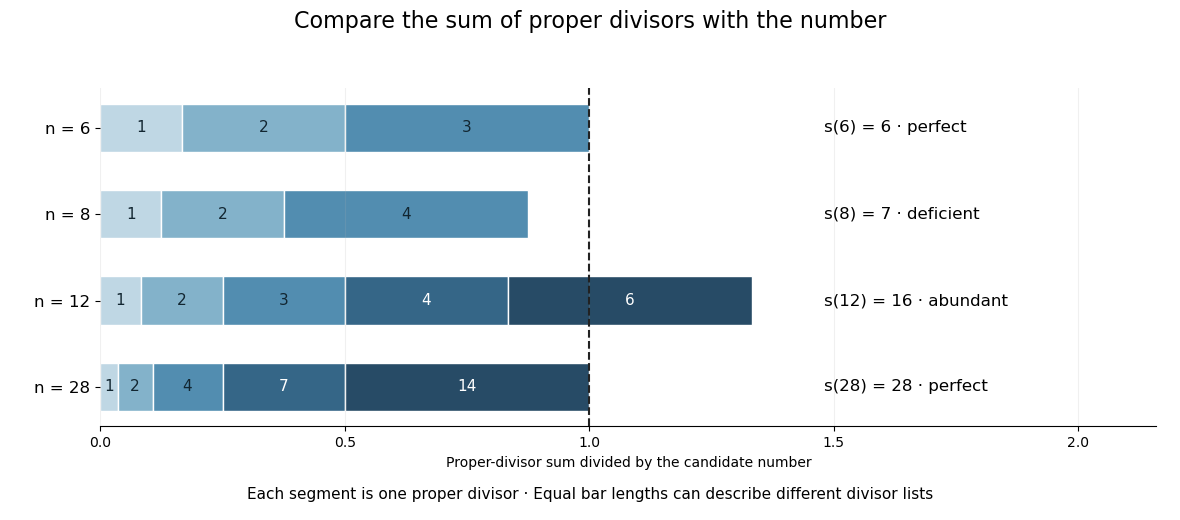
Proper divisors balance a perfect number, fall short of a deficient number, or exceed an abundant number
. Original exact proper-divisor sums for . Each bar is normalized by its candidate number, and its segments are labelled with the actual proper divisors. The dashed line at one marks equality with the candidate. These are finite arithmetic calculations, not empirical data. Details.The interesting question is how such balances can be constructed without testing every smaller integer as a possible divisor. The Euclid-Euler theorem answers it for even integers: a Mersenne prime gives , and every even perfect number arises this way. For , this produces . The connection links divisor sums to primality testing for a particular family, while keeping the necessary hypotheses visible.[ref]
Euclid's Elements already gives the construction in Book IX, Proposition 36: add a succession of powers of two, and if their sum is prime, multiply by the final power of two. The modern finite geometric series makes the same pattern transparent. This original statement supplies the forward construction, rather than the converse classification of all even perfect numbers.[ref]
Pinned article: Introduction to the OurBigBook Project
Welcome to the OurBigBook Project! Our goal is to create the perfect publishing platform for STEM subjects, and get university-level students to write the best free STEM tutorials ever.
Everyone is welcome to create an account and play with the site: ourbigbook.com/go/register. We belive that students themselves can write amazing tutorials, but teachers are welcome too. You can write about anything you want, it doesn't have to be STEM or even educational. Silly test content is very welcome and you won't be penalized in any way. Just keep it legal!
Intro to OurBigBook
. Source. We have two killer features:
- topics: topics group articles by different users with the same title, e.g. here is the topic for the "Fundamental Theorem of Calculus" ourbigbook.com/go/topic/fundamental-theorem-of-calculusArticles of different users are sorted by upvote within each article page. This feature is a bit like:
- a Wikipedia where each user can have their own version of each article
- a Q&A website like Stack Overflow, where multiple people can give their views on a given topic, and the best ones are sorted by upvote. Except you don't need to wait for someone to ask first, and any topic goes, no matter how narrow or broad
This feature makes it possible for readers to find better explanations of any topic created by other writers. And it allows writers to create an explanation in a place that readers might actually find it.
Figure 1. Screenshot of the "Derivative" topic page. View it live at: ourbigbook.com/go/topic/derivativeVideo 2. OurBigBook Web topics demo. Source. - local editing: you can store all your personal knowledge base content locally in a plaintext markup format that can be edited locally and published either:This way you can be sure that even if OurBigBook.com were to go down one day (which we have no plans to do as it is quite cheap to host!), your content will still be perfectly readable as a static site.
- to OurBigBook.com to get awesome multi-user features like topics and likes
- as HTML files to a static website, which you can host yourself for free on many external providers like GitHub Pages, and remain in full control

Figure 2. You can publish local OurBigBook lightweight markup files to either OurBigBook.com or as a static website.
Figure 3. Visual Studio Code extension installation.
Figure 5. . You can also edit articles on the Web editor without installing anything locally. Video 3. Edit locally and publish demo. Source. This shows editing OurBigBook Markup and publishing it using the Visual Studio Code extension. 
- Infinitely deep tables of contents:



All our software is open source and hosted at: github.com/ourbigbook/ourbigbook
Further documentation can be found at: docs.ourbigbook.com
Feel free to reach our to us for any help or suggestions: docs.ourbigbook.com/#contact